Security and AI Essentials
Protect your organization with AI-powered, end-to-end security.
Defend Against Threats
Get ahead of threat actors with integrated solutions.
Secure All Your Clouds
Protection from code to runtime.
Secure All Access
Secure access for any identity, anywhere, to any resource.
Protect Your Data
Comprehensive data security across your entire estate.
Recent Blogs
For many organizations using Microsoft Intune to manage devices, integrating Intune logs into Microsoft Sentinel is an essential for security operations (Incorporate the device into the SEIM). By rou...
Apr 10, 2026255Views
0likes
0Comments
5 MIN READ
Many organizations run workloads across multiple cloud providers and need to maintain a strong security posture while ensuring interoperability. Microsoft Defender for Cloud is a cloud-native applica...
Apr 10, 2026119Views
0likes
0Comments
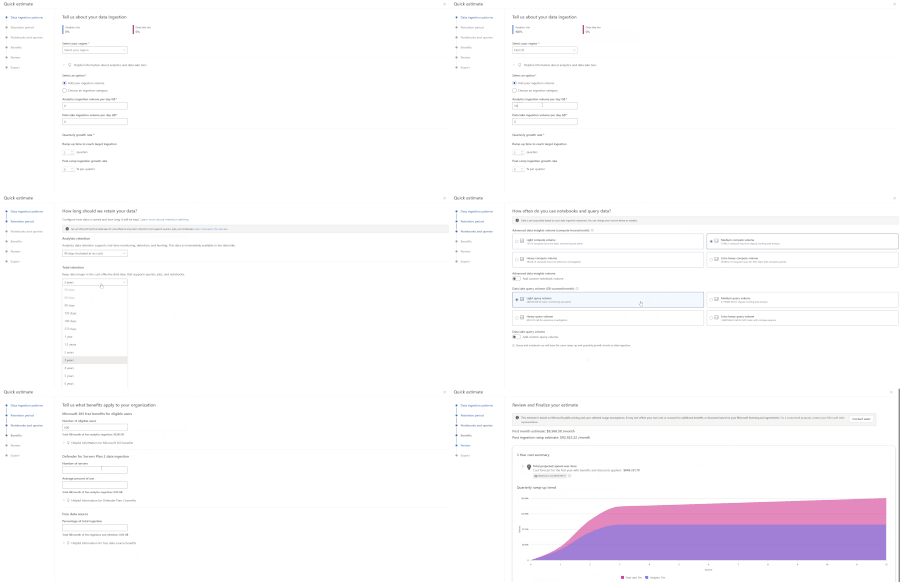
One of the first questions teams ask when evaluating Microsoft Sentinel is simple: what will this actually cost? Today, many customers and partners estimate Sentinel costs using the Azure Pricing Cal...
Apr 09, 2026600Views
0likes
0Comments
We have reviewed the new settings in Microsoft Edge version 147 and determined that there are no additional security settings that require enforcement. The Microsoft Edge version 139 security baselin...
Apr 09, 2026197Views
0likes
0Comments
Recent Discussions

VPN Integration not persistent
Hello, We tried to configure https://learn.microsoft.com/en-us/defender-for-identity/vpn-integration from supported Cisco VPN GW. We established the RADIUS Accounting logs to be sent to DC with MDI sensors installed. Yet when we enabled this in Defender Portal (Settings > Identities > VPN) by checking the box and inserting the shared secret, the configuration is not persistent. We hit save, and we are presented with the success green message, but once we refresh the page or go elsewhere in the portal, the checkbox is not checked. Has anyone encountered the same issue? Thanks, Simon
Understand Why a Service Principal Was Created in Your Entra Tenant
Are you a tenant admin or member of a security team in your organization and find yourself asking “Why was this service principal created in our tenant?” Historically, answering this required correlating audit logs with Microsoft Graph queries or going through long investigations. Microsoft Entra now introduces enhanced audit log properties that make it significantly easier to understand the origin and intent behind newly created service principals directly from tenant audit logs. These new improvements surface additional insights within the Add service principal activity under the ApplicationManagement category—helping administrators determine whether a service principal was provisioned automatically by Microsoft services, triggered by a purchased subscription, or explicitly created by user or application activity. What’s in it for me as an Admins or member of the Security Team When a service principal is created, new metadata is now captured within Microsoft Entra audit logs that enables faster root‑cause analysis. These properties help distinguish between Microsoft‑driven provisioning processes and tenant‑initiated actions, allowing teams to quickly assess whether an event is expected platform behavior or something requiring deeper investigation. For example, administrators can now: Identify provisioning initiated by Microsoft services versus internal users or automation. Determine which tenant subscription or service plan enabled just‑in‑time provisioning. Recognize provisioning linked to Azure resource onboarding or managed identities. Investigate service principal creation without relying on additional Graph lookups. By leveraging these enriched audit logs, security teams can streamline investigations into newly created enterprise applications and reduce manual dependency on downstream data sources. This ultimately improves visibility into application onboarding events and supports faster decision‑making when assessing potential risk or unexpected provisioning activity within the tenant. Learn more here- Understand why a service principal was created in your tenant - Microsoft Entra ID | Microsoft Learn25Views0likes0Comments
Purview Graph API
Hello. I'm trying to find information on the Purview Graph API and it's endpoints. It looks like the endpoints aren't posted publicly and are listed within an admin console. Can someone help me with how to view the endpoints? Also, are the graph API endpoints capable of reading and creating assets into Purview?17Views0likes0CommentsLeveraging Microsoft Graph to Automate Compliance Workflows MS Purview
Background Microsoft Purview provides organizations with capabilities to discover, classify, protect, and govern sensitive information across Microsoft 365 workloads. As organizations increasingly rely on Purview for compliance operations such as auditing, investigations, and regulatory response, there is a growing need to automate these processes beyond the Microsoft Purview portal. Microsoft exposes key compliance capabilities through Microsoft Graph APIs, enabling organizations to integrate Purview operations directly into automation workflows. The Microsoft Purview APIs in Microsoft Graph allow applications to align with data governance, security, and compliance policies defined within the Purview portal, helping ensure that applications handling sensitive information respect organizational controls. Automating eDiscovery Operations with Microsoft Graph The Microsoft Purview eDiscovery APIs available through Microsoft Graph enable organizations to automate repetitive compliance tasks and integrate with existing investigation or legal workflows. These APIs are intended to support litigation, investigation, and regulatory scenarios by allowing administrators to programmatically manage key eDiscovery components such as cases, custodians, searches, review sets, and exports. This capability allows organizations to move from manual portal‑based workflows toward repeatable, policy‑aligned processes integrated into automation platforms or downstream compliance tooling. Programmatic Access to Audit Logs Microsoft Purview Audit captures thousands of operations across Microsoft 365 services and retains them in the unified audit log for security investigations and compliance obligations. Through Microsoft Graph, administrators can now programmatically search and retrieve audit logs using the Purview Audit Search API. This API enables administrators and applications to query and retrieve relevant audit activity logs across workloads such as Exchange, Entra ID, OneDrive, SharePoint, and Intune, providing visibility into user activity and administrative operations performed across the organization. This provides a programmatic alternative to legacy PowerShell‑based audit search methods, improving reliability and enabling automation of compliance monitoring workflows. Supporting Policy‑Aware Applications Applications that integrate with Microsoft Purview APIs through Microsoft Graph can interpret and enforce compliance policies such as sensitivity labels or data loss prevention (DLP) rules. Microsoft documents that apps built using these APIs can prevent data misuse by aligning with compliance and security requirements defined within the organization’s governance framework. This integration also allows enterprise applications to respect sensitivity labels and policy‑driven controls, ensuring that interactions with organizational data remain compliant with regulatory requirements and internal governance policies. Conclusion Microsoft Purview governs organizational data through classification, retention, auditing, and investigation capabilities. Microsoft Graph provides the automation layer that allows these governance controls to be accessed programmatically. By integrating Microsoft Graph with Microsoft Purview APIs, organizations can automate eDiscovery workflows, retrieve audit logs programmatically, and ensure that applications interacting with sensitive data respect compliance policies defined within their Microsoft 365 environment. Learning Resources Use the Microsoft Purview eDiscovery API in Microsoft Graph Use Microsoft Purview APIs for eDiscovery Overview of Microsoft Purview APIs in Microsoft Graph Introducing the Microsoft Purview Audit Search Graph API37Views1like0CommentsMicrosoft Entra Conditional Access Optimization Agent - Move from Static to Continuous Protection
Conditional Access has long been Microsoft Entra’s Zero Trust policy engine—powerful, flexible, and can easily go wrong with misconfiguration over time due to large volume of policies. As the no of tenants increase the no of new users and applications the new modern authentication methods are introduced continuously, and Conditional Access policies that once provided full coverage often drift into partial or inconsistent protection. This is an operational gap which introduces complexity and manageability challenges. The solution to this is utilizing Conditional Access Optimization Agent, an AI‑powered agent integrated with Microsoft Security Copilot that continuously evaluates Conditional Access coverage and recommends targeted improvements aligned to Microsoft Zero Trust best practices. In this article, Let us understand what problem the agent can solve, how it works, how it can be best utilized with the real‑world Entra Conditional Access strategy. The Problem is Conditional Access does not break loudly Most Conditional Access issues are not caused by incorrect syntax or outright failure. Instead, they emerge gradually due to the continuous changes into the enviornment. New users are created but not included in existing policies New SaaS or enterprise apps bypass baseline controls MFA policies exist, but exclusions expand silently Legacy authentication or device code flow remains enabled for edge cases Multiple overlapping policies grow difficult to reason about Although there are tools like What‑If, Insights & Reporting, and Gap Analyzer workbooks help, they all require manual review and interpretation. At enterprise scale with large no of users and applications, this becomes increasingly reactive rather than preventative. What is the Conditional Access Optimization Agent? The Conditional Access Optimization Agent is one of the Microsoft Entra agents built to operate autonomously using Security Copilot. Its purpose is to continuously answer a critical question. Are all users, applications, and agent identities protected by the right Conditional Access policies - right now? The agent analyzes your tenant and recommends the following. Creating new policies Updating existing policies Consolidating similar policies Reviewing unexpected policy behavior patterns All recommendations are reviewable and optional, with actions typically staged in Report‑Only mode before enforcement. How the agents actually works ? The agent operates in two distinct phases - First the Analysis and then Recommendation & remediation During the analysis phase it evaluates the following. Enabled Conditional Access policies User, application, and agent identity coverage Authentication methods and device‑based controls Recent sign‑in activity (24‑hour evaluation window) Redundant or near‑duplicate policies This phase identifies gaps, overlaps, and deviations from Microsoft’s learned best practices. The next and final phase of recommendation and remediation depends on the results from the finding. Based on this the agent can suggest the following. Enforcing MFA where coverage is missing Adding device compliance or app protection requirements Blocking legacy authentication and device code flow Consolidating policies that differ only by minor conditions Creating new policies in report‑only mode Some of offer one click remediation making it easy for the administrators to control and enforce the decisions more appropriately. What are its key capabilities ? Continuous coverage validation The agent continuously checks for new users and applications that fall outside existing Conditional Access policy scope - one of the most common real‑world gaps in Zero Trust deployments. Policy consolidation support Large environments often accumulate near‑duplicate policies over time. The agent analyzes similar policy pairs and proposes consolidation, reducing policy sprawl while preserving intent. Plain‑language explanations Each recommendation includes a clear rationale explaining why the suggestion exists and what risk it addresses, helping administrators validate changes rather than blindly accepting automation. Policy review reports (This feature is still in preview) The agent can generate policy review reports that highlight spikes or dips in enforcement behavior—often early indicators of misconfiguration or unintended impact Beyond classic MFA and device controls, One of the most important use case is the agent also supports passkey adoption campaigns (This feature is still in preview) . It can include the following. Assess user readiness Generate phased deployment plans Guide enforcement once prerequisites are met This makes the agent not only a corrective tool, but it is helpful as a migration and modernization assistant for building phishing‑resistant authentication strategies. Zero Trust strategies utilizing agents For a mature Zero Trust strategies, the agent provides continuous assurance that Conditional Access intent does not drift as identities and applications evolve. The use of Conditional Access Optimization Agent does not replace the architectural design or automatic policy enforcement instead it can be utilized to ensure continuous evaluation, early‑alarm system for any policy drift and can act as a force‑multiplier for identity teams managing change at scale. The object of agent usage is to help close the gap upfront between policy intent depending on the actual use, instead of waiting for the analysis to complete upon resolving incidents and post auditing. In this modernized era, the identity environments are dynamic by default. The Microsoft Entra Conditional Access Optimization Agent reflects a shift toward continuous validation and assisted governance, where policies are no longer assumed to be correct simply because they exist. For organizations already mature in Conditional Access, the agent offers operational resilience. For those still building, it provides guardrails that scale with complexity but without removing human accountability.
Unable to use MS Graph DLP Api's to use with my Entra Registered App
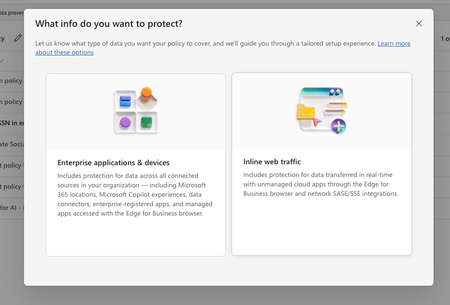
In purview, I have set of policies in DLP, where I have registered to block the US SSN in the text contents and I have created different policies in all of them I have selected the available locations: Exchange email - All accounts SharePoint sites OneDrive accounts - All accounts Teams chat and channel messages - All accounts Devices - All accounts Microsoft Defender for Cloud Apps On-premises repositories And selected action as block all, in all of them for the rule and enabled the rule (not in simulation mode) Now, I have the app registered in Entra and I try to use the following API's https://learn.microsoft.com/en-us/graph/api/userprotectionscopecontainer-compute?view=graph-rest-1.0 https://learn.microsoft.com/en-us/graph/api/userdatasecurityandgovernance-processcontent?view=graph-rest-1.0&tabs=http But whenever I use the compute api I can see i'm only getting curl -X POST https://graph.microsoft.com/v1.0/users/5fd51e08-c5f1-4298-b79b-a357eaa414ff/dataSecurityAndGovernance/protectionScopes/compute\ -H 'Authorization: Bearer <ACCESS_TOKEN>'\ -H 'Content-Type: application/json' -d '{ "activities": "uploadText,downloadText" }' { "@odata.context": "https://graph.microsoft.com/v1.0/$metadata#Collection(microsoft.graph.policyUserScope)", "value": [ { "activities": "uploadText,downloadText", "executionMode": "evaluateOffline", "locations": [ { "@odata.type": "#microsoft.graph.policyLocationApplication", "value": "b48106d9-1cdb-4d90-9485-fe2b6ee78acf" } ], "policyActions": [] } ] } My sample App's Id is showing up but always with `evaluateOffline` I don't know why it always gives 'evaluteOffline' and policyActions is always empty array Also, I can see my Entra registered app is showing up here in the value of the locations And when I use the processContent api , I always get modified in the response and nothing else like below: curl -XPOST https://graph.microsoft.com/v1.0/users/5fd51e08-c5f1-4298-b79b-a357eaa414ff/dataSecurityAndGovernance/processContent \ -H 'Authorization: <ACCESS TOKEN>'\ -H 'Content-Type: application/json' -d '{ "contentToProcess": { "contentEntries": [ { "@odata.type": "microsoft.graph.processConversationMetadata", "identifier": "07785517-9081-4fe7-a9dc-85bcdf5e9075", "content": { "@odata.type": "microsoft.graph.textContent", "data": "Please process this application for John VSmith, his SSN is 121-98-1437 and credit card number is 4532667785213500" }, "name": "Postman message", "correlationId": "d63eafd2-e3a9-4c1a-b726-a2e9b9d9580d", "sequenceNumber": 0, "isTruncated": false, "createdDateTime": "2026-04-06T00:23:20", "modifiedDateTime": "2026-04-06T00:23:20" } ], "activityMetadata": { "activity": "uploadText" }, "deviceMetadata": { "operatingSystemSpecifications": { "operatingSystemPlatform": "Windows 11", "operatingSystemVersion": "10.0.26100.0" }, "ipAddress": "127.0.0.1" }, "protectedAppMetadata": { "name": "Postman", "version": "1.0", "applicationLocation": { "@odata.type": "microsoft.graph.policyLocationApplication", "value": "b48106d9-1cdb-4d90-9485-fe2b6ee78acf" } }, "integratedAppMetadata": { "name": "Postman", "version": "1.0" } } }' In the above request I have mentioned some sample US Security SSN, but the response I get is { "@odata.context": "https://graph.microsoft.com/v1.0/$metadata#microsoft.graph.processContentResponse", "protectionScopeState": "notModified", "policyActions": [], "processingErrors": [] } But Ideally I want to see whether I can get the content is valid or not, for example in the above request, it has SSN, so ideally I should get restrictAction or something right? Or is that evaluateInline is not available or something? Note that I have purchased E5 and assigned to the user who is trying this Also, whenever I choose to create a Policy in DLP , I got two options And Lets say I choose "Enterprise applications & devices", what happens is in the Locations, I'm seeing only these as the options: And If I choose the "Inline Traffic", i'm seeing only these options In Unmanaged, I'm seeing the following And in the Enforcement Options, I have the following : And in the "Advanced DLP rules" I'm seeing only these So, can you tell me the exact steps in the Purview suite, I couldn't where to mention the Entra registered App, I searched and I couldn't find one But in the compute endpoint, https://learn.microsoft.com/en-us/graph/api/userprotectionscopecontainer-compute?view=graph-rest-1.0 I'm getting my app but only with "evaluateOffline" and with that ETag, If I use the processContent Api, its not giving anything except as I mentioned above in the postSolvedEntra CBA Preview Bug: Issuer Scoping Policy fails group claim (AADSTS500191)
I am deploying a zero-trust, cloud-native Certificate-Based Authentication (CBA) architecture for a break-glass emergency access account in Microsoft Entra ID. I am intentionally bypassing Intune/MDM to prevent circular dependencies during an outage. The PKI is generated via OpenSSL (Offline Root CA -> Client Cert). The cryptography is flawless: - The OpenSSL chain verifies perfectly (openssl verify -CAfile...). - The Root SKI and Client AKI are a perfect 1:1 hex match. - The client cert EKU includes TLS Web Client Authentication. - The client cert SAN includes othername: UPN::[break-glass-UPN]. - The Root CA and CRL are uploaded to Entra and publicly accessible via Azure Blob Storage. The Issue: When I attempt to restrict the Root CA using the "Certificate issuer scoping policy (Preview)" targeted to a specific Security Group (e.g., sg_cba), the TLS handshake drops and Entra throws: Error: AADSTS500191: The certificate authority that issued your certificate has not been set up in the tenant. Troubleshooting Performed: 1. Group Architecture: Verified via Microsoft Graph that the user is a direct, static member of sg_cba (Security Enabled, non-dynamic, not nested). 2. Micro-Group Bypass: Created a brand-new cloud-only micro-group with only the break-glass user. Waited for replication. Same 500191 error. 3. The Control Test (Success): If I completely remove the Preview scoping policy and move the targeting to the Generally Available (GA) tenant-wide trust ("All Users"), the login succeeds immediately. (I am securing this via High-Affinity binding matching the SKI to CertificateUserIDs). The Ask: Because the tenant-wide GA policy works perfectly, it mathematically proves the certificates, CRL, and bindings are correct. The failure is entirely isolated to the Preview scoping engine failing to correlate the incoming certificate to the Security Group claim fast enough. - Has anyone successfully deployed the "Certificate issuer scoping policy (Preview)" using a targeted security group without it dropping the trust? - Are there undocumented constraints on group evaluation during the CBA TLS handshake that cause this Preview feature to fail closed?65Views0likes2CommentsSentinel to Defender Portal Migration - my 5 Gotchas to help you
The migration to the unified Defender portal is one of those transitions where the documentation covers "what's new" but glosses over what breaks on cutover day. Here are the gotchas that consistently catch teams off-guard, along with practical fixes. Gotcha 1: Automatic Connector Enablement When a Sentinel workspace connects to the Defender portal, Microsoft auto-enables certain connectors - often without clear notification. The most common surprises: Connector Auto-Enables? Impact Defender for Endpoint Yes EDR telemetry starts flowing, new alerts created Defender for Cloud Yes Additional incidents, potential ingestion cost increase Defender for Cloud Apps Conditional Depends on existing tenant config Azure AD Identity Protection No Stays in Sentinel workspace only Immediate action: Within 2 hours of connecting, navigate to Security.microsoft.com > Connectors & integrations > Data connectors and audit what auto-enabled. Compare against your pre-migration connector list and disable anything unplanned. Why this matters: Auto-enabled connectors can duplicate data sources - ingesting the same telemetry through both Sentinel and Defender connectors inflates Log Analytics costs by 20-40%. Gotcha 2: Incident Duplication The most disruptive surprise. The same incident appears twice: once from a Sentinel analytics rule, once from the Defender portal's auto-created incident creation rule. SOC teams get paged twice, deduplication breaks, and MTTR metrics go sideways. Diagnosis: SecurityIncident | where TimeGenerated > ago(7d) | summarize IncidentCount = count() by Title | where IncidentCount > 1 | order by IncidentCount desc If you see unexpected duplicates, the cause is almost certainly the auto-enabled Microsoft incident creation rule conflicting with your existing analytics rules. Fix: Disable the auto-created incident creation rule in Sentinel Automation rules, and rely on your existing analytics rule > incident mapping instead. This ensures incidents are created only through Sentinel's pipeline. Gotcha 3: Analytics Rule Title Dependencies The Defender portal matches incidents to analytics rules by title, not by rule ID. This creates subtle problems: Renaming a rule breaks the incident linkage Copying a rule with a similar title causes cross-linkage Two workspaces with identically named rules generate separate incidents for the same alert Prevention checklist: Audit all analytics rule titles for uniqueness before migration Document the title-to-GUID mapping as a reference Avoid renaming rules en masse during migration Use a naming convention like <Severity>_<Tactic>_<Technique> to prevent collisions Gotcha 4: RBAC Gaps Sentinel workspace RBAC roles don't directly translate to Defender portal permissions: Sentinel Role Defender Portal Equivalent Gap Microsoft Sentinel Responder Security Operator Minor - name change Microsoft Sentinel Contributor Security Operator + Security settings (manage) Significant - split across roles Sentinel Automation Contributor Automation Contributor (new) New role required Migration approach: Create new unified RBAC roles in the Defender portal that mirror your existing Sentinel permissions. Test with a pilot group before org-wide rollout. Keep workspace RBAC roles for 30 days as a fallback. Gotcha 5: Automation Rules Don't Auto-Migrate Sentinel automation rules and playbooks don't carry over to the Defender portal automatically. The syntax has changed, and not all Sentinel automation actions are available in Defender. Recommended approach: Export existing Sentinel automation rules (screenshot condition logic and actions) Recreate them in the Defender portal Run both in parallel for one week to validate behavior Retire Sentinel automation rules only after confirming Defender equivalents work correctly Practical Migration Timeline Phase 1 - Pre-migration (1-2 weeks before): Audit connectors, analytics rules, RBAC roles, and automation rules Document everything - titles, GUIDs, permissions, automation logic Test in a pilot environment first Phase 2 - Cutover day: Connect workspace to Defender portal Within 2 hours: audit auto-enabled connectors Within 4 hours: check for duplicate incidents Within 24 hours: validate RBAC and automation rules Phase 3 - Post-migration (1-2 weeks after): Monitor incident volume for duplication spikes Validate automation rules fire correctly Collect SOC team feedback on workflow impact After 1 week of stability: retire legacy automation rules Phase 4 - Cleanup (2-4 weeks after): Remove duplicate automation rules Archive workspace-specific RBAC roles once unified RBAC is stable Update SOC runbooks and documentation The bottom line: treat this as a parallel-run migration, not a lift-and-shift. Budget 2 weeks for parallel operations. Teams that rushed this transition consistently reported longer MTTR during the first month post-migration.
Co Authoring with Sensitivity Labels
Hello, I am working with sensitivity labels with my organization. We currently have Standard, Confidential, and Highly Confidential which all are encrypted. I have Co-Authoring turned on but I have some trouble with. We a lot of documents being collaborated on. Standard: Co-Authoring functions normal and Auto-Save is toggled on. Highly Confidential: Custom Permission in Sensitivity Label (View, Edit, Reply, Forward) I asked copilot and it stated even though my permissions are selected custom I have "Edit" on their for my internal users it is reading it as Co authoring; Co-Authoring is on and functioning but internal end users Auto-Save is toggled off and they are being asked to save a copy of the document or excel sheet then upload it again to SharePoint. Why isn't "Auto-Save" toggled on for "Highly Confidential" label? Can it be adjusted so it can be on? Do I have to make adjustments to my permissions in the Sensitivity label? Any help is appreciated. Thank you!Introducing the Entra Helpdesk Portal: A Zero-Trust, Dockerized ITSM Interface for Tier 1 Support
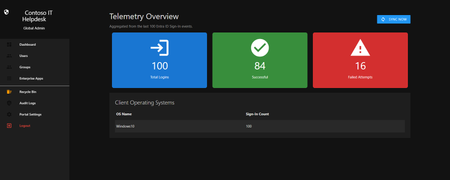
Hello everyone, If you manage identity in Microsoft Entra ID at an enterprise scale, you know the struggle: delegating day-to-day operational tasks (like password resets, session revocations, and MFA management) to Tier 1 and Tier 2 support staff is inherently risky. The native Azure/Entra portal is incredibly powerful, but it’s complex and lacks mandatory ITSM enforcement. Giving a helpdesk technician the "Helpdesk Administrator" role grants them access to a portal where a single misclick can cause a major headache. To solve this, I’ve developed the Entra Helpdesk Portal (Community Edition)—an open-source, containerized application designed to act as an isolated "airlock" between your support team and your Entra ID tenant. Why This Adds Value to Your Tenant Instead of having technicians log into the Azure portal, they log into this clean, Material Design web interface. It leverages a backend Service Principal (using MSAL and the Graph API) to execute commands on their behalf. Strict Zero Trust: Logging in via Microsoft SSO isn’t enough. The app intercepts the token and checks the user’s UPN against a hardcoded ALLOWED_ADMINS whitelist in your Docker environment file. Mandatory ITSM Ticketing: You cannot enforce ticketing in the native Azure Portal. In this app, every write action prompts a modal requiring a valid ticket number (e.g., INC-123456). Local Audit Logging: All actions, along with the actor, timestamp, and ticket number, are written to an immutable local SQLite database (audit.db) inside the container volume. Performance: Heavy Graph API reads are cached in-memory with a Time-To-Live (TTL) and smart invalidation. Searching for users or loading Enterprise Apps takes milliseconds. What Can It Do? Identity Lifecycle: Create users, auto-generate secure 16-character passwords, revoke sign-in sessions, reset passwords, and delete specific MFA methods to force re-registration. Diagnostics: View a user's last 5 sign-in logs, translating Microsoft error codes into plain English. Group Management: Add/remove members to Security and M365 groups. App/SPN Management: Lazy-load raw requiredResourceAccess Graph API payloads to audit app permissions, and instantly rotate client secrets. Universal Restore: Paste the Object ID of any soft-deleted item into the Recycle Bin tab to instantly resurrect it. How Easy Is It to Setup? I wanted this to be universally deployable, so I compiled it as a multi-architecture Docker image (linux/amd64 and linux/arm64). It will run on a massive Windows Server or a simple Raspberry Pi. Setup takes less than 5 minutes: Create an App Registration in Entra ID and grant it the necessary Graph API Application Permissions (e.g., User.ReadWrite.All, AuditLog.Read.All). Create a docker-compose.yml file. Define your feature toggles. You can literally turn off features (like User Deletion) by setting an environment variable to false. version: '3.8' services: helpdesk-portal: image: jahmed22/entra-helpdesk:latest container_name: entra_helpdesk restart: unless-stopped ports: - "8000:8000" environment: # CORE IDENTITY - TENANT_ID=your_tenant_id_here - CLIENT_ID=your_client_id_here - CLIENT_SECRET=your_client_secret_here - BASE_URL=https://entradesk.jahmed.cloud - ALLOWED_ADMINS=email address removed for privacy reasons # CUSTOMIZATION & FEATURE FLAGS - APP_NAME=Entra Help Desk - ENABLE_PASSWORD_RESET=true - ENABLE_MFA_MANAGEMENT=true - ENABLE_USER_DELETION=false - ENABLE_GROUP_MANAGEMENT=true - ENABLE_APP_MANAGEMENT=true volumes: - entra_helpdesk_data:/app/static/uploads - entra_helpdesk_db:/app volumes: entra_helpdesk_data: entra_helpdesk_db: 4.Run docker compose up -d and you are done! I built this to give back to the community and help secure our Tier 1 operations. If you are interested in testing it out in your dev tenants or want to see the full architecture breakdown, you can read the complete documentation on my website here I’d love to hear your thoughts, feedback, or any feature requests you might have!
Do XDR Alerts cover the same alerts available in Alert Policies?
The alerts in question are the 'User requested to release a quarantined message', 'User clicked a malicious link', etc. About 8 of these we send to 'email address removed for privacy reasons'. That administrator account has an EOM license, so Outlook rules can be set. We set rules to forward those 8 alerts to our 'email address removed for privacy reasons' address. This is, very specifically, so the alert passes through the @tenant.com address, and our ticketing endpoint knows what tenant sent it. But this ISN'T ideal because it requires an EOP license (or similar - this actually hasn't been an issue until now just because of our customer environments). I've looked at the following alternatives: - Setting email address removed for privacy reasons as the recipient directly on the Alert Policies in question. This results in the mail going directly from microsoft to our Ticketing Portal - so it ends up sorted into Microsoft tickets. and the right team doesn't get it. SMTP Forwarding via either Exchange AC User controls or Mail Flow Rules. But these aren't traditional forwarding, and they have the same issue as above. Making administrator @tenant.com a SHARED mailbox that we can also login to (for administration purposes). But this doesn't allow you to set Outlook rules (or even login to Outlook). I've checked out the newer alerts under Defender's Settings panel - XDR alerts, I think they're called. Wondering if these can be leveraged at all for this? Essentially, trying to get these Alerts to come to our external ticketing address, from the tenants domain (instead of Microsoft). I could probably update Autotask's rules to check for a header, and set that header via Mail Flow rules, but.. just hoping I don't have to do that for everyone.Impersonation Protection: Users to Protect should also be Trusted Senders
Hey all, sort of a weird question here. Teaching my staff about Impersonation Protection, and it's kind of occurred to me that any external sender added to 'Senders to Protect' sort of implicitly should also be a 'Trusted Sender'. Example - we're an MSP, and we want our Help Desk (email address removed for privacy reasons) to be protected from impersonation. Specifically, we want to protect the 'Help Desk' name. So we add email address removed for privacy reasons to Senders to protect. However, we ALSO want to make sure our emails come thru. So we've ALSO had to add email address removed for privacy reasons to Trusted Senders on other tenants. Chats with Copilot have sort of given me an understanding that this is essentially a 'which is more usefuI' scenario. But CoPilot makes things up, and I want some human input. In theory, ANYONE we add to 'trusted senders' we ALSO want protected from Impersonation. Anyone we protect from Impersonation we ALSO want to trust. Copilot says you SHOULDN'T do both. Which is better / more practical?Governing Entra‑Registered AI Apps with Microsoft Purview
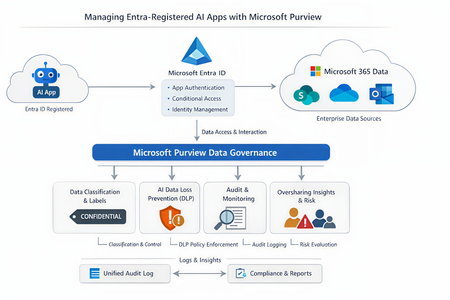
As the enterprise adoption of AI agents and intelligent applications continues to accelerate, organizations are rapidly moving beyond simple productivity tools toward autonomous, Entra‑registered AI workloads that can access, reason over, and act on enterprise data. While these capabilities unlock significant business value, they also introduce new governance, security, and compliance risks—particularly around data oversharing, identity trust boundaries, and auditability. In this context, it becomes imperative to govern AI interactions at the data layer, not just the identity layer. This is where Microsoft Purview, working alongside Microsoft Entra ID, provides a critical foundation for securing AI adoption—ensuring that AI agents can operate safely, compliantly, and transparently without undermining existing data protection controls. Lets look at the role of each solution Entra ID vs Microsoft Purview A very common misconception is that Purview “manages AI apps.” In reality, Purview and Entra serve distinct but complementary roles: Microsoft Entra ID Registers the AI app Controls authentication and authorization Enforces Conditional Access and identity governance Microsoft Purview Governs data interactions once access is granted Applies classification, sensitivity labels, DLP, auditing, and compliance controls Monitors and mitigates oversharing risks in AI prompts and responses Microsoft formally documents this split in its guidance for Entra‑registered AI apps, where Purview operates as the data governance and compliance layer on top of Entra‑secured identities. Lets look at how purview governs the Entra registered AI apps. Below is the high level reference architecture which can be extended to low level details 1. Visibility and inventory of AI usage Once an AI app is registered in Entra ID and integrated with Microsoft Purview APIs or SDK, Purview can surface AI interaction telemetry through Data Security Posture Management (DSPM). DSPM for AI provides: Visibility into which AI apps are being used Which users are invoking them What data locations and labels are touched during interactions Early indicators of oversharing risk This observability layer becomes increasingly important as organizations adopt Copilot extensions, custom agents and third‑party AI apps. 2. Classification and sensitivity awareness Purview does not rely on the AI app to “understand” sensitivity. Instead the Data remains classified and labeled at rest. AI interactions inherit that metadata at runtime Prompts and responses are evaluated against existing sensitivity labels If an AI app accesses content labeled Confidential or Highly Confidential, that classification travels with the interaction and becomes enforceable through policy. This ensures AI does not silently bypass years of data classification work already in place. 3. DLP for AI prompts and responses One of the most powerful but yet misunderstood purview capabilities is the AI‑aware DLP. Using DSPM for AI and standard Purview DLP: Prompts sent to AI apps are inspected Responses generated by AI can be validated Sensitive data types (PII, PCI, credentials, etc.) can be blocked, warned, or audited Policies are enforced consistently across M365 and AI workloads Microsoft specifically highlights this capability to prevent sensitive data from leaving trust boundaries via AI interactions. 4. Auditing and investigation Every AI interaction governed by Purview can be recorded in the Unified Audit Log, enabling: Forensic investigation Compliance validation Insider risk analysis eDiscovery for legal or regulatory needs This becomes critical when AI output influences business decisions and regulatory scrutiny increases. Audit records treat AI interactions as first‑class compliance events, not opaque system actions 5. Oversharing risk management Rather than waiting for a breach, Purview proactively highlights oversharing patterns using DSPM: AI repeatedly accessing broadly shared SharePoint sites High volumes of sensitive data referenced in prompts Excessive AI access to business‑critical repositories These insights feed remediation workflows, enabling administrators to tighten permissions, re‑scope access, or restrict AI visibility into specific datasets. In a nutshell, With agentic AI accelerating rapidly, Microsoft has made it clear that organizations must move governance closer to data, not embed it into individual AI apps. Purview provides a scalable way to enforce governance without rewriting every AI workload, while Entra continues to enforce who is allowed to act in the first place. This journey makes every organizations adopt Zero Trust at scale as its no longer limited to users, devices, and applications; It must now extend to AI apps and autonomous agents that act on behalf of the business. If you find the article insightful and you appreciate my time, please do not forget to like it 🙂120Views1like1Comment
Feature Request: Extend Security Copilot inclusion (M365 E5) to M365 A5 Education tenants
Background At Ignite 2025, Microsoft announced that Security Copilot is included for all Microsoft 365 E5 customers, with a phased rollout starting November 18, 2025. This is a significant step forward for security operations. The gap Microsoft 365 A5 for Education is the academic equivalent of E5 — it includes the same core security stack: Microsoft Defender, Entra, Intune, and Purview. However, the Security Copilot inclusion explicitly covers only commercial E5 customers. There is no public roadmap or timeline for extending this benefit to A5 education tenants. Why this matters Education institutions face the same cybersecurity threats as commercial organizations — often with fewer dedicated security resources. The A5 license was positioned as the premium security offering for education. Excluding it from Security Copilot inclusion creates an inequity between commercial and education customers holding functionally equivalent license tiers. Request We would like Microsoft to: Confirm whether Security Copilot inclusion will be extended to M365 A5 Education tenants If yes, provide an indicative timeline If no, clarify the rationale and what alternative paths exist for education customers Are other EDU admins in the same situation? Would appreciate any upvotes or comments to help raise visibility with the product team.PURVIEW - SCANNER ACCOUNT MISMATCH
Hello I have a strange issue on Scanner Setup is fine also discover is fine, in activity explorer we see discovered file, issue was in USER column that reports not scanner dedicated user but purview admin user. We also try open a case with MS but no one respond Any suggestions? Thanks Zeno42Views0likes1CommentStuck looking up a watchlist value
Hiya, I get stuck working with watchlists sometimes. In this example, I'm wanting to focus on account activity from a list of UPNs. If I split the elements up, I get the individual results, but can't seem to pull it all together. ===================================================== In its entirety, the query returns zero results: let ServiceAccounts=(_GetWatchlist('ServiceAccounts_Monitoring'))| project SearchKey; let OpName = dynamic(['Reset password (self-service)','Reset User Password','Change user password','User reset password','User started password reset','Enable Account','Change password (self-service)','Update PasswordProfile','Self-service password reset flow activity progress']); AuditLogs | where OperationName has_any (OpName) | extend upn = TargetResources.[0].userPrincipalName | where upn in (ServiceAccounts) //<=This is where I think I'm wrong | project upn ===================================================== This line on its own, returns the user on the list: let ServiceAccounts=(_GetWatchlist('ServiceAccounts_Monitoring'))| project SearchKey; ===================================================== This section on its own, returns all the activity let OpName = dynamic(['Reset password (self-service)','Reset User Password','Change user password','User reset password','User started password reset','Enable Account','Change password (self-service)','Update PasswordProfile','Self-service password reset flow activity progress']); AuditLogs | where OperationName has_any (OpName) | extend upn = TargetResources.[0].userPrincipalName | where upn contains "username" //This is the name on the watchlistlist - so I know the activity exists) ==================================================== I'm doing something wrong when I'm trying to use the watchlist cache (I think) Any help\guidance or wisdom would be greatly appreciated! Many thanksSolved34Views0likes2CommentsSecurity Copilot Integration with Microsoft Sentinel - Why Automation matters now
Security Operations Centers face a relentless challenge - the volume of security alerts far exceeds the capacity of human analysts. On average, a mid-sized SOC receives thousands of alerts per day, and analysts spend up to 80% of their time on initial triage. That means determining whether an alert is a true positive, understanding its scope, and deciding on next steps. With Microsoft Security Copilot now deeply integrated into Microsoft Sentinel, there is finally a practical path to automating the most time-consuming parts of this workflow. So I decided to walk you through how to combine Security Copilot with Sentinel to build an automated incident triage pipeline - complete with KQL queries, automation rule patterns, and practical scenarios drawn from common enterprise deployments. Traditional triage workflows rely on analysts manually reviewing each incident - reading alert details, correlating entities across data sources, checking threat intelligence, and making a severity assessment. This is slow, inconsistent, and does not scale. Security Copilot changes this equation by providing: Natural language incident summarization - turning complex, multi-alert incidents into analyst-readable narratives Automated entity enrichment - pulling threat intelligence, user risk scores, and device compliance state without manual lookups Guided response recommendations - suggesting containment and remediation steps based on the incident type and organizational context The key insight is that Copilot does not replace analysts - it handles the repetitive first-pass triage so analysts can focus on decision-making and complex investigations. Architecture - How the Pieces Fit Together The automated triage pipeline consists of four layers: Detection Layer - Sentinel analytics rules generate incidents from log data Enrichment Layer - Automation rules trigger Logic Apps that call Security Copilot Triage Layer - Copilot analyzes the incident, enriches entities, and produces a triage summary Routing Layer - Based on Copilot's assessment, incidents are routed, re-prioritized, or auto-closed (Forgive my AI-painted illustration here, but I find it a nice way to display dependencies.) +-----------------------------------------------------------+ | Microsoft Sentinel | | | | Analytics Rules --> Incidents --> Automation Rules | | | | | v | | Logic App / Playbook | | | | | v | | Security Copilot API | | +-----------------+ | | | Summarize | | | | Enrich Entities | | | | Assess Risk | | | | Recommend Action| | | +--------+--------+ | | | | | v | | +-----------------------------+ | | | Update Incident | | | | - Add triage summary tag | | | | - Adjust severity | | | | - Assign to analyst/team | | | | - Auto-close false positive| | | +-----------------------------+ | +-----------------------------------------------------------+ Step 1 - Identify High-Volume Triage Candidates Not every incident type benefits equally from automated triage. Start with alert types that are high in volume but often turn out to be false positives or low severity. Use this KQL query to identify your top candidates: SecurityIncident | where TimeGenerated > ago(30d) | summarize TotalIncidents = count(), AutoClosed = countif(Classification == "FalsePositive" or Classification == "BenignPositive"), AvgTimeToTriageMinutes = avg(datetime_diff('minute', FirstActivityTime, CreatedTime)) by Title | extend FalsePositiveRate = round(AutoClosed * 100.0 / TotalIncidents, 1) | where TotalIncidents > 10 | order by TotalIncidents desc | take 20 This query surfaces the incident types where automation will deliver the highest ROI. Based on publicly available data and community reports, the following categories consistently appear at the top: Impossible travel alerts (high volume, around 60% false positive rate) Suspicious sign-in activity from unfamiliar locations Mass file download and share events Mailbox forwarding rule creation Step 2 - Build the Copilot-Powered Triage Playbook Create a Logic App playbook that triggers on incident creation and leverages the Security Copilot connector. The core flow looks like this: Trigger: Microsoft Sentinel Incident - When an incident is created Action 1 - Get incident entities: let incidentEntities = SecurityIncident | where IncidentNumber == <IncidentNumber> | mv-expand AlertIds | join kind=inner (SecurityAlert | extend AlertId = SystemAlertId) on $left.AlertIds == $right.AlertId | mv-expand Entities | extend EntityData = parse_json(Entities) | project EntityType = tostring(EntityData.Type), EntityValue = coalesce( tostring(EntityData.HostName), tostring(EntityData.Address), tostring(EntityData.Name), tostring(EntityData.DnsDomain) ); incidentEntities Note: The <IncidentNumber> placeholder above is a Logic App dynamic content variable. When building your playbook, select the incident number from the trigger output rather than hardcoding a value. Action 2 - Copilot prompt session: Send a structured prompt to Security Copilot that requests: Analyze this Microsoft Sentinel incident and provide a triage assessment: Incident Title: {IncidentTitle} Severity: {Severity} Description: {Description} Entities involved: {EntityList} Alert count: {AlertCount} Please provide: 1. A concise summary of what happened (2-3 sentences) 2. Entity risk assessment for each IP, user, and host 3. Whether this appears to be a true positive, benign positive, or false positive 4. Recommended next steps 5. Suggested severity adjustment (if any) Action 3 - Parse and route: Use the Copilot response to update the incident. The Logic App parses the structured output and: Adds the triage summary as an incident comment Tags the incident with copilot-triaged Adjusts severity if Copilot recommends it Routes to the appropriate analyst tier based on the assessment Step 3 - Enrich with Contextual KQL Lookups Security Copilot's assessment improves dramatically when you feed it contextual data. Before sending the prompt, enrich the incident with organization-specific signals: // Check if the user has a history of similar alerts (repeat offender vs. first time) let userAlertHistory = SecurityAlert | where TimeGenerated > ago(90d) | mv-expand Entities | extend EntityData = parse_json(Entities) | where EntityData.Type == "account" | where tostring(EntityData.Name) == "<UserPrincipalName>" | summarize PriorAlertCount = count(), DistinctAlertTypes = dcount(AlertName), LastAlertTime = max(TimeGenerated) | extend IsRepeatOffender = PriorAlertCount > 5; userAlertHistory // Check user risk level from Entra ID Protection AADUserRiskEvents | where TimeGenerated > ago(7d) | where UserPrincipalName == "<UserPrincipalName>" | summarize arg_max(TimeGenerated, RiskLevel), RecentRiskEvents = count() | project RiskLevel, RecentRiskEvents Including this context in the Copilot prompt transforms generic assessments into organization-aware triage decisions. A "suspicious sign-in" for a user who travels internationally every week is very different from the same alert for a user who has never left their home country. Step 4 - Implement Feedback Loops Automated triage is only as good as its accuracy over time. Build a feedback mechanism by tracking Copilot's assessments against analyst final classifications: SecurityIncident | where Tags has "copilot-triaged" | where TimeGenerated > ago(30d) | where Classification != "" | mv-expand Comments | extend CopilotAssessment = extract("Assessment: (True Positive|False Positive|Benign Positive)", 1, tostring(Comments)) | where isnotempty(CopilotAssessment) | summarize Total = dcount(IncidentNumber), Correct = dcountif(IncidentNumber, (CopilotAssessment == "False Positive" and Classification == "FalsePositive") or (CopilotAssessment == "True Positive" and Classification == "TruePositive") or (CopilotAssessment == "Benign Positive" and Classification == "BenignPositive") ) by bin(TimeGenerated, 7d) | extend AccuracyPercent = round(Correct * 100.0 / Total, 1) | order by TimeGenerated asc For this query to work reliably, the automation playbook must write the assessment in a consistent format within the incident comments. Use a structured prefix such as Assessment: True Positive so the regex extraction remains stable. According to Microsoft's published benchmarks and community feedback, Copilot-assisted triage typically achieves 85-92% agreement with senior analyst classifications after prompt tuning - significantly reducing the manual triage burden. A Note on Licensing and Compute Units Security Copilot is licensed through Security Compute Units (SCUs), which are provisioned in Azure. Each prompt session consumes SCUs based on the complexity of the request. For automated triage at scale, plan your SCU capacity carefully - high-volume playbooks can accumulate significant usage. Start with a conservative allocation, monitor consumption through the Security Copilot usage dashboard, and scale up as you validate ROI. Microsoft provides detailed guidance on SCU sizing in the official Security Copilot documentation. Example Scenario - Impossible Travel at Scale Consider a typical enterprise that generates over 200 impossible travel alerts per week. The SOC team spends roughly 15 hours weekly just triaging these. Here is how automated triage addresses this: Detection - Sentinel's built-in impossible travel analytics rule flags the incidents Enrichment - The playbook pulls each user's typical travel patterns from sign-in logs over the past 90 days, VPN usage, and whether the "impossible" location matches any known corporate office or VPN egress point Copilot Analysis - Security Copilot receives the enriched context and classifies each incident Expected Result - Based on common deployment patterns, around 70-75% of impossible travel incidents are auto-closed as benign (VPN, known travel patterns), roughly 20% are downgraded to informational with a triage note, and only about 5% are escalated to analysts as genuine suspicious activity This type of automation can reclaim over 10 hours per week - time that analysts can redirect to proactive threat hunting. Getting Started - Practical Recommendations For teams ready to implement automated triage with Security Copilot and Sentinel, here is a recommended approach: Start small. Pick one high-volume, high-false-positive incident type. Do not try to automate everything at once. Run in shadow mode first. Have the playbook add triage comments but do not auto-close or re-route. Let analysts compare Copilot's assessment with their own for two to four weeks. Tune your prompts. Generic prompts produce generic results. Include organization-specific context - naming conventions, known infrastructure, typical user behavior patterns. Monitor accuracy continuously. Use the feedback loop KQL above. If accuracy drops below 80%, pause automation and investigate. Maintain human oversight. Even at 90%+ accuracy, keep a human review step for high-severity incidents. Automation handles volume - analysts handle judgment. The combination of Security Copilot and Microsoft Sentinel represents a genuine step forward for SOC efficiency. By automating the initial triage pass - summarizing incidents, enriching entities, and providing classification recommendations - analysts are freed to focus on what humans do best: making nuanced security decisions under uncertainty. Feel free to like or/and connect :)I would like to know the complete list of alerts whose serviceSource is MDO
Hi all In order to determine the alerts that should be monitored by the SOC, I would like to identify, from the alerts listed at the link below, those whose serviceSource is Microsoft Defender for Office 365 (MDO). https://learn.microsoft.com/en-us/defender-xdr/alert-policies I couldn’t find where this is documented, no matter how thoroughly I searched, so I would appreciate it if you could point me to the relevant documentation. thxWebinar Cancellation
Hi everyone! The webinar originally scheduled for April 14th on "Using distributed content to manage your multi-tenant SecOps" has unfortunately been cancelled for now. We apologize for the inconvenience and hope to reschedule it in the future. Please find other available webinars at: http://aka.ms/securitycommunity All the best, The Microsoft Security Community Team19Views0likes0Comments




Events
Accidental changes and security compromises can quickly cascade across your tenant. Learn how to recover with confidence using Microsoft Entra Backup and Recovery.
Tune in to see how this Microsof...
Wednesday, Apr 22, 2026, 09:00 AM PDTOnline
0likes
42Attendees
0Comments

Purview Lightning Talks Join the Microsoft Security Community for Purview Lightning Talks; quick technical sessions delivered by the community, for the community.
You’ll pick up practical Pu...
Thursday, Apr 30, 2026, 08:00 AM PDTOnline
0likes
12Attendees
0Comments