admin
51 TopicsKerberos and the End of RC4: Protocol Hardening and Preparing for CVE‑2026‑20833
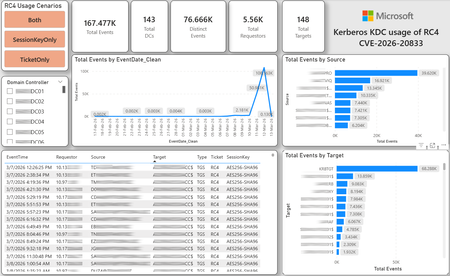
CVE-2026-20833 addresses the continued use of the RC4‑HMAC algorithm within the Kerberos protocol in Active Directory environments. Although RC4 has been retained for many years for compatibility with legacy systems, it is now considered cryptographically weak and unsuitable for modern authentication scenarios. As part of the security evolution of Kerberos, Microsoft has initiated a process of progressive protocol hardening, whose objective is to eliminate RC4 as an implicit fallback, establishing AES128 and AES256 as the default and recommended algorithms. This change should not be treated as optional or merely preventive. It represents a structural change in Kerberos behavior that will be progressively enforced through Windows security updates, culminating in a model where RC4 will no longer be implicitly accepted by the KDC. If Active Directory environments maintain service accounts, applications, or systems dependent on RC4, authentication failures may occur after the application of the updates planned for 2026, especially during the enforcement phases introduced starting in April and finalized in July 2026. For this reason, it is essential that organizations proactively identify and eliminate RC4 dependencies, ensuring that accounts, services, and applications are properly configured to use AES128 or AES256 before the definitive changes to Kerberos protocol behavior take effect. Official Microsoft References CVE-2026-25177 - Security Update Guide - Microsoft - Active Directory Domain Services Elevation of Privilege Vulnerability Microsoft Support – How to manage Kerberos KDC usage of RC4 for service account ticket issuance changes related to CVE-2026-20833 (KB 5073381) Microsoft Learn – Detect and Remediate RC4 Usage in Kerberos AskDS – What is going on with RC4 in Kerberos? Beyond RC4 for Windows authentication | Microsoft Windows Server Blog So, you think you’re ready for enforcing AES for Kerberos? | Microsoft Community Hub Risk Associated with the Vulnerability When RC4 is used in Kerberos tickets, an authenticated attacker can request Service Tickets (TGS) for valid SPNs, capture these tickets, and perform offline brute-force attacks, particularly Kerberoasting scenarios, with the goal of recovering service account passwords. Compared to AES, RC4 allows significantly faster cracking, especially for older accounts or accounts with weak passwords. Technical Overview of the Exploitation In simplified terms, the exploitation flow occurs as follows: The attacker requests a TGS for a valid SPN. The KDC issues the ticket using RC4, when that algorithm is still accepted. The ticket is captured and analyzed offline. The service account password is recovered. The compromised account is used for lateral movement or privilege escalation. Official Timeline Defined by Microsoft Important clarification on enforcement behavior Explicit account encryption type configurations continue to be honored even during enforcement mode. The Kerberos hardening associated with CVE‑2026‑20833 focuses on changing the default behavior of the KDC, enforcing AES-only encryption for TGS ticket issuance when no explicit configuration exists. This approach follows the same enforcement model previously applied to Kerberos session keys in earlier security updates (for example, KB5021131 related to CVE‑2022‑37966), representing another step in the progressive removal of RC4 as an implicit fallback. January 2026 – Audit Phase Starting in January 2026, Microsoft initiated the Audit Phase related to changes in RC4 usage within Kerberos, as described in the official guidance associated with CVE-2026-20833. The primary objective of this phase is to allow organizations to identify existing RC4 dependencies before enforcement changes are applied in later phases. During this phase, no functional breakage is expected, as RC4 is still permitted by the KDC. However, additional auditing mechanisms were introduced, providing greater visibility into how Kerberos tickets are issued in the environment. Analysis is primarily based on the following events recorded in the Security Log of Domain Controllers: Event ID 4768 – Kerberos Authentication Service (AS request / Ticket Granting Ticket) Event ID 4769 – Kerberos Service Ticket Operations (Ticket Granting Service – TGS) Additional events related to the KDCSVC service These events allow identification of: the account that requested authentication the requested service or SPN the source host of the request the encryption algorithm used for the ticket and session key This information is critical for detecting scenarios where RC4 is still being implicitly used, enabling operations teams to plan remediation ahead of the enforcement phase. If these events are not being logged on Domain Controllers, it is necessary to verify whether Kerberos auditing is properly enabled. For Kerberos authentication events to be recorded in the Security Log, the corresponding audit policies must be configured. The minimum recommended configuration is to enable Success auditing for the following subcategories: Kerberos Authentication Service Kerberos Service Ticket Operations Verification can be performed directly on a Domain Controller using the following commands: auditpol /get /subcategory:"Kerberos Service Ticket Operations" auditpol /get /subcategory:"Kerberos Authentication Service" In enterprise environments, the recommended approach is to apply this configuration via Group Policy, ensuring consistency across all Domain Controllers. The corresponding policy can be found at: Computer Configuration - Policies - Windows Settings - Security Settings - Advanced Audit Policy Configuration - Audit Policies - Account Logon Once enabled, these audits record events 4768 and 4769 in the Domain Controllers’ Security Log, allowing analysis tools—such as inventory scripts or SIEM/Log Analytics queries—to accurately identify where RC4 is still present in the Kerberos authentication flow. April 2026 – Enforcement with Manual Rollback With the April 2026 update, the KDC begins operating in AES-only mode (0x18) when the msDS-SupportedEncryptionTypes attribute is not defined. This means RC4 is no longer accepted as an implicit fallback. During this phase, applications, accounts, or computers that still implicitly depend on RC4 may start failing. Manual rollback remains possible via explicit configuration of the attribute in Active Directory. July 2026 – Final Enforcement Starting in July 2026, audit mode and rollback options are removed. RC4 will only function if explicitly configured—a practice that is strongly discouraged. This represents the point of no return in the hardening process. Official Monitoring Approach Microsoft provides official scripts in the repository: https://github.com/microsoft/Kerberos-Crypto/tree/main/scripts The two primary scripts used in this analysis are: Get-KerbEncryptionUsage.ps1 The Get-KerbEncryptionUsage.ps1 script, provided by Microsoft in the Kerberos‑Crypto repository, is designed to identify how Kerberos tickets are issued in the environment by analyzing authentication events recorded on Domain Controllers. Data collection is primarily based on: Event ID 4768 – Kerberos Authentication Service (AS‑REQ / TGT issuance) Event ID 4769 – Kerberos Service Ticket Operations (TGS issuance) From these events, the script extracts and consolidates several relevant fields for authentication flow analysis: Time – when the authentication occurred Requestor – IP address or host that initiated the request Source – account that requested the ticket Target – requested service or SPN Type – operation type (AS or TGS) Ticket – algorithm used to encrypt the ticket SessionKey – algorithm used to protect the session key Based on these fields, it becomes possible to objectively identify which algorithms are being used in the environment, both for ticket issuance and session establishment. This visibility is essential for detecting RC4 dependencies in the Kerberos authentication flow, enabling precise identification of which clients, services, or accounts still rely on this legacy algorithm. Example usage: .\Get-KerbEncryptionUsage.ps1 -Encryption RC4 -Searchscope AllKdcs | Export-Csv -Path .\KerbUsage_RC4_All_ThisDC.csv -NoTypeInformation -Encoding UTF8 Data Consolidation and Analysis In enterprise environments, where event volumes may be high, it is recommended to consolidate script results into analytical tools such as Power BI to facilitate visualization and investigation. The presented image illustrates an example dashboard built from collected results, enabling visibility into: Total events analyzed Number of Domain Controllers involved Number of requesting clients (Requestors) Most frequently involved services or SPNs (Targets) Temporal distribution of events RC4 usage scenarios (Ticket, SessionKey, or both) This type of visualization enables rapid identification of RC4 usage patterns, remediation prioritization, and progress tracking as dependencies are eliminated. Additionally, dashboards help answer key operational questions, such as: Which services still depend on RC4 Which clients are negotiating RC4 for sessions Which Domain Controllers are issuing these tickets Whether RC4 usage is decreasing over time This combined automated collection + analytical visualization approach is the recommended strategy to prepare environments for the Microsoft changes related to CVE‑2026‑20833 and the progressive removal of RC4 in Kerberos. Visualizing Results with Power BI To facilitate analysis and monitoring of RC4 usage in Kerberos, it is recommended to consolidate script results into a Power BI analytical dashboard. 1. Install Power BI Desktop Download and install Power BI Desktop from the official Microsoft website 2. Execute data collection After running the Get-KerbEncryptionUsage.ps1 script, save the generated CSV file to the following directory: C:\Temp\Kerberos_KDC_usage_of_RC4_Logs\KerbEncryptionUsage_RC4.csv 3. Open the dashboard in Power BI Open the file RC4-KerbEncryptionUsage-Dashboards.pbix using Power BI Desktop. If you are interested, please leave a comment on this post with your email address, and I will be happy to share with you. 4. Update the data source If the CSV file is located in a different directory, it will be necessary to adjust the data source path in Power BI. As illustrated, the dashboard uses a parameter named CsvFilePath, which defines the path to the collected CSV file. To adjust it: Open Transform Data in Power BI. Locate the CsvFilePath parameter in the list of Queries. Update the value to the directory where the CSV file was saved. Click Refresh Preview or Refresh to update the data. Click Home → Close & Apply. This approach allows rapid identification of RC4 dependencies, prioritization of remediation actions, and tracking of progress throughout the elimination process. List-AccountKeys.ps1 This script is used to identify which long-term keys are present on user, computer, and service accounts, enabling verification of whether RC4 is still required or whether AES128/AES256 keys are already available. Interpreting Observed Scenarios Microsoft recommends analyzing RC4 usage by jointly considering two key fields present in Kerberos events: Ticket Encryption Type Session Encryption Type Each combination represents a distinct Kerberos behavior, indicating the source of the issue, risk level, and remediation point in the environment. In addition to events 4768 and 4769, updates released starting January 13, 2026, introduce new Kdcsvc events in the System Event Log that assist in identifying RC4 dependencies ahead of enforcement. These events include: Event ID 201 – RC4 usage detected because the client advertises only RC4 and the service does not have msDS-SupportedEncryptionTypes defined. Event ID 202 – RC4 usage detected because the service account does not have AES keys and the msDS-SupportedEncryptionTypes attribute is not defined. Event ID 203 – RC4 usage blocked (enforcement phase) because the client advertises only RC4 and the service does not have msDS-SupportedEncryptionTypes defined. Event ID 204 – RC4 usage blocked (enforcement phase) because the service account does not have AES keys and msDS-SupportedEncryptionTypes is not defined. Event ID 205 – Detection of explicit enablement of insecure algorithms (such as RC4) in the domain policy DefaultDomainSupportedEncTypes. Event ID 206 – RC4 usage detected because the service accepts only AES, but the client does not advertise AES support. Event ID 207 – RC4 usage detected because the service is configured for AES, but the service account does not have AES keys. Event ID 208 – RC4 usage blocked (enforcement phase) because the service accepts only AES and the client does not advertise AES support. Event ID 209 – RC4 usage blocked (enforcement phase) because the service accepts only AES, but the service account does not have AES keys. https://support.microsoft.com/en-gb/topic/how-to-manage-kerberos-kdc-usage-of-rc4-for-service-account-ticket-issuance-changes-related-to-cve-2026-20833-1ebcda33-720a-4da8-93c1-b0496e1910dc They indicate situations where RC4 usage will be blocked in future phases, allowing early detection of configuration issues in clients, services, or accounts. These events are logged under: Log: System Source: Kdcsvc Below are the primary scenarios observed during the analysis of Kerberos authentication behavior, highlighting how RC4 usage manifests across different ticket and session encryption combinations. Each scenario represents a distinct risk profile and indicates specific remediation actions required to ensure compliance with the upcoming enforcement phases. Scenario A – RC4 / RC4 In this scenario, both the Kerberos ticket and the session key are issued using RC4. This is the worst possible scenario from a security and compatibility perspective, as it indicates full and explicit dependence on RC4 in the authentication flow. This condition significantly increases exposure to Kerberoasting attacks, since RC4‑encrypted tickets can be subjected to offline brute-force attacks to recover service account passwords. In addition, environments remaining in this state have a high probability of authentication failure after the April 2026 updates, when RC4 will no longer be accepted as an implicit fallback by the KDC. Events Associated with This Scenario During the Audit Phase, this scenario is typically associated with: Event ID 201 – Kdcsvc Indicates that: the client advertises only RC4 the service does not have msDS-SupportedEncryptionTypes defined the Domain Controller does not have DefaultDomainSupportedEncTypes defined This means RC4 is being used implicitly. This event indicates that the authentication will fail during the enforcement phase. Event ID 202 – Kdcsvc Indicates that: the service account does not have AES keys the service does not have msDS-SupportedEncryptionTypes defined This typically occurs when: legacy accounts have never had their passwords reset only RC4 keys exist in Active Directory Possible Causes Common causes include: the originating client (Requestor) advertises only RC4 the target service (Target) is not explicitly configured to support AES the account has only legacy RC4 keys the msDS-SupportedEncryptionTypes attribute is not defined Recommended Actions To remediate this scenario: Correctly identify the object involved in the authentication flow, typically: a service account (SPN) a computer account or a Domain Controller computer object Verify whether the object has AES keys available using analysis tools or scripts such as List-AccountKeys.ps1. If AES keys are not present, reset the account password, forcing generation of modern cryptographic keys (AES128 and AES256). Explicitly define the msDS-SupportedEncryptionTypes attribute to enable AES support. Recommended value for modern environments: 0x18 (AES128 + AES256) = 24 As illustrated below, this configuration can be applied directly to the msDS-SupportedEncryptionTypes attribute in Active Directory. AES can also be enabled via Active Directory Users and Computers by explicitly selecting: This account supports Kerberos AES 128 bit encryption This account supports Kerberos AES 256 bit encryption These options ensure that new Kerberos tickets are issued using AES algorithms instead of RC4. Temporary RC4 Usage (Controlled Rollback) In transitional scenarios—during migration or troubleshooting—it may be acceptable to temporarily use: 0x1C (RC4 + AES) = 28 This configuration allows the object to accept both RC4 and AES simultaneously, functioning as a controlled rollback while legacy dependencies are identified and corrected. However, the final objective must be to fully eliminate RC4 before the final enforcement phase in July 2026, ensuring the environment operates exclusively with AES128 and AES256. Scenario B – AES / RC4 In this case, the ticket is protected with AES, but the session is still negotiated using RC4. This typically indicates a client limitation, legacy configuration, or restricted advertisement of supported algorithms. Events Associated with This Scenario During the Audit Phase, this scenario may generate: Event ID 206 Indicates that: the service accepts only AES the client does not advertise AES in the Advertised Etypes In this case, the client is the issue. Recommended Action Investigate the Requestor Validate operating system, client type, and advertised algorithms Review legacy GPOs, hardening configurations, or settings that still force RC4 For Linux clients or third‑party applications, review krb5.conf, keytabs, and Kerberos libraries Scenario C – RC4 / AES Here, the session already uses AES, but the ticket is still issued using RC4. This indicates an implicit RC4 dependency on the Target or KDC side, and the environment may fail once enforcement begins. Events Associated with This Scenario This scenario may generate: Event ID 205 Indicates that the domain has explicit insecure algorithm configuration in: DefaultDomainSupportedEncTypes This means RC4 is explicitly allowed at the domain level. Recommended Action Correct the Target object Explicitly define msDS-SupportedEncryptionTypes with 0x18 = 24 Revalidate new ticket issuance to confirm full migration to AES / AES Conclusion CVE‑2026‑20833 represents a structural change in Kerberos behavior within Active Directory environments. Proper monitoring is essential before April 2026, and the msDS-SupportedEncryptionTypes attribute becomes the primary control point for service accounts, computer accounts, and Domain Controllers. July 2026 represents the final enforcement point, after which there will be no implicit rollback to RC4.33KViews4likes16CommentsSensitivity Auto-labelling via Document Property
Why is this needed? Sensitivity labels are generally relevant within an organisation only. If a file is labelled within one environment and then moved to another environment, sensitivity label content markings may be visible, but by default, the applied sensitivity label will not be understood. This can lead to scenarios where information that has been generated externally is not adequately protected. My favourite analogy for these scenarios is to consider the parallels between receiving sensitive information and unpacking groceries. When unpacking groceries, you might sit your grocery bag on a counter or on the floor next to the pantry. You’ll likely then unpack each item, take a look at it and then decide where to place it. Without looking at an item to determine its correct location, you might place it in the wrong location. Porridge might be safe from the kids on the bottom shelf. If you place items that need to be protected, such as chocolate, on the bottom shelf, it’s not likely to last very long. So, I affectionately refer to information that hasn’t been evaluated as ‘porridge’, as until it has been checked, it will end up on the bottom shelf of the pantry where it is quite accessible. Label-based security controls, such as Data Loss Prevention (DLP) policies using conditions of ‘content contains sensitivity label’ will not apply to these items. To ensure the security of any contained sensitive information, we should look for potential clues to its sensitivity and then utilize these clues to ensure that the contained information is adequately protected - We take a closer look at the ‘porridge’, determine whether it’s an item that needs protection and if so, move it to a higher shelf in the pantry so that it’s out of reach for the kids. Effective use of Purview revolves around the use of ‘know your data’ strategies. We should be using as many methods as possible to try to determine the sensitivity of items. This can include the use of Sensitive Information Types (SITs) containing keyword or pattern-based classifiers, trainable classifiers, Exact Data Match, Document fingerprinting, etc. Matching items via SITs present in the items content can be problematic due to false positives. Keywords like ‘Sensitive’ or ‘Protected’ may be mentioned out of context, such as when referring to a classification or an environment. When classifications have been stamped via a property, it allows us to match via context rather than content. We don’t need to guess at an item’s sensitivity if another system has already established what the item’s classification is. These methods are much less prone to false positives. Why isn’t everyone doing this? Document properties are often not considered in Purview deployments. SharePoint metadata management seems to be a dying artform and most compliance or security resources completing Purview configurations don’t have this skill set. There’s also a lack of understanding of the relevance of checking for item properties. Microsoft haven’t helped as the documentation in this space is somewhat lacking and needs to be unpicked via some aligning DLP guidance (Create a DLP policy to protect documents with FCI or other properties). Many of these configurations will also be tied to regional requirements. Document properties being used by systems where I’m from, in Australia, will likely be very different to those used in other parts of the world. In the following sections, we’ll take a look at applicable use cases and walk through how to enable these configurations. Scenarios for use Labelling via document property isn’t for everyone. If your organisation is new to classification or you don’t have external partners that you collaborate with at higher sensitivity levels, then this likely isn’t for you. For those that collaborate heavily and have a shared classification framework, as is often seen across government, this is a must! This approach will also be highly relevant to multi-tenant organisations or conglomerates where information is regularly shared between environments. The following scenarios are examples of where this configuration will be relevant: 1. Migrating from 3 rd party classification tools If an item has been previously stamped by a 3 rd party classification tool, then evaluating its applied document properties will provide a clear picture of its security classification. These properties can then be used in service-based auto-labelling policies to effectively transition items from 3 rd party tools to Microsoft Purview sensitivity labels. As labels are applied to items, they will be brought into scope of label-based controls. 2. Detecting data spill Data spill is a term that is used to define situations where information that is of a higher than permitted security classification land in an environment. Consider a Microsoft 365 tenant that is approved for the storage of Official information but Top Secret files are uploaded to it. Document properties that align with higher than permitted classifications provide us with an almost guaranteed method of identifying spilled items. Pairing this document property with an auto-labelling policy allows for the application of encryption to lock unauthorized users out of the items. Tools like Content Explorer and eDiscovery can then be used to easily perform cleanup activities. If using document properties and auto-labelling for this purpose, keep in mind that you’ll need to create sensitivity labels for higher than permitted classifications in order to catch spilled items. These labels won’t impact usability as you won’t publish them to users. You will, however, need to publish them to a single user or break glass account so that they’re not ignored by auto-labelling. 3. Blocking access by AI tools If your organization was concerned about items with certain properties applied being accessed by generative AI tools, such as Copilot, you could use Auto-labelling to apply a sensitivity label that restricts EXTRACT permissions. You can find some information on this at Microsoft 365 Copilot data protection architecture | Microsoft Learn. This should be relevant for spilled data, but might also be useful in situations where there are certain records that have been marked via properties and which should not be Copilot accessible. 4. External Microsoft Purview Configurations Sensitivity labels are relevant internally only. A label, in its raw form, is essentially a piece of metadata with an ID (or GUID) that we stamp on pieces of information. These GUIDs are understood by your tenant only. If an item marked with a GUID shows up in another Microsoft 365 tenant, the GUID won’t correspond with any of that tenant’s labels or label-based controls. The art in Microsoft Purview lies in interpreting the sensitivity of items based on content markings and other identifiers, so that data security can be maintained. Document properties applied by Purview, such as ClassificationContentMarkingHeaderText are not relevant to a specific tenant, which makes them portable. We can use these properties to help maintain classifications as items move between environments. 5. Utilizing metadata applied by Records Management solutions Some EDRMS, Records or Content Management solutions will apply properties to items. If an item has been previously managed and then stamped with properties, potentially including a security classification, via one of these systems, we could use this information to inform sensitivity label application. 6. 3 rd party classification tools used externally Even if your organisation hasn’t been using 3rd party classification tools, you should consider that partner organisations, such as other Government departments, might be. Evaluating the properties applied by external organisations to items that you receive will allow you to extend protections to these items. If classification tools like Janus or Titus are used in your geography/industry, then you may want to consider checking for their properties. Regarding the use of auto-classification tools Some organisations, particularly those in Government, will have organisational policies that prevent the use of automatic classification capabilities. These policies are intended to ensure that each item is assessed by an actual person for risk of disclosure rather than via an automated service that could be prone to error. However, when auto-labelling is used to interpret and honour existing classifications, we are lowering rather than raising the risk profile. If the item’s existing classification (applied via property) is ignored, the item will be treated as porridge and is likely to be at risk. If auto-labelling is able to identify a high-risk item and apply the relevant label, it will then be within scope of Purview’s data security controls, including label-based DLP, groups and sites data out of place alerting, and potentially even item encryption. The outcome is that, through the use of auto-labelling, we are able to significantly reduce risk of inappropriate or unintended disclosure. Configuration Process Setting up document property-based auto-labelling is fairly straightforward. We need to setup a managed property and then utilize it an auto-labelling policy. Below, I've split this process into 6 steps: Step 1 – Prepare your files In order to make use of document properties, an item with the properties applied will first need to be indexed by SharePoint. SharePoint will record the properties as ‘crawled properties’, which we’ll then need to convert into ‘managed properties’ to make them useful. If you already have items with the relevant properties stored in SharePoint, then they are likely already indexed. If not, you’ll need to upload or create an item or items with the properties applied. For testing, you’ll want to create a file with each property/value combination so that you can confirm that your auto-labelling policies are all working correctly. This could require quite a few files depending on the number of properties you’re looking for. To kick off your crawled property generation though, you could create or upload a single file with the correct properties applied. For example: In the above, I’ve created properties for ClassificationContentMarkingHeaderText and ClassificationContentMarkingFooterText, which you’ll often see applied by Purview when an item has a sensitivity label content marking applied to it. I’ve also included properties to help identify items classified via JanusSeal, Titus and Objective. Step 2 – Index the files After creating or uploading your file, we then need SharePoint to index it. This should happen fairly quickly depending on the size of your environment. I'd expect to wait sometime between 10 minutes and 24 hrs. If you're not in a hurry, then I'd recommend just checking back the next day. You'll know when this has been completed when you head into SharePoint Admin > Search > Managed Search Schema > Crawled Properties and can find your newly indexed properties: Step 3 – Configure managed properties Next, the properties need to be configured as managed properties. To do this, go to SharePoint Admin > More features > Search > Managed Search Schema > Managed Properties. Create a new managed property and give it a name. Note that there are some character restrictions in naming, but you should be able to get it close to your document property name. Set the property’s type to text, select queryable and retrievable. Under ‘mappings to crawled properties’, choose add mapping, search for and select the property indexed from the file property. Note that the crawled property will have the same name as your document property, so there’s no need to browse through all of them: Repeat this so that you have a managed property for each document property that you want to look for. Step 4 – Configure Auto-labelling policies Next up, create some auto-labelling policies. You’ll need one for each label that you want to apply, not one per property as you can check multiple properties within the one auto-labelling policy. - From within Purview, head to Information Protection > Policies > Auto-labelling policies. - Create a new policy using the custom policy template. - Give your policy an appropriate name (e.g. Label PROTECTED via property). - Select the label that you want to apply (e.g. PROTECTED). - Select SharePoint based services (SharePoint and OneDrive). - Name your auto-labelling rules appropriately (e.g. SPO – Contains PROTECTED property) - Enter your conditions as a long string with property and value separated via a colon and multiple entries separated with a comma. For example: ClassificationContentMarkingHeaderText:PROTECTED,ClassificationContentMarkingFooterText:PROTECTED,Objective-Classification:PROTECTED,PMDisplay:PROTECTED,TitusSEC:PROTECTED Note that the properties that you are referencing are the Managed Property rather than the document property. This will be relevant if your managed property ended up having a different name due to character restrictions. After pasting in your string into the UI, the resultant rule should look something like this: When done, you can either leave your policy in simulation mode or save it and then turn it on from the auto-labelling policies screen. Just be aware of any potential impacts, such as accidently locking users out by automatically deploying a label with encryption configuration. You can reduce any potential impact by targeting your auto-labelling policy at a site or set of sites initially and then expanding its scope after testing. Step 5 - Test Testing your configuration will be as easy as uploading or creating a set of files with the relevant document properties in place. Once uploaded, you’ll need to give SharePoint some time to index the items and then the auto-labelling policy some time to apply sensitivity labels to them. To confirm label application, you can head to the document library where your test files are located and enable the sensitivity column. Files that have been auto-labelled will have their label listed: You could also check for auto-labelling activity in Purview via Activity explorer: Step 6 – Expand into DLP If you’ve spent the time setting up managed properties, then you really should consider capitalizing on them in your DLP configurations. DLP policy conditions can be configured in the same manner that we configured Auto-labelling in Step 3 above. The document property also gives us an anchor for DLP conditions that is independent of an item’s sensitivity label. You may wish to consider the following: DLP policies blocking external sharing of items with certain properties applied. This might be handy for situations where auto-labelling hasn’t yet labelled an item. DLP policies blocking the external sharing of items where the applied sensitivity label doesn’t match the applied document property. This could provide an indication of risky label downgrade. You could extend such policies into Insider Risk Management (IRM) by creating IRM policies that are aligned with the above DLP policies. This will allow for document properties to be considered in user risk calculation, which can inform controls like Adaptive Protection. Here's an example of a policy from the DLP rule summary screen that shows conditions of item contains a label or one of our configured document properties: Thanks for reading and I hope this article has been of use. If you have any questions or feedback, please feel free to reach out.4.3KViews9likes9Comments
Feature Request: Extend Security Copilot inclusion (M365 E5) to M365 A5 Education tenants
Background At Ignite 2025, Microsoft announced that Security Copilot is included for all Microsoft 365 E5 customers, with a phased rollout starting November 18, 2025. This is a significant step forward for security operations. The gap Microsoft 365 A5 for Education is the academic equivalent of E5 — it includes the same core security stack: Microsoft Defender, Entra, Intune, and Purview. However, the Security Copilot inclusion explicitly covers only commercial E5 customers. There is no public roadmap or timeline for extending this benefit to A5 education tenants. Why this matters Education institutions face the same cybersecurity threats as commercial organizations — often with fewer dedicated security resources. The A5 license was positioned as the premium security offering for education. Excluding it from Security Copilot inclusion creates an inequity between commercial and education customers holding functionally equivalent license tiers. Request We would like Microsoft to: Confirm whether Security Copilot inclusion will be extended to M365 A5 Education tenants If yes, provide an indicative timeline If no, clarify the rationale and what alternative paths exist for education customers Are other EDU admins in the same situation? Would appreciate any upvotes or comments to help raise visibility with the product team.1.1KViews14likes3CommentsStep by Step: 2-Tier PKI Lab
Purpose of this blog Public Key Infrastructure (PKI) is the backbone of secure digital identity management, enabling encryption, digital signatures, and certificate-based authentication. However, neither setting up a PKI nor management of certificates is something most IT pros do on a regular basis and given the complexity and vastness of the subject it only makes sense to revisit the topic from time to time. What I have found works best for me is to just set up a lab and get my hands dirty with the topic that I want to revisit. One such topic that I keep coming back to is PKI - be it for creating certificate templates, enrolling clients, or flat out creating a new PKI itself. But every time I start deploying a lab or start planning a PKI setup, I end up spending too much time sifting through the documentations and trying to figure out why my issuing certificate authority won't come online! To make my life easier I decided to create a cheatsheet to deploy a simple but secure 2-tier PKI lab based on industry best practices that I thought would be beneficial for others like me, so I decided to polish it and make it into a blog. This blog walks through deploying a two-tier PKI hierarchy using Active Directory Certificate Services (AD CS) on Windows Server: an offline Root Certification Authority (Root CA) and an online Issuing Certification Authority (Issuing CA). We’ll cover step-by-step deployment and best practices for securing the root CA, conducting key ceremonies, and maintaining Certificate Revocation Lists (CRLs). Overview: Two-Tier PKI Architecture and Components In a two-tier PKI, the Root CA sits at the top of the trust hierarchy and issues a certificate only to the subordinate Issuing CA. The Root CA is kept offline (disconnected from networks) to protect its private key and is typically a standalone CA (not domain-joined). The Issuing CA (sometimes called a subordinate or intermediate CA) is kept online to issue certificates to end-entities (users, computers, services) and is usually an enterprise CA integrated with Active Directory for automation and certificate template support. Key components: Offline Root CA: A standalone CA, often on a workgroup server, powered on only when necessary (initial setup, subordinate CA certificate signing, or periodic CRL publishing). By staying offline, it is insulated from network threats. Its self-signed certificate serves as the trust anchor for the entire PKI. The Root CA’s private key must be rigorously protected (ideally by a Hardware Security Module) because if the root is compromised, all certificates in the hierarchy are compromised. Online Issuing CA: An enterprise subordinate CA (domain-joined) that handles day-to-day certificate issuance for the organization. It trusts the Root CA (via the root’s certificate) and is the one actually responding to certificate requests. Being online, it must also be secured, but its key is kept online for operations. Typically, the Issuing CA publishes certificates and CRLs to Active Directory and/or HTTP locations for clients to download. The following diagram shows the simplified view of this implementations: The table below summarizes the roles and differences: Aspect Offline Root CA Online Issuing CA Role Standalone Root CA (workgroup) Enterprise Subordinate CA (domain member) Network Connectivity Kept offline (powered off or disconnected when not issuing) Online (running continuously to serve requests) Usage Signs only one certificate (the subordinate CA’s cert) and CRLs Issues end-entity certificates (users, computers, services) Active Directory Not a member of AD domain; doesn’t use templates or auto-enrollment Integrated with AD DS; uses certificate templates for streamlined issuance Security Extremely high: physically secured, limited access, often protected by HSM Very High: server hardened, but accessible on network; HSM recommended for private key CRL Publication Manual. Admin must periodically connect, generate, and distribute CRL. Delta CRLs usually disabled. Automatic. Publishes CRLs to configured CDP locations (AD DS, HTTP) at scheduled intervals. Validity Period Longer (e.g. 5-10+ years for the CA certificate) to reduce frequency of renewal. Shorter (e.g. 2 years) to align with organizational policy; renewed under the root when needed. In this lab setup, we will create a Contoso Root CA (offline) and a Contoso Issuing CA (online) as an example. This mirrors real-world best practices which is to "deploy a standalone offline root CA and an online enterprise subordinate CA”. Deploying the Offline Root CA Setting up the offline Root CA involves preparing a dedicated server, installing AD CS, configuring it as a root CA, and then securing it. We’ll also configure certificate CDP/AIA (CRL Distribution Point and Authority Information Access) locations so that issued certificates will point clients to the correct locations to fetch the CA’s certificate and revocation list. Step 1: Prepare the Root CA Server (Offline) Provision an isolated server: Install a Windows Server OS (e.g., Windows Server 2022) on the machine designated to be the Root CA. Preferably on a portable enterprise grade physical server that can be stored in a safe. Do not join this server to any domain – it should function in a Workgroup to remain independent of your AD forest. System configuration: Give the server a descriptive name (e.g., ROOTCA) and assign a static IP (even though it will be offline, a static IP helps when connecting it temporarily for management). Install the latest updates and security patches while it’s still able to go online. Lock down network access: Once setup is complete, disable or unplug network connections. If the server must remain powered on for any reason, ensure all unnecessary services/ports are disabled to minimize exposure. In practice, you will keep this server shut down or physically disconnected except when performing CA maintenance. Step 2: Install the AD CS Role on the Root CA Add the Certification Authority role: On the Root CA server, open Server Manager and add the Active Directory Certificate Services role. During the wizard, select the Certification Authority role service (no need for web enrollment or others on the root). Proceed through the wizard and complete the installation. You can also install the CA role and management tools via PowerShell: Install-WindowsFeature AD-Certificate -IncludeManagementToolsThis Role Services: Choose Certification Authority. Setup Type: Select Standalone CA (since this root CA is not domain-joined). CA Type: Select Root CA. Private Key: Choose “Create a new private key.” Cryptography: If using an HSM, select the HSM’s Cryptographic Service Provider (CSP) here; otherwise use default. Choose a strong key length (e.g., 2048 or 4096 bits) and a secure hash algorithm (SHA-256 or higher). CA Name: Provide a common name for the CA (e.g., “Contoso Root CA”). This name will appear in issued certificates as the Issuer. Avoid using a machine DNS name here for security – pick a name without revealing the server’s actual hostname. Validity Period: Set a long validity (e.g., 10 years) for the root CA’s self-signed certificate. A decade is common for enterprise roots, reducing how often you must touch the offline CA for renewal. Database: Specify locations for the CA database and logs (the defaults are fine for a lab). Review settings and complete the configuration. This process will generate the root CA’s key pair and self-signed certificate, establishing the Root CA.Post-install configuration: After the binary installation, click Configure Active Directory Certificate Services (a notification in Server Manager). In the configuration wizard: You can also perform this configuration via PowerShell in one line: Install-AdcsCertificationAuthority ` -CAType StandaloneRootCA ` -CryptoProviderName "YourHSMProvider" ` -HashAlgorithmName SHA256 -KeyLength 2048 ` -CACommonName "Contoso Root CA" ` -ValidityPeriod Years -ValidityPeriodUnits 10 This would set up a standalone Root CA named "Contoso Root CA" with a 2048-bit key on an HSM provider, valid for 10 years. Step 3: Integrate an HSM (Optional but Recommended) If your lab has a Hardware Security Module, use it to secure the Root CA’s keys. Using an HSM provides a dedicated, tamper-resistant storage for CA private keys and can further protect against key compromise. To integrate: Install the HSM vendor’s software and drivers on the Root CA server. Initialize the HSM and create a security world or partition as per the vendor instructions. Before or during the CA configuration (Step 2 above), ensure the HSM is ready to generate/store the key. When running the AD CS configuration, select the HSM’s CSP/KSP for the cryptographic provider so that the CA’s private key is generated on the HSM. Secure any HSM admin tokens or smartcards. For a root CA, you might employ M of N key splits – requiring multiple key custodians to collaborate to activate the HSM or key – as part of the key ceremony (discussed later). (If an HSM is not available, the root key will be stored on the server’s disk. At minimum, protect it with a strong admin passphrase when prompted, and consider enabling the option to require administrator interaction (e.g., a password) whenever the key is accessed.) Step 4: Configure CA Extensions (CDP/AIA) It’s critical to configure how the Root CA publishes its certificate and revocation list, since the root is offline and cannot use Active Directory auto-publishing. Open the Certification Authority management console (certsrv.msc), right-click the CA name > Properties, and go to the Extensions tab. We will set the CRL Distribution Points (CDP) and Authority Information Access (AIA) URLs: CRL Distribution Point (CDP): This is where certificates will tell clients to fetch the CRL for the Root CA. By default, a standalone CA might have a file:// path or no HTTP URL. Click Add and specify an HTTP URL that will be accessible to all network clients, such as: http://<IssuingCA_Server>/CertEnroll/<CaName><CRLNameSuffix><DeltaCRLAllowed>.crl For example, if your issuing CA’s server name is ISSUINGCA.contoso.local, the URL might be http://issuingca.contoso.local/CertEnroll/Contoso%20Root%20CA.crl This assumes the Issuing CA (or another web server) will host the Root CA’s CRL in the CertEnroll directory. Check the boxes for “Include in the CDP extension of issued certificates” and “Include in all CRLs. Clients use this to find Delta CRLs” (you can uncheck the delta CRL publication on the root, as we won’t use delta CRLs on an offline root). Since the root CA won’t often revoke its single issued cert (the subordinate CA), delta CRLs aren’t necessary. Note: If your Active Directory is in use and you want to publish the Root CA’s CRL to AD, you can also add an ldap:///CN=... path and check “Publish in Active Directory”. However, publishing to AD from an offline CA must be done manually using the following command when the root is temporarily connected. certutil -dspublish Many setups skip LDAP for offline roots and rely on HTTP distribution. Authority Information Access (AIA): This is where the Root CA’s certificate will be published for clients to download (to build certificate chains). Add an HTTP URL similarly, for example: http://<IssuingCA_Server>/CertEnroll/<ServerDNSName>_<CaName><CertificateName>.crt This would point to a copy of the Root CA’s certificate that will be hosted on the issuing CA web server. Check “Include in the AIA extension of issued certificates”. This way, any certificate signed by the Root CA (like your subordinate CA’s cert) contains a URL where clients can fetch the Root CA’s cert if they don’t already have it. After adding these, remove any default entries that are not applicable (e.g., LDAP if the root isn’t going to publish to AD, or file paths that won’t be used by clients). These settings ensure that certificates issued by the Root CA (in practice, just the subordinate CA’s certificate) will carry the correct URLs for chain building and revocation checking. Step 5: Back Up the Root CA and Issue the Subordinate Certificate With the Root CA configured, we need to issue a certificate for the Issuing CA (subordinate). We’ll perform that in the next section from the Issuing CA’s side via a request file. Before taking the root offline, ensure you: Back up the CA’s private key and certificate: In the Certification Authority console, or via the CA Backup wizard, export the Root CA’s key pair and CA certificate. Protect this backup (store it offline in a secure location, e.g., on encrypted removable media in a safe). This backup is crucial for disaster recovery or if the Root CA needs to be migrated or restored. Save the Root CA Certificate: You will need the Root CA’s public certificate (*.crt) to distribute to other systems. Have it exported (Base-64 or DER format) for use on the Issuing CA and for clients. Initial CRL publication: Manually publish the first CRL so that it can be distributed. Open an elevated Command Prompt on the Root CA and run: certutil -crl This generates a new CRL file (in the CA’s configured CRL folder, typically %windir%\system32\CertSrv\CertEnroll). Take that CRL file and copy it to the designated distribution point (for example, to the CertEnroll directory on the Issuing CA’s web server, as per the HTTP URL configured). If using Active Directory for CRL distribution, you would also publish it to AD now (e.g., certutil -dspublish -f RootCA.crl on a domain-connected machine). In most lab setups, copying to an HTTP share is sufficient. With these tasks done, the Root CA is ready. At this point, disconnect or power off the Root CA and store it securely – it should remain offline except when it’s absolutely needed (like publishing a new CRL or renewing the subordinate CA’s certificate in the far future). Keeping the root CA offline maximizes its security by minimizing exposure to compromise. Best Practices for Securing the Root CA: The Root CA is the trust anchor, so apply stringent security practices: Physical security: Store the Root CA machine in a locked, secure location. If it’s a virtual machine, consider storing it on a disconnected hypervisor or a USB drive locked in a safe. Only authorized PKI team members should have access. An offline CA should be treated like crown jewels – offline CAs should be stored in secure locations. Minimal exposure: Keep the Root CA powered off and disconnected when not in use. It should not be left running or connected to any network. Routine operations (like issuing end-entity certs) should never involve the root. Admin access control: Limit administrative access on the Root CA server. Use dedicated accounts for PKI administration. Enable auditing on the CA for any changes or issuance events. No additional roles or software: Do not use the Root CA server for any other function (no web browsing, no email, etc.). Fewer installed components means fewer potential vulnerabilities. Protect the private key: Use an HSM if possible; if not, ensure the key is at least protected by a strong password and consider splitting knowledge of that password among multiple people (so no single person can activate the CA). Many organizations opt for an offline root key ceremony (see below) to generate and handle the root key with multiple witnesses and strict procedures. Keep system time and settings consistent: If the Root CA is powered off for long periods, ensure its clock is accurate whenever it is started (to avoid issuing a CRL or certificate with a wrong date). Don’t change the server name or CA name after installation (doing so invalidates issued certs). Periodic health checks: Even though offline, plan to turn on the Root CA at a secure interval (e.g., semi-annually or annually) to perform tasks like CRL publishing and system updates. Make sure to apply OS security updates during these maintenance windows, as offline does not mean immune to vulnerabilities (especially if it ever connects to a network for CRL publication or uses removable media). Deploying the Online Issuing CA Next, set up the Issuing CA server which will actually issue certificates to end entities in the lab. This server will be domain-joined (if using AD integration) and will obtain its CA certificate from the Root CA we just configured. Step 1: Prepare the Issuing CA Server Provision the server: Install Windows Server on a new machine (or VM) that will be the Issuing CA. Join this server to the Active Directory domain (e.g., Contoso.local). Being an enterprise CA, it needs domain membership to publish templates and integrate with AD security groups. Rename the server to something descriptive like ISSUINGCA for clarity. Assign a static IP and ensure it can communicate on the network. IIS for web enrollment (optional): If you plan to use the Web Enrollment or Certificate Enrollment Web Services, ensure IIS is installed. (The AD CS installation wizard can add it if you include those role services.) For this guide, we will include the Web Enrollment role so that the CertEnroll directory is set up for hosting certificate and CRL files. Step 2: Install AD CS Role on Issuing CA On the Issuing CA server, add the Active Directory Certificate Services role via Server Manager or PowerShell. This time, select both Certification Authority and Certification Authority Web Enrollment role services (Web Enrollment will set up the HTTP endpoints for certificate requests if needed). For example, using PowerShell: Install-WindowsFeature AD-Certificate, ADCS-Web-Enrollment -IncludeManagementTools After installation, launch the AD CS configuration wizard: Role Services: Choose Certification Authority (and Web Enrollment if prompted). Setup Type: Select Enterprise CA (since this CA will integrate with AD DS). CA Type: Select Subordinate CA (this indicates it will get its cert from an existing root CA). Private Key: Choose “Create a new private key” (we’ll generate a new key pair for this CA). Cryptography: If using an HSM here as well, select the HSM’s CSP/KSP for the issuing CA’s key. Otherwise, choose a strong key length (2048+ bits, SHA256 or better for hash). CA Name: Provide a name (e.g., “Contoso Issuing CA”). This name will appear as the Issuer on certificates it issues. Certificate Request: The wizard will ask how you want to get the subordinate CA’s certificate. Choose “Save a certificate request to file”. Specify a path, e.g., C:\CertRequest\issuingCA.req. The wizard will generate a request file that we need to take to the Root CA for signing. (Since our Root CA is offline, this file transfer might be via secure USB or a network share when the root is temporarily online.) CA Database: Choose locations or accept defaults for the certificate DB and logs. Finish the configuration wizard, which will complete pending because the CA doesn’t have a certificate yet. The AD CS service on this server won’t start until we import the issued cert from the root. Step 3: Integrate HSM on Issuing CA (Optional) If available, repeat the HSM setup on the Issuing CA: install HSM drivers, initialize it, and generate/secure the key for the subordinate CA on the HSM. Ensure you chose the HSM provider during the above configuration so that the issuing CA’s private key is stored in the HSM. Even though this CA is online, an HSM still greatly enhances security by protecting the private key from extraction. The issuing CA’s HSM may not require multiple custodians to activate (as it needs to run continuously), but should still be physically secured. Step 4: Obtain the Issuing CA’s Certificate from the Root CA Now we have a pending request (issuingCA.req) for the subordinate CA. To get its certificate: Transport the request to the Root CA: Copy the request file to the offline Root CA (via secure means – e.g., formatted new USB stick). Start up the Root CA (in a secure, offline setting) and open the Certification Authority console. Submit the request on Root CA: Right-click the Root CA in the CA console -> All Tasks -> Submit new request, and select the .req file. The request will appear in the Pending Requests on the root. Issue the subordinate CA certificate: Find the pending request (it will list the Issuing CA’s name). Right-click and choose All Tasks > Issue. The subordinate CA’s certificate is now issued by the Root CA. Export the issued certificate: Still on the Root CA, go to Issued Certificates, find the newly issued subordinate CA cert (you can identify it by the Request ID or by the name). Right-click it and choose Open or All Tasks > Export to get the certificate in a file form. If using the console’s built-in “Export” it might only allow binary; alternatively use the certutil command: certutil -dup <RequestID> .\ContosoIssuingCA.cer or simply open and copy to file. Save the certificate as issuingCA.cer. Also make sure you have a copy of the Root CA’s certificate (if not already done). Publish Root CA cert and CRL as needed: Before leaving the Root CA, you may also want to ensure the Root’s own certificate and latest CRL are available to the issuing CA and clients. If not already done in Step 5 of root deployment, export the Root CA cert (DER format) and copy the CRL file. You might use certutil -crl again if some time has passed since initial CRL. Now take the issuingCA.cer file (and root cert/CRL files) and move them back to the Issuing CA server. Step 5: Install the Issuing CA’s Certificate and Complete Configuration On the Issuing CA server (which is still waiting for its CA cert): Install the subordinate CA certificate: In Server Manager or the Certification Authority console on the Issuing CA, there should be an option to “Install CA Certificate” (if the AD CS configuration wizard is still open, it will prompt for the file; or otherwise, in the CA console right-click the CA name > All Tasks > Install CA Certificate). Provide the issuingCA.cer file obtained from the root. This will install the CA’s own certificate and start the CA service. The Issuing CA is now operational as a subordinate CA. Alternatively, use PowerShell: certutil -installcert C:\CertRequest\issuingCA.cer This installs the cert and associates it with the pending key. Trust the Root CA certificate: Because the Issuing CA is domain-joined, when you install the subordinate cert, it might automatically place the Root CA’s certificate in the Trusted Root Certification Authorities store on that server (and possibly publish it to AD). If not, you should manually install the Root CA’s certificate into the Trusted Root CA store on the Issuing CA machine (using the Certificates MMC or certutil -addstore -f Root rootCA.cer). This step prevents any “chain not trusted” warnings on the Issuing CA and ensures it trusts its parent. In an enterprise environment, you would also distribute the root certificate to all client machines (e.g., via Group Policy) so that they trust the whole chain. Import Root CRL: Copy the Root CA’s CRL (*.crl file) to the Issuing CA’s CRL distribution point location (e.g., C:\Windows\System32\CertSrv\CertEnroll\ if that’s the directory served by the web server). This matches the HTTP URL we configured on the root. Place the CRL file there and ensure it is accessible (the Issuing CA’s IIS might need to serve static .crl files; often, if Web Enrollment is installed, the CertEnroll folder is under C:\Inetpub\wwwroot\CertEnroll). At this point, the subordinate CA and any client hitting the HTTP URL can retrieve the root’s CRL. The subordinate CA is now fully established. It holds a certificate issued by the Root CA (forming a complete chain of trust), and it’s ready to issue end-entity certificates. Step 6: Configure Issuing CA Settings and Start Services Start the Certificate Services: If the CA service (CertSvc) isn’t started automatically, start or restart it. On PowerShell: Restart-Service certsvc The CA should show as running in the CA console with the name “Contoso Issuing CA” (or your chosen name). Configure Certificate Templates: Because this is an Enterprise CA, it can utilize certificate templates stored in Active Directory to simplify issuing common cert types (user auth, computer auth, web server SSL, etc.). By default, some templates (e.g., User, Computer) are available but not issued. In the Certification Authority console under Certificate Templates, you can choose which templates to issue (e.g., right-click > New > Certificate Template to Issue, then select templates like “User” or “Computer”). This lab guide doesn’t require specific templates but know that only Enterprise CAs can use templates. Templates define the policies and settings (cryptography, enrollment permissions, etc.) for issued certificates. Ensure you enable only the templates needed and configure their permissions appropriately (e.g., allow the appropriate groups to enroll). Set CRL publishing schedule: The Issuing CA will automatically publish its own CRL (for certificates it issues) at intervals. You can adjust the CRL and Delta CRL publication interval in the CA’s Properties > CRL Period. A common practice is a small base CRL period (e.g., 1 week or 2 weeks) for issuing CAs, because they may revoke user certs more frequently; and enable Delta CRLs (published daily) for timely revocation information. Make sure the CDP/AIA for the Issuing CA itself are properly configured too (the wizard usually sets LDAP and HTTP locations, but verify in the Extensions tab). In a lab, the default settings are fine. Web Enrollment (if installed): You can verify the web enrollment by browsing to http://<IssuingCA>/certsrv. This web UI allows browser-based certificate requests. It’s a legacy interface mostly, but for testing it can be used if your clients aren’t domain-joined or if you want a manual request method. In modern use, the Certificate Enrollment Web Service/Policy roles or auto-enrollment via Group Policy are preferred for remote and automated enrollment. At this stage, your PKI is operational: the Issuing CA trusts the offline Root CA and can issue certificates. The Root CA can be kept offline with confidence that the subordinate will handle all regular work. Validation and Testing of the PKI It’s important to verify that the PKI is configured correctly: Check CA status: On the Issuing CA, open the Certification Authority console and ensure no errors. Verify that the Issuing CA’s certificate shows OK (no red X). On the Root CA (offline most of the time), you can use the Pkiview.msc snap-in (Microsoft PKI Health Tool) on a domain-connected machine to check the health of the PKI. This tool will show if the CDPs/AIA are reachable and if certificates are properly published. Trust chain on clients: On a domain-joined client PC, the Root CA certificate should be present in the Trusted Root Certification Authorities store (if the Issuing CA was installed as Enterprise CA, it likely published the root cert to AD automatically; you can also distribute it via Group Policy or manually). The Issuing CA’s certificate should appear in the Intermediate Certification Authorities store. This establishes the chain of trust. If not, import the root cert into the domain’s Group Policy for Trusted Roots. A quick test: on a client, run certutil -config "ISSUINGCA\\Contoso Issuing CA" -ping to see if it can contact the CA (or use the Certification Authority MMC targeting the issuing CA). Enroll a test certificate: Try to enroll for a certificate from the Issuing CA. For instance, from a domain-joined client, use the Certificates MMC (in Current User or Computer context) and initiate a certificate request for a User or Computer certificate (depending on templates issued). If auto-enrollment is configured via Group Policy for a template, you can simply log on a client and see if it automatically receives a certificate. Alternatively, use the web enrollment page or certreq command to submit a request. The request should be approved and a certificate issued by "Contoso Issuing CA". After enrollment, inspect the issued certificate: it should chain up to "Contoso Root CA" without errors. Ensure that the certificate’s CDP points to the URL we set (and try to browse that URL to see the CRL file), and that the AIA points to the root cert location. Revocation test (optional): To test CRL behavior, you could revoke a test certificate on the Issuing CA (using the CA console) and publish a new CRL. On the client, after updating the CRL, the revoked certificate should show as revoked. For the Root CA, since it shouldn’t issue end-entity certs, you wouldn’t normally revoke anything except potentially the subordinate CA’s certificate (which would be a drastic action in case of compromise). By issuing a test certificate and validating the chain and revocation, you confirm that your two-tier PKI lab is functioning correctly. Maintaining the PKI: CRLs, Key Ceremonies, and Security Procedures Deploying the PKI is only the beginning. Proper maintenance and operational procedures are crucial to ensure the PKI remains secure and reliable over time. Periodic CRL Updates for the Offline Root: The Root CA’s CRL has a defined validity period (set during configuration, often 6 or 12 months for offline roots). Before the CRL expires, the Root CA must be brought online (in a secure environment) to issue a new CRL. It’s recommended to schedule CRL updates periodically (e.g., semi-annually) to prevent the CRL from expiring. An expired CRL can cause certificate chain validation to fail, potentially disrupting services. Typically, organizations set the offline root CRL validity so that publishing 1-2 times a year is sufficient. When the time comes: Start the Root CA (ensuring the system clock is correct). Run certutil -crl to issue a fresh CRL. Distribute the new CRL: copy it to the HTTP CDP location (overwrite the old file) and, if applicable, use certutil -dspublish -f RootCA.crl to update it in Active Directory. Verify that the new CRL’s next update date is extended appropriately (e.g., another 6 months out). Clients and the Issuing CA will automatically pick up the new CRL when checking for revocation. (The Issuing CA, if configured, might cache the root CRL and need a restart or certutil -setreg ca\CRLFlags +CRLF_REVCHECK_IGNORE_OFFLINE tweak if the root CRL expires unexpectedly. Keeping the schedule prevents such issues.) Issuing CA CRL and OCSP: The Issuing CA’s CRLs are published automatically as it is online. Ensure the IIS or file share hosting the CRL is accessible. Optionally, consider setting up an Online Responder (OCSP) for real-time status checking, especially if CRLs are large or you need faster revocation information. OCSP is another AD CS role service that can be configured on the issuing CA or another server to answer certificate status queries. This might be beyond a simple lab, but it’s worth mentioning for completeness. Key Ceremonies and Documentation: For production environments (and good practice even in labs), formalize the process of handling CA keys in a Key Ceremony. A key ceremony is a carefully controlled process for activities like generating the Root CA’s key pair, installing the CA, and signing subordinate certificates. It often involves multiple people to ensure no single person has unilateral control (principle of dual control) and to witness the process. Best practices for a Root CA key ceremony include: Advance Planning: Create a step-by-step script of the ceremony tasks. Include who will do what, what materials are needed (HSMs, installation media, backup devices, etc.), and the order of operations. Multiple trusted individuals present: Roles might include a Ceremony Administrator (leads the process), a Security Officer (responsible for HSM or key material handling), an Auditor (to observe and record), etc. This prevents any one person from manipulating the process and increases trust. Secure environment: Conduct the ceremony in a secure location (e.g., a locked room) free of recording devices or unauthorized personnel. Ensure the Root CA machine is isolated (no network), and ideally that BIOS/USB access controls are in place to prevent any malware. Generate keys with proper controls: If using an HSM, initialize and generate the key with the required number of key custodians each providing part of the activation material (e.g., smartcards or passphrases). Immediately back up the HSM partition or key to secure media (requiring the same custodians to restore). Sign subordinate CA certificate: As part of the ceremony, once the root key is ready, sign the subordinate’s request. This might also be a witnessed step. Document every action: Write down each command run, each key generated, serial numbers of devices used, and have all participants sign an acknowledgment of the outcomes. Also record the fingerprints of the generated Root CA certificate and any subordinate certificate to ensure they are exactly as expected. Secure storage: After the ceremony, store the Root CA machine (if it’s a laptop or VM) and HSM tokens in a tamper-evident bag or safe. The idea is to make it evident if someone tries to access the root outside of an authorized ceremony. While a full key ceremony might be overkill for a small lab, understanding these practices is important. Even in a lab, you can simulate some aspects (for learning), like documenting the procedure of taking the root online to sign the request and then locking it away. These practices greatly increase the trust in a production PKI by ensuring transparency and accountability for critical operations. Backup and Recovery Plans: Both CAs’ data should be regularly backed up: For the Root CA: since it’s rarely online, backup after any change. Typically, you’d back up the CA’s private key and certificate once (right after setup or any renewal). Store this securely offline (separate from the server itself). Also back up the CA database if it ever issues more than one cert (for root it might not issue many). For the Issuing CA: schedule automated backups of the CA database and private key. You can use the built-in certutil -backup or Windows Server Backup (which is aware of the AD CS database). Keep backups secure and test restoration procedures. Having a documented recovery procedure for the CA is crucial for continuity. Also consider backup of templates and any scripts. Maintain spare hardware or VMs in case you need to restore the CA on new hardware (especially for the root, having a procedure to restore on a new machine if the original is destroyed). Security maintenance: Apply OS updates to the CAs carefully. For the offline root, patch it offline if possible (offline servicing or connecting it briefly to a management network). For the issuing CA, treat it as a critical infrastructure server: limit its exposure (firewall it so only required services are reachable), monitor its event logs (enable auditing for Certificate Services events, which can log each issuance and revocation), and employ anti-malware tools with caution (whitelisting the CA processes to avoid interference). Also, periodically review the CA’s configuration and certificate templates to ensure they meet current security standards (for example, deprecate any weak cryptography or adjust validity periods if needed). By following these maintenance steps and best practices, your two-tier PKI will remain secure and trustworthy over time. Remember that PKI is not “set and forget” – it requires operational diligence, but the payoff is a robust trust infrastructure for your organization’s security. Additional AD CS Features and References Active Directory Certificate Services provides more capabilities than covered in this basic lab. Depending on your needs, you might explore: Certificate Templates: We touched on templates; they are a powerful feature on Enterprise CAs to enforce standardized certificate settings. Administrators can create custom templates for various use cases (SSL, S/MIME email, code signing) and control enrollment permissions. Understanding template versions and permissions is key for enterprise deployments. (Refer to Microsoft’s documentation on Certificate template concepts in Windows Server for details on how templates work and can be customized.) Web Services for Enrollment: In scenarios with remote or non-domain clients, AD CS offers the Certificate Enrollment Web Service (CES) and Certificate Enrollment Policy Web Service (CEP) role services. These allow clients to fetch enrollment policy information and request certificates over HTTP or HTTPS, even when not connected directly to the domain. They work with the certificate templates to enable similar auto-enrollment experiences over the web. See Microsoft’s guides on the Certificate Enrollment Web Service overview and Certificate Enrollment Policy Web Service overview for when to use these. Network Device Enrollment Service (NDES): This AD CS role service implements the Simple Certificate Enrollment Protocol (SCEP) to allow devices like routers, switches, and mobile devices to obtain certificates from the CA without domain credentials. NDES acts as a proxy (Registration Authority) between devices and the CA, using one-time passwords for authentication. If you need to issue certificates to network equipment or MDM-managed mobile devices, NDES is the solution. Microsoft Docs provide a Network Device Enrollment Service(NDES) overview and even details on using a policy module with NDES for advanced scenarios (like customizing how requests are processed or integrating with custom policies). Online Responders (OCSP): As mentioned, an Online Responder can be configured to answer revocation status queries more efficiently than CRLs, especially useful if your CRLs grow large or you have high-volume certificate validation (VPNs, etc.). AD CS’s Online Responder role service can be installed on a member server and configured with the OCSP Response Signing certificate from your Issuing CA. Monitoring and Auditing: Windows Servers have options to audit CA events. Enabling auditing can log events such as certificate issuance, revocation, or changes to the CA configuration. These logs are important in enterprise PKI to track who did what (for compliance and security forensics). Also, tools like the PKI Health Tool (pkiview.msc) and PowerShell cmdlets (like Get-CertificationAuthority, Get-CertificationAuthorityCertificate) can help monitor the health and configuration of your CAs. Conclusion By following this guide, you have set up a secure two-tier PKI environment consisting of an offline Root CA and an online Issuing CA. This design, which uses an offline root, is considered a security best practice for enterprise PKI deployments because it reduces the risk of your root key being compromised. With the offline Root CA acting as a hardened trust anchor and the enterprise Issuing CA handling day-to-day certificate issuance, your lab PKI can issue certificates for various purposes (HTTPS, code signing, user authentication, etc.) in a way that models real-world deployments. As you expand this lab or move to production, always remember that PKI security is as much about process as technology. Applying strict controls to protect CA keys, keeping software up to date, and monitoring your PKI’s health are all part of the journey. For further reading and official guidance, refer to these Microsoft documentation resources: 📖 AD CS PKI Design Considerations: PKI design considerations using Active Directory Certificate Services in Windows Server helps in planning a PKI deployment (number of CAs, hierarchy depth, naming, key lengths, validity periods, etc.). This is useful to read when adapting this lab design to a production environment. It also covers configuring CDP/AIA and why offline roots usually don’t need delta CRLs. 📖 AD CS Step-by-Step Guides: Microsoft’s Test Lab Guide Test Lab Guide: Deploying an AD CS Two-Tier PKI Hierarchy walk through a similar scenario.
Short survey: Feedback on Sensitivity Label Suggestions in Microsoft 365 Apps
Hi everyone, I’m looking to gather feedback on user experiences with Sensitivity Label suggestions in Microsoft 365 apps. This short survey aims to understand how label recommendations are working in practice and where improvements may be needed. Your responses will help identify common challenges and opportunities to make the label recommendation process more accurate, useful, and seamless for users. Survey link: Experience with Recommended Sensitivity Labels in Microsoft 365 – Fill out form The survey takes around 3 minutes to complete. Your feedback will directly help us better understand real-world experiences with label suggestions. Thank you very much for taking the time to contribute.New Microsoft Purview innovations for Fabric to safely accelerate your AI transformation
As organizations adopt AI, security and governance remain core primitives for safe AI transformation and acceleration. After all, data leaders are aware of the notion that: Your AI is only as good as your data. Organizations are skeptical about AI transformation due to concerns of sensitive data oversharing and poor data quality. In fact, 86% of organizations lack visibility into AI data flows, operating in darkness about what information employees share with AI systems [1]. Compounding on this challenge, about 67% of executives are uncomfortable using data for AI due to quality concerns [2]. The challenges of data oversharing and poor data quality requires organizations to solve these issues seamlessly for the safe usage of AI. Microsoft Purview offers a modern, unified approach to help organizations secure and govern data across their entire data estate, in particular best in class integrations with M365, Microsoft Fabric, and Azure data estates, streamlining oversight and reducing complexity across the estate. At FabCon Atlanta, we’re announcing new Microsoft Purview innovations for Fabric to help seamlessly secure and confidently activate your data for AI transformation. These updates span data security and data governance, granting Fabric users to both Discover risks and prevent data oversharing in Fabric Improve governance processes and data quality across their data estate 1. Discover risks and prevent data oversharing in Fabric As data volume increases with AI usage, Microsoft Purview secures your data with capabilities such as Information Protection, Data Loss Prevention (DLP), Insider Risk Management (IRM), and Data Security Posture Management (DSPM). These capabilities work together to secure data throughout its lifecycle and now specifically for your Fabric data estate. Here are a few new Purview innovations for your Fabric estate: Microsoft Purview DLP policies to prevent data leakage for Fabric Warehouse and KQL/SQL DBs Now generally available, Microsoft Purview DLP policies allow Fabric admins to prevent data oversharing in Fabric through policy tip triggering when sensitive data is detected in assets uploaded to Warehouses. Additionally, in preview, Purview DLP enables Fabric admins to restrict access to assets with sensitive data in KQL/SQL DBs and Fabric Warehouses to prevent data oversharing. This helps admins limit access to sensitive data detected in these data sources and data stores to just asset owners and allowed collaborators. These DLP innovations expand upon the depth and breadth of existing DLP policies to ensure sensitive data in Fabric is protected. Figure 1. DLP restrict access preventing data oversharing of customer information stored in a KQL database. Microsoft Purview Insider Risk Management (IRM) indicators for Lakehouse, IRM data theft quick policy for Fabric, and IRM pay-as-you-go usage report for Fabric Microsoft Purview Insider Risk Management is now generally available for Microsoft Fabric extending its risk-detection capabilities to Microsoft Fabric lakehouses (in addition to Power BI which is supported today) by offering ready-to-use risk indicators based on risky user activities in Fabric lakehouses, such as sharing data from a Fabric lakehouse with people outside the organization . Additionally, IRM data theft policy is now generally available for security admins to create a data theft policy to detect Fabric data exfiltration, such as exporting Power BI reports. Also, organizations now have visibility into how much they are billed with the IRM pay-as-you-go usage report for Fabric, providing customers with an easy-to-use dashboard to track their consumption and predictability on costs. Figure 2. IRM identifying risky user behavior when handling data in a Fabric Lakehouse. Figure 3. Security admins can create a data theft policy to detect Fabric data exfiltration. Figure 4. Security admins can check the pay-as-you-go usage (processing units) across different workloads and activities such as the downgrading of sensitivity labels of a lakehouse through the usage report. Microsoft Purview for all Fabric Copilots and Agents Microsoft Purview currently provides capabilities in preview for all Copilots and Agents in Fabric. Organizations can: Discover data risks such as sensitive data in user prompts and responses and receive recommended actions to reduce these risks. Detect and remediate oversharing risks with Data Risk Assessments on DSPM, that identify potentially overshared, unprotected, or sensitive Fabric assets, giving teams clear visibility into where data exposure exists and enabling targeted actions—like applying labels or policies—to reduce risk and ensure Fabric data is AI‑ready and governed by design. Identify risky AI usage with Microsoft Purview Insider Risk Management to investigate risky AI usage, such as an inadvertent user who has neglected security best practices and shared sensitive data in AI. Govern AI usage with Microsoft Purview Audit, Microsoft Purview eDiscovery, retention policies, and non-compliant usage detection. Figure 5. Purview DSPM provides admins with the ability to discover data risks such as a user’s attempt to obtain historical data within a data agent in the Data Science workload in Fabric. DSPM subsequently provides actions to solve this risk. Now that we’ve covered how Purview helps secure Fabric data and AI, the next focus is ensuring Fabric users can use that data responsibly. 2. Improve governance processes and data quality across their data estate Once an organization’s data is secured for AI, the next challenge is ensuring consumers can easily find and trust the data needed for AI. This is where the Purview Unified Catalog comes in, serving as the foundation for enterprise data governance. Estate-wide data discovery provides a holistic view of the data landscape, helping prevent valuable data from being underutilized. Built-in data quality tools enable teams to measure, monitor, and remediate issues such as incomplete records, inconsistencies, and redundancies, ensuring decisions and AI outcomes are based on trusted, reliable data. Purview provides additional governance capabilities for all data consumers and governance teams and supplement those who utilize the Fabric OneLake catalog. Here are a few new innovations within the Purview Unified Catalog: Publication workflows for data products and glossary terms Now generally available, data owners can leverage Workflows in the Purview Unified Catalog to manage how data products and glossary terms are published. Customizable workflows enable governance teams to work faster to create a well curated catalog, specifically by ensuring that data products and glossary terms are published and governed responsibly. Data consumers can request access to data products and be reassured that the data is held to a certain governance standard by governance teams. Figure 6. Customizing a Workflow for publishing a glossary term in your catalog. Data quality for ungoverned assets in the Unified Catalog, including Fabric data In the Unified Catalog, Data Quality for ungoverned data assets allows organizations to run data quality on data assets, including Fabric assets, without linking them to data products. This approach enables data quality stewards to run data quality at a faster speed and on greater scale, ensuring that their organizations can democratize high quality data for AI use cases. Figure 7. Running data quality on data assets without it being associated with a data product. Looking Forward As organizations accelerate their AI ambitions, data security and governance become essential. Microsoft Purview and Microsoft Fabric deliver an integrated and unified foundation that enables organizations to innovate with confidence, ensuring data is protected, governed, and trusted for responsible AI activation. We’re committed to helping you stay ahead of evolving challenges and opportunities as you unlock more value from your data. Explore these new capabilities and join us on the journey toward a more secure, governed, and AI‑ready data future. [1] 2025 AI Security Gap: 83% of Organizations Flying Blind [2] The Importance Of Data Quality: Metrics That Drive Business Success
Always‑on Diagnostics for Purview Endpoint DLP: Effortless, Zero‑Friction troubleshooting for admins
Historically, some security teams have struggled with the challenge of troubleshooting issues with endpoint DLP. Investigations can often slow down because reproducing issues, collecting traces, and aligning on context can be tedious. With always-on diagnostics in Purview endpoint data loss prevention (DLP), our goal has been simple: make troubleshooting seamless, and effortless—without ever disrupting the information worker. Today, we’re excited to share new enhancements to always-on diagnostics for Purview endpoint DLP. This is the next step in our journey to modernize supportability in Microsoft Purview and dramatically reduce admin friction during investigations. Where We Started: Introduction of continuous diagnostic collection Earlier this year, we introduced continuous diagnostic trace collection on Windows endpoints (support for macOS endpoints coming soon). This eliminated the single largest source of friction: the need to reproduce issues. With this capability: Logs are captured persistently for up to 90 days Information workers no longer need admin permissions to retrieve traces Admins can submit complete logs on the first attempt Support teams can diagnose transient or rare issues with high accuracy In just a few months, we saw resolution times drop dramatically. The message was clear: Always-on diagnostics is becoming a new troubleshooting standard. Our Newest Enhancements: Built for Admins. Designed for Zero Friction. The newest enhancements to always-on diagnostics unlock the most requested capability from our IT and security administrators: the ability to retrieve and upload always-on diagnostic traces directly from devices using the Purview portal — with no user interaction required. This means: Admins can now initiate trace uploads on demand No interruption to information workers and their productivity No issue reproduction sessions, minimizing unnecessary disruption and coordination Every investigation starts with complete context Because the traces are already captured on-device, these improvements now help complete the loop by giving admins a seamless, portal-integrated workflow to deliver logs to Microsoft when needed. This experience is now fully available for customers using endpoint DLP on Windows. Why This Matters As a product team, our success is measured not just by usage, but by how effectively we eliminate friction for customers. Always-on diagnostics minimizes the friction and frustration that has historically affected some customers. - No more asking your employee or information worker to "can you reproduce that?" and share logs - No more lost context - No more delays while logs are collected after the fact How it Works Local trace capture Devices continuously capture endpoint DLP diagnostic data in a compressed, proprietary format, and this data stays solely on the respective device based on the retention period and storage limits configured by the admin. Users no longer need to reproduce issues during retrieval—everything the investigation requires is already captured on the endpoint. Admin-triggered upload Admins can now request diagnostic uploads directly from the Purview portal, eliminating the need to disrupt users. Upload requests can be initiated from multiple entry points, including: Alerts (Data Loss Prevention → Alerts → Events) Activity Explorer (Data Loss Prevention → Explorers → Activity explorer) Device Policy Status Page (Settings → Device onboarding → Devices) From any of these locations, admins can simply choose Request device log, select the date range, add a brief description, and submit the request. Once processed, the device’s always-on diagnostic logs are securely uploaded to Microsoft telemetry as per customer-approved settings. Admins can include the upload request number in their ticket with Microsoft Support, and sharing this number removes the need for the support engineer to ask for logs again during the investigation. This workflow ensures investigations start with complete diagnostic context. Privacy & compliance considerations Data is only uploaded during admin-initiated investigations Data adheres to our published diagnostic data retention policies Logs are only accessible to the Microsoft support team, not any other parties We Want to Hear From You Are you using always-on diagnostics? We'd love to hear about your experience. Share your feedback, questions, or success stories in the Microsoft Tech Community, or reach out to our engineering team directly. Making troubleshooting effortless—so you can focus on what matters, not on chasing logs.
From “No” to “Now”: A 7-Layer Strategy for Enterprise AI Safety
The “block” posture on Generative AI has failed. In a global enterprise, banning these tools doesn't stop usage; it simply pushes intellectual property into unmanaged channels and creates a massive visibility gap in corporate telemetry. The priority has now shifted from stopping AI to hardening the environment so that innovation can run at velocity without compromising data sovereignty. Traditional security perimeters are ineffective against the “slow bleed” of AI leakage - where data moves through prompts, clipboards, and autonomous agents rather than bulk file transfers. To secure this environment, a 7-layer defense-in-depth model is required to treat the conversation itself as the new perimeter. 1. Identity: The Only Verifiable Perimeter Identity is the primary control plane. Access to AI services must be treated with the same rigor as administrative access to core infrastructure. The strategy centers on enforcing device-bound Conditional Access, where access is strictly contingent on device health. To solve the "Account Leak" problem, the deployment of Tenant Restrictions v2 (TRv2) is essential to prevent users from signing into personal tenants using corporate-managed devices. For enhanced coverage, Universal Tenant Restrictions (UTR) via Global Secure Access (GSA) allows for consistent enforcement at the cloud edge. While TRv2 authentication-plane is GA, data-plane protection is GA for the Microsoft 365 admin center and remains in preview for other workloads such as SharePoint and Teams. 2. Eliminating the Visibility Gap (Shadow AI) You can’t secure what you can't see. Microsoft Defender for Cloud Apps (MDCA) serves to discover and govern the enterprise AI footprint, while Purview DSPM for AI (formerly AI Hub) monitors Copilot and third-party interactions. By categorizing tools using MDCA risk scores and compliance attributes, organizations can apply automated sanctioning decisions and enforce session controls for high-risk endpoints. 3. Data Hygiene: Hardening the “Work IQ” AI acts as a mirror of internal permissions. In a "flat" environment, AI acts like a search engine for your over-shared data. Hardening the foundation requires automated sensitivity labeling in Purview Information Protection. Identifying PII and proprietary code before assigning AI licenses ensures that labels travel with the data, preventing labeled content from being exfiltrated via prompts or unauthorized sharing. 4. Session Governance: Solving the “Clipboard Leak” The most common leak in 2025 is not a file upload; it’s a simple copy-paste action or a USB transfer. Deploying Conditional Access App Control (CAAC) via MDCA session policies allows sanctioned apps to function while specifically blocking cut/copy/paste. This is complemented by Endpoint DLP, which extends governance to the physical device level, preventing sensitive data from being moved to unmanaged USB storage or printers during an AI-assisted workflow. Purview Information Protection with IRM rounds this out by enforcing encryption and usage rights on the files themselves. When a user tries to print a "Do Not Print" document, Purview triggers an alert that flows into Microsoft Sentinel. This gives the SOC visibility into actual policy violations instead of them having to hunt through generic activity logs. 5. The “Agentic” Era: Agent 365 & Sharing Controls Now that we're moving from "Chat" to "Agents", Agent 365 and Entra Agent ID provide the necessary identity and control plane for autonomous entities. A quick tip: in large-scale tenants, default settings often present a governance risk. A critical first step is navigating to the Microsoft 365 admin center (Copilot > Agents) to disable the default “Anyone in organization” sharing option. Restricting agent creation and sharing to a validated security group is essential to prevent unvetted agent sprawl and ensure that only compliant agents are discoverable. 6. The Human Layer: “Safe Harbors” over Bans Security fails when it creates more friction than the risk it seeks to mitigate. Instead of an outright ban, investment in AI skilling-teaching users context minimization (redacting specifics before interacting with a model) - is the better path. Providing a sanctioned, enterprise-grade "Safe Harbor" like M365 Copilot offers a superior tool that naturally cuts down the use of Shadow AI. 7. Continuous Ops: Monitoring & Regulatory Audit Security is not a “set and forget” project, particularly with the EU AI Act on the horizon. Correlating AI interactions and DLP alerts in Microsoft Sentinel using Purview Audit (specifically the CopilotInteraction logs) data allows for real-time responses. Automated SOAR playbooks can then trigger protective actions - such as revoking an Agent ID - if an entity attempts to access sensitive HR or financial data. Final Thoughts Securing AI at scale is an architectural shift. By layering Identity, Session Governance, and Agentic Identity, AI moves from being a fragmented risk to a governed tool that actually works for the modern workplace.Microsoft Ignite 2025: Top Security Innovations You Need to Know
🤖 Security & AI -The Big Story This Year 2025 marks a turning point for cybersecurity. Rapid adoption of AI across enterprises has unlocked innovation but introduced new risks. AI agents are now part of everyday workflows-automating tasks and interacting with sensitive data—creating new attack surfaces that traditional security models cannot fully address. Threat actors are leveraging AI to accelerate attacks, making speed and automation critical for defense. Organizations need solutions that deliver visibility, governance, and proactive risk management for both human and machine identities. Microsoft Ignite 2025 reflects this shift with announcements focused on securing AI at scale, extending Zero Trust principles to AI agents, and embedding intelligent automation into security operations. As a Senior Cybersecurity Solution Architect, I’ve curated the top security announcements from Microsoft Ignite 2025 to help you stay ahead of evolving threats and understand the latest innovations in enterprise security. Agent 365: Control Plane for AI Agents Agent 365 is a centralized platform that gives organizations full visibility, governance, and risk management over AI agents across Microsoft and third-party ecosystems. Why it matters: Unmanaged AI agents can introduce compliance gaps and security risks. Agent 365 ensures full lifecycle control. Key Features: Complete agent registry and discovery Access control and conditional policies Visualization of agent interactions and risk posture Built-in integration with Defender, Entra, and Purview Available via the Frontier Program Microsoft Agent 365: The control plane for AI agents Deep dive blog on Agent 365 Entra Agent ID: Zero Trust for AI Identities Microsoft Entra is the identity and access management suite (covering Azure AD, permissions, and secure access). Entra Agent ID extends Zero Trust identity principles to AI agents, ensuring they are governed like human identities. Why it matters: Unmanaged or over-privileged AI agents can create major security gaps. Agent ID enforces identity governance on AI agents and reduces automation risks. Key Features: Provides unique identities for AI agents Lifecycle governance and sponsorship for agents Conditional access policies applied to agent activity Integrated with open SDKs/APIs for third‑party platforms Microsoft Entra Agent ID Overview Entra Ignite 2025 announcements Public Preview details Security Copilot Expansion Security Copilot is Microsoft’s AI assistant for security teams, now expanded to automate threat hunting, phishing triage, identity risk remediation, and compliance tasks. Why it matters: Security teams face alert fatigue and resource constraints. Copilot accelerates response and reduces manual effort. Key Features: 12 new Microsoft-built agents across Defender, Entra, Intune, and Purview. 30+ partner-built agents available in the Microsoft Security Store. Automates threat hunting, phishing triage, identity risk remediation, and compliance tasks. Included for Microsoft 365 E5 customers at no extra cost. Security Copilot inclusion in Microsoft 365 E5 Security Copilot Ignite blog Security Dashboard for AI A unified dashboard for CISOs and risk leaders to monitor AI risks, aggregate signals from Microsoft security services, and assign tasks via Security Copilot - included at no extra cost. Why it matters: Provides a single pane of glass for AI risk management, improving visibility and decision-making. Key Features: Aggregates signals from Entra, Defender, and Purview Supports natural language queries for risk insights Enables task assignment via Security Copilot Ignite Session: Securing AI at Scale Microsoft Security Blog Microsoft Defender Innovations Microsoft Defender serves as Microsoft’s CNAPP solution, offering comprehensive, AI-driven threat protection that spans endpoints, email, cloud workloads, and SIEM/SOAR integrations. Why It Matters Modern attacks target multi-cloud environments and software supply chains. These innovations provide proactive defense, reduce breach risks before exploitation, and extend protection beyond Microsoft ecosystems-helping organizations secure endpoints, identities, and workloads at scale. Key Features: Predictive Shielding: Proactively hardens attack paths before adversaries pivot. Automatic Attack Disruption: Extended to AWS, Okta, and Proofpoint via Sentinel. Supply Chain Security: Defender for Cloud now integrates with GitHub Advanced Security. What’s new in Microsoft Defender at Ignite Defender for Cloud innovations Global Secure Access & AI Gateway Part of Microsoft Entra’s secure access portfolio, providing secure connectivity and inspection for web and AI traffic. Why it matters: Protects against lateral movement and AI-specific threats while maintaining secure connectivity. Key Features: TLS inspection, URL/file filtering AI Prompt Injection protection Private access for domain controllers to prevent lateral movement attacks. Learn about Secure Web and AI Gateway for agents Microsoft Entra: What’s new in secure access on the AI frontier Purview Enhancements Microsoft Purview is the data governance and compliance platform, ensuring sensitive data is classified, protected, and monitored. Why it matters: Ensures sensitive data remains protected and compliant in AI-driven environments. Key Features: AI Observability: Monitor agent activities and prevent sensitive data leakage. Compliance Guardrails: Communication compliance for AI interactions. Expanded DSPM: Data Security Posture Management for AI workloads. Announcing new Microsoft Purview capabilities to protect GenAI agents Intune Updates Microsoft Intune is a cloud-based endpoint device management solution that secures apps, devices, and data across platforms. It simplifies endpoint security management and accelerates response to device risks using AI. Why it matters: Endpoint security is critical as organizations manage diverse devices in hybrid environments. These updates reduce complexity, speed up remediation, and leverage AI-driven automation-helping security teams stay ahead of evolving threats. Key Features: Security Copilot agents automate policy reviews, device offboarding, and risk-based remediation. Enhanced remote management for Windows Recovery Environment (WinRE). Policy Configuration Agent in Intune lets IT admins create and validate policies with natural language What’s new in Microsoft Intune at Ignite Your guide to Intune at Ignite Closing Thoughts Microsoft Ignite 2025 signals the start of an AI-driven security era. From visibility and governance for AI agents to Zero Trust for machine identities, automation in security operations, and stronger compliance for AI workloads-these innovations empower organizations to anticipate threats, simplify governance, and accelerate secure AI adoption without compromising compliance or control. 📘 Full Coverage: Microsoft Ignite 2025 Book of News3.3KViews2likes0CommentsEmpowering organizations with integrated data security: What’s new in Microsoft Purview
Today, data moves across clouds, apps, and devices at an unprecedented speed, often outside the visibility of siloed legacy tools. The rise of autonomous agents, generative AI, and distributed data ecosystems means that traditional perimeter-based security models are no longer sufficient. Even though companies are spending more than $213 billion globally, they still face several persistent security challenges: Fragmented tools don’t integrate together well and leave customers lacking full visibility of their data security risks The growing use of AI in the workplace is creating new data risks for companies to manage The shortage of skilled cybersecurity professionals is making it difficult to accomplish data security objectives Microsoft is a global leader in cloud, productivity, and security solutions. Microsoft Purview benefits from this breadth of offerings, integrating seamlessly across Microsoft 365, Azure, Microsoft Fabric, and other Microsoft platforms — while also working in harmony with complementary security tools. Unlike fragmented point solutions, Purview delivers an end-to-end data security platform built into the productivity and collaboration tools organizations already rely on. This deep understanding of data within Microsoft environments, combined with continually improving external data risk detections, allows customers to simplify their security stack, increase visibility, and act on data risks more quickly. At Ignite, we’re introducing the next generation of data security — delivering advanced protection and operational efficiency, so security teams can move at business speed while maintaining control of their data. Go beyond visibility into action, across your data estate Many customers today lack a comprehensive view of how to holistically address data security risks and properly manage their data security posture. To help customers strengthen data security across their data estate, we are excited to announce the new, enhanced Microsoft Purview Data Security Posture Management (DSPM). This new AI-powered DSPM experience unifies current Purview DSPM and DSPM for AI capabilities to create a central entry point for data security insights and controls, from which organizations can take action to continually improve their data security posture and prioritize risks. The new capabilities in the enhanced DSPM experience are: Outcome-Based workflows: Choose a data security objective and see related metrics, risk patterns, a recommended action plan and its impact - going from insight to action. Expanded coverage and remediation on Data Risk Assessments: Conduct item-level analysis with new remediation actions like bulk disabling of overshared SharePoint links. Out-of-box posture reports: Uncover data protection gaps and track security posture improvements with out-of-box reports that provide rich context on label usage, auto-labeling effectiveness, posture drift through label transitions, and DLP policy activities. AI Observability: Surface an organization’s agent inventory with assigned agent risk level and agent posture metrics based on agentic interactions with the organization’s data. New Security Copilot Agent: Accelerate the discovery and analysis of sensitive data to uncover hidden risks across files, emails, and messages. Gain visibility of non-Microsoft data within your data estate: Enable a unified view of data risks by gaining visibility into Salesforce, Snowflake, Google Cloud Platform, and Databricks – available through integrations with external partners via Microsoft Sentinel. These DSPM enhancements will be available in Public Preview within the upcoming weeks. Learn more in our blog dedicated to the announcement of the new Microsoft Purview DSPM. Together, these innovations reflect a larger shift: data security is no longer about silos—it’s about unified visibility and control everywhere data lives and having a comprehensive understanding of the data estate to detect and prevent data risks. Organizations trust Microsoft for their productivity and security platforms, but their footprint spans across third-party data environments too. That’s why Purview continues to expand protection beyond Microsoft environments. In addition to bringing in 3rd party data into DSPM, we are also expanding auto-labeling to three new Data Map sources, adding to the data sources we previously announced. Currently in public preview, the new sources include Snowflake, SQL Server, and Amazon S3. Once connected to Purview, admins gain an “at-a-glance” view of all data sources and can automatically apply sensitivity labels, enforcing consistent security policies without manual effort. This helps organizations discover sensitive information at scale, reduce the risk of data exposure, and ensure safer AI adoption all while simplifying governance through centralized policy management and visibility across their entire data estate. Enable AI adoption and prevent data oversharing As organizations adopt more autonomous agents, new risks emerge, such as unsupervised data access and creation, cascading agent interactions, and unclear data activity accountability. Besides AI Observability in DSPM providing details on the inventory and risk level of the agents, Purview is expanding its industry-leading data security and compliance capabilities to secure and govern agents that inherit users’ policies and controls, as well as agents that have their own unique IDs, policies, and controls. This includes agent types across Microsoft 365 Copilot, Copilot Studio, Microsoft Foundry, and third-party platforms. Key enhancements include: Extension of Purview Information Protection and Data Loss Prevention policies to autonomous agents: Scope autonomous agents with an Agent ID into Purview policies that work for users across Microsoft 365 apps, including Exchange, SharePoint, and Teams. Microsoft Purview Insider Risk Management for Agents: With dedicated indicators and behavioral analytics to flag specific risky agent activities, enable proactive investigation by assigning risk levels to each agent. Extension of Purview data compliance capabilities to agent interactions: Microsoft Purview Communication Compliance, Data Lifecycle Management, Audit, and eDiscovery extend to agent interactions, supporting responsible use, secure retention, and agentic accountability. Purview SDK embedded in Agent Framework SDK: Purview SDK embedded in Agent Framework SDK enables developers to integrate enterprise-grade security, compliance, and governance into AI agents. It delivers automatic data classification, prevents sensitive data leaks and oversharing, and provides visibility and control for regulatory compliance, empowering secure adoption of AI agents in complex environments. Purview integration with Foundry: Purview is now enabled within Foundry, allowing Foundry admins to activate Microsoft Purview on their subscription. Once enabled, interaction data from all apps and agents flows into Purview for centralized compliance, governance, and posture management of AI data. Azure AI Search honors Purview labels and policies: Azure AI Search now ingests Microsoft Purview sensitivity labels and enforces corresponding protection policies through built-in indexers (SharePoint, OneLake, Azure Blob, ADLS Gen2). This ensures secure, policy-aligned search over enterprise data, enabling agentic RAG scenarios where only authorized documents are returned or sent to LLMs, preventing oversharing and aligning with enterprise data protection standards. Extension of Purview Data Loss Prevention policies to Copilot Mode in Edge for Business: This week, Microsoft Edge for Business introduced Copilot Mode, transforming the browser into a proactive, agentic partner. This is AI-assisted browsing will honor the user’s existing DLP protections, such as endpoint DLP policies that prevent pasting to sensitive service domains, or summarizing sensitive page content. Learn more in our blog dedicated to the announcements of Microsoft Purview for Agents. New capabilities in Microsoft Purview, now in public preview, to help prevent data oversharing and leakage through AI include: Expansion of Microsoft Purview Data Loss Prevention (DLP) for Microsoft 365 Copilot: Previously, we introduced DLP for Microsoft 365 Copilot to prevent labeled files & emails from being used as grounding data for responses, therefore reducing the risk of oversharing. Today, we are expanding DLP for Microsoft 365 Copilot to safeguard prompts containing sensitive data. This real-time control helps organizations mitigate data leakage and oversharing risks by preventing Microsoft 365 Copilot, Copilot Chat, and Microsoft 365 Copilot agents from returning a response when prompts contain sensitive data or using that sensitive data for grounding in Microsoft 365 or the web. For example, if a user searches, “Can you tell me more about my customer based on their address: 1234 Main Street,” Copilot will both inform the user that organizational policies prevent it from responding to their prompt, as well as block any web queries to Bing for “1234 Main Street.” Enhancements to inline data protection in Edge for Business: Earlier this year, we introduced inline data protection in Edge for Business to prevent sensitive data from being leaked to unmanaged consumer AI apps, starting with ChatGPT, Google Gemini, and DeepSeek. We are not only making this capability generally available for the initial set of AI apps, but also expanding the capability to 30+ new apps in public preview and supporting file upload activity in addition to text. This addresses potential data leakage that can occur when employees send organizational files or data to consumer AI apps for help with work-related tasks, such as document creation or code reviews. Inline data protection for the network: For user activity outside of the browser, we are also enabling inline data protection at the network layer. Earlier this year, we introduced integrations with supported secure service edge (SSE) providers to detect when sensitive data is shared to unmanaged cloud locations, such as consumer AI apps or personal cloud storage, even if sharing occurs outside of the Edge browser. In addition to the discovery of sensitive data, these integrations now support protection controls that block sensitive data from leaving a user device and reaching an unmanaged cloud service or application. These capabilities are now generally available through the Netskope and iboss integrations, and inline data discovery is available in public preview through the Palo Alto Networks integration. Extension of Purview protection to on-device AI: Purview DLP policies now extend to the Recall experience in Copilot+ PC devices to prevent sensitive organizational data from being undesirably captured and retained. Admins can now block Recall snapshots based on sensitivity label or the presence of Purview sensitive information types (SITs) in a document open on the device, or simply honor and display the sensitivity labels of content captured in the Recall snapshot library. For example, a DLP policy can be configured to prevent recall from taking snapshots of any documents labeled “Highly Confidential,” or a product design file that contains intellectual property. Learn more in the Windows IT Pro blog. Best-in-class data security for Microsoft environments Microsoft Purview sets the standard for data security within its own ecosystem. Organizations benefit from unified security policies and seamless compliance controls that are purpose-built for Microsoft environments, ensuring sensitive data remains secure without compromising productivity. We also are constantly investing in expanding protections and controls to Microsoft collaboration tools including SharePoint, Teams, Fabric, Azure and across Microsoft 365. On-demand classification adds meeting transcript coverage and new enhancements: To help organizations protect sensitive data sitting in data-at-rest, on-demand classification now extends to meeting transcripts, enabling the discovery and classification of sensitive information shared in existing recorded meeting transcripts. Once classified, admins can set up DLP or Data Lifecycle Management (DLM) policies to properly protect and retain this data according to organizational policies. This is now generally available, empowering organizations to strengthen data security, streamline compliance, and ensure even sensitive information in data-at-rest is discovered, protected, and governed more effectively. In addition, on-demand classification for endpoints is also generally available, giving organizations even broader coverage across their data estate. New usage posture and consumption reports: We’re introducing new usage posture and consumption reports, now in public preview. Admins can quickly identify compliance gaps, optimize Purview seat assignments, and understand how consumptive features are driving spend. With granular insights by feature, policy, and user type, admins can analyze usage trends, forecast costs, and toggle consumptive features on and off directly, all from a unified dashboard. The result: stronger compliance, easier cost management, and better alignment of Purview investments to your organization’s needs. Enable DLP and Copilot protection with extended SharePoint permissions: Extended SharePoint permissions, now generally available, make it simple to protect and manage files in SharePoint by allowing library owners to apply a default sensitivity label to an entire document library. When this is enabled, the label is dynamically enforced across all unprotected files in the library, both new and existing, within the library. Downloaded files are automatically encrypted, and access is managed based on SharePoint site membership, giving organizations powerful, scalable access control. With extended SharePoint permissions, teams can consistently apply labels at scale, automate DLP policy enforcement, and confidently deploy Copilot, all without the need for manually labeling files. Whether for internal teams, external partners, or any group where permissions need to be tightly controlled, extended SharePoint permissions streamline protection and compliance in SharePoint. Network file filtering via Entra GSA integration: We are integrating Purview with Microsoft Entra to enable file filtering at the network layer. These filtering controls help prevent sensitive content from being shared to unauthorized services based on properties such as sensitivity labels or presence of Purview sensitive information types (SITs) within the file. For example, Entra admins can now create a file policy to block files containing credit card numbers from passing through the network. Learn more here. Expanded protection scenarios enabled by Purview endpoint DLP: We are introducing several noteworthy enhancements to Purview endpoint DLP to protect an even broader range of exfiltration or leakage scenarios from organizational devices, without hindering user productivity. These enhancements, initially available on Windows devices, include: Extending protection to unsaved files: Files no longer need to be saved to disk to be protected under a DLP policy. With this improvement, unsaved files will undergo a point-in-time evaluation to detect the presence of sensitive data and apply the appropriate protections. Expanded support for removable media: Admins can now prevent data exfiltration to broader list of removable media devices, including iPhones, Android devices, and CD-ROMs. Protection for Outlook attachments downloaded to removable media or network shares: Admins can now prevent exfiltration of email attachments when users attempt to drag and drop them into USB devices, network shares, and other removable media. Expanded capability support for macOS: In addition to the new endpoint DLP protections introduced above, we are also expanding the following capabilities, already available for Windows devices, to devices running on macOS: Expanded file type coverage to 110+ file types, blanket protections for non-Office or PDF file types, addition of “allow” and “off” policy actions, device-based policy scoping to scope policies to specific devices or device groups (or apply exclusions), and integration with Power Automate. Manageability and alert investigation improvements in Purview DLP: Lastly, we are also introducing device manageability and alert investigation improvements in Purview DLP to simplify the day-to-day experience for admins. These improvements include: Reporting and troubleshooting improvements for devices onboarded to endpoint DLP: We are introducing additional tools for admins to build confidence in their Purview DLP protections for endpoint devices. These enhancements, designed to maximize reliability and enable better troubleshooting of potential issues, include near real-time reporting of policy syncs initiated on devices and policy health insights into devices’ compliance status and readiness to receive policies. Enhancements to always-on diagnostics: Earlier this year, we introduced always-on diagnostics to automatically collect logs from Windows endpoint devices, eliminating the need to reproduce issues when submitting an investigation request or raising a support ticket. This capability is expanding so that admins now have on-demand access to diagnostic logs from users’ devices without intervening in their operations. This further streamlines the issue resolution process for DLP admins while minimizing end user disruption. Simplified DLP alert investigation, including easier navigation to crucial alert details in just 1 click, and the ability to aggregate alerts originating from a single user for more streamlined investigation and response. For organizations who manage Purview DLP alerts within their broader incident management process in Microsoft Defender, we are pleased to share that alert severities will now be synced between the Purview portal and the Defender portal. Expanding enterprise-grade data security to small and medium businesses (SMBs): Purview is extending its reach beyond large enterprises by introducing a new add-on for Microsoft 365 Business Premium, bringing advanced data security and compliance capabilities to SMBs. The Microsoft Purview suite for Business Premium brings the same enterprise-grade protection, such as sensitivity labeling, data loss prevention, and compliance management, to organizations with up to 300 users. This enables SMBs to operate with the same level of compliance and data security as large enterprises, all within a simplified, cost-effective experience built for smaller teams. Stepping into the new era of technology with AI-powered data security Globally, there is a shortage of skilled cybersecurity professionals. Simultaneously, the volume of alerts and incidents is ever growing. By infusing AI into data security solutions, admins can scale their impact. By reducing manual workloads, they enhance operational effectiveness and strengthen overall security posture – allowing defenders to stay ahead. In 2025, 82% of organizations have developed plans to use GenAI to fortify their data security programs. With its cutting-edge generative AI-powered investigative capabilities, Microsoft Purview Data Security Investigations (DSI) is transforming and scaling how data security admins analyze incident-related data. Since being released into public preview in April, the product has made a big impact with customers like Toyota Motors North America. "Data Security Investigations eliminates manual work, automating investigations in minutes. It’s designed to handle the scale and complexity of large data sets by correlating user activity with data movement, giving analysts a faster, more efficient path to meaningful insights,” said solution architect Dan Garawecki. This Ignite, we are introducing several new capabilities in DSI, including: DSI integration with DSPM: View proactive, summary insights and launch a Data Security Investigation directly from DSPM. This integration brings the full power of DSI analysis to your fingertips, enabling admins to drill into data risks surfaced in DSPM with speed and precision. Enhancements in DSI AI-powered deep content analysis capabilities: Admins can now add context before AI analysis for higher-quality, more efficient investigations. A new AI-powered natural language search function lets admins locate specific files using keywords, metadata, and embeddings. Vector search and content categorization enhancements allow admins to better identify risky assets. Together, these enhancements equip admins with sharper, faster tools for identifying buried data risks – both proactively and reactively. DSI cost transparency report and in-product estimator: To help customers manage pay-as-you-go billing, DSI is adding a new lightweight in-product cost estimator and transparency report. We are also expanding Security Copilot in Microsoft Purview with AI-powered capabilities that strengthen both the protection and investigation of sensitive data by introducing the Data Security Posture Agent and Data Security Triage Agent. Data Security Posture Agent: Available in preview, the new Data Security Posture Agent uses LLMs to help admins answer “Is this happening?” across thousands of files—delivering fast, intent-driven discovery and risk profiling, even when explicit keywords are absent. Integrated with Purview DSPM, it surfaces actionable insights and improves compliance, helping teams reduce risk and respond to threats before they escalate. Data Security Triage Agent: Alongside this, the Data Security Triage Agent, now generally available, enables analysts to efficiently triage and remediate the most critical alerts, automating incident response and surfacing the threats that matter most. Together, these agentic capabilities convert high-volume signals into consistent, closed-loop action, accelerate investigations and remediation, reduce policy-violation dwell time, and improve audit readiness, all natively integrated within Microsoft 365 and Purview so security teams can scale outcomes without scaling headcount. To make the agents easily accessible and help teams get started more quickly, we are excited to announce that Security Copilot will be available to all Microsoft 365 E5 customers. Rollout starts today for existing Security Copilot customers with Microsoft 365 E5 and will continue in the upcoming months for all Microsoft 365 E5 customers. Customers will receive advanced notice before activation. Learn more: https://aka.ms/SCP-Ignite25 Data security that keeps innovating alongside you As we look ahead, Microsoft Purview remains focused on empowering organizations with scalable solutions that address the evolving challenges of data security. While we deliver best-in-class security for Microsoft, we recognize that today’s organizations rarely operate in a single cloud, many businesses rely on a diverse mix of platforms to power their operations and innovation. That’s why we have been extending Purview’s capabilities beyond Microsoft environments, helping customers protect data across their entire digital estate. In a world where data is the lifeblood of innovation, securing it must be more than a checkbox—it must be a catalyst for progress. As organizations embrace AI, autonomous agents, and increasingly complex digital ecosystems, Microsoft Purview empowers them to move forward with confidence. By unifying visibility, governance, and protection across the entire data estate, Purview transforms security from a fragmented challenge into a strategic advantage. The future of data security isn’t just about defense—it’s about enabling bold, responsible innovation at scale. Let’s build that future together.