sensitivity labels
33 Topics
Unlabelled Files
I have a requirement to produce a report which contains the number of files in M365 SharePoint & OneDrive which do not have a sensitivity label applied. I am struggling to find a sensible approach to this and I am fairly certain this is not possible in Purview unless I have missed something. If anyone can help it would be appreciated. ThanksSolved236Views0likes3Comments
Co Authoring with Sensitivity Labels
Hello, I am working with sensitivity labels with my organization. We currently have Standard, Confidential, and Highly Confidential which all are encrypted. I have Co-Authoring turned on but I have some trouble with. We a lot of documents being collaborated on. Standard: Co-Authoring functions normal and Auto-Save is toggled on. Highly Confidential: Custom Permission in Sensitivity Label (View, Edit, Reply, Forward) I asked copilot and it stated even though my permissions are selected custom I have "Edit" on their for my internal users it is reading it as Co authoring; Co-Authoring is on and functioning but internal end users Auto-Save is toggled off and they are being asked to save a copy of the document or excel sheet then upload it again to SharePoint. Why isn't "Auto-Save" toggled on for "Highly Confidential" label? Can it be adjusted so it can be on? Do I have to make adjustments to my permissions in the Sensitivity label? Any help is appreciated. Thank you!437Views0likes2CommentsPurview DLP Behaviours in Outlook Desktop
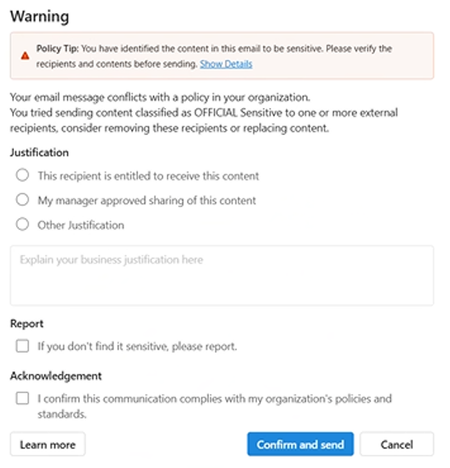
We are currently testing Microsoft Purview DLP policies for user awareness, where sensitive information shared externally triggers a policy tip, with override allowed (justification options enabled) and no blocking action configured. We are observing the following behaviours in Outlook Desktop: Inconsistent policy tip display (across Outlook Desktop Windows clients) – For some users, the policy tip renders correctly, while for others it appears with duplicated/stacked lines of text. This is occurring across users with similar configurations. Override without justification – Users are able to click “Send Anyway/Confirm and send” without selecting any justification option (e.g. business justification, manager approval, etc.), which bypasses the intended control. New Outlook: Classic Outlook: This has been observed on Outlook Desktop (Microsoft 365 Apps), including: Version 2602 (Build 19725.20170 Click-to-Run) Version 2602 (Build 16.0.19725.20126 MSO) Has anyone experienced similar behaviour with DLP policy tips or override enforcement in Outlook Desktop? Keen to understand if this is a known issue or if there are any recommended fixes or workarounds.641Views0likes3CommentsSharing: PDF readers that support Purview labels
As I was researching on Adobe Acrobat reader and Sensitivity labels, I decided to check if the common alternative PDF readers out there are able to support Purview MIP Sensitivity labels. There is already a published documentation on this for SharePoint-Compatible PDF readers that supports Microsoft IRM: https://learn.microsoft.com/en-us/purview/sp-compatible-pdf-readers-for-irm (last updated Nov-2023) but I wanted to see if these same PDF readers supports the ability for end-users to use/ select labels similar to that of Adobe Acrobat As of 11-June-2025; atleast one of them clearly do: Nitro PDF: Yes. Documentation shows that users can see and use the sensitivity labels. PDF -X.change Editor: Yes. Documentation show that users can see and use the sensitivity labels. (check the official website, I can't hyperlink it because the site is blocked. FOX PDF editor: No. Documentation only states RMS and not clear if it show Purview labels. This is for F.O.X.I.T editor (spelled without the ".") but for some reason there is a community ban on that word and it won't allow me to post the full name PDFescape: No. Sumatra PDF: No Okular: No If there are other PDF readers that I've missed, I encourage you list it down in the comment below. Would love to grow this list.1.6KViews5likes4Comments
Auto Labeling Policy Delay for Old Files (Exsisting Files)
Hi Everyone, We are observing a difference in auto labelling policy behaviour in Purview for Sharepoint. An auto labelling policy has been enabled and scoped to sharepoint with metadata based rule(document creation date or document modification date). The scoped sharepoint only contain 7 unlabeled files that were uploaded before the policy turned on. The policy is working because if i placed any new file after enabling the policy got labelled within about 5 minutes, but the exsisting files are not labeled and remains unlabelled. It seems the new files are evalauated via the near time while exsisting file rely on asychronous mode. Can anyone help explain why exsisting files take longer to be proceesed even when there there are only a few files or share if you faced similar behaviour. This is the test scenario, as we plan to enable the same policy across more than 50 plus sites containing millions of unlabeled files and we want to understand and predict that even though its takes time all exsisting unlabeled files will eventually will be labelled. This is very crucial, so please helo us understand this behaviour. Regards, BanuMuraliSolved475Views0likes3CommentsGuidance: Sensitivity Labels during Mergers & Acquisitions (separate tenants, non-M365, etc.)
We’re building an internal playbook for how to handle Microsoft Purview sensitivity labels during mergers and acquisitions, and I’d really appreciate any lessons learned or best practices. Specifically, I’m interested in how others have handled: Acquired organizations on a separate Microsoft 365/O365 tenant for an extended period (pre- and post-close): How did you handle “Internal Only” content when the two tenants couldn’t fully trust each other yet? Any tips to reduce friction for collaboration between tenants during the transition? Existing label structures, such as: We use labels like “All Internal Only” and labels with user-defined permissions — has anyone found good patterns for mapping or reconciling these with another company’s labels? What if the acquired company is already using sensitivity labels with a different taxonomy? How did you rationalize or migrate them? Acquisitions where the target does not use Microsoft 365 (for example, Google Workspace, on-prem, or other platforms): Any strategies for protecting imported content with labels during or after migration? Gotchas around legacy permissions versus label-based protections? General pitfalls or watch-outs between deal close and full migration: Anything you wish you had known before your first M&A with Purview labels in play? Policies or configurations you’d recommend setting (or avoiding) during the interim period? Any examples, war stories, or template approaches you’re willing to share would be incredibly helpful as we shape our playbook. Thanks in advance for any insights!326Views0likes1Comment
Auto-labelling does not support content marking
We’ve hit a limitation with service-side auto-labeling in Purview: when a sensitivity label is applied by an auto-labeling policy, any configured visual markings (headers, footers, watermarks) are not written into the document. A further complication is that there is a requirement which includes a custom script that applies sensitivity labels at the folder level and relies on the service-side engine to cascade those labels down to the folder's contents. This means automation isn't just a 'nice to have' for scale — it is a core dependency of our labeling architecture. The inability to also apply visual markings through this same automated path creates a direct gap in our compliance posture and the MS solution. For environments where visible classification is mandated by regulation, this effectively means we can’t rely on service-side auto-labeling alone, which is a big constraint. I’d really appreciate: Any confirmed best practices/workarounds others are using, and Input from the product team on whether server-side visual markings tied to auto-labeling are being considered / and what to consider meeting this requirement as an alternativeSolved362Views1like1Comment
Email to external(trusted user) not require verify user Identity(with Google or One-time passcode)
Dear Expert and Community, I am starting with MS Purview - Data Loss Prevention. I have one point to clarify and seek your advise / comment / contribute or sharing good practice regarding with below: - Firstly, we can send email to externally user contain sensitive information, it is encryption or blocked (result: worked as expected). If remail encrypt, the external receiver require verify the Identity via sign in with google acc / with a one time password. - Second: we plan sending email to external user (only trusted user / domain). Is it possible, do not require these scope user reverify their Identity again and again? If yes, how to do it? If not - why? Well appreciated for update and supporting. Thanks,313Views0likes3CommentsCan´t Sign confidential documents
Hello, I have a problem. I want to send confidential contracts to customers for signing with Adobe DocuSign. This contracts have a label "confidential" from purview and are encrypted. But now the customer cant sign the contract with DocuSign because of the encryption. Is there a way that they can sign the document? We must encrypt the documents because compliance reasons and ISMS. Thank you.415Views2likes5Comments
Lifecycle using Custom Protection with Purview Sensitivity Labels
Organizations using Purview Sensitivity Labels with custom protection face a fundamental governance challenge: there is no lifecycle‑ready way to maintain, audit, or update per‑document user rights as teams evolve. This affects compliance, need‑to‑know enforcement, and operational security. Document lifecycle challenges Team growth: new members do not inherit document‑specific rights. Team shrinkage: departing members retain access unless manually removed. Employee offboarding: accounts are disabled, but compliance may require explicit removal from protected documents. Audit requirements: organizations need to answer “Who has what rights on document X?” — and today, no native tool provides this for custom‑protected files. Existing method Limitation Purview PowerShell Overwrites all existing assignments; no granular updates MIP Client Not yet capable of bulk lifecycle operations OlaProeis/FileLabeler Great tool, but limited by the same PowerShell constraints What the tool enables Rights audit trail per document Controlled lifecycle updates (add/remove/transfer rights) Preservation of original files for rollback Multi‑action batch processing Admin‑only delegated workflow with MIP superuser role Full logging for compliance Supported operations ListRightAssignments – extract all rights from each document under a given label GUID SetOwner / AddOwner – assign or add owners AddEditor / AddRestrictedEditor / AddViewer – role‑based additions RemoveAccess – remove any user from all roles AddAccessAs – map one user’s role to one or more new users Multi‑action execution – combine operations in a single run Safe mode – original files preserved; updated copies created with a trailer Because this tool can modify access to highly sensitive content, it must be embedded in a controlled workflow: ticket‑based approval, delegated admin, MIP superuser assignment, and retention of all logs as part of the audit trail. This ensures compliance with need‑to‑know, separation of duties, and legal requirements. I would appreciate feedback from the community and Microsoft product teams on: whether similar lifecycle capabilities are planned for Purview whether the MIP SDK is the right long‑term approach how others handle custom‑protected document lifecycle today interest in collaborating on a more robust open‑source version Max242Views0likes1Comment