Recent Discussions

Teams HAL driver update skips coreaudiod restart mediaremoted spins at 100% CPU
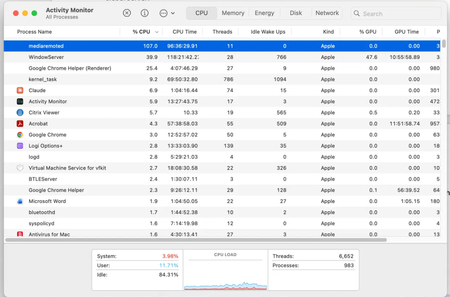
Environment: macOS 15.7.7 build 24G720, Apple M3 Max. Teams updated from 26183.1901.4874.5228 to 26198.202.4929.7171 via Microsoft AutoUpdate. What happens: The delta package installs the MSTeamsAudioDevice component into the system-wide CoreAudio HAL plug-ins folder. The system install log shows the bundle being atomically replaced, after which the postinstall script logs that it is a non-interactive command line installation and therefore will not restart coreaudiod, then exits. Because MAU always runs non-interactively, coreaudiod is never restarted and continues running against the replaced HAL bundle. Impact: Long-lived processes holding references to the Teams audio device never converge. In my case mediaremoted entered a permanent single-core spin at 107 percent CPU, sustained for days. A sample shows 100 percent of main-thread time inside AudioObjectGetPropertyData and AudioObjectGetPropertyDataSize, with the HALObjectMap CopyObjectByObjectID and ReleaseObject methods accounting for roughly 99 percent of top-of-stack samples. HALPlugIn ObjectHasProperty also emits an os_log call on every probe, so logd burns additional CPU. Teams itself was not running. Workaround: Force-quit the core audio daemon and then the media remote daemon; both relaunch automatically under launchd. Suggested fix: Restart coreaudiod from the postinstall regardless of interactivity whenever the HAL bundle payload actually changed, or defer the bundle swap until the next coreaudiod restart.35Views0likes1Comment
App Validation failing for no clear reason
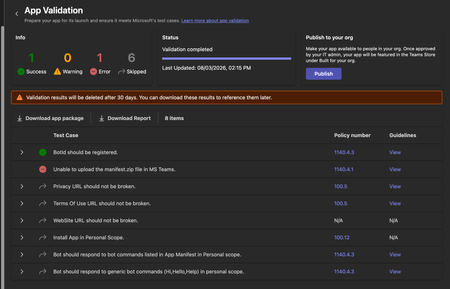
We're trying to get our (very simple) Teams App listed on the app store, but during the App Validation we keep getting the same error: "Unable to upload the manifest.zip file in MS Teams." as seen below: Downloading the report doesn't give any more information, it only lists the only successful validation step ("BotID should be registered") and the error doesn't appear there. I've validated the manifest.json file against the schema, tried reuploading the same manifest to a different org (creating a new app and bot) - validation fails there too. Does anyone have any pointers? Here is my (anonymized) manifest file: { "$schema": "https://developer.microsoft.com/en-us/json-schemas/teams/v1.19/MicrosoftTeams.schema.json", "manifestVersion": "1.19", "version": "1.1.1", "id": "[redacted]", "developer": { "name": "[redacted]", "websiteUrl": "https://www.[redacted].com", "privacyUrl": "[redacted]", "termsOfUseUrl": "[redacted]" }, "icons": { "color": "color.png", "outline": "outline.png" }, "name": { "short": "[redacted]", "full": "[redacted]" }, "description": { "short": "[redacted]", "full": "[redacted]" }, "accentColor": "#4A3AFF", "bots": [ { "botId": "[redacted]", "scopes": ["personal"], "supportsFiles": false, "isNotificationOnly": false, "commandLists": [ { "scopes": ["personal"], "commands": [ { "title": "help", "description": "Show what this bot does and how to connect your account" }, { "title": "connect", "description": "Get a fresh link to (re-)connect your account" } ] } ] } ], "staticTabs": [ { "entityId": "conversations", "scopes": ["personal"] }, { "entityId": "about", "scopes": ["personal"] } ], "permissions": ["identity", "messageTeamMembers"], "validDomains": ["app.[redacted].com", "auth.[redacted].com"] }38Views0likes1Comment
Running engagement pulse checks in Teams, how do you track trends over time?
My lead asked me to start doing monthly pulse checks across our team of 20. I've been using Forms and dropping the link in the channel. Response rate sits around 50% which I can live with, but the real problem is that every survey is its own isolated result set. I can see this month's numbers fine. Comparing them to three months ago means exporting everything to Excel and rebuilding the comparison by hand.39Views0likes1CommentTeams Premium + Bookings : Automatic recording and transcription for Bookings meetings ?
Hello, I have a Teams Premium license, recording and transcription policies are enabled on the admin side, and Video Recap works correctly when both are active simultaneously in the same meeting. My use case : my clients book time slots via Microsoft Bookings. Teams meetings are therefore created automatically by Bookings and I have no control over their scheduling. According to Microsoft Learn documentation (https://learn.microsoft.com/microsoftteams/virtual-appointment-meeting-template and https://learn.microsoft.com/microsoft-365/bookings/bookings-overview), there is no documented mechanism to automatically apply a Teams meeting template, and therefore automatic recording and transcription, to meetings generated by Bookings. My question: has anyone found a workaround for this limitation (Power Automate, Graph API, or anything else)? And does Microsoft have a documented roadmap on this topic? This gap directly prevents Teams Premium users from accessing Video Recap on their client meetings, which is one of the core use cases Teams Premium is designed for. Thank you for your help49Views0likes1Comment
Share content didn't appear or freeze during teams meeting.
Hi Everyone, I having an issue where when participant trying to share content during microsoft teams meeting, the content didn't show on the display and sometime the content is freeze. We join the meeting from Cisco Room Bar Pro on Cisco Room OS Platform. This issue also happen intermittently. Have reboot the device but it's still occurred. Anyone encounter this issue before? Thanks,47Views0likes2CommentsWho verifies Teams Meeting summary accurately reflects what was actually agreed in the meeting
Can we really trust AI-generated meeting summaries? Microsoft Teams and Copilot can create impressive meeting summaries, action items, and insights. But a question remains: Who verifies that the summary accurately reflects what was actually agreed in the meeting? In many organisations, meeting notes become the basis for: project decisions customer commitments compliance records accountability for actions Yet when there is disagreement, we often hear: "That is not what I said." "I don't remember agreeing to that." "The summary missed the context." How is your organisation handling this today? Do you: Trust AI-generated summaries as they are? Have a human review process? Keep the original transcript/audio as evidence? Use another approach? Interested to hear how Teams users are managing this challenge.57Views0likes3Comments
Create event sometimes returns 201 but no Teams meeting link
Hello, I am creating calendar events through Microsoft Graph and setting them as Teams online meetings. Most of the time it works correctly, but very rarely the API returns 201 Created and the event is created without the Teams join link in the response. I have already checked the following: isOnlineMeeting is always set to true. The correct online meeting provider is being used. The issue is intermittent, not consistent. The same integration normally creates Teams meetings successfully. What I need to understand is: Why can Graph return 201 Created but still omit the Teams meeting link? Is this a known intermittent issue with event creation or Teams meeting provisioning? Is there anything I should check in the response, headers, permissions, or follow-up GET call to verify the meeting link was actually created42Views0likes1Comment
TeamsTab.ReadWriteSelfForTeam: deleting a tab fails with 400 "appId cannot be null or whitespace"
We have a published Teams app that pins a configurable tab into a team channel via Microsoft Graph and removes it again when the user uninstalls our app from that channel. Creating the tab works. Deleting it always fails with a 400 that looks like an unhandled null-argument exception inside the Graph Teams service rather than a permission problem. I reported this in October 2025 as https://github.com/MicrosoftDocs/msteams-docs/issues/13432, but that is a documentation repository and the issue has had no response, so I am reposting here, as we can still reproduce the issue. We're using a delegated token for the operation. The only tab-related scopes are `TeamsTab.Read.All` (read-only) and `TeamsTab.ReadWriteSelfForTeam`. According to the docs (https://learn.microsoft.com/en-us/graph/api/channel-delete-tabs), `TeamsTab.ReadWriteSelfForTeam` is the **least privileged** delegated permission for the delete, so the token should be ok. What works Creating the tab, with the same delegated user token: POST https://graph.microsoft.com/v1.0/teams/«teamId»/channels/«channelId»/tabs Content-Type: application/json { "displayName": "«AppName»", "email address removed for privacy reasons": "https://graph.microsoft.com/v1.0/appCatalogs/teamsApps/«teamsAppId»", "configuration": { "entityId": "«entityId»", "contentUrl": "https://«ourhost»/teams/tabs/channel/«entityId»", "websiteUrl": "https://«ourhost»/app/tickets?channel=«entityId»", "removeUrl": "https://«ourhost»/teams/remove-tab/«entityId»" } } → `201 Created`. The tab appears in the channel and renders correctly. Listing the tabs afterwards also works and returns our tab together with its `id`: GET https://graph.microsoft.com/v1.0/teams/«teamId»/channels/«channelId»/tabs?$expand=teamsApp Works as well and lists our tab. Might be served by the TeamsTab.Read.All permission. What fails DELETE https://graph.microsoft.com/v1.0/teams/«teamId»/channels/«channelId»/tabs/«tabId» → `400 Bad Request` { "error":{ "code":"BadRequest", "message":"appId cannot be null or whitespace. (Parameter 'appId')", "innerError":{ "date":"2026-07-27T13:45:31", "request-id":"f930c847-0b48-4a46-b17e-f0ee10ff8177", "client-request-id":"f930c847-0b48-4a46-b17e-f0ee10ff8177" } } } (leaving in the error details, maybe that helps diagnosing the issue) appID is not even part of the request, it's probably resolved against the TeamsTab.ReadWriteSelfForTeam permission on your side. Let me know if you need any more details.57Views0likes2CommentsFeature request: Historical Agent Activity Timeline for Microsoft Teams Queues
Hi everyone, We're currently using the new Microsoft Teams Queues app for our IT Service Desk and are very pleased with the improvements Microsoft has introduced. One capability we feel is still missing is a historical Agent Activity Timeline. Today supervisors can only see an agent's current Opt-in/Opt-out status. There is no historical overview showing: When an agent opted in When an agent opted out Which agents were opted in at a specific moment Whether the change was made by the agent, a supervisor or automatically This makes it difficult to investigate: Missed calls Queue performance SLA deviations Staffing questions Incident investigations A simple historical timeline containing the timestamp, queue, agent and source of the status change would already provide tremendous value for supervisors and service desk managers. We've submitted this as a feature request through the Microsoft Feedback Portal: https://feedbackportal.microsoft.com/feedback/idea/2df346ee-bc89-f111-9b47-7c1e52444ef6 If you experience the same limitation, we'd really appreciate your vote. I'm also interested in hearing how other organisations deal with this today. Are you using manual checks, screenshots or another workaround? Thank you! Romain Weimer Head of ICT Operations and Support Witteveen+Bos51Views1like1CommentIs Microsoft Teams a good Intranet?
Our company is fully on Microsoft 365, but employees still struggle to find basic information like policies, company updates, forms, department resources, and important links. Most of it is scattered across SharePoint sites, Teams channels, emails, and random folders. I want to turn Microsoft Teams into that hub where all of this lives, kind of like an intranet. Any suggestions?79Views0likes1CommentIs Microsoft Teams a good Intranet?
Our company is fully on Microsoft 365, but employees still struggle to find basic information like policies, company updates, forms, department resources, and important links. Most of it is scattered across SharePoint sites, Teams channels, emails, and random folders. I want to turn Microsoft Teams into that hub where all of this lives, kind of like an intranet. Any suggestions?54Views0likes2Comments
Auto Attendant & Call Queue Call forwarding to external numbers failing.
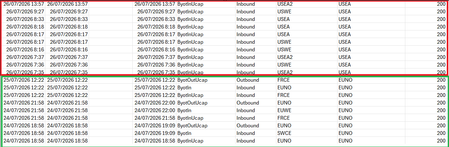
Hi all, Since this weekend users accross our org. have been noticing that AA/CQ that forward Calls to external numbers FAIL. This was not the case last week. Flow example : User dials number of AA, this AA has a menu which has Internal and external numbers. Internal numbers -> no problem. Externa numbers -> message (new never heard this): "Please Hold while we forward your call, .... Sorry we could not forward your call at this time, try again later". On user level we are not experiencing this issue when I redirect my calls from work number to external number there is no issue. What is very strange in this entire scenario is that we are EU bases, the resource accounts "Usage location" is on the proper country in EU. But in the Microsoft PSTN USAGE logs we see that the "Azure region for Media" is USSC, USEA, USWE, JPWE, JPEA, MAWE, KRCE where it should be EUWE, FRCE and EUNO ... But No Fail Codes, just Bye ... The dates hold up with the issue... before 26/07 everything passed over EU Region. After 26/07 everything passes over US, KR, MA, JP ... Anyone else having this issue ? Related to the new AI routing implementation gone bad ?65Views0likes1CommentTeams PowerShell Embraces Web Account Manager and Imposes Control Over Federated Chat
Teams released a new version of their PowerShell module on July 19. The new module contains WAM support and cmdlets to limit federated chat for specific users and tenants. The new controls are welcome, but it’s a sad state of affairs that to configure the settings you must install a new version of a module that doesn’t work so well alongside other Microsoft 365 modules. https://office365itpros.com/2026/07/24/federated-chat-controls/21Views0likes0CommentsCS agent OK in M365 Copilot; Teams chat silent / no Studio session
We are troubleshooting a Copilot Studio agent that works correctly in Microsoft 365 Copilot and in the Copilot Studio test surface, but does not receive inbound activities from Microsoft Teams personal chat. Environment and evidence: - Agent: Copilot Studio agent (custom business assistant) - Copilot Studio agent ID: 88901b10-… (truncated) - Teams/Entra app ID: 7e4a53cc-… (truncated) - Manifest version: 1.0.8 - Channel configuration: Microsoft 365 Copilot + Microsoft Teams - Publish: Succeeded / Channel state: Synchronized - Agent Registry: Available - Authentication: Integrated / Tool credentials: Maker-provided - MCP/custom connector runtime: working (Studio tool test HTTP 200) - Microsoft 365 Copilot routing: working Failure specific to Teams: - Messages in Teams web and desktop appear delivered in the agent personal chat - Agent never replies - Studio monitor has M365 Copilot sessions, but no Teams session for those timestamps - Teams Admin Center Manage apps returns 0 results by name or exact app ID despite Agent Registry Available - Intentionally not republishing / reconnecting OAuth / rewiring connectors because M365 Copilot path proves the same agent+connection works Classification: FAIL — Teams inbound activity is not reaching the Copilot Studio agent. Questions focused on Teams delivery: 1. Why would Teams personal 1:1 messages never create a Studio conversation while M365 Copilot does? 2. Is a missing TAC Manage apps row expected under Unified App Management when Registry shows Available? 3. Known gaps: Agent Registry Available + channel Synchronized, but Teams client chat bound to a non-runtime endpoint? 4. Best diagnostic if Monitor shows 0 Teams sessions after a confirmed client send? Looking for production experience / documented workaround. Redacted evidence available; no tokens/secrets.92Views0likes2CommentsNo function to clear my own chat history like others
Hi, There are "Remove chat history" functionality for others. But There is no way of one shot clear all history of my Own chat history. This should be added to new feature. We can not delete one by one of each notes of our own chat dialog.40Views0likes1Comment
MC1317197 Microsoft Teams: simpler controls and a smarter share panel
Has anybody seen the end user visual guide supposedly to be published on July 9th, 2026, to the Microsoft Adoption site? Either they have not published the visual guide yet or I cannot find the guide on the site. We need to notify users this is coming, and it would be great to have the visual guide to use for the communications / messaging. https://adoption.microsoft.com/microsoft-teams/new-meeting-controls-experience https://admin.cloud.microsoft/?ref=MessageCenter/:/messages/MC1317197 Thank you Sharyn108Views1like3Comments
Bug? Teams thread permalink does not show the full thread history (Desktop + Web)
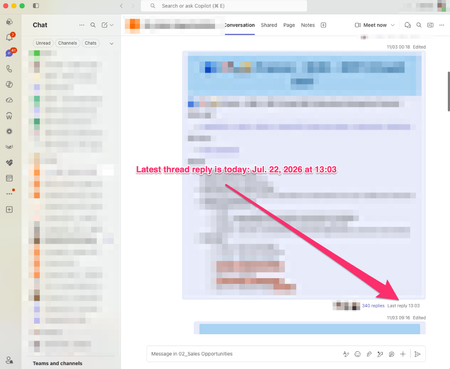
Hi everyone, I believe I've found a bug in the new Teams threaded channel experience and I'm trying to determine whether others can reproduce it. Scenario I have a long-running thread in a Teams channel. If I open the thread directly from the channel by clicking the reply count (e.g."340 replies"), I can see the complete conversation, including the most recent replies. However, if I: Open the thread Use Copy link Open the generated link Teams opens the thread, but only displays part of the conversation. Newer replies are missing even though they exist and are visible when opening the same thread directly from the channel. Note: I cannot share the permalink publicly because it points to content within my organisation. However, the link was generated by Teams itself using the thread's Copy link action. The issue is reproducible with any user who has access to the thread. What I've tested Teams Desktop Teams Web Same behaviour in both clients Opening via the channel reply count shows all recent replies Opening via the permalink shows only a partial thread Expected behaviour A thread permalink generated by Teams should open the same live thread view as clicking the reply count from within the channel. The full conversation history should be available and the latest replies should be visible. Ideally: The full thread history should be available. The latest replies should be visible. The link should open the current state of the thread, not an apparently truncated version. Actual behaviour The permalink opens the correct thread but appears to stop at an older point in the conversation, while newer replies remain accessible only when opening the thread from the channel itself. Has anybody else seen this behaviour with threaded channels? Screenshot 1 and 2: Correct behaviour Open thread via "340 replies" Show: Thread title Reply count (e.g. 340 replies) One or two recent messages (July 2026) Screenshot 3: Incorrect behaviour Open the same thread via the permalink Show: Same thread title Same thread Conversation stopping much earlier Missing recent replies101Views1like3CommentsTEAMS - Extra Space between Keyboard and Typing Window
Dear All, I am also facing the issue in TEAMS. During the typing, a large space appears between Keyboard and Typing Window. This is happening only in TEAMS app. I moved from my Nothing phone to Vivo X200Fe, then this problem started. This may be a bug in TEAMS to be fixed for VIVO phones. I use VIVO X200 FE with Android 16 and Google Keyboard. It's very annoying to see this big gap and making us uncomfortable while typing. Please help me how to resolve this. Thanks for your help. Mobile : Vivo X200FE Operating System : Origin OS Android 16 Teams Version : 1416 / 1.0.0.2026123608 Keyboard : Google Keyboard - Version 17.7.4.93236420174Views1like4CommentsBuilding an employee recognition program that actually lives in Teams?
HR asked me to set up some kind of peer recognition system where people can give kudos to each other. They want it inside Teams because thats where everyone already is. I spent a few hours looking at options, Power Automate flows with adaptive cards, custom bots, etc. but nothing feels clean or sustainable. Has anyone set up a recognition/kudos system thats actually integrated into Teams and not just a bot that posts to a channel?78Views1like3CommentsHow to Schedule Teams Meetings from Shared Mailboxes
It is possible to schedule Teams meetings from shared mailboxes without incurring the need to license the shared mailboxes. However, Microsoft’s recent clampdown on unlicensed OneDrive for Business accounts creates a problem because Teams meeting recordings are stored in the OneDrive account for the organizer (shared mailbox). And if that account remains unlicensed for 365 days, it will be removed along with all the recordings. https://office365itpros.com/2026/07/16/schedule-teams-meeting-shared-mbx/41Views0likes0Comments



Events
Recent Blogs
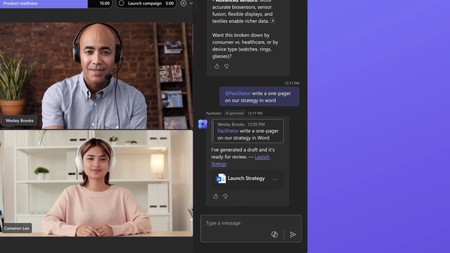
- Most people don't need more meetings—they need meetings that lead to action. At their best, meetings drive decisions and keep work moving forward. But poorly managed meetings can actually slow progre...Aug 11, 202632Views0likes0Comments
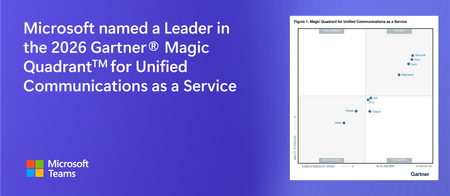
- 8 MIN READMicrosoft has been recognized as a Leader in the 2026 Gartner® Magic Quadrant™ for Unified Communications as a Service—our eighth consecutive year with this recognition. We’re also excited to sha...Aug 06, 2026657Views0likes0Comments