Recent Discussions
Accounts.microsoft.com works but the privacy tab with the lock icon has been broken for weeks!!
I’m able to browse to account.microsoft.com/?ref=MeControl&refd=outlook.live.com (account.microsoft.com in Bing), but clicking the lock icon to open the Privacy tab causes an endless flashing/refresh loop. The page repeatedly attempts to load multiple token redirects and never completes. I’ve reproduced this on multiple devices and browsers: Edge Firefox Chrome Bing App on iPhone All other Microsoft Account sections load normally. Only the Privacy Dashboard fails, and it has been broken for several weeks. This appears to be a server-side redirect/token validation failure in MeControl, not a client issue. Since this prevents access to required privacy controls, can this be escalated to the Microsoft Account/Identity team? Is this a known Microsoft-side issue?41Views0likes2CommentsTask Manager show high CPU usage on my PC
My PC's Task Manager consistently shows high CPU usage, often peaking at 90-100% even when only a few programs are running, causing noticeable system slowdowns and lag. I have checked for background processes and malware, but the high usage persists, and I am looking for advice on diagnosing the root cause and fixing it.20Views0likes1CommentWindows asks for administrator permission often
Windows frequently prompts me for administrator permission when I try to open programs, move files, or change system settings, even though I am logged in as the only user account on this computer. I would like to understand why these User Account Control pop-ups appear so often and how I can reduce them without compromising security or disabling UAC entirely.57Views0likes1CommentWhy does my printer work on my phone but not Windows?
My printer connects and prints fine from my Android and iPhone devices, but it is not recognized or fails to print when I try to use it from my Windows computer. I have already checked that both devices are on the same Wi-Fi network, but the issue persists, and I need guidance on Windows-specific driver or network configuration settings to resolve this.28Views0likes1CommentWhy does my mouse stop working randomly?
My mouse randomly freezes or stops responding for a few seconds, even when the rest of my system continues running smoothly. This happens across different USB ports and even with a different mouse, so I suspect it is a driver, power management, or system-level conflict rather than a hardware failure. The problem occurs several times per day and requires unplugging and replugging the mouse to get it working again temporarily.56Views0likes2CommentsWindows stuck on update loading screen
Hi! So my pc has started to try and update to the latest windows update as of a couple of days ago (on it's own, I didn't tell it to do this, I don't know if that's relevant or not). And now whenever I try and turn on my pc it goes straight to the "loading update" screen with a little loading symbol and no percentage bar. It just seems to be stuck on that screen and I can't get to my desktop. The longest I've left it for was a couple of hours with zero change to the screen. I've tried restarting the pc, it just goes straight to that screen every time I try. I've also tried going into bios before that screen has a chance to appear, and everything seems fine. I'm not sure what to do. Any suggestions? Thanks!28Views0likes1CommentUpgrade 10 > 11 question- low disk space?
I've been having trouble upgrading from Windows 10 to Windows 11. I finally passed the Windows 11 PC health check, then tried using the Windows 11 Installation Assistant to upgrade to Windows 11. It seems to get to the point where it's downloading the updates, then fails and gives me a warning about calculating disk space. This seems odd as I have 91 Gigs available on the C: partition. The drive is 1 TB, do I need to re-partition the drive to make more space for Windows 11?40Views0likes2CommentsCan't Get Phone Link to Work
everybody. I just got a new phone and have been trying to get Phone Link to work. Yesterday it said to try again tomorrow, and today it's doing the same thing. It will ask me to put a number in Authenticator when I'm already in it, and there's no place to put a number. It has asked me to go to three of my email apps, to give me a code and when I try to put it in it says something like "Try again later, or if not try tomorrow" It asks me to login with a passkey when I don't have or know my passkey. It will ask me to login using my Microsoft Account and when I enter ****@hotmail.com or ****@live.com and put in my password which I know is correct because I keep it in my password manager and it always works, it will say wrong password. I'm at my wit's end. I have never had a problem with any of my previous phones. When I chatted with MS support they told me to delete phone link "link to Windows" from my phone and reinstall it, but I don't see any way to uninstall it. Today it's telling me to scan a QR code on my PC and the QR code never shows up, even if I go to the site it tells me go to if I can't see it. I'm older and have disabilities. My eyesight is poor and I have problems typing on my phone. I like to use the full size keyboard on my PC.31Views0likes2CommentsSound disappears after Windows updates
After installing recent Windows updates, my system audio completely stops working even though the volume mixer shows sound is playing. I have already tried restarting the audio service and updating drivers, but nothing restores the sound until I uninstall the latest updates. This problem has occurred after multiple update cycles now.22Views0likes0CommentsHas Microsoft Forgotten What Windows Is?
Foreword I am just an amateur computer enthusiast and hardware nerd from Asia. Recently, though, I have found myself thinking much more deeply about a question that seems to have drifted very far away from the state of things and the ideas Microsoft once represented. Only recently have I started spending much more time on Western technology forums, such as Level1Techs and LTT. I do not post or debate very often, but I tend to observe first, think things through, and only put something into writing when I feel there is a question worth asking or a point worth making. I should also make one thing clear at the beginning: I used AI to help translate and proofread this article, because my English is not good enough for me to write a complete article like this naturally. The ideas, arguments, and questions here are my own. I am not using AI as an excuse to generate random criticism or to attack Microsoft. I keep coming back to one very simple, but perhaps uncomfortable, question: Has Microsoft accepted that Windows today is, in effect, mature global infrastructure? Windows is no longer the young platform of thirty or forty years ago, when it needed to prove every few years what a personal computer could become. Today, countless businesses, governments, schools, factories, developers, OEMs, hardware vendors, and ordinary users depend on Windows. Behind it sit decades of Win32 software, drivers, enterprise management tools, games, professional applications, and very old internal systems. So the question I actually want to ask is not: Should Windows continue to innovate? Of course it should. New CPUs, new GPUs, new security threats, new display technologies, new storage devices, new programming languages, and new computing architectures all require an operating system to keep evolving. But “continuing to evolve underneath” and “Windows must constantly redefine the user experience” are not the same thing. What I really want to know is this: When innovation conflicts with stability, predictability, backward compatibility, and administrative control, which one does Microsoft believe should take priority? This is not a word game. Every major change in Windows product direction affects far more than Microsoft itself. OEMs have to revalidate firmware and drivers. Hardware vendors have to reconfirm compatibility. Enterprise IT teams have to retest deployment policies and internal software. Software companies have to run QA again. Game developers have to verify that the OS, drivers, anti-cheat systems, display stack, and various middleware layers still behave correctly together. All of these are real engineering costs. And the more influential Windows becomes, the greater the external cost of every change Microsoft makes. So I have started to wonder: Is Microsoft still managing a mature infrastructure platform with the mindset of a growth-stage product? For mature infrastructure, “nothing dramatic happened” should itself be considered a success. A year later: The system is a little more secure. Memory management is a little better. The scheduler is more mature. The file system has had some problems fixed. The driver model is more reliable. Old software still runs properly. Enterprise deployments did not suddenly become much more difficult because of one update. Ordinary users barely noticed that the operating system changed at all. I do not consider that “a lack of innovation.” In fact, that may be one of the highest forms of engineering success for a mature operating system. But recent versions of Windows can easily give a very different impression: Windows still seems to feel the need to prove that it is constantly entering “the next era.” A new interface. A new way to search. Deeper cloud integration. AI PCs. Copilot. Agents. ARM. New modes of interaction. There is nothing inherently wrong with any of these technologies. The question is: Why must every new Microsoft dream be introduced directly into Windows, a mature piece of infrastructure? Microsoft is no longer a company with only Windows as a path for growth. Microsoft also has Azure, Microsoft 365, GitHub, Xbox, Visual Studio, .NET, SQL Server, Entra, Intune, and many other enterprise and developer platforms. Even if Windows stopped trying to “redefine personal computing” every few years, Microsoft would not lose its reason to exist. So I am curious about another possibility. Suppose Microsoft truly defined Windows as a mature infrastructure platform: Long-term stability. Compatibility first. Clear update rules. Clear licensing. A clear separation between security fixes and feature changes. System administrators know what will change and what will not. OEMs know how long a platform can be maintained reliably. Developers know their software does not have to keep chasing new Windows behaviour. And if Microsoft genuinely wants to explore AI-first, ARM-first, agent-first computing, a completely new UI, a new application model, or even an entirely different philosophy of personal computing— Why not create a separate product line? Let that platform experiment freely. Do not require it to carry thirty or forty years of Windows compatibility. And do not require existing Windows users to become part of the experiment. If the new platform is genuinely good, new users, new developers, new software, and new communities will naturally grow around it. If it fails, then at least the result will be clear: The problem was with the new platform itself, not because “old Windows users refused to change.” I do not hold Microsoft to a different standard from anyone else. Google, Apple, IBM, Linux distributions, the various Unix systems, NEC, Toshiba, or any other long-established platform would face the same question from me: Before changing a mature system, do you still understand the core value that made that system worth keeping and worth depending on in the first place? There is nothing wrong with innovation. There is nothing wrong with redesign. There is nothing wrong even with reinventing an entire product. But before a mature platform changes, perhaps it first needs to understand: Which things should not be changed lightly. So in the end, I have only two questions for Microsoft: What does Microsoft believe Windows actually is today? And: If “the next Windows experience” conflicts with the stability of Windows as mature global infrastructure, which side will Microsoft choose? I do not believe Windows has to stop moving forward. I only wonder: Perhaps what Windows most needs to learn now is not how to change the world again, but how to reliably carry a world that already depends on it. P.S. I sometimes think back to the personal computer market of the 1980s and early 1990s. Platforms such as the Commodore 64, IBM PC, Commodore Amiga, Atari ST, and ZX Spectrum had very clearly defined market positions, hardware designs, technical directions, and user bases. They did not all need to be forced into the same product philosophy. Each platform had its own direction, and users with different needs naturally gravitated toward different systems. Of course, today’s market is completely different, and I am not arguing that we should return to that era. But if Windows has accumulated decades of compatibility requirements, technical debt, and historical baggage to the point where Microsoft can no longer push aggressively in new directions without disrupting existing users and the wider ecosystem, then I have to ask: Why not simply separate the resources and product lines more clearly? Keep one Windows line focused on long-term stability, backward compatibility, and enterprise maintenance, while creating a separate and more flexible product line to explore new UI concepts, AI, ARM, agents, entirely new application models, or even different philosophies of computing. It could be a different edition, a different product, or even a separate business unit or subsidiary. If the new direction genuinely has value, then let it build its own market, developer community, and user base, rather than asking the entire existing Windows ecosystem to bear the cost of that transition. If a mature platform can no longer carry both decades of compatibility obligations and aggressive experimentation at the same time, then separating those two responsibilities may be more reasonable than continually asking the same Windows platform to play both roles at once.33Views0likes1CommentBorder around right-click context menu – is this new or just a bug?
Switched back to the old context menu recently using Chris Titus's Windows util. Don't remember seeing a border around it before—is this a native Windows 11 thing now? Looks nice either way. Edit: It disappears after a restart. Seems to happen when I boot with both TV and monitor connected—output defaults to the TV, and when I switch to the monitor, the border shows up. Probably a scaling-related visual bug, though I have no clue how that affects the context menu. Somehow it does. Also noticed shortcut icons aren't showing the usual arrow indicator—everything in the screenshot except This PC, Recycle Bin, and folders is a shortcut. And some Windows-related icons in the context menu look glitched too.85Views0likes3CommentsPoint-in-Time restore saved my sanity
Was messing with Windhawk and broke my taskbar icons. Figured System Restore would fix it—except it didn't. Ended up in a GSOD loop that kept dumping me into WinRE. Tried everything, nothing worked. Had Point-in-Time restore enabled but never used it. Gave it a shot anyway. Took forever and got stuck at 21% for a while—thought I was done for. But it eventually finished and booted Windows back up perfectly, exactly as it was two days ago. System Restore failed. Point-in-Time saved it.55Views0likes2CommentsWhy does my computer turn on but show a black screen?
My computer powers on with all fans and lights running, but the monitor stays completely black with no boot screen or BIOS display. I have already checked cables and tried a different monitor, but the problem persists and I cannot access Windows at all. The system appears to be running but shows no video output from startup.16Views0likes0CommentsWSL2 makes Windows feel subtly slower and it's driving me crazy
Been running WSL2 daily for a while now, and I'm pretty convinced it quietly degrades the overall Windows experience. Nothing dramatic, nothing in Task Manager—just a bunch of small "huh, that's weird" moments that add up. Setup: Windows 11 (latest stable), Ubuntu on WSL2, mirrored networking, decent hardware. Not a potato. Stuff I keep noticing: Wi-Fi list takes a second to populate. Instant when WSL is off. Scrolling feels stuttery in random apps—Explorer, browsers, Settings. Cursor drops frames occasionally. Not lag, just feels like frames are missing. Sleep/wake is flaky—sometimes fine, sometimes forever, sometimes hard reset. Touchpad acts up—gestures stop registering, occasional freezes, even a couple crashes I never had before. Any single symptom you can shrug off as "eh, Windows being Windows." But shut WSL down and the machine feels noticeably snappier. Turn it back on, and within a day the hitches are back. Not saying WSL2 is bad—it's incredibly useful. Just tired of the "zero overhead" narrative. There's a cost, it's just paid in small annoying increments instead of one obvious slowdown. Curious if others have noticed the same.23Views0likes1CommentCan I upgrade Windows 11 Home to Pro without product key?
I want to use the BitLocker encryption but this feature is not available in Windows 11 Home. Is there any way to let me upgrade Windows 11 Home to Windows 11 Pro without a product key? The Windows 11 Pro license key ($99) is so expensive and I can't afford it now. Thanks47Views0likes8CommentsFile History has stopped functioning
My file history program has stopped functioning. I tried searching the internet for some of these error messages and I have not found anything that has a solution that works. I tried deleting the backup on my backup drive, and also deleting the file history data/configuration folders so it would "start fresh" and I still keep getting errors. Here are some of the errors: Also have gotten a bunch of different errors for "reparse points". This is one example. I tried to exclude some of these folders from the backup but it didn't seem to help. But how do I find and eliminate a "reparse point" so it doesn't cause the file history to fail? And why doesn't file history just ignore those folders and go on and back up everything else?1.8KViews4likes23CommentsWindows11 Voice typing does not work in text fields of certain UWP apps
Pressing the Windows + H key combination to activate voice input works as expected in Notepad, browsers, and most Win32 applications, but when used in certain UWP applications, it fails to recognize any voice input. Although the microphone icon appears, the application does not respond to voice input. Even if the microphone is properly configured and works elsewhere, restarting the voice runtime service or the application does not resolve this issue.12Views0likes0CommentsWin11 Find my device settings page fails to open with a blank screen
When I go to Settings → Privacy & Security → Find My Device, the page appears blank. The page fails to load any options or status information related to device location features. Closing and reopening Settings does not resolve the issue, and the problem persists even after restarting the computer. This issue occurs on my version of Windows 11 and prevents me from managing the location settings for lost or stolen devices.9Views0likes0Comments
Events
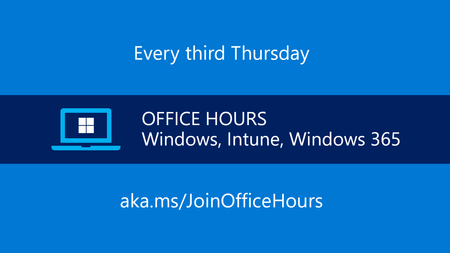
Have a question about Windows 11, device management, security, updates, or modern endpoint operations? This hour is dedicated entirely to your questions. Bring what's top of mind—from Windows 11 adop...
Thursday, Sep 17, 2026, 08:00 AM PDTOnline
0likes
19Attendees
0Comments
Recent Blogs
- Process Monitor v4.1 This update to Process Monitor, a utility for observing real-time file system, Registry, and process or thread activity, adds the IPC event class for named pipes and mailslot...Aug 19, 20261.3KViews0likes3Comments
- Discover real-time NPU and GPU neural engine tracking in Windows Task Manager on newer devices.Aug 19, 20262.2KViews3likes1Comment