Forum Widgets
Latest Discussions

Is Microsoft Teams a good Intranet?
Our company is fully on Microsoft 365, but employees still struggle to find basic information like policies, company updates, forms, department resources, and important links. Most of it is scattered across SharePoint sites, Teams channels, emails, and random folders. I want to turn Microsoft Teams into that hub where all of this lives, kind of like an intranet. Any suggestions?CandyMullanyJul 28, 2026Brass Contributor15Views0likes1Comment
Bug? Teams thread permalink does not show the full thread history (Desktop + Web)
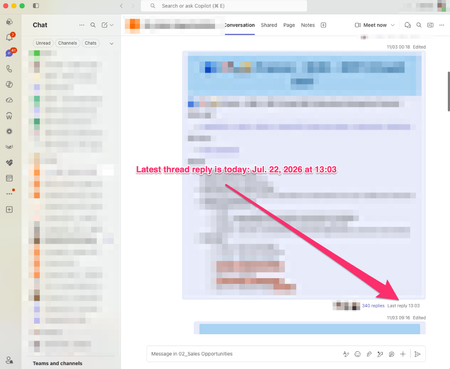
Hi everyone, I believe I've found a bug in the new Teams threaded channel experience and I'm trying to determine whether others can reproduce it. Scenario I have a long-running thread in a Teams channel. If I open the thread directly from the channel by clicking the reply count (e.g."340 replies"), I can see the complete conversation, including the most recent replies. However, if I: Open the thread Use Copy link Open the generated link Teams opens the thread, but only displays part of the conversation. Newer replies are missing even though they exist and are visible when opening the same thread directly from the channel. Note: I cannot share the permalink publicly because it points to content within my organisation. However, the link was generated by Teams itself using the thread's Copy link action. The issue is reproducible with any user who has access to the thread. What I've tested Teams Desktop Teams Web Same behaviour in both clients Opening via the channel reply count shows all recent replies Opening via the permalink shows only a partial thread Expected behaviour A thread permalink generated by Teams should open the same live thread view as clicking the reply count from within the channel. The full conversation history should be available and the latest replies should be visible. Ideally: The full thread history should be available. The latest replies should be visible. The link should open the current state of the thread, not an apparently truncated version. Actual behaviour The permalink opens the correct thread but appears to stop at an older point in the conversation, while newer replies remain accessible only when opening the thread from the channel itself. Has anybody else seen this behaviour with threaded channels? Screenshot 1 and 2: Correct behaviour Open thread via "340 replies" Show: Thread title Reply count (e.g. 340 replies) One or two recent messages (July 2026) Screenshot 3: Incorrect behaviour Open the same thread via the permalink Show: Same thread title Same thread Conversation stopping much earlier Missing recent repliesvalentindJul 28, 2026Copper Contributor60Views1like2Comments
Feature request: Historical Agent Activity Timeline for Microsoft Teams Queues
Hi everyone, We're currently using the new Microsoft Teams Queues app for our IT Service Desk and are very pleased with the improvements Microsoft has introduced. One capability we feel is still missing is a historical Agent Activity Timeline. Today supervisors can only see an agent's current Opt-in/Opt-out status. There is no historical overview showing: When an agent opted in When an agent opted out Which agents were opted in at a specific moment Whether the change was made by the agent, a supervisor or automatically This makes it difficult to investigate: Missed calls Queue performance SLA deviations Staffing questions Incident investigations A simple historical timeline containing the timestamp, queue, agent and source of the status change would already provide tremendous value for supervisors and service desk managers. We've submitted this as a feature request through the Microsoft Feedback Portal: https://feedbackportal.microsoft.com/feedback/idea/2df346ee-bc89-f111-9b47-7c1e52444ef6 If you experience the same limitation, we'd really appreciate your vote. I'm also interested in hearing how other organisations deal with this today. Are you using manual checks, screenshots or another workaround? Thank you! Romain Weimer Head of ICT Operations and Support Witteveen+Bos24Views1like1Comment
Auto Attendant & Call Queue Call forwarding to external numbers failing.
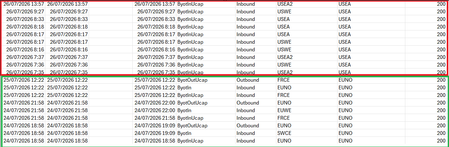
Hi all, Since this weekend users accross our org. have been noticing that AA/CQ that forward Calls to external numbers FAIL. This was not the case last week. Flow example : User dials number of AA, this AA has a menu which has Internal and external numbers. Internal numbers -> no problem. Externa numbers -> message (new never heard this): "Please Hold while we forward your call, .... Sorry we could not forward your call at this time, try again later". On user level we are not experiencing this issue when I redirect my calls from work number to external number there is no issue. What is very strange in this entire scenario is that we are EU bases, the resource accounts "Usage location" is on the proper country in EU. But in the Microsoft PSTN USAGE logs we see that the "Azure region for Media" is USSC, USEA, USWE, JPWE, JPEA, MAWE, KRCE where it should be EUWE, FRCE and EUNO ... But No Fail Codes, just Bye ... The dates hold up with the issue... before 26/07 everything passed over EU Region. After 26/07 everything passes over US, KR, MA, JP ... Anyone else having this issue ? Related to the new AI routing implementation gone bad ?BM001Jul 27, 2026Copper Contributor35Views0likes1CommentIs Microsoft Teams a good Intranet?
Our company is fully on Microsoft 365, but employees still struggle to find basic information like policies, company updates, forms, department resources, and important links. Most of it is scattered across SharePoint sites, Teams channels, emails, and random folders. I want to turn Microsoft Teams into that hub where all of this lives, kind of like an intranet. Any suggestions?CandyMullanyJul 27, 2026Brass Contributor16Views0likes0CommentsBuilding an employee recognition program that actually lives in Teams?
HR asked me to set up some kind of peer recognition system where people can give kudos to each other. They want it inside Teams because thats where everyone already is. I spent a few hours looking at options, Power Automate flows with adaptive cards, custom bots, etc. but nothing feels clean or sustainable. Has anyone set up a recognition/kudos system thats actually integrated into Teams and not just a bot that posts to a channel?JordanT86Jul 27, 2026Brass Contributor64Views1like3Comments
MC1317197 Microsoft Teams: simpler controls and a smarter share panel
Has anybody seen the end user visual guide supposedly to be published on July 9th, 2026, to the Microsoft Adoption site? Either they have not published the visual guide yet or I cannot find the guide on the site. We need to notify users this is coming, and it would be great to have the visual guide to use for the communications / messaging. https://adoption.microsoft.com/microsoft-teams/new-meeting-controls-experience https://admin.cloud.microsoft/?ref=MessageCenter/:/messages/MC1317197 Thank you SharynSharyn_MayneJul 25, 2026Iron Contributor45Views0likes1CommentAndroid phone stuck in login loop for account with previous organisation
Hi. I've recently joined a new organisation and want to have Teams active on my phone as I did with a previous organisation. Unfortunately, my app is stuck in a login loop, I can't log in to log out (my account has been deactivated) and I can't find any place to remove any further user accounts in the system. Basically, I can't use Teams on my phone until I can find away to fix this. Any suggestions?Badwolf77Jul 24, 2026Tin Contributor93KViews4likes18Comments
No function to clear my own chat history like others
Hi, There are "Remove chat history" functionality for others. But There is no way of one shot clear all history of my Own chat history. This should be added to new feature. We can not delete one by one of each notes of our own chat dialog.ykburdaJul 24, 2026Copper Contributor28Views0likes1Comment

Tags
- microsoft teams13,540 Topics
- how-to2,947 Topics
- Administrator2,668 Topics
- meetings2,572 Topics
- Settings2,311 Topics
- User Interface1,662 Topics
- tips & tricks1,514 Topics
- calling1,261 Topics
- teams1,040 Topics
- best practices1,003 Topics