calling
1263 Topics
Multi Teams enviroment drops current call when receiving a call on other Teams profile
Hi all, I'm running multiple Teams accounts on Windows. This is all working fine, untill I receive some calls, while I'm on a call already, from another account. This abruptly cancels the current call!! How is that possible? So, while on a call with PROFILE-A, I do get another call from PROFILE-B, the call in PROFILE-A gots ended, while the PROFILE-B call get to ring. Any idea how I could prevent this? I dont want to go over all the profile to set to DND mode, which would make it really hard for me to manage during all the day. Thanks!1.4KViews0likes4Comments
Microsoft Teams Calling blocked "We couldn't complete the call. Please contact your admin"
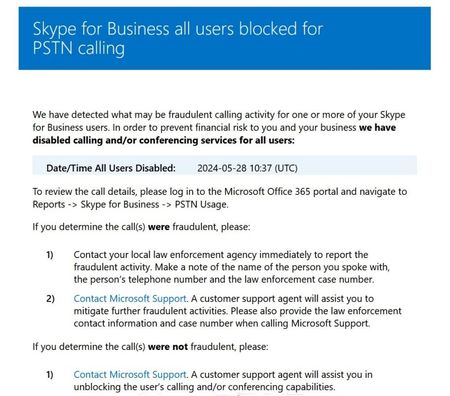
On a relatively new (3 weeks old) tenant, set up cleanly, with paid subscriptions and proper, correct licensing for Teams Calling, PSTN calling has been working fine since implementation. But last night I received multiple emails stating "Skype for Business all users blocked for PSTN calling - We have detected what may be fraudulent calling activity for one or more of your Skype for Business users. In order to prevent financial risk to you and your business we have disabled calling and/or conferencing services for all users:" I got an email for each user, AND an email stating that ALL users were blocked. This is a brand new tenant in Teams-only mode, SkypeForBusiness doesn't even show up in the tenant. There is no "Reports->Skype for Business->ANYTHING" option in the M365 Admin Center. Entra Admin Center shows no logins or unknown activity for any of the users (all of which are protected with 2FA and authenticators). The Teams Admin Center Usage Report shows only two calls made in the past 24 hours - both were test calls from me to my cell testing out call forwarding. The Teams Admin Center Blocked Users Report is broken and crashing. I tried to test with the self-help diagnostics. Interestingly, the diagnostic fails saying there is no number assigned to the user... Except that there is. In the assigned numbers screen, everything shows up properly and correctly. The emails state: "If you determine the call(s) were not fraudulent, please: Contact Microsoft Support. A customer support agent will assist you in unblocking the user’s calling and/or conferencing capabilities." The problem is that the support engineers I'm getting are on the other side of the planet, with an accent very different than mine. They can barely understand me and I can barely hear them. Worse: they kept attempting to debug using Get-CsUser - which is a fully-deprecated and no-longer-working cmdlet, and then basically gave up, saying they would "escalate it to their back office." They have no idea what is happening or why or how to fix it. I've had no updates since. Does anyone know why this happened or how to fix it? No fraudulent logins, no compromised accounts, no strange calls, no nothing... and yet the entire tenant is blocked? I've gone through most of the PowerShell cmdlets I can think of, compared them against a working tenant, and they're all identical - yet both incoming and outgoing PSTN calling remains blocked. Can anyone help me either fix this, or teach me how to get past the front-line support at Microsoft to someone who knows how to unblock this? My users are already looking at Google Voice... ugh...2.4KViews0likes3Comments
Direct Routing PSTN calls to Teams Auto Attendant does not forward to Shared Voicemail
Hi all, I’m running into a strange issue with a Teams Auto Attendant and I’m hoping someone here has seen it before. We have a Direct Routing number where business hours calls go to a Call Queue, which works, and after hours calls should go to Shared Voicemail for a Microsoft 365 Group. If I call the Auto Attendant from inside our Teams tenant, the after-hours Shared Voicemail works correctly. I can leave a message and the voicemail is delivered to the group inbox as expected. If I call the same number from the PSTN over Direct Routing, I hear the after-hours greeting, so the schedule and call flow are clearly being hit, but once the greeting finishes I get: “Sorry, we cannot connect your call at the moment, please try again later.” I have already verified that the resource account has the correct Teams Phone Resource Account license, Enterprise Voice is enabled, the LineURI is assigned, the Online Voice Routing Policy is assigned, the Direct Routing route and SBC look healthy, the Auto Attendant is associated with the correct resource account, the after-hours call flow points to the correct Microsoft 365 Group, and the group mailbox exists and is healthy. What makes this more confusing is that redirects to internal or tenant-side destinations work, but redirect to Shared Voicemail from a PSTN-originated call does not work. I also tested redirect to an external PSTN number, and that fails with the same error as well. Because the after-hours greeting plays correctly, and because internal Teams calls can successfully leave voicemail in the shared mailbox, I do not think the issue is with the Auto Attendant configuration itself or with the Microsoft 365 Group mailbox. At this point it looks more like the handoff or redirect path for PSTN-originated calls over Direct Routing is where things break. Has anyone run into this with a Teams Auto Attendant, Shared Voicemail, and inbound PSTN over Direct Routing? I’m trying to figure out whether this is a known limitation, a bug, or if there is some specific setting related to PSTN-originated redirects that I am missing. Thanks!329Views1like1Comment
Stop Automatic Calling when Screensharing
I screenshare a lot in my position; I call the coworker (Phone/Headset) and train them on what I need them to look at. I am in a large office building, and the automatic calling of the receivers' PC is disruptive, as I do not was the whole office to hear my conversation or have people hear my trainee. I see no way to disable the team auto-call once I start to screen share or in the Options. All my coworkers feel this frustration as well. I do use the computer microphone/speaks aspect when working from home, but would disable it totally, if it would stop the auto-call. I do not want it to affect meeting invites to others, as others around the country can use their PC speak/microphone, if they want. Please advise.275Views0likes2CommentsTeams devices (deskphones) Throwing 488 error regarding media bypass
Have a Direct routing setup that is using media bypass. Calls using PC client or web client are fine. Calls using any model\mfg of Teams phone throws the following every 10 minutes and then the call drops on the 3rd event. Primarily looking at Poly CCX500 but have tried Yealink MP58 and Audiocodes C450HD as well. Updating to latest firmware and Teams app in TAC doesn't fix it. "488 Not Acceptable Here REASON: Q.850;cause=79;text="15cfcbd7-1ab7-4d79-9957-85344e485f29;BackToBackBypass offer was declined by Peer" " I have tickets open with Microsoft and Poly. No one seems to know what is going on. Any one else seeing the same behavior?4.9KViews0likes7CommentsTeams phone calling features: Direct Routing vs Operator Connect
Hello everyone, As far as I know Teams phone Direct Routing provide more features than Operator connect. Does anyone have detailed feature list that Direct routing has while Operator connect doesn't? or vice versa? From my previous post I learn that "it is possible to assign numbers from a different country if you are using direct routing numbers. Operator Connect and Calling plans requires that the user have the same usage location as the number." (Thanks go to Linus Cansby) Your information is appreciated. EZ3.9KViews0likes3Comments
Teams user's webcam is showing black for remote participants
we have a user who has an issue with the teams client on Windows Whenever she participates in a call (one on one or group meeting), she can turn on her webcam, and sees herselves. In the Teams settings, the webcam is availlable under "devices" as well While she has her webcam turned off, other participants in the call see her initials. As soon as she turns on her webcam, the other parties involved just see a black screen. No video image, no user initials. as soon as she turns of her webcam, the remote participants get the users initials again. No other applications are using the webcam, and in the privacy settings of Windows Microsoft Teams has access to the camera When she uses teams on the web, the camera is working just fine. Also when using the ZOOM application for attending to a meeting, the camera is working just fine. Ath that time , other participants can see the videofeed. Troubleshooting done so far: - reinstalled webcam drivers - reinstalled Microsoft Teams - Teams client version on all sides: 1.6.00.4472 - Updated all available drivers for this computer - PC was originally running Windows 11 build 21H2 with patches installed up to the patches released on February's patch tuesday. - we formatted the hard drive and reinstalled Windows 11, but with build 22H2, and february's patch tuesday updates. Updated drivers again No difference. She is the only user in the company experiencing this. We are using a Microsoft 365 tennant with Microsoft 365 E3 licenses applied to the users. We don't have any custom policies applied to this user, nor to other users. All users are using the same settings. Any advices on this would be greatly appriciated.Solved3.3KViews0likes8CommentsTeams phone demo
I work in the IS Department at a school and we (IS Dept) use Teams regularly and others are slowly getting around. Due to a mixed environment of Google Docs/Zoom users and M365 users, there is a lot of push back or silence whenever the topic of Teams comes up. It is my opinion that key to getting everyone to buy in is to add the calling feature to our system. We have an existing controller that will work with it (Mitel). Ideally we would not change our current phone system, instead we can just add our existing system to Teams adding the ability to call users extensions and outbound numbers. Is it possible to set up a demonstration or enable this ability for a small group?Solved8.2KViews0likes7CommentsTeams calls reporting as potentially scams incorrectly
Hey Teams Community, In the past 5 days I am seeing callers from external tenants that are trusted and in mto showing as suspected scam callers when they call me. They see.me as a suspected scam also when I call. These tenants are all trusted and most of them are.members of the same MTO. This only started happening in the last 7 days. What is causing this? Does anybody else see this happening recently with a similar setup?348Views0likes2Comments