Forum Widgets
Latest Discussions

Follow Microsoft Build Live for the latest updates and announcements
Microsoft Build is happening now, and the live blog is a great way to stay up to date on the latest announcements, demos, and key moments as they happen: 👉 Follow Microsoft Build Live What are you most interested in learning more about from Build this year? 👀JSteckrothJun 02, 2026Community Manager21Views1like0CommentsHow to Build Your First AI Agent in Copilot Studio in 15 Minutes
Artificial Intelligence is no longer reserved for data scientists and software developers. With tools like Microsoft Copilot Studio, anyone can create intelligent AI agents that automate tasks, answer questions, and improve productivity without writing complex code. https://dellenny.com/how-to-build-your-first-ai-agent-in-copilot-studio-in-15-minutes/22Views0likes0CommentsCopilot Employee Self-Service Agent
I’m looking for some clarity regarding the rollout of the https://adoption.microsoft.com/en-us/ai-agents/employee-self-service-agent/ and whether others are seeing it in their environments yet. I’ve been following this closely and initially understood that a formal request was required to gain access. However, the Microsoft Learn documentation now provides specific, step-by-step instructions on how to enable and access it directly. Despite following those instructions to the letter, the agent is still not appearing within my tenant. I’ve verified my configurations against the guide, but the options simply aren't visible. A few questions for the community: Has anyone else successfully enabled the agent using the self-service steps in the documentation? Is there or was there ever a manual "request-for-access" process that overrides the published steps? I’d appreciate any insights or if anyone from the product team could clarify if the documentation is slightly ahead of the actual deployment.LuiIacobellisJun 02, 2026Iron Contributor104Views0likes3Comments
Prompt Lab: Three Critical Bugs That Make It Unusable as a Prompt Management Tool
Product: Microsoft 365 Copilot — Prompt Lab (accessed via ... button in Copilot Chat) Date: June 1, 2026 Environment: M365 Copilot, Web (Edge), Work IQ mode Bug #1: Empty State Crash Steps to reproduce: Open Prompt Lab via the ... button in Copilot Chat Ensure "Your saved prompts" contains zero prompts (either as a new user or by deleting all saved prompts) Observe the result Expected behavior: An empty state placeholder (e.g., "You haven't saved any prompts yet.") Actual behavior: The entire Prompt Lab panel throws a red error banner: "Something went wrong. Please close the dialog and try again later." The "Your saved prompts" category does not render at all. The panel only shows Microsoft's preset categories (Prompt topics, Agent prompts). Why this matters: An empty container is a valid state — it is literally every new user's initial state. A UI component should never crash because a list has zero items. This is a null/empty array handling failure that should have been caught by basic QA. Bug #2: Search Does Not Index User's Saved Prompts Steps to reproduce: Save a custom prompt with a distinctive title (e.g., "AI每日新闻") and body containing the keyword "AI" Open Prompt Lab Use the search box at the bottom to search for "AI" Expected behavior: Search results include the user's saved prompt alongside Microsoft's preset prompts. Actual behavior: Only Microsoft preset prompts matching "AI" are returned (e.g., "Stay on top of AI," "Prompt Compliance"). The user's own saved prompt — whose title and body both contain "AI" — does not appear in the results. Why this matters: The search box creates a false expectation that it searches all prompts. In reality, it only indexes Microsoft's template library. This means as a user accumulates more saved prompts, the only way to find one is manual scrolling. A search function that excludes user-created content is fundamentally broken by design. Bug #3: Saved Prompts Lost During Migration Context: The standalone Copilot Lab / Prompt Gallery app was retired on July 15, 2025, and its functionality was merged into the built-in Prompt Lab within Copilot Chat. What happened: All previously saved prompts from the old Copilot Lab app are gone. They do not appear in the new Prompt Lab's "Your saved prompts" section. There was no migration notice, no export tool for end users, and no recovery path. Why this matters: Users invested time curating and refining their prompt libraries. Silently dropping that data during a platform migration — without warning, backup, or migration tooling — is a breach of user trust. Summary These three issues compound into a single conclusion: Prompt Lab is currently non-functional as a prompt management tool. Capability Status Reliable storage ❌ Data lost during migration Empty state handling ❌ Crashes when empty Search / retrieval ❌ Does not index user content Displaying Microsoft templates ✅ Works The only feature that works correctly is showcasing Microsoft's own preset prompts. For a tool whose entire purpose is to help users save, organize, and reuse their own prompts, this is an unacceptable state of quality. I'd strongly recommend the team prioritize: (1) proper null-state handling, (2) including user prompts in the search index, and (3) investigating whether migrated prompt data can be recovered from Substrate.UBJun 01, 2026Copper Contributor7Views0likes0Comments
Copilot Down - June 1st
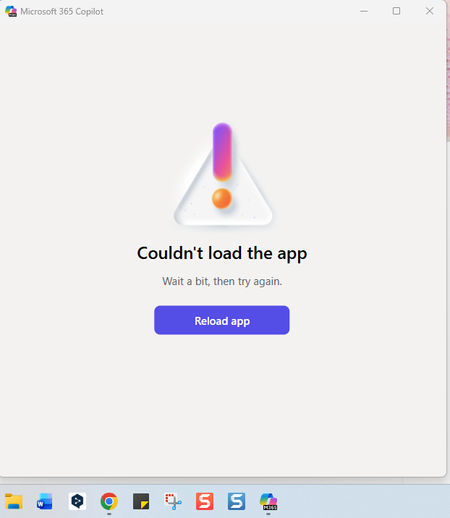
I used Copilot this morning and everything was working smoothly. All of a sudden when I open the app on Windows I get this message "Couldn't load the app. Wait a bit, then try again." I tried using the version on Edge but I get a "503 Service Unavailable Error." I tried restarting my laptop and I get the same error. Checked on my phone app and indeed, it confirmed the service is down. Does anyone know when this will be resolved?sfarahDCMJun 01, 2026Occasional Reader65Views0likes1CommentSurface Copilot+ PCs: Microsoft’s Bold Step into the Future of AI Computing
The personal computer has evolved dramatically over the past few decades. From simple productivity machines to powerful devices capable of handling creative workloads, gaming, and business operations, PCs continue to redefine what users can accomplish. Now, Microsoft is ushering in a new era with its Surface Copilot+ PCs, a lineup designed to bring artificial intelligence directly into everyday computing experiences. https://dellenny.com/surface-copilot-pcs-microsofts-bold-step-into-the-future-of-ai-computing/30Views0likes0CommentsHow Microsoft Copilot Studio Fits Into the Power Platform Ecosystem
Artificial intelligence is no longer just a futuristic concept reserved for large enterprises with deep technical teams. Today, businesses of all sizes are searching for practical ways to automate repetitive tasks, improve customer experiences, and empower employees with smarter tools. This shift is exactly where Microsoft Copilot Studio enters the picture. https://dellenny.com/how-microsoft-copilot-studio-fits-into-the-power-platform-ecosystem/25Views0likes0Comments
Feature Proposal: OS-level Intelligent Task Organizer (Windows + Copilot)
A Idea about Intelligent Tasks organizer, I have to remember a lot of things during the team meetings like what is been said (we'll schedule a call or follow up etc.,) and what has been communicated in the emails (I'll get back to you after 2 weeks, or call us after two weeks) , And notes that I took in the notepad, or notepad ++,or sticky notes, or word, or one note. I want to chronologically display tasks on the right hand side of the laptop screen just like sticky note and it shall display all tasks one by one, it shall remove tasks are already complete (email sent with confirmation). and arrange, adjust every few mins according to priority/time or user added priority. App shall display small icon (just like chat) upon clicking it shall display ordered list of tasks. and desktop apps like teams/note/word/notepad++,sticky notes can participate by default or other apps like notepad++ can be onboarded manually in to the app. You can use a local model which infers the meaning of “I’ll call you in two weeks” - who is “I”? you or them? “Let’s follow up later” - task or casual statement? “I sent it” - which task did this complete? You can use a local model such that Corporate Teams/Outlook access may allow by corporate policy. Need to put much emphasis on false positives if the app keeps inventing tasks. Do not need to bring big LLMs in to the picture for inference, because of corporate policies may not allow. Microsoft provides operating system,office 365, tools with copilot, the inference can be possible because of all apps/content can be accessible at os level. Problem: Users capture tasks across multiple tools: Teams meetings and chats Outlook emails Notes (OneNote, Notepad, Sticky Notes, Word) Tasks become fragmented, untracked, and often lost. Proposed Solution: A lightweight system-level task layer integrated with Windows + Copilot that: Core Features Automatic task extraction From Teams, Outlook, notes, and user text Example interpretations: “I’ll call you in 2 weeks” “Let’s follow up later” Context-aware inference (local model) Identify: Task owner (“I” vs “you”) Priority signals Deadlines Minimize false positives Chronological task timeline Tasks auto-organized by: Time Priority Recency Floating task panel (desktop UI) Docked widget (like Sticky Notes or chat bubble) Expand/collapse view Always visible option Automatic task lifecycle tracking Detect completion: “Email sent” “File shared” Remove or mark complete automatically Continuous re-prioritization Adjust every few minutes based on: New inputs Deadlines User behavior Privacy-first architecture Use local models (SLM) instead of large cloud LLMs Enterprise admin control for data access Why this matters: Millions of users manually track tasks across fragmented tools, losing productivity daily. This feature would unify task understanding across the OS and M365 ecosystem.busi_2May 30, 2026Occasional Reader21Views0likes0CommentsAdd a "Print Conversation" Feature in Microsoft Copilot
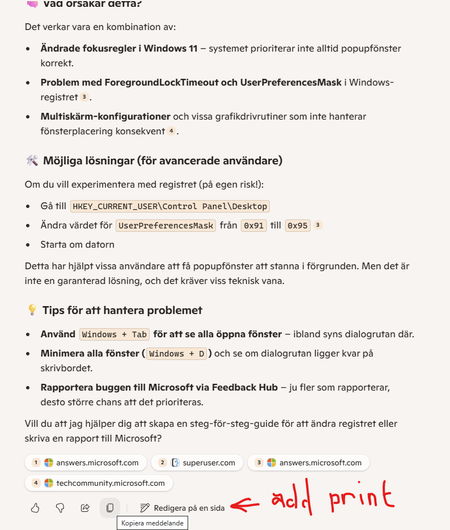
I'm warming up to using Copilot for quick answers and support. It is even better, more detailed and more honest about Microsoft shortcomings than Microsofts forum and support staff. But one thing that’s noticeably missing in Copilot is a simple way to print or export parts of a conversation. Many apps and websites offer a “Print” button for selected sections, allowing users to easily create a PDF or paper copy of important content. In Copilot, this would be especially useful for saving guidance, troubleshooting steps, or creative content in a clean format immediately. Currently, the only way is to manually copy text and paste it into another app, which feels like unnecessary extra work. A built-in “Print” or “Export to PDF” option would greatly improve usability and workflow efficiency. (This feedback was formulated with help from Copilot. I amended some sentiments of Copilotbeing too full of it self. Still it is much nicer than I would have written it! ;) Thank Copilot for that!SolvedJim_MundaneMay 28, 2026Brass Contributor4.8KViews1like14CommentsThe Difference Between Declarative Agents and Autonomous Agents in Copilot Studio
Artificial intelligence is rapidly transforming the way businesses automate tasks, improve customer experiences, and increase productivity. One of the most exciting platforms leading this transformation is Microsoft’s Copilot Studio, a low-code environment that enables organizations to create intelligent AI-powered assistants and workflows. https://dellenny.com/the-difference-between-declarative-agents-and-autonomous-agents-in-copilot-studio/33Views0likes0Comments



Tags
- tips and tricks301 Topics
- microsoft 365 copilot290 Topics
- Getting Started241 Topics
- copilot chat215 Topics
- troubleshooting203 Topics
- copilot in teams112 Topics
- management and extensibility75 Topics
- training and resources73 Topics
- copilot in outlook71 Topics
- Copilot in SharePoint69 Topics