
Forum Widgets
Latest Discussions

RemoteHelp.exe reports FileVersion 10.4.10008.1000 while the product version is 5.2.1037.0
Problem 1 - File Version Because RemoteHelp.exe reports FileVersion 10.4.10008.1000 while the product version is 5.2.1037.0, this makes Intune detection, packaging, inventory reporting, and supersedence unnecessarily difficult. Remote Help publishes release versions such as 5.2.1037.0, but the primary executable reports a different FileVersion (10.4.10008.1000). This prevents administrators from using standard file-version detection methods in Intune, Configuration Manager, and software inventory solutions. Administrators must instead enumerate uninstall registry entries and distinguish between the Burn bundle and MSI entries. Aligning the executable FileVersion/ProductVersion with the published release version would significantly simplify enterprise application management. Remote Help combines both common enterprise packaging mistakes: The executable version doesn't match the advertised product version. The installer creates two uninstall entries with the same DisplayName. Neither issue is fatal, but together they make what should be a trivial Intune detection rule far more complicated than it needs to be. From an enterprise management perspective, this causes several problems: Application detection scripts become more complicated. Supersedence rules are harder to create. Administrators waste time investigating apparent version mismatches. Software inventory reports show different versions depending on which source is queried. Automated packaging systems cannot simply use file versioning. Documentation has to explicitly state "do not use the EXE version". Problem 2 - Duplicate Uninstall entries The Burn bootstrapper situation makes it even more confusing because there are two uninstall entries, both called Remote Help, both reporting version 5.2.1037.0, but representing two different installer components. This isn't unique to Remote Help unfortunately. Microsoft has a history of doing similar things with: Company Portal Teams (various generations) Edge WebView2 Visual Studio bootstrapper installers Azure VPN Client Some Defender components where the executable version represents the underlying codebase rather than the product release version that administrators actually deploy. The file version should be treated as an API contract with administrators. Once an application is broadly managed by enterprises, changing versioning schemes or exposing an internal build number instead of the published product version makes lifecycle management considerably harder than it needs to be. Problem 3 - Unversioned download URL The URL to download the latest version https://aka.ms/downloadremotehelp is only a redirect link, not a versioned artefact. The download URL itself does not expose any metadata about: The current Remote Help version The release date When the installer was last updated Previous versions A changelog Microsoft's documentation simply points administrators to the download link for installation. When you download the 'latest version' you always receive whatever Microsoft currently considers the latest installer, but the URL itself provides no version information. For enterprise deployment scenarios, the ideal solution would be one of: A "What's New" page with version history. A release notes page containing: Version Release date Changes Versioned download URLs, for example: RemoteHelp-5.2.1037.0.exe RemoteHelp-5.2.1037.0.msi Please can these three issues be resolved to ease some of the unnecessary burden placed on Intune Administrators?Adrian_ScottAug 06, 2026Copper Contributor93Views0likes0Comments 56Views0likes0Comments
Entra Shared Device Mode Remote Control
Hi All I hope you are well. Anyway, does anyone have any experience of a decent remote control solution for Android based Entra Shared Mode devices? Preferably with the "LEAST" Android permissions to set / and or an App Config that can suppress Android permissions. SKStuartK73Mar 17, 2026Steel Contributor61Views0likes0Comments
Erweiterungsmanagement im Browser
We would like to distribute browser extensions in Edge via Intune in a granular manner. The problem is that assigning two profiles with different extensions leads to a conflict. We would like to be able to assign extensions individually and assign multiple different profiles with different browser extensions to a user. With the current options, it becomes very complex and error-prone when there are multiple extensions with different user groups. Or have I overlooked a possibility?Regine147Mar 04, 2026Copper Contributor56Views0likes0CommentsWill Intune device-only subscription get additional value in FY27
Will the Intune device-only subscription (Microsoft Intune announces device-only subscription for shared resources | Microsoft Community Hub) get the additional features which Intune P1 will get in FY27 (Microsoft 365 adds advanced Microsoft Intune solutions at scale - Microsoft Intune Blog), Intune Remote Help, Intune Advanced Analytics and Intune P2? This would have a huge impact of our planning how to manage special purpose devices in production environments without any user affinity. Deploying security and configuration settings, Windows Autopilot for Windows IoT Enterprise LTSC kiosk deployment, Windows Autopatch (servicing), Remote Help and FOTA for Zebra devices would be drivers to add these production devices to Intune.
How to Disable Self-Service Passcode Reset for Standard Users in Microsoft Intune
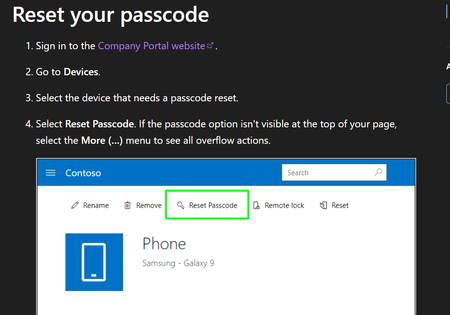
Hi, We are using Microsoft Intune to manage Android corporate-owned devices. Currently, standard users can reset their own device passcode remotely. The problem is: Users reset the passcode themselves Then they get confused They call IT saying they cannot open their phone We want to prevent users from doing self-service passcode reset. Only admin should be able to reset the device passcode. I already checked configuration profiles and compliance policies in Intune, but I cannot find any setting to disable this. Has anyone successfully disabled this feature? Thank you.tarunograa29Feb 17, 2026Copper Contributor70Views0likes0CommentsCreating a successful intune deployment using an installer exe combine with XML configuration file.
I am having issue creating a successful intune deployment package involving MathCad Prime 11 and XML file, this might be cause my powershell scripting is very weak. This is the current script I am trying to used, but it does not seem to deploy successfully, the errors I am seeing from intune is "The unmonitored process is in progress, however it may timeout. (0x87D300C9)." Perhaps someone has come across this and point me in the right direction on how to handle installer with exe and using XML for configuration. " # Get the current script directory to locate setup.xml $CurrentDir = $PSScriptRoot # Define the installer path and the XML argument file $ExePath = Join-Path -Path $CurrentDir -ChildPath "setup.exe" $XmlPath = Join-Path -Path $CurrentDir -ChildPath "mathcad.p.xml" # Adobe command-line parameters for silent installation with a deployment file $Arguments = "--mode=silent --deploymentFile=`"$XmlPath`"" # Start the installation process and wait for completion $Process = Start-Process -FilePath $ExePath -ArgumentList $Arguments -Wait -PassThru # Return the exit code to Intune (0 is success) Exit $Process.ExitCode "XSupramanXFeb 12, 2026Copper Contributor185Views0likes0CommentsSave the date - January 26, 2026 - Tech Community Live: Intune edition
Save the date for Tech Community Live: Intune edition, starting at 8:00 AM PT! Join us for an exclusive live event designed for IT professionals managing endpoints with Microsoft Intune. This interactive experience features four Ask Microsoft Anything (AMA) sessions focused on the most critical aspects of modern endpoint management. Learn how to secure your endpoints with policy and Microsoft Defender, streamline app deployment and updates with Intune, and apply Zero Trust principles effectively across your organization. Each session is led by Microsoft experts ready to answer your toughest questions and share best practices for real-world scenarios. Whether you’re looking to strengthen compliance, optimize app lifecycle management, or embrace Zero Trust strategies, this event delivers actionable insights to keep your organization secure and efficient. Don't miss this opportunity to connect with the experts and elevate your Intune skills. Go to Tech Community Live: Intune edition to add this event to your calendar! Better yet, sign in to add your questions now.Pearl-AngelesJan 20, 2026Community Manager195Views0likes0Comments
restore Personal Iphone on onother supervised iphone
Good morning, Our employees would like to keep their iPhone settings on the company phone supervised by Intune. How can we restore a personal iPhone from iCloud to an iPhone supervised with Intune? I've heard of a method that allows a restore on an intermediate device before moving to the supervised one. Has anyone already solved that problem?Andrea91Nov 20, 2025Copper Contributor41Views0likes0Comments
Not able to use derived credentials on android
I have successfully enrolled a Samsung Galaxy S22 ultra using intune. All my apps are installed on the device. I am now trying to use derived credentials but I am not able to scan the QRCode. As soon as the QRCode comes up, the intune app crashes. Wanted to know if anyone else is seeing this issue. The intune app version is 2025.11.02.SalmanDhedhiNov 10, 2025Copper Contributor43Views0likes0Comments



Tags
- intune4,370 Topics
- mobile device management (mdm)2,327 Topics
- Mobile Application Management (MAM)852 Topics
- Software Management477 Topics
- Conditional Access465 Topics
- Graph API255 Topics
- Azure Friday166 Topics
- Autopilot118 Topics
- android75 Topics
- ios63 Topics