office 365
768 Topics
Outlook Version 16.114.1 (26102031) not *sending* mail-BT is my mail service provider
Over the last few weeks I have had an intermittent problem whereby I cannot send emails from Outlook. BT is my email provider. I use the Legacy version of Outlook but occasionally switch to New Outlook to test whether I have the same issue and much of the time I do not, but this morning I do. Nobody on the Microsoft Support Team (as per "Help-Contact Support") has been able to advise or help. Having done my own AI/Google search, it seems that there is a conflict between BT and Outlook re-BT's servers? Does anyone know what is going on? I can send when I use BT's web based mail but I want to use Outlook, which I am paying for!21Views0likes1Comment
Outlook 365 "forced categories" in FROM field
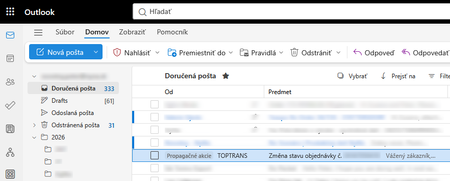
Outlook 365 got new "feature" that marks random e-mail with "forced category" named "Promotion" (on screenshot "Propagacne akcie"). On attached screenshot you can see fairly important e-mail about delivery of big packet I'm waiting for. Definitely this is not related to any promotion or advertising. This new "forced categories" do not exists in normal categories. They can not be deleted, changed, or hidden from view. Please note that what you normally understand as category is displayed in SUBJECT ("Predmet" on screenshot) field, but these "forced categories" are displayed in the FROM ("Od" on screenshot) field. This feature was implemented cca 1 or 2 weeks ago. Has anyone experienced situation like this? How to get rid of these "forced categories"? What I tried: 1. Checked categories in settings - category like this does not exists 2. Checked categories in settings - suggested categories switch does not exists 3. Tried to create rule to remove the "forced category", but rules ignore these "forced categories", they work only with standard categories (in the subject field) 4. Searched view menu if it can be changed to not display "forced categories", but there is no single switch about it. 5. Tried all available conversation view options 6. Disabled copilot611Views0likes7Comments
New Outlook: "Changing the ImapRemoteServerInfo is not allowed" after host migration
Hi everyone! I've migrated my domain/mailbox from one IMAP host to another in May. It cannot be added to New Outlook for Windows — fails instantly with INVALID_CREDENTIALS INTERACTION_REQUIRED, even when I deliberately enter a wrong password (so it's failing before authentication is even attempted). Using DevTools (olk.exe -devtools), the Network tab shows the real rejection from Microsoft's backend: Changing the ImapRemoteServerInfo is not allowed. Attempted to change it from imap.olddomain.sk to imap.newdomain.sk So New Outlook has a cloud-mailbox / connected-account shadow record for this address, pinned to the old host from a previous add attempt, and the backend refuses to update it. What I've confirmed: Webmail and a second mailbox on the same domain/host both work fine → not credentials, not the host. The account does not appear in Settings → Accounts (so I can't use "Remove from all devices" which worked on my first account). It's on no other device or client. App reset didn't help (record is server-side, not local). It's been ~7 weeks, so any 30-day inactivity purge hasn't cleared it How do I get this stuck cloud-mailbox / connected-account record purged when it isn't attached to any removable account? Is there a way to force it, or does this need Microsoft backend action?1.8KViews4likes35Comments
MS Outlook 2024 LTSC automatically gets closed and later not getting open
In Outlook 2024 LTSC, the application suddenly stops and closed automatically. Later troubleshooting, it is observed that it doesn't even open in safe mode. Tried to create a new profile where it is not able to search the user from exchange and automatically redirect to Microsoft 365 login page whereas our mail server works in exchange mode. Even after reinstalling the MS office 2024, it is not able to search the user and redirects to Microsoft 365 login page. What is the issue and resolution.348Views0likes2Comments
New Outlook - PST file cannot reopen and PST search not working
Hi, Issue 1 – One PST file cannot be reopened I have two PST files, PST A and PST B. PST A can currently be opened and browsed normally in New Outlook. PST B was previously opened in New Outlook and I was able to browse the folders and emails. However, after I closed/removed PST B from New Outlook, I am now unable to open/add the same PST file again. The PST file can still be opened using Classic Outlook. If the PST format is unsupported or too old for New Outlook, why was New Outlook able to open and browse it previously before I closed it? Could this be related to the PST format (ANSI vs Unicode), PST corruption, or a limitation/bug in New Outlook? Issue 2 – Unable to search emails stored in PST For PST A, I can open the PST and manually browse and read the emails in New Outlook. However, when I use Search, emails stored inside the PST do not appear in the search results. This is referring to searching for the email/message itself, not searching for attachments. The same PST can be searched using Classic Outlook. My understanding is that New Outlook now supports searching emails stored in PST files. Is PST search fully supported, or are there still limitations compared with Classic Outlook? I would appreciate any advice on how to troubleshoot both issues, especially whether there is a way to verify PST compatibility with New Outlook.247Views0likes1Comment
Send Button Greyed Out For New Messages
This morning, I am not able to send new emails form outlook 365 on a Mac. I can type a message and put in a recipient but the Send button stays greyed out. I have quit and relaunched Outlook and am still having the issue. Any advice on how to resolve? I am able to create and send through the Outlook app on my phone and I am able to reply and forward form my computer. I just cannot create new messages form my computer.119KViews0likes17Comments
Support for auto-filing sent emails
I am looking for a solution to this scenario in the New Outlook: I send tens of emails per day The sent emails are stored in the Sent Items folder I need to manually move each of them into the sub-folders in my Archive folder - e.g. one for support cases Is there any way to automate the step (3) - i.e. to automatically file the sent emails into the folders they belong to? The Classic Outlook had "When replying to a message that is not in the Inbox, save the reply in the same folder" which is not present in the New Outlook. Maybe the New Outlook should have something even more powerful? In addition to this feature, a button suggesting into which folder each message should be filed? Finally, the Outlook Rules are very powerful but they do not apply to the sent emails. Maybe time to generalize these?1.6KViews3likes12Comments
New Outlook autocompletes an address that is no longer in use and I can't seem to delete it
Topic says it all, really. Client of mine has a new company and when I type the start of his name Outlook autocompletes for his old company even though it is no longer in my address book and his contact is updated with new information. I seem to recall there used to be an "x" that would let me delete incorrect autocompletes, but I can't find anything and Copilot has no useful suggestions. The autocomplete comes up in both the web version of Outlook--I basically never use this--on my PC which I primarily use, and IOS.3.5KViews5likes4CommentsAttachement date of outlook classic
when i download the attachment from old email, the date of the file, should be today date, but that doesn't happen, it appears the old date of when it was created. In a big folder of downloads i cant find it. This happens in outlook 365, outlook 2016 and Outlook 2024 classic with email 365 account. But in Outlook 2019 classic works perfectly it sava with today date. Should be some configuration?214Views0likes3CommentsiCloud for Windows Contacts sync issue with Outlook Classic (Part of M365 package)
I have lost count the amount of times I see iCloud Sync issues cropping up with Outlook Classic (M365) but they never exactly describe the issue I am having. After uninstalling Outlook, iCloud for Windows, re-installing and enabled / disable the AddIn/ re-enable it for iCloud I've run into a brick wall I think So iCloud for Windows partly integrates with Outlook Classic - but I have an issue where the correct Sync'd contacts are appearing in the Contacts tab of Outlook and I enable that as an Address book by ticking the box in Properties. I give it a specific name Then open the main Home page of Outlook and start to create a test mail. If I open the Address Button on the main ribbon I can see the Contacts list name for iCloud and open it. Problem is it is not the correct list. It looks like a very old iCloud Contacts List - but where on earth is Outlook getting this old list from ?. The list is the same name as that one I just gave it under Outlook Contacts management page, but I can never get the correct sync'd iCloud contacts list to appear using the Address Button. Can anyone point me in the direction of where this old iCloud contact list is being stored within Outlook Classic ?. If I remove iCloud for Windows it is still there under the Address Ribbon button. Any help here welcomed !211Views0likes4Comments