office 365
20848 Topics
Outlook 365 "forced categories" in FROM field
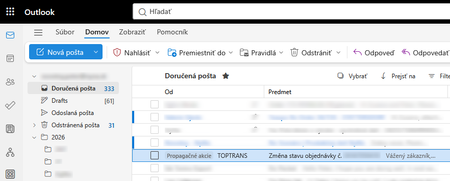
Outlook 365 got new "feature" that marks random e-mail with "forced category" named "Promotion" (on screenshot "Propagacne akcie"). On attached screenshot you can see fairly important e-mail about delivery of big packet I'm waiting for. Definitely this is not related to any promotion or advertising. This new "forced categories" do not exists in normal categories. They can not be deleted, changed, or hidden from view. Please note that what you normally understand as category is displayed in SUBJECT ("Predmet" on screenshot) field, but these "forced categories" are displayed in the FROM ("Od" on screenshot) field. This feature was implemented cca 1 or 2 weeks ago. Has anyone experienced situation like this? How to get rid of these "forced categories"? What I tried: 1. Checked categories in settings - category like this does not exists 2. Checked categories in settings - suggested categories switch does not exists 3. Tried to create rule to remove the "forced category", but rules ignore these "forced categories", they work only with standard categories (in the subject field) 4. Searched view menu if it can be changed to not display "forced categories", but there is no single switch about it. 5. Tried all available conversation view options 6. Disabled copilot39Views0likes1Comment
New Outlook: "Changing the ImapRemoteServerInfo is not allowed" after host migration
Hi everyone! I've migrated my domain/mailbox from one IMAP host to another in May. It cannot be added to New Outlook for Windows — fails instantly with INVALID_CREDENTIALS INTERACTION_REQUIRED, even when I deliberately enter a wrong password (so it's failing before authentication is even attempted). Using DevTools (olk.exe -devtools), the Network tab shows the real rejection from Microsoft's backend: Changing the ImapRemoteServerInfo is not allowed. Attempted to change it from imap.olddomain.sk to imap.newdomain.sk So New Outlook has a cloud-mailbox / connected-account shadow record for this address, pinned to the old host from a previous add attempt, and the backend refuses to update it. What I've confirmed: Webmail and a second mailbox on the same domain/host both work fine → not credentials, not the host. The account does not appear in Settings → Accounts (so I can't use "Remove from all devices" which worked on my first account). It's on no other device or client. App reset didn't help (record is server-side, not local). It's been ~7 weeks, so any 30-day inactivity purge hasn't cleared it How do I get this stuck cloud-mailbox / connected-account record purged when it isn't attached to any removable account? Is there a way to force it, or does this need Microsoft backend action?1.1KViews1like21Comments
Excel pivot chart's secondary axis disappears after parameter in chart is filtered at slicer
Hi, A pivot chart on Sales (primary y axis) and Rate (secondary y axis) is plotted against time (X axis). Area parameter is part of the underlying dataset, but not plotted in same chart. When Area or Rate is filtered at respective slicer, the secondary y axis disappears i.e. pivot chart resets to having only primary y axis How may I keep the secondary y axis after filtering? Thank you.1KViews0likes5Comments
Microsoft Bookings: Already booked slots remain visible and selectable for some time
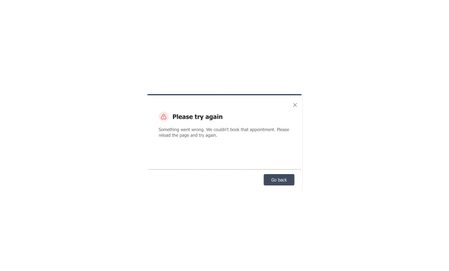
Hello everyone, I am experiencing an issue with Microsoft Bookings and would like to understand whether this is expected behavior, a configuration issue, or a known product limitation. The issue: When a user books a slot, the booking is created successfully. However, if another user opens the booking page shortly afterwards, the same slot is still shown as available for at least 5 minutes and can be selected. Only when they try to complete the booking, they receive a weird error message that asks them to "please try again" (see screenshot). Has anyone else experienced this? Is there a known caching or synchronization delay in Bookings, or are there any settings that can improve the refresh of available slots? How can I fix this? Any help or insights would be greatly appreciated. Thank you!12Views0likes0CommentsAutoSave disabled when opening SharePoint-synced files from Finder after macOS Tahoe 26.6 update
Files stored in SharePoint Online and synchronized locally through OneDrive are opened as local documents when launched from Finder. Office applications display "Saved to my Mac" and AutoSave is turned off by default. However, opening the exact same files through Word/Excel > Open > Sites, or via SharePoint "Open in Desktop App", correctly identifies them as cloud documents. In that scenario, AutoSave is enabled and collaboration/version history features work as expected. Troubleshooting already performed: OneDrive reset and re-linked SharePoint library re-synced Signed out and back into both Office and OneDrive Removed Microsoft credentials from macOS Keychain and re-authenticated Recreated local OneDrive sync relationships Verified OneDrive File Provider extensions are enabled Verified Office applications and OneDrive are fully up to date Tested with newly created files and existing files Tested "Always Keep on This Device" with no change in behavior The issue appears to be specific to the Finder-to-Office launch path after upgrading to macOS Tahoe 26.6. Before upgrading to macOS Tahoe 26.6, opening the same SharePoint-synchronized files directly from Finder correctly preserved cloud document identity and AutoSave was enabled as expected. I discussed this issue in detail with Apple Support, but they quickly dismissed it, saying that the problem is not on Apple's side and that I should contact Microsoft instead.3.4KViews13likes36Comments
OneDrive Login Issue Persisting for Over 2 Weeks
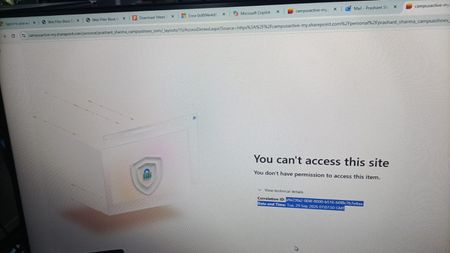
Hello Community, We are experiencing an issue where a user is unable to sign in to OneDrive. The problem has been ongoing for more than two weeks, and despite extensive troubleshooting, the issue remains unresolved (error screenshot attached). Troubleshooting performed so far: Unassigned and reassigned the Microsoft 365/OneDrive licence. Re-granted the required permissions. Attempted sign-in using an InPrivate/Incognito browser session. Reset the user's device. Cleared browser and OneDrive application cache. Unfortunately, the user continues to receive the same error after performing all the above steps. Has anyone encountered a similar issue or can suggest additional troubleshooting steps? Any guidance would be greatly appreciated, as the issue is impacting the user's ability to access OneDrive. Thank you in advance for your support.49Views0likes0Comments
Theme Not Available For Cengage Project
I am currently trying to do a Cengage project for Microsoft power point. I need the Berlin theme and it is currently unavailable. I am using Microsoft 365 Family and only see a limited set of themes. Can someone PLEASE help me? Thank you!Solved60Views0likes1Comment