marketplace channel
22 TopicsMultiparty private offers in Microsoft Marketplace are expanding to 30 countries across Europe
We're excited to share that beginning on May 27, multiparty private offers through Microsoft Marketplace will expand to 30 countries in Europe. Further expansion to Australia, Japan, and South Africa will be available July 15—with more markets to follow. Multiparty private offers empower channel partners to bring vetted solutions to their customers to differentiate while companies developing software can lean on the partners’ local expertise to scale to new markets. Learn more: aka.ms/MPOEEAblog Additional resource: we recently hosted a Marketplace community event on Multi‑currency private offers in Microsoft Marketplace. Given this recent announcement about multiparty private offer expansion, I encourage you to access the recording. You will learn how to confidently navigate local currency transactions, understand how timing impacts payments, and apply best practices when executing deals across geographies.499Views2likes0Comments
Lead traction from MS Teams Store vs MS Marketplace
Hello community! We have both a Teams app and a SaaS offer published in Microsoft Marketplace. We’ve noticed that we’re getting new organic installs directly from the Microsoft Teams Store, but these installs don’t seem to be reflected properly in Partner Center statistics. In particular, we can’t see enough details about these users/installs or track them in the same way we can track leads, views, and other activity for our SaaS offer. How are you tracking this audience? Is there another Microsoft report, analytics tool, or data source we should be using to understand where these Teams Store installs are coming from, at least those who click "Get it now" and don´t complete the installation. We would love to follow up them to provide security detales for their admin teams, so they can approve the installation. Would really appreciate any insights from those who have experience with this. 🙏Solved
Can a reseller set exact customer totals on an Azure private offer?
When we create a multiperiod private offer, we enter our markup as a percentage. Sometimes the customer total Azure calculates is a few cents off the signed quote, even when we use all eight decimal places. Is there a way to set the exact customer price for each period? If not, how are other resellers handling these rounding differences?Delay in Marketplace Revenue Being Reported in Revenue Report
We're having an issue where we're missing a large chunk of our July 2026 revenue being reported in our https://partner.microsoft.com/en-us/dashboard/insights/commercial-marketplace/analytics/revenue. We usually see a small delay of up to a few days for the previous month's revenue to show up, but it's been over 2 weeks now and we're still missing a large portion of our expected Revenue. We've confirmed in our service that we sent the correct meters and we haven't churned a large chunk of our customer base. Is there a place we can go or API we can call to pull more up to date information? Or is there a known delay in August that is causing a longer-than-usual delay?Auto Activation for SaaS Private Offers is a Game Changer!
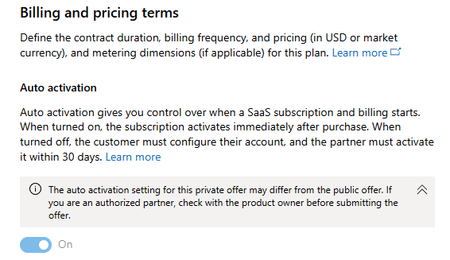
Shout out to Microsoft Marketplace for launching AUTO ACTIVATION for SaaS private offers. This has simplified our sales operations for Microsoft Marketplace private offers, as well as dramatically improved our seller and customer experience with by eliminating the #1 reason we've historically seen block customers from completing Marketplace SaaS private offer procurement. Auto activation for private offers allows customers to skip the step of going to our SaaS landing page and activate Marketplace SaaS billing by having to SSO with their AAD. The problem with this step is that most of our customers are in regulated industries, and their AAD admins do not allow SSO on SaaS landing pages without enabling profile sharing, which requires a Global Admin to enable. We've encountered far too many times where our customer is scrambling to find their Global Admin so that they can complete the final steps to finish the steps to activate Marketplace SaaS billing. This also puts our sellers in the awkward position of having to help customers diagnose and troubleshoot the situation, which as a rule they are not equipped to, or find a Microsoft resource to help. Now, with this new feature the whole SSO to our SaaS landing page and associated problems are eliminated. Ever since we started using it our customers' procurement experience has been faster and smoother. I'm looking forward to more improvements to the Marketplace experience! Here is the feature: https://learn.microsoft.com/en-us/partner-center/marketplace-offers/create-new-saas-offer-plans#configure-auto-activationChecklist for Marketplace cancellation and refund requests?
Is there a guide or checklist for what should be gathered before submitting a cancellation and refund request for a private or multiparty private offer?Specifically, what does Microsoft need from the vendor, the customer, and us as the reseller? I’m looking for required IDs, reports, refund details, consent language, and any steps that need to be completed before opening the ticket. The goal is to submit everything correctly the first time, reduce back-and-forth, and help the request move faster. If anyone has a guide or standard process, I’d appreciate it.A cautionary tale if you have customers who use Coupa
We learned the very very very hard way that next-day Marketplace invoicing does NOT play nicely with Coupa. Here's what happened: Back in April, we closed a Marketplace transaction via private offer with one of our enterprise customers. Not a new customer, either - this was for a license extension with a current customer with which we'd transacted through Marketplace twice before. 30 days go by, and Partner Center still shows the invoice as 'uncollected.' 60 days go by, and Partner Center still shows the invoice as 'uncollected.' I open a ticket with Marketplace support. And kudos to them, they pick up my ticket within an hour. "Customer hasn't paid the invoice," they tell us. So now we are forced to take on the role of collections agency for a Microsoft invoice our customer hasn't paid and for which we don't know why they haven't paid. (Partner Center's Revenue reports are rather light on useful details.) Our buyer inside the customer also has no idea why the invoice wasn't paid: She sits far away from the folks who pay the Microsoft bills. Her colleague in IT who pushed the buttons to purchase the private offer likewise has no idea why the invoice wasn't paid: He too sits far away from accounts payable. We're baffled because never before have we had any delay in getting our payouts for this customer's Marketplace purchases. Our first thought is okay, maybe they now have custom net 60 payment terms with Microsoft. (A different issue we experienced on a different delayed payout back in January!) After ten days of intensive investigations involving nearly a dozen different people, we finally discover the source of the issue: The customer pays its Microsoft bills through Coupa, BUT: they did NOT know about nor integrate into Coupa workflow the (relatively new) next-day invoicing mechanism for Marketplace transactions. For their accounts payable team, if an invoice doesn't land in Coupa, it doesn't exist. The invoice for this Marketplace purchase was generated, but it got sent . . . nowhere, I guess? So in picking up my support ticket, Marketplace Support could only say "Customer hasn't paid the invoice." They probably had no way to know the correct response was "Customer hasn't received the invoice." Moral of the story: Ask your customers if they use Coupa. And if yes, prepare them for the possibility they might not receive the invoice for your software.How channel partners participate in multiparty private offers
Multiparty private offers in Microsoft Marketplace enable software companies and channel partners to work together to create customized offers for customers with negotiated pricing, terms, and billing options. Watch this short video to learn the role of channel partners in the multiparty private offer process, including providing required Marketplace and customer information, reviewing pending partner actions in Partner Center, applying eligible pricing adjustments, adding custom terms or supporting documents, and submitting the offer for customer review. Whether you're new to multiparty private offers or looking to better support joint sales opportunities, this walkthrough provides an overview of the key steps channel partners complete before an offer can be shared with a customer. 199Views2likes0Comments
Confirming a Marketplace purchase counts toward an Azure commitment
Hi everyone, is there a way for us as the reseller to confirm that a Marketplace purchase will count toward the customer’s Azure commitment? We can check whether the product is Azure benefit eligible, but is there anything else we should check before sending the offer? And once the customer buys, can we see whether it counted, or can only the customer see that?Solved129Views1like3CommentsMatching customer invoices to multiparty private offers
What’s the best way for a reseller to match an Azure Marketplace customer invoice to its multiparty private offer and subscription in Partner Center? We’ve had invoices missing from our reporting and multiple charges tied to the same offer with different Asset IDs. Which reports or fields should we use to match them? Can we also see whether a credit was issued, or does that require the customer’s billing access or Microsoft Support?