marketplace channel
15 TopicsPartner perspective: How Breakthru uses App Advisor and AI-listing optimization to drive growth
Optimizing a Marketplace listing isn’t just a marketing exercise—it directly impacts discoverability, demand, and revenue. But knowing what to change (and when) can be challenging for software development companies. In this partner‑written blog post, Marketplace software development company Breakthru shares firsthand experience using AI‑powered listing recommendations in App Advisor to move from guesswork to confident, data‑driven optimization—without risking listing performance. Dan Langille also reflects on how App Advisor became a core part of their business, what’s working in practice, and how AI is changing how teams iterate on their Marketplace presence. 👉 Read the partner story here: Improve Marketplace outcomes with AI‑powered listing recommendations in App Advisor Discussion prompts for the community: Would AI‑driven recommendations change how often you iterate on your listing? Have you used App Advisor for selling and growing app and AI agent sales? Curious to hear how other Marketplace partners are approaching listing optimization today!
Can Marketplace Become the Trusted Delivery Ecosystem for Specialized Microsoft Services?
Over the past several years, Azure Marketplace has become an increasingly important mechanism for connecting customers, partners, publishers, and Microsoft. As Marketplace adoption grows, I have been reflecting on one aspect of ecosystem collaboration. Many customer initiatives involve multiple organizations, each with different responsibilities, commercial models, onboarding requirements, and procurement processes. This raises an interesting question for the community: Can Azure Marketplace play a larger role in reducing operational friction between Marketplace participants who are already transacting through the platform? Potential outcomes could include: Faster customer project execution. Simpler cross-organizational collaboration. Greater adoption of Marketplace-transactable solutions. Reduced administrative overhead. Increased Marketplace transaction activity. From a Marketplace ecosystem perspective, reducing friction between participants may create value for customers, partners, publishers, and Microsoft alike. I would be interested in learning: Whether others have encountered similar challenges. Whether existing Marketplace capabilities already address this area. Which future improvements would have the greatest impact. Looking forward to hearing the community's perspective.
Auto Activation for SaaS Private Offers is a Game Changer!
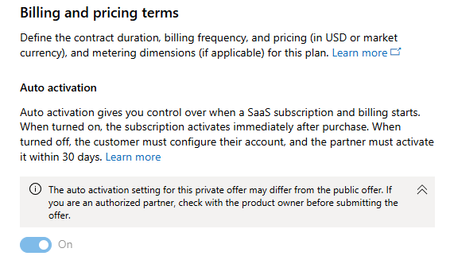
Shout out to Microsoft Marketplace for launching AUTO ACTIVATION for SaaS private offers. This has simplified our sales operations for Microsoft Marketplace private offers, as well as dramatically improved our seller and customer experience with by eliminating the #1 reason we've historically seen block customers from completing Marketplace SaaS private offer procurement. Auto activation for private offers allows customers to skip the step of going to our SaaS landing page and activate Marketplace SaaS billing by having to SSO with their AAD. The problem with this step is that most of our customers are in regulated industries, and their AAD admins do not allow SSO on SaaS landing pages without enabling profile sharing, which requires a Global Admin to enable. We've encountered far too many times where our customer is scrambling to find their Global Admin so that they can complete the final steps to finish the steps to activate Marketplace SaaS billing. This also puts our sellers in the awkward position of having to help customers diagnose and troubleshoot the situation, which as a rule they are not equipped to, or find a Microsoft resource to help. Now, with this new feature the whole SSO to our SaaS landing page and associated problems are eliminated. Ever since we started using it our customers' procurement experience has been faster and smoother. I'm looking forward to more improvements to the Marketplace experience! Here is the feature: https://learn.microsoft.com/en-us/partner-center/marketplace-offers/create-new-saas-offer-plans#configure-auto-activationA cautionary tale if you have customers who use Coupa
We learned the very very very hard way that next-day Marketplace invoicing does NOT play nicely with Coupa. Here's what happened: Back in April, we closed a Marketplace transaction via private offer with one of our enterprise customers. Not a new customer, either - this was for a license extension with a current customer with which we'd transacted through Marketplace twice before. 30 days go by, and Partner Center still shows the invoice as 'uncollected.' 60 days go by, and Partner Center still shows the invoice as 'uncollected.' I open a ticket with Marketplace support. And kudos to them, they pick up my ticket within an hour. "Customer hasn't paid the invoice," they tell us. So now we are forced to take on the role of collections agency for a Microsoft invoice our customer hasn't paid and for which we don't know why they haven't paid. (Partner Center's Revenue reports are rather light on useful details.) Our buyer inside the customer also has no idea why the invoice wasn't paid: She sits far away from the folks who pay the Microsoft bills. Her colleague in IT who pushed the buttons to purchase the private offer likewise has no idea why the invoice wasn't paid: He too sits far away from accounts payable. We're baffled because never before have we had any delay in getting our payouts for this customer's Marketplace purchases. Our first thought is okay, maybe they now have custom net 60 payment terms with Microsoft. (A different issue we experienced on a different delayed payout back in January!) After ten days of intensive investigations involving nearly a dozen different people, we finally discover the source of the issue: The customer pays its Microsoft bills through Coupa, BUT: they did NOT know about nor integrate into Coupa workflow the (relatively new) next-day invoicing mechanism for Marketplace transactions. For their accounts payable team, if an invoice doesn't land in Coupa, it doesn't exist. The invoice for this Marketplace purchase was generated, but it got sent . . . nowhere, I guess? So in picking up my support ticket, Marketplace Support could only say "Customer hasn't paid the invoice." They probably had no way to know the correct response was "Customer hasn't received the invoice." Moral of the story: Ask your customers if they use Coupa. And if yes, prepare them for the possibility they might not receive the invoice for your software.Multiparty private offers in Microsoft Marketplace are expanding to 30 countries across Europe
We're excited to share that beginning on May 27, multiparty private offers through Microsoft Marketplace will expand to 30 countries in Europe. Further expansion to Australia, Japan, and South Africa will be available July 15—with more markets to follow. Multiparty private offers empower channel partners to bring vetted solutions to their customers to differentiate while companies developing software can lean on the partners’ local expertise to scale to new markets. Learn more: aka.ms/MPOEEAblog Additional resource: we recently hosted a Marketplace community event on Multi‑currency private offers in Microsoft Marketplace. Given this recent announcement about multiparty private offer expansion, I encourage you to access the recording. You will learn how to confidently navigate local currency transactions, understand how timing impacts payments, and apply best practices when executing deals across geographies.407Views2likes0CommentsTurn your Azure commitments into smarter cloud investments with Microsoft Marketplace
Discover how organizations are using Microsoft Marketplace as a strategic procurement engine to optimize Azure spend, streamline purchasing, and accelerate time to value. Learn how aligning software purchases with Microsoft Azure Consumption Commitment (MACC) can unlock cost savings, improve visibility, and ensure every dollar of cloud investment is fully optimized—helping teams make more informed, outcomes-driven decisions. Read the full article: Optimizing Azure spend with Microsoft Marketplace | Microsoft Community Hub Watch the recorded conversation: Using Microsoft Marketplace to optimize Azure spend - Microsoft Marketplace CommunityThe AI Trust Gap: We're Auditing Outputs, But Nobody's Watching the Input
Hi all, Manjish here, founder of Pryvasee.AI. I want to open a conversation rather than make a pitch, because I think this is a problem bigger than any one company can solve, and I'd like to hear how others in this community are approaching it. Over the past year, watching enterprises adopt LLMs like ChatGPT, Claude, Gemini, Grok, DeepSeek, etc one pattern kept showing up. Almost every governance conversation started after the prompt was sent. Teams were building dashboards to review AI outputs, running periodic audits, writing acceptable use policies. All useful, but all reactive. Nobody I spoke to had a clear answer to a much simpler question: what actually happens to the sensitive data in that prompt in the moments before it leaves your organisation's control? That gap is why we built Pryvasee.AI differently. Instead of sitting after the model and reviewing what came back, we sit before it. Pryvasee Guard screens prompts, documents, and images for PII, PHI, and PCI and other such sensitive data before anything reaches a model. Pryvasee Thread lets you run the same request across OpenAI, Gemini, Grok, and DeepSeek from one interface, so you're never trusting a single model's answer by default. And the Trust Engine scores every response that comes back for groundedness and hallucination risk, so there's a number behind "does this look right" instead of a gut feeling. We built it natively on Azure (AKS, Azure SQL, Azure SQL Ledger for a tamper evident audit trail) because we think the next wave of AI governance problems won't just be about data leakage. They will be about proving, after the fact, exactly what happened, for a regulator, an auditor, or your own board. Most organisations can't do that today for a single AI interaction, let alone thousands a day across four different model providers. We're early. MVP/Beta since July 2026, live on the Microsoft Commercial Marketplace since late August, and currently working through a handful of enterprise pilots rather than claiming a long customer list. I would rather be upfront about that than oversell it. What I'm genuinely curious about: for those of you building or advising on enterprise AI adoption, is anyone handling the "before the model" problem today, whether with tooling, policy, or something else? And do you think this becomes a bigger issue as more employees start using multiple AI tools side by side, or does it resolve itself as the big model providers add more guardrails natively? Would love to hear how others are thinking about this.
Microsoft Templates for Azure Application upload
Hi All, Are there ready to use templates for the documentation that Microsoft is requesting to upload for this offer type - such as Solution and Deployment Architecture, Customer Installation Guide, Customer Onboarding and Configuration Guide, Data Integration Guide. If yes, could someone share the links or the templates. Thank you!Delay in Marketplace Revenue Being Reported in Revenue Report
We're having an issue where we're missing a large chunk of our July 2026 revenue being reported in our https://partner.microsoft.com/en-us/dashboard/insights/commercial-marketplace/analytics/revenue. We usually see a small delay of up to a few days for the previous month's revenue to show up, but it's been over 2 weeks now and we're still missing a large portion of our expected Revenue. We've confirmed in our service that we sent the correct meters and we haven't churned a large chunk of our customer base. Is there a place we can go or API we can call to pull more up to date information? Or is there a known delay in August that is causing a longer-than-usual delay?Accelerate channel-led growth by activating partners through Microsoft Marketplace
Unlock new revenue opportunities and scale your go-to-market strategy by activating your channel ecosystem through Microsoft Marketplace. This comprehensive sales and marketing playbook provides software companies with practical guidance, proven frameworks, and ready-to-use assets to recruit, enable, and grow channel partnerships in a modern, cloud-first marketplace. Learn how to streamline transactions, simplify procurement, and expand into new markets using Marketplace capabilities such as resale-enabled offers and multiparty private offers empowering partners to co-sell more effectively and reach customers who are actively investing in cloud and AI solutions. Whether you’re looking to build a repeatable channel-led sales motion, increase deal velocity, or strengthen partner engagement, this playbook delivers actionable insights to help you drive scalable growth through Microsoft Marketplace. Read the full article: Activating channel partners on Microsoft Marketplace: A sales and marketing playbook