copilot
34 Topics
Launching DIY Data Control for Nonprofits
I want to create a library of open-source resources that helps self-taught IT champions in nonprofit organisations build fully governed, secure shared data systems. I have plenty of ideas about how to do this, but before I press ahead, I want to listen to the people I hope to support to ground those ideas in reality. For my first project, I want to draw on part of the Microsoft ecosystem, which provides some useful tools for safely building your own data systems: Microsoft Learn: Microsoft provides a wealth of free learning resources. I use them a lot and they are as good as other resources that I have happily paid for. The two big barriers to using them are finding time and working out where to start. The Common Data Model for Nonprofits: This is an open-source resource from Microsoft, it describes the tables of data that a nonprofit organisation needs, and the relationships between them. Once you add your own data it becomes a shared functioning model of your organisation. Role based column and row level security: This is the revolutionary part that lets you safely replace scattered spreadsheets with a single, comprehensive, shared model of your organisation. It lets you decide exactly which parts of which records people are allowed to see or change, so everyone who interacts with your shared model can only see and change the things that they need to. Model-driven Power Apps and Power BI: Once you have a detailed model of your organisation with governance baked into it, adding tools to interact with it becomes straightforward. Both Model-driven Power Apps and Power BI can understand the structure of your organisation from your model, and they will respect the governance policies that you built into it. In theory, these should provide all the tools you need to bring together scattered data in siloed spreadsheets into a single, secure, auditable shared source of truth. But there are gaps, and I want to find out what guides, signposts and tools would be needed to bridge them. Later I will want to explore the features that you could add with Copilot Studio if you wanted to. Once you have established a clearly defined, precisely secured data environment, Copilot Studio can provide the tools to develop and deploy AI agents safely. But for now, I will focus on the foundations of well-defined, well-governed, accessible data. If you have any thoughts about this project then I would love to hear them, and I’d especially like to find out what pain-points there are that I can target. So please do get in touch. Patrick Killeen Head and Heart CIC email address removed for privacy reasons https://www.headandheart.info/ This work is released under the MIT Licence and is available at https://github.com/head-and-heart-cic/public/blob/main/in-practice/2600707-launching-diy-data-control-for-nonprofits/README.md317Views2likes5Comments
Want to get more out of Microsoft Copilot Chat without adding another tool—or cost—to your stack?
Microsoft has released a free Copilot Chat learning pathway that helps users quickly build practical, everyday skills using Copilot Chat already built into Microsoft 365 apps. Even better, Copilot Chat is now available to users without a paid Microsoft 365 license, making this learning opportunity widely accessible. In under an hour, you’ll learn how to: Write clearer, more effective prompts Refine Copilot responses for better results Use Copilot Chat for real work—summarizing, drafting, brainstorming, and planning It’s a quick, hands‑on way to boost productivity and help teams feel confident using AI in the tools they already know. 👉 Check out the learning pathway and the original LinkedIn post here.330Views1like1CommentA Practical, Technical Guide to Bringing AI Into Everyday Nonprofit Workflows
Nonprofits face increasing pressure to improve efficiency, strengthen reporting, and communicate more frequently—often with limited staff and resources. Microsoft Copilot for Microsoft 365 embeds AI directly into familiar tools like Word, Excel, Outlook, Teams, and PowerPoint, allowing nonprofits to automate knowledge work without adopting entirely new systems or hiring specialized AI teams. How Copilot Works Under the Hood Copilot is built on three core components: 1. Large Language Models (LLMs) These AI models generate, summarize, and transform text and other content. 2. Microsoft Graph Microsoft Graph connects Copilot to your organization’s data—including: Emails Files (SharePoint, OneDrive) Meetings and calendars Teams chats This provides context-aware responses based on your organization’s existing content. 3. Microsoft 365 Apps Copilot is embedded directly inside: Word Excel Outlook Teams PowerPoint Together, these components allow Copilot to generate insights and content grounded in your organization’s data. [learn.microsoft.com] 📌 Important: Copilot does not create new data silos. It respects existing permissions, so users only see data they are already authorized to access. 👉 Learn more: Microsoft 365 Copilot overview Requirements to Enable Copilot To use Copilot in Microsoft 365, organizations generally need: A supported Microsoft 365 plan (e.g., Business Standard, Business Premium, E3, or E5) A Copilot add-on license Proper data stored in Microsoft 365 (e.g., OneDrive, SharePoint, Teams) 📌 Copilot’s effectiveness depends heavily on how well your data is organized and accessible. Technical Use Cases for Nonprofits 1. Grant Writing & Reporting Automation Copilot can: Summarize program outcomes from documents (Word, SharePoint) Generate draft grant narratives Rewrite content to align with funder tone Extract insights from structured data (Excel, reports) ⚠️ Clarification: In many standard Microsoft 365 Copilot scenarios, Copilot does not directly query Power BI datasets. Instead, it relies on data embedded in documents, emails, or exported reports. However, newer integrations (e.g., Microsoft Fabric and Copilot Power BI integration) allow Copilot to access and answer questions using Power BI reports and semantic models, depending on licensing, environment, and configuration. Technical Advantage Copilot uses Microsoft Graph to pull relevant context from your organization’s documents, reducing manual copy-paste work. How to Use Copilot in Word for Grant Writing Open Word Select Copilot icon to open the Copilot pane Choose Draft with Copilot (or start typing a prompt) Enter a prompt such as: “Draft a 2-page grant narrative using the attached program summary and last year’s outcomes.” (Optional) Reference or attach relevant files from OneDrive or SharePoint Click Generate Review the draft Refine using Copilot commands such as: Rewrite (improve clarity) Expand (add detail) Adjust tone (formal, persuasive, etc.) 2. Outlook + Copilot for Donor Communications Copilot can: Draft personalized donor emails Summarize long email threads Rewrite messages for tone and clarity Suggest follow-ups Technical Note Copilot can use: Previous email threads Attached documents Calendar context to generate more relevant responses. How to Use Copilot in Outlook Open a new email Click Copilot icon in the tool bar Select Draft with Copilot Enter a prompt such as: “Write a warm thank-you email to a donor who contributed $500 to our youth program.” Click Generate Review the drafted email Edit directly or use Copilot to: Rewrite Adjust tone (formal, friendly, etc.) Change length (shorter or longer) Select Keep it, then send when ready 3. Teams Meeting Summaries Copilot in Teams can: Generate meeting summaries Identify decisions and key points Extract action items Suggest follow-ups 📌 Copilot works from meeting transcripts and chat logs. How to Use Copilot in Teams Start or join a Teams meeting Enable Transcription (recommended for full Copilot functionality) After the meeting, open the meeting chat or calendar event Select the Recap tab Click Copilot Select or enter a prompt (e.g., "Recap the meeting") Review: key discussion points Decision Action items 4. PowerPoint Storytelling Copilot can transform content into presentations: Word documents → slide decks Meeting summaries → presentations Reports → visual narratives Technical Advantage Copilot uses semantic understanding to: Structure slides Generate speaker notes Suggest layouts and visuals How to Use Copilot in PowerPoint Open PowerPoint Select the Copilot icon to open the Copilot pane Provide a prompt or upload a document Copilot generates slides and notes Refine using design and layout suggestions Security & Compliance Copilot inherits Microsoft 365’s enterprise-grade security model, including: Role-based access control (RBAC) Data residency and compliance controls Existing permissions enforcement Zero Trust principles 📌 Important clarification: Microsoft states that customer data is not used to train foundation models. Data remains within your organization’s tenant boundary. 👉 Learn more: Data, Privacy, and Security for Microsoft 365 Copilot | Microsoft Learn Important Implementation Considerations 1. Data Readiness Copilot’s quality depends on your data: Organized SharePoint libraries Consistent file naming Structured documents 2. Access Control Ensure proper permissions before rollout: Avoid overexposure of sensitive data Audit SharePoint and Teams access 3. Human Oversight Copilot generates drafts—not final outputs. Always review grant narratives Validate donor messaging Confirm factual accuracy Final Thought Microsoft Copilot is not a replacement for nonprofit expertise—it is a force multiplier. By embedding AI into everyday tools, nonprofits can: Reduce administrative workload Accelerate writing and reporting Improve internal communication Focus more time on mission-driven work When implemented thoughtfully—with strong data practices, governance, and human oversight—Copilot can help organizations move faster, communicate more effectively, and make better-informed decisions. Ultimately, the goal is not just efficiency, but greater impact—freeing teams to spend less time on repetitive tasks and more time advancing the mission they serve.498Views0likes2Comments
Integrate MS AI into our 3rd party app
Is there a way to integrate AI (copilot) into our 3rd party app? Our app is used by large number of users to access technical content. They have to navigate through tons of content which is not very efficient. The AI for example could based on the user profile, push matching content on the top. This is just one example, there are many more. I am not sure whether MS NP division has any dedicated team who collaborate with NP organisations like us on such needs, is there a way to contact someone there? Luckily, I found this community while looking for ways to contact MS. I can already see some interesting discussions in different sections.1.7KViews0likes9Comments
Goodstack-Validated Nonprofit Rejected After Forced Resubmission — No Escalation Path
I am posting this because Microsoft Elevate frontline support told me there are no further escalation paths available, and I believe this may affect other nonprofits. Timeline of facts: - June 19, 2026: Goodstack, Microsoft's authorized validation partner, confirmed our nonprofit (Opera Verace Foundation, EIN 33-2305878, California 501(c)(3)) was approved for Microsoft nonprofit grants and discounts. - June 23, 2026: Microsoft Elevate support informed me the original application was in an unrecoverable system error state due to an unrecoverable error in their system, and they instructed me to resubmit under a different email address. I only had one email directed to my business email and asked if I could use a Yahoo email. - June 30, 2026: The same Elevate representative confirmed in email to me that using a Yahoo email address as a temporary workaround was fully supported and "the correct and supported path forward." - July 2026: A different Microsoft Validation Team (not the one I had worked with originally) rejected the resubmission (likely due to use of a yahoo.com email as my business email address) and demanded documents not listed in the published eligibility requirements, including a bank statement. They stated the original Goodstack approval cannot be reinstated. - When I pointed out that Goodstack's validation was never rescinded, that my organization's nonprofit status can be confirmed on propublica online, and that the resubmission existed solely due to Microsoft's own system error and instructions, I was told this was a determination of another team and no further escalation paths exist. The core issue: Goodstack validated our organization on Microsoft's behalf. Microsoft's own system error forced resubmission. Microsoft's own representative authorized the (incorrect) workaround in writing. The Validation Team is now treating the workaround submission as a brand new independent submission requiring extraordinary measures for re-validation, ignoring the Goodstack validation, ignoring the request to check propublica, and ignoring the fact that thier reuest for additional documents is nowhere to be found in Microsoft's own document requirements in Microsoft's published nonprofit eligibility policies. Ticket number: 2606210040000788 Is anyone at Microsoft able to escalate this to someone with authority over the Validation Team? Has anyone else encountered this after being directed to use a personal email for resubmission?279Views0likes0CommentsTurn AI Potential into Real Impact—One Day Is All It Takes
🌐 Online | Multiple session times 📅 May 6, 2026 🔗 Register: https://aka.ms/AgentathonMay2026 If AI is on your roadmap—but still feels out of reach—this is your reminder that May 6 is coming up fast. The Microsoft Global Agent‑a‑thon is your opportunity to move from AI interest to real, usable solutions in one day, with guidance and support that continues well beyond the event. This isn’t about watching demos or talking about possibilities. It’s about building. Why This Matters Right Now Across nonprofits, public sector, education, and business, teams are stretched thin. Workloads are increasing, expectations are growing, and there’s little room to experiment without support. AI agents can help—if teams know how to build and apply them responsibly and effectively. That’s exactly what the Agent‑a‑thon provides: Hands‑on building Clear learning paths Real use cases Ongoing guidance A global community solving real problems There’s a Level for You Whether you’re brand new to AI or already building solutions, there’s a path designed for your role and goals: 🌱 Explorer Build your first AI agent, no coding required and walk away with something you can use immediately. ⚙️ Commander Automate workflows, connect systems, and reduce repetitive work using Copilot Studio and no‑code tools. 🚀 Master Design secure, enterprise‑grade AI agents with governance, orchestration, and scale in mind. No matter the level, the focus is the same: practical impact, not theory. A Special Note for Nonprofits Nonprofits often feel the pressure of “doing more with less” the most. Through the Agent‑a‑thon, nonprofits can: Automate administrative tasks that drain time and energy Support staff and volunteers with faster access to information Scale services without adding overhead Explore AI in a safe, guided environment Build solutions aligned directly to their mission Most importantly, you don’t have to do it alone. The Agent‑a‑thon is designed to support you before, during, and after the event. More Than a Day—A Starting Point Yes, the build happens in one day. But the learning, support, and momentum continue. Participants can submit their agents, access continued resources, and learn alongside a global community focused on real‑world outcomes—not shelfware. If AI is on your list this year, this is your moment. One day to build. Ongoing support to grow. A chance to shine globally.290Views0likes0CommentsChildren International: Turning time saved into lives changed
What happens when a nonprofit gives hours back to its people? Children International is using AI to reduce administrative work and reinvest that time into children, families, and communities. The impact is already clear — in Colombia, participation in educational programs rose from 33% to 95%. Read the full story and watch how this shift is helping scale mission where it matters most: Microsoft for Nonprofits LinkedIn98Views0likes0Comments
REGISTER: Nonprofit & Education Partners Webinar - Mar 24 (EMEA)
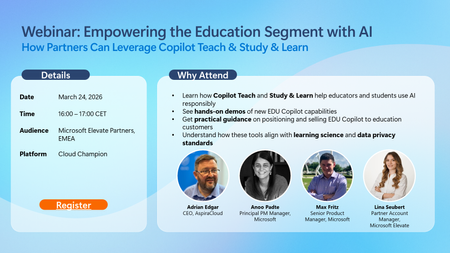
Microsoft Elevate Partners in EMEA — Don’t Miss This EDU Copilot Webinar! MARCH WEBINAR | Empowering the Education Segment with AI: How Partners can Leverage Copilot Teach and Study & Learn When: March 24, 2026 Time: 4:00 PM CET 👉 Register ✔️ Why join: Get a clear view of how Copilot for EDU is evolving and what it means for education customers today. ✔️ What you’ll gain: Hands-on demos of the new Teach and Study & Learn agents now available in Copilot Chat for EDU Clear guidance on how these learning-science–based capabilities support responsible AI use while meeting strict education data privacy requirements Practical positioning tips from Microsoft Partner AspiraCloud, drawing on real-world experience with educational institutions ✔️ How it helps Stronger education customer conversations, and more confident positioning of Copilot for EDU. Webinar: Empowering the Education Segment with AI | Microsoft Community Hub114Views0likes0CommentsDiscontinuation of M365 Business Premium Grant Deeply Disappointing,Harmful to Small Nonprofits
As a Microsoft CSP partner supporting multiple nonprofit organizations, I am extremely disappointed by the decision to discontinue the Microsoft 365 Business Premium grant. This change disproportionately affects small nonprofits that rely on these tools to fulfill their missions with limited resources. The justification that this is about “alignment” or “sustainability” is disingenuous. Let’s be honest—this is a revenue-driven decision that undermines Microsoft’s long-standing commitment to empowering nonprofits. Removing access to essential tools like Office desktop apps and Intune from the grant program forces small organizations into paid plans they cannot afford, jeopardizing their operations and security. Microsoft has built goodwill in the nonprofit sector over the years. This move erodes that trust. I urge you to reconsider this decision or at least provide a longer transition period and more flexible options for small nonprofits. Please do better. The nonprofit sector deserves more than a corporate cost-cutting maneuver disguised as a strategic realignment.1.3KViews8likes3Comments