

Forum Widgets
Latest Discussions

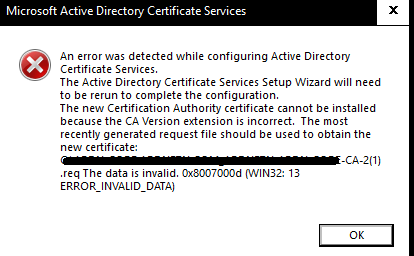
Two-tier AD Certificate Services error importing cert into SubCA
Hello, I'm new here, but excited about being able to hob nob with all you in furthering our IT goals. I'm setting up my root and Subordinate CA and I'm importing my rootCA issued, subCA certificate into the subCA. I get I get the same error when the subCA automatically exports its cert req to the root Ca and when I do it manually. I also get this error whether i'm using X.509 or p7b files. what's unusual about this error is that it seems to be referencing a .req file with a '(1)' added to the end of the title. Original .req did not have the '(1)'. any assistance I can get from the community would be appreciated.156Views0likes2Comments
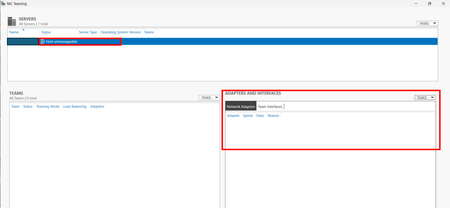
try to create NIC-Teaming but its shown Host Unmanagable
I have install new Windows Server to Physical Server and try to create NIC-Teaming but its shown Host Unmanagable Even I create by using PowerShell It work properly but in this Server Manager its still not shown.PSJSep 08, 2026Occasional Reader4Views0likes1Comment jameeeSep 07, 2026Copper Contributor123Views0likes2Comments
Assign IP Address for Windows Server 2025 VM on Hyper-V
I have built my first Windows Server 2025 VM on HyperV and trying to assign an IP address. I want the VM's to be like an actual server so I Created an external vswitch. The HyperV server IP is 172.16.1.41 with a physical gateway of 172.16.1.5. I have tried to assign the new VM with 172.16.1.42/255.255.255.0 and the Gateway is 172.16.1.5 also. However, I cannot get a positive ping. Do I need another VSWITCH configured or what am I missing?Mike_GarczynskiSep 04, 2026Tin Contributor141Views0likes4Comments
How are you managing Group Policy changes after AGPM end of support?
Hi, I’m interested in how organizations are handling Group Policy change management now that AGPM is no longer supported. In environments where GPOs are still heavily used, what are you relying on today for version history, change tracking, rollback and approvals? Are you continuing with AGPM, moving to products such as GPOADmin or Cayosoft, or mainly using native GPMC backups and PowerShell? I’m also interested in whether there is still a gap around having a clear web-based view of GPO history and changes, especially being able to understand exactly what changed and which users or computers may be affected before a change is applied. I’d be interested to hear how this is handled in real production environments and what parts of the process are still manual or difficult.techoraitSep 04, 2026Copper Contributor77Views0likes1CommentSNMP Query fails with Error: Error in packet. Reason: (genError) A general failure occured
I have enabled a win Server 2022 and a Win11 machine to answer SNMP requests. However both machines run into error while doing a snmpwalk. I have started with OID just before errornous OID. Both machines show same behaviour. Does someone experience same problem? Can someone recreate this problem? Does someone know a cure fort this problem? Does someone have any ideas how to proceed? root# snmpwalk -Os -v 1 -c public <hostname> .1.3.6.1.4.1.77 comVersionMaj.0 = STRING: "10" comVersionMin.0 = STRING: "0" comType.0 = Hex-STRING: 03 00 00 00 Error in packet. Reason: (genError) A general failure occured Failed object: comType.0 root@monitor:/etc/munin/plugins# snmpwalk -On -v 1 -c public <hostname> .1.3.6.1.4.1.77 .1.3.6.1.4.1.77.1.1.1.0 = STRING: "10" .1.3.6.1.4.1.77.1.1.2.0 = STRING: "0" .1.3.6.1.4.1.77.1.1.3.0 = Hex-STRING: 03 00 00 00 Error in packet. Reason: (genError) A general failure occured Failed object: .1.3.6.1.4.1.77.1.1.3.0UtnapischtimSep 02, 2026Copper Contributor125Views0likes2CommentsWindows Server 2022 Hyper-V : vmconnect introuvable pour accéder à la console VM (Server Core)
Contexte Windows Server 2022 [Standard/Datacenter — à préciser], rôle Hyper-V installé. J'ai créé une VM invitée Linux nommée « Wazuh » (installation d'une plateforme SIEM), elle démarre correctement. ce serveur est une VM imbriquée dans un autre hyperviseur type VMware Workstation. je suis en simple groupe de travail (workgroup). Ce que je constate PS C:\Users\Administrator> Start-VM -Name 'Wazuh' PS C:\Users\Administrator> vmconnect localhost Wazuh vmconnect : The term 'vmconnect' is not recognized as the name of a cmdlet, function, script file, or operable program. Check the spelling of the name, or if a path was included, verify that the path is correct and try again. At line:1 char:1 + vmconnect localhost Wazuh + ~~~~~~~~~ + CategoryInfo : ObjectNotFound: (vmconnect:String) [], CommandNotFoundException + FullyQualifiedErrorId : CommandNotFoundException PS C:\Users\Administrator> Get-VM -Name 'Wazuh' | Select-Object State, Status State Status ----- ------ Running Operating normally PS C:\Users\Administrator> vmconnect localhost Wazuh vmconnect : The term 'vmconnect' is not recognized as the name of a cmdlet, function, script file, or operable program... La VM est bien « Running / Operating normally » selon Get-VM, donc le souci n'est pas la VM elle-même mais l'accès à sa console. Ce que j'ai déjà essayé Get-WindowsFeature *Hyper-V* → [colle ici la sortie exacte que tu as obtenue] Install-WindowsFeature -Name RSAT-Hyper-V-Tools -IncludeAllSubFeature → toujours pas de vmconnect.exe fonctionnel après coup Je soupçonne que ce serveur est installé en mode Server Core (pas d'interface graphique locale), et j'ai lu que la conversion Core → Desktop Experience n'est plus possible après coup depuis Server 2016. Ma question pour la communauté Est-il vraiment impossible d'obtenir une console graphique locale (vmconnect / Hyper-V Manager) sur un Server Core, même une fois les outils de gestion Hyper-V installés ? Quelle est la méthode la plus fiable pour accéder à la console d'une VM Hyper-V hébergée sur un Server Core, en environnement non-domaine (workgroup) : Windows Admin Center, Hyper-V Manager distant (config WinRM/TrustedHosts), ou faut-il simplement réinstaller en Desktop Experience ? Si quelqu'un a déjà mis en place Windows Admin Center ou du Hyper-V Manager distant sur un lab en groupe de travail (sans AD), un retour d'expérience serait très utile. Merci d'avance !AntonioDownavan02Aug 30, 2026Copper Contributor138Views0likes1Comment
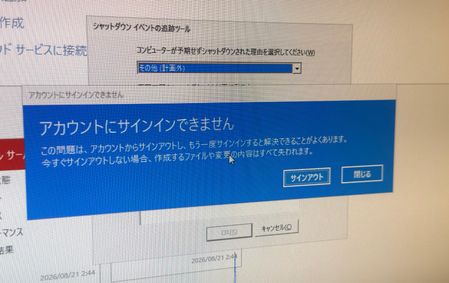
Issue with Temporary Profile on Windows Server 2025 after renaming built-in Administrator account
Hi everyone, I am facing an issue with a temporary profile on Windows Server. Environment details: ・OS: Windows Server 2025 Datacenter ・Setup: On-premises environment with 2 servers (AD DS Domain Controller and Web Server) ・Affected Server: Web Server (Domain joined) Recently, I renamed the built-in Administrator account on the Web Server. After that, the system became completely unresponsive, so I had to force a power off. Upon signing in after the reboot, I received the error message: "We can't sign in to your account" (or "You've been signed in with a temporary profile"). It seems the profile folder or registry mapping for the renamed Administrator account was corrupted due to the force shutdown. I tried restarting the server, but the issue persists. Could anyone please advise on the proper way to resolve this registry/profile conflict and safely restore the renamed Administrator profile? Please note that I am a native Japanese speaker and a beginner in IT, so I may not fully understand complex technical English. Simple, step-by-step instructions would be greatly appreciated! Thank you in advance for your help! Translated by Gemini, grammar checked by DeepLFumaAug 27, 2026Tin Contributor396Views2likes7Comments
Migrating from VMware to Hyper-v
Hi, I've recently deployed a new 3x node Hyper-v cluster running Windows Server 2025. I have an existing VMware cluster running exsi 7.x. What tools or approach have you guys used to migrate from VMware to Hyper-v? I can see there are many 3rd party tools available, and now the Windows Admin Center appears to also support this. Having never done this before (vmware to hyper-v) I'm not sure what the best method is, does anyone here have any experience and recommendations pls?AndrewStoryAug 27, 2026Copper Contributor4.3KViews0likes6Comments


Tags
- windows server2,290 Topics
- Active Directory859 Topics
- management398 Topics
- Hyper-V349 Topics
- networking334 Topics
- security305 Topics
- storage218 Topics
- clustering162 Topics
- powershell155 Topics
- AMA102 Topics