
Forum Widgets
Latest Discussions

File History problems after installing KB5124008, KB5126052,KB5126146, KB5122878, and KB890830
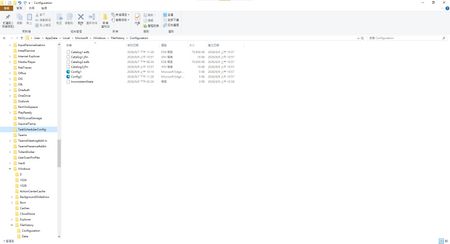
This morning, I ran Windows Update on two Windows 10/11 computers, but the file history feature stopped working completely after the update. Previously, after updating KB5121003 and KB5101684, files could still be backed up to the D: drive normally. The "Last Backup" time in "File History" is not updating correctly. Newly created or saved Word documents, pictures, videos, etc., still show "No previous version available" in "Content → Previous Versions". No folders were corrected; their dates are automatically updated. After running Windows Update again today, the file history feature stopped working on both computers. The File History panel pops up but cannot be used, prompting for a hard drive connection. (The hard drive is connected and I've confirmed it can read and write.) resulting in an "InconsistentState" entry in C:\Users\User\AppData\Local\Microsoft\Windows\FileHistory\Configuration. I'm very angry. If Microsoft doesn't address this, I'll keep complaining. If anyone else has encountered the same situation, please leave a comment below. You can also check Microsoft Q&A or the Microsoft Community Hub. The five updates installed are: September 8, 2026—KB5122878 (OS Builds 19045.7725 and 19044.7725) September 8, 2026-KB5126146 Cumulative Update for .NET Framework 3.5, 4.8 and 4.8.1 for Windows 10 Version 22H2 2026-09 Security Update (KB5124008) (26200.9445) 2026-09 .NET Framework Security Update (KB5126052) Windows Malicious Software Removal Tool x64 - v5.145 (KB890830) Deleting the %LocalAppData%\Microsoft\Windows\FileHistory folder also failed. Furthermore, "File History" itself is not listed in Microsoft's "Deprecated Features List." While other backup features suggest that Microsoft has no plans to discontinue it. Microsoft is going to pretend it doesn't exist. These worked normally before the update but stopped working afterward. This is to inform other users experiencing the same problem.sheratonSep 12, 2026Iron Contributor2KViews1like9Comments
Can't upgrade to Windows 11 Build 26340.9354
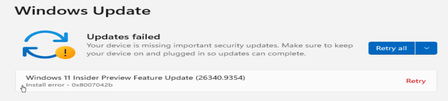
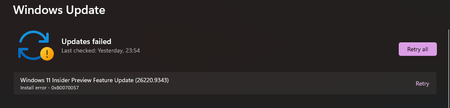
So on 8th of Sept Microsoft release the preview build on the windows insider program for the experimental channel build 26340.9354 but no matter what I can't upgrade to this build no matter what I tried to via windows update and it would download and install and ask me to reboot but when I did and the upgrade process start it would always fail and roll back so then I tried running sfc /scannow 3 times and dism to fix any corruptions but still it kept failing then I said well might try with uup dump but the download links are broken on uup dump for this build so then I did a fresh install of windows 11 joined windows insider program and tried to upgrade but it keeps failing with different error codes for example - 0x8007042b I am just now out of ideas what to do next maybe wait for a feature build or something idk I would highly appreciate if you guys leave your comments down bellow52Views0likes0Comments
KB5124008 issue
KB5124008 (26200.9445) prevents HyperX headphones from connecting/working I am experiencing a reproducible audio/headphone issue after installing the 2026-09 Security Update (KB5124008), OS Build 26200.9445. My computer is an ASUS TUF Gaming A16 (FA608UM) running Windows 11 Home 25H2. The affected audio device appears in Device Manager as HyperX Virtual Surround Sound. Its currently installed driver information is: Driver Provider: Microsoft Driver Date: 04/09/2026 Driver Version: 10.0.26100.9444 Digital Signer: Microsoft Windows After KB5124008 is installed, my headphones are no longer able to connect/work correctly with the computer. I have already spent significant time troubleshooting this issue and eventually isolated KB5124008 as the cause. The behavior is reproducible: KB5124008 installed → headphones stop connecting/working. KB5124008 uninstalled → headphones work again. Windows Update automatically reinstalls KB5124008 → the headphone problem immediately returns. This has now happened multiple times. Uninstalling the update restores the functionality, but Windows Update automatically downloads and installs KB5124008 again, leaving me with the same problem. I contacted Microsoft Support regarding the issue and was advised to report it here on Microsoft Tech Community. I do not want to permanently disable Windows Update, particularly because KB5124008 is a security update. I would like either a fix for the regression introduced by this update or a way to temporarily prevent KB5124008 specifically from reinstalling while continuing to receive other Windows updates. Given that removing and reinstalling the exact same update consistently changes whether the headphones work, this appears to be a regression associated with KB5124008 rather than a hardware failure. System information: ASUS TUF Gaming A16 FA608UM Windows 11 Home Version 25H2 OS Build 26200.9445 AMD Ryzen 7 260 with Radeon 780M Graphics NVIDIA GeForce RTX 5060 Laptop GPU 16 GB RAM HyperX Virtual Surround Sound Microsoft audio driver 10.0.26100.9444 dated 04/09/2026 I can provide additional Device Manager information, hardware IDs, Event Viewer logs, or other diagnostics if required. I would appreciate it if this issue could be investigated, as I am currently forced to choose between keeping the latest Windows security update installed and having functional headphones.PacoDheedeneSep 11, 2026Copper Contributor73Views1like0Comments
Cant Install ChatGPT
I have tried to install ChatGPT many times but it just either gets stuck installing or errors with error: 0X80073CF9 I have tried: - wsreset.exe - DISM /Online /Cleanup-Image /RestoreHealth - winget source reset --force - winget install 9PLM9XGG6VKS --source msstore - Get-AppxPackage -allusers Microsoft.WindowsStore | Foreach {Add-AppxPackage -DisableDevelopmentMode -Register "$($_.InstallLocation)\AppxManifest.xml"} - Get-AppxPackage -allusers Microsoft.DesktopAppInstaller | Foreach {Add-AppxPackage -DisableDevelopmentMode -Register "$($_.InstallLocation)\AppxManifest.xml"} I've tried all the AI Assistants to help me out. I then tried Microsoft themselves and i got told to post on heretomhv9Sep 09, 2026Copper Contributor31Views0likes0CommentsThere is problem with file history logging after the recent Windows updates (KB5101684 / KB5121003)
Hi everyone, This is not spam, I did not spam the site. It appeared after the update. I hope Microsoft can resolve this issue, and I also hope other users experiencing the same problem can reply to me. Please, please. Ever since the latest Windows updates (specifically around KB5101684 / KB5120249 on Windows 11 Build 26200/Windows 10 Build 19045), The File History feature is almost unusable for me; although it works, the problem only occurs after an update. Symptoms: The "Last Backup" time in File History is not updating correctly. Newly created or saved Word documents, images, videos, etc., still show "No previous version available" in "Content → Previous Versions". The Correct folder's date is automatically changed. System details: OS: Windows 11 25H2 (Build 26200.9278) OS: Windows 10 22H2 (Build 19045.7663) Recent Updates Installed: KB5120998, KB5120249, KB5101684. Has anyone else experienced this issue with recent Windows updates? Currently, the only solution is to go to Control Panel → All Console Items → File History → Select Drive → Select D: drive again. After completing this step, File History will return to normal. This is a post I made. Other users who have experienced the same thing left comments below. KB5101684/KB5120249 caused File History errors, but Microsoft has not acknowledged them. | Microsoft Community Hub Welcome to comment if KB5101684 or KB5120249 caused the same File History issue. | Microsoft Community Hub I want to ask Microsoft, why are there abnormal in the file history logs after these two updates? | Microsoft Community Hub Win 10/11 file history is malfunctioning after an update why hasn't Microsoft fixed this issue yet? | Microsoft Community Hub https://learn.microsoft.com/en-nz/answers/questions/5972265/windows-11-file-history-not-updating-correctly-aft https://learn.microsoft.com/en-nz/answers/questions/5978256/win-11-25h2kb5101684-os-builds-26200-8973-and-2610 https://www.reddit.com/r/computerhelp/comments/1vituh0/comment/p6dxvs4/?context=1&screen_view_count=2&ext-referrer=DIRECT https://www.reddit.com/r/WindowsHelp/comments/1w6zlem/comment/p8bbu3j/?context=1&screen_view_count=2&ext-referrer=DIRECTsheratonSep 07, 2026Iron Contributor122Views2likes1Comment
windows fungerar inte att uppdatera sig felkoder hela tiden
jag kan inte uppdatera min windows i 1 års tid nuthomassaronySep 07, 2026Copper Contributor2Views0likes0Comments
When can I leave the program?
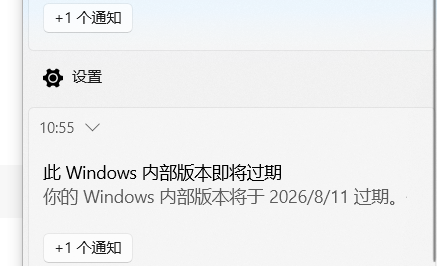
I want to leave the program as it does not work with ubisoft anti cheat any more so I cannot play my games. I toggled to unenrol at the next update, but it gives zero information on when this might happen. I currently have build 26220.8754. Is there any way I can find out when I might go back to the stable build?freddie211Sep 06, 2026Copper Contributor31Views0likes1Comment- LANYI1145Sep 04, 2026Copper Contributor28Views0likes0Comments
Tags
- insider183 Topics
- windows 11169 Topics
- windows 10129 Topics
- Feedback128 Topics
- Windows Insider116 Topics
- dev79 Topics
- Windows1164 Topics
- suggestion63 Topics
- new51 Topics
- fast ring51 Topics