purview
157 TopicsSharing: PDF readers that support Purview labels
As I was researching on Adobe Acrobat reader and Sensitivity labels, I decided to check if the common alternative PDF readers out there are able to support Purview MIP Sensitivity labels. There is already a published documentation on this for SharePoint-Compatible PDF readers that supports Microsoft IRM: https://learn.microsoft.com/en-us/purview/sp-compatible-pdf-readers-for-irm (last updated Nov-2023) but I wanted to see if these same PDF readers supports the ability for end-users to use/ select labels similar to that of Adobe Acrobat As of 11-June-2025; atleast one of them clearly do: Nitro PDF: Yes. Documentation shows that users can see and use the sensitivity labels. PDF -X.change Editor: Yes. Documentation show that users can see and use the sensitivity labels. (check the official website, I can't hyperlink it because the site is blocked. FOX PDF editor: No. Documentation only states RMS and not clear if it show Purview labels. This is for F.O.X.I.T editor (spelled without the ".") but for some reason there is a community ban on that word and it won't allow me to post the full name PDFescape: No. Sumatra PDF: No Okular: No If there are other PDF readers that I've missed, I encourage you list it down in the comment below. Would love to grow this list.1.5KViews5likes4Comments
Updates to Assets Prevent Future Scan Updates
We've been working with Purview slowly over the last few days. Today I was able to scan some heavily used on-prem SQL server databases. Once the scan was complete I went into the assets, located the first asset I wanted to classify, and started to add a description. The minute I clicked Edit on the asset a warning appeared stating "Making a manual update to the asset will prevent future scans on this asset from updating it." As a software developer, I understand why this might be necessary, however as a member of the data governance team it concerns me. I need the ability to add classifications/glossary terms/contacts/descriptions to newly discovered assets, but I'd also like scanning to update the schema as the asset changes based on information found in scans. Is the functionality to edit an asset manually and receive updates from scans something that is on the roadmap? Will it be available in GA?6.4KViews3likes8Comments
Anthropic Claude Purview Data Connector showing all users as Guests..
It appears this connector is not mapping fields properly causing internal users to be mapped as "guests", and since prompts/data isn't maintained for guest users the connector is effectively not gathering anything but noise. Unlike the other data connectors, one cannot create field mappings. Also the app being named using the guid of Microsoft's own "dataassessments" service principal I don't think is intended either. Has anybody else experienced this? See below for an example.549Views2likes7Comments
Can´t Sign confidential documents
Hello, I have a problem. I want to send confidential contracts to customers for signing with Adobe DocuSign. This contracts have a label "confidential" from purview and are encrypted. But now the customer cant sign the contract with DocuSign because of the encryption. Is there a way that they can sign the document? We must encrypt the documents because compliance reasons and ISMS. Thank you.331Views2likes5CommentsApply Sensitivity label on SharePoint or Teams site to block offeline sync
Hi All, I was wondering is there any way if we apply a label toa SharePoint or Teams site (backed by SharePoint), we can enforce restrictions such as "Don't allow offline sync". Thanks in advance, DilanSolved203Views2likes2CommentsMicrosoft Purview Best Practices
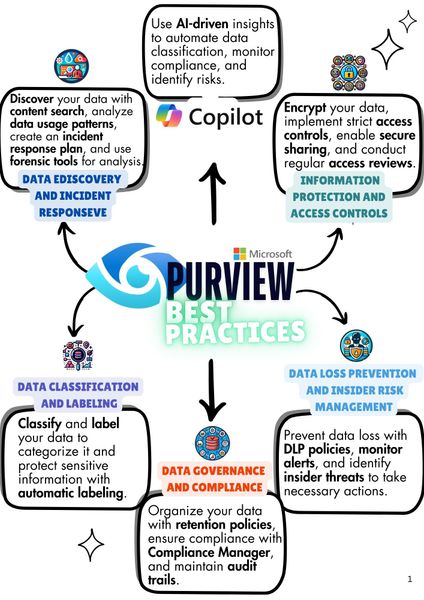
Microsoft Purview is a solution that helps organizations manage data and compliance. It also uses AI to classify data, monitor compliance, and identify risks. Key features include data discovery, classification, governence, retention, compliance management, encryption, and access controls. Purview ensures data security, prevents insider threats, and helps implement data loss prevention policies to meet compliance requirements. Hello everyone - This is just a short introduction, I am Dogan Colak. I have been working as an M365 Consultant for about 5 years, holding certifications such as MCT, SC-100, SC-200, SC-300, and MS-102, with a focus on Security & Compliance. This year, I am excited to share what I have learned with the Microsoft Technology Community. In the coming days, I will be publishing videos and articles based on the training agenda I have created. I will also share these articles on LinkedIn, so feel free to follow me there. I am always open to feedback and suggestions. See you soon!1.3KViews2likes1Comment
Onboarding Devices: "No authenticated user found"
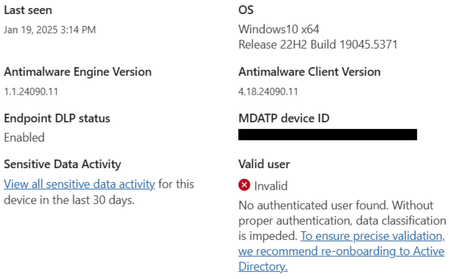
Hi, I am looking to onboard a device in Purview for the purpose of testing some Endpoint DLP policies. I have ran the onboarding script locally and the device successfully appears on the 'Devices' screen. 'Real time protection/RTP' and 'Behavior monitoring/BM' both show as 'enabled' with a green tick, however under 'Valid User' it has a red cross and states: "Invalid: No authenticated user found. Without proper authentication, data classification is impeded. To ensure precise validation, we recommend re-onboarding to Active Directory". The device is in active directory. I have signed into the device with an account that is also in Active Directory. Is there anything additional that I need to do? Any help would be really appreciated - thank you!!!Solved2KViews2likes4Comments
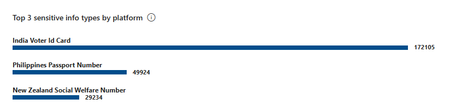
India Voter ID Card found 172,000 times. How can I disable built-in "Sensitive Info Types"?
When I open up Purview, one of the things I'm greeted with is the image below. I found another forum post and it appears you cannot disable these built-in items. I was also unable to delete them (grayed out). This is insanely frustrating and seems to be a huge security detriment. I could have a hundred United States SSNs but they would be pushed off this list by literally a million things I don't care about (I know for a fact our documents don't have any India Voter ID cards...). Even if I could delete the, one by one, there are HUNDREDS of types that are not relevant to us. Is there any way to just disable all the defaults?354Views2likes5CommentsMissing activity names from Audit Log documentation
We all know that the documentation team is A-tier and amazing at what they do and isn't just copy and pasting marketing materials. But I've noticed that some really obscure functionalities like 'user registered a device' or 'user joined a device' or about half the other things a user can do, are not documented on this list of activity names. The ironically named 'friendly' list doesn't work. So I actually can't audit the unfamiliar devices under our tenants? It appears that this KB is actually locked down, so more can't be added when they are discovered. How are we supposed to use the tool Microsoft has forced everyone towards, when the Documentation team is too bad to document anything, so they outsource it to the community (Microsoft victims), but then they lock down contributions (presumably, because they have some metric that keeps them from being useful - atleast based on my interactions with them). Documentation seems to be a massive fail on Microsoft's part. How did it get this way? Is there a reliable way of finding the activity name - one that ISN'T some preview Graph endpoint that I can't teach my techs to use, because I'm not teaching my techs to program?129Views1like1Comment