outlook
2168 Topics
Planning a Google Workspace to Microsoft 365 Migration? What Should You Consider?
Hi everyone, Has anyone recently migrated from Google Workspace to Microsoft 365? I’m interested in knowing what challenges you faced during the migration, especially around mailbox data, calendars, contacts, user mapping, or the final cutover process. For those planning the migration, what are the key things you recommend preparing before getting started? Would like to hear your experiences and suggestions.520Views0likes5Comments
Microsoft Sign In Loop
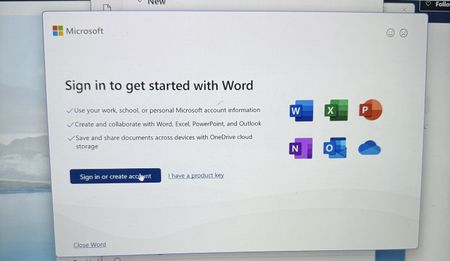
I am trying to sing into Microsoft 365, but every time I do, it takes me back to the login screen. I sing in with my outlook account, but I can't reach the applications. I can sign in on the browser, but not the applications on my computer. I have tried uninstalling and reinstalling M365, but the issue still persists76Views0likes1Comment[Community tool] Find the GPO, registry value and Intune setting for any Office ribbon button
Hi everyone, as a technical service owner for Microsoft 365 Apps, one question comes up for me again and again: which policy actually controls this button or option? The information is all there – in the Office ADMX/ADML templates, the Office Fluent UI control ID lists, the Intune Settings Catalog and many Learn articles. But I never found it in one place, so every answer meant connecting several sources by hand. Especially when onboarding new colleagues, this costs a lot of time. So I built a free community tool for it: Office Admin Explorer https://tools.pascal-donath.de/office-admin-explorer/ How it works It's a clickable mock of Word, Excel, PowerPoint and Outlook (ribbon, File menu, Options, Trust Center). Click any element and you get: idMso and Policy ID (for customUI and the "Disable commands" policy) the ADMX policy with its exact path in Group Policy Management the registry value it writes, with ready-to-copy PowerShell or .reg the matching Intune Settings Catalog entry Cloud Policy notes, step-by-step guides and Microsoft Learn links The search covers all Office ADMX policies (2,400+) and command IDs (8,000+), including elements that aren't part of the mock. Also included Ribbon builder – hide or disable buttons, groups or tabs and export the result as customUI XML, a macro-free add-in (.dotx / .xlam / .ppam) or the "Disable commands" policy for Group Policy and Intune Deployment view – configuration.xml generator for the Office Deployment Tool User Support view – typical user problems: symptom → cause → fix Policy names and registry values are checked against Microsoft's ADMX/ADML files, and the Intune mapping against the Graph settings catalog. It runs in the browser without sign-in and is available in English and German. Please test any configuration on a lab device or pilot group first. I'd like your input How do you handle this today – ADMX search, Group Policy Search, the Intune catalog, your own documentation? Which Office settings do you get asked about most often? I'd like to add the most requested ones next. If you find a wrong or outdated entry, every entry has a "Report it on GitHub" link – corrections are very welcome. Thanks! Pascal --- *Transparency note: The tool was developed with the help of AI. The content is based on my own admin experience, and policy names, registry values and Intune mappings are validated automatically against Microsoft's official sources (ADMX/ADML templates, Fluent UI control lists, Microsoft Graph settings catalog). This is a community project and not affiliated with Microsoft.*Outlook clients receive error 0x8004010f when downloading the Offline Address Book
EDIT 10/01/2008: To read the updated (and more comprehensive) guidance for troubleshooting errors 0x8004010f, please go here. There are a multiple reasons for why an Outlook client can receive the 0x8004010f sync error. Unfortunately, 0x8004010f is just a generic MAPI error and will show up for a variety of problems. Here is what the error looks like under err.exe (Microsoft Exchange Server Error Code Look-up Tool): C:\WXP\system32>err 0x8004010f # for hex 0x8004010f / decimal -2147221233 ecNotFound ec.h ecAttachNotFound ec.h ecUnknownRecip ec.h ecPropNotExistent ec.h MAPI_E_NOT_FOUND mapicode.h # 5 matches found for "0x8004010f" This is what the error looks like from the sync log from within Outlook: 12:45:53 Synchronizing Mailbox <dgoldman> 12:45:53 Done 12:45:54 Microsoft Exchange offline address book 12:45:54 0x8004010f Some of the most common reasons for Outlook clients to receive the 0x8004010f error with regards to downloading the OAB are listed below. Most of these are documented and I have linked articles to each of these to help everybody out. Please note that these solutions can change a small bit depending on unknown factors in a company's environment. An administrator decommissioned the last Exchange server in a site and never pushes replicas to another Exchange server. A new OAB is created in the active directory and the information store never reads the active directory during its maintenance schedule. This will result in the OAB files never being generated and the Outlook client will fail to download anything. The information store has an invalid EntryID that points to the legacy EX:/ folders. Again there is nothing for the client to download. An outlook client logging in from one domain to another domain and attempting to log in to another users mailbox. The OAB was never generated or some OAB folders are missing from the public folder store. Multiple OAB Version folders exist of the same type. Clients are attempting to download the OAB files from a public folder store that have not received the replicated updates. The offline address book list object has a missing address list. The offline address book list object has an incorrect address list. Send/As changes in the store affect users accounts with no mailbox full rights to another mailbox. If you are seeing this error on an Exchange 2007 server and your OAB is generated by an Exchange 2007 server, please make sure of the following: 1. Make sure that you have added the replicas of OAB to the Exchange 2007 server 2. Make sure public folder replication is working. 3. Make sure the OAB is public folder enabled and you have OAB Version 2, OAB Version 3 and OAB Version 4 checked off so your legacy clients can download the OAB files from the public folder store. 4. Make sure that if you are using an Outlook 2007 client, your OAB is Web Distribution enabled and the OAB files have been replicated over to the Client Access Server. For more information on this process please see this blog: http://blogs.msdn.com/dgoldman/archive/2006/10/23/outlook-client-fails-to-download-the-oab-with-error-0x8004011b.aspx and http://blogs.msdn.com/dgoldman/archive/2006/08/25/How-Exchange-2007-OAB-Files-are-replicated-to-a-Client-Access-Server-for-download.aspx 5. If you are removing your last Exchange 2003 server from the org, please make sure that you follow our documentation on this process. - Dave Goldman82KViews1like18CommentsHow to Recover Data from a Damaged or Corrupted OST File When Outlook Cannot Open It
Hi everyone, I have seen several cases where users still have an old OST file but cannot access the mailbox data inside it. This usually happens after an Outlook profile is removed, a Microsoft 365 or Exchange account is changed, a mailbox is no longer available, or the OST file becomes damaged or corrupted. One common misunderstanding is that an OST file can be opened on another computer in the same way as a PST file. However, an OST file is linked to the Outlook profile and mailbox that created it. If that connection is no longer available, Outlook may not be able to open the file normally. Before trying to recover the OST data, it is worth checking a few things: Is the original Microsoft 365 or Exchange mailbox still available? Can the Outlook profile be recreated and synchronized again? Is the issue related to the OST file itself or only the Outlook profile? Do you need the complete mailbox data or only specific folders/items? If the mailbox is still available, rebuilding the Outlook profile and allowing Outlook to create a new OST may be the better approach. However, if the mailbox no longer exists, the Outlook profile has been deleted, or the OST file is damaged and contains the only available copy of the mailbox data, recovery becomes a different process. In these situations, it is important to first check what information is still readable from the OST file. Scanning and previewing the mailbox data before export can help identify available folders, emails, attachments, contacts, and calendar items before creating a new PST file. A practical OST recovery workflow usually involves: Keeping a copy of the original OST file before making any changes. Checking whether the original mailbox can still be synchronized. Scanning the OST file to identify available mailbox items. Reviewing important folders and messages. Exporting the required data to PST. Validating the resulting PST in Outlook. A detailed overview of the OST to PST conversion process, including scanning, previewing, selecting mailbox items, and exporting recoverable data, is available here: https://www.edbmails.com/pages/ost-to-pst-converter.html One important point to remember is that recovery results depend on the condition and readability of the OST file. A conversion tool can help extract available mailbox information, but it cannot recreate data that is no longer present or readable inside the source file.199Views0likes1CommentWhy do Apple macOS and Ubuntu clients display Exchange meeting times one hour earlier than scheduled
If a meeting is generated from Apple macOS and Ubuntu clients showing the meeting time as one hour earlier than the actual scheduled time email solution is exchange server 2019, what will be the issue.164Views0likes1CommentUnable to Open an Old OST File After Outlook Profile or Mailbox Changes
Hi everyone, I am looking for suggestions on handling an old OST file where the original Outlook profile or mailbox is no longer available. The situation is that an OST file contains important mailbox data, but Outlook cannot open it normally after changes to the user account or profile. This can happen after a Microsoft 365 mailbox change, Exchange migration, user account removal, or when an OST file becomes damaged. Since OST files are linked to the Outlook profile and mailbox that created them, simply moving the file to another system does not always make the data accessible. Before attempting any recovery approach, I would like to understand the recommended steps: Is there any Microsoft-recommended method to access an orphaned OST file? What checks should be performed before trying to recover data from the OST? How do administrators usually handle old OST files when the original mailbox is no longer available? What is the best way to validate recovered mailbox data? I would appreciate feedback from anyone who has handled similar Outlook OST recovery scenarios after Microsoft 365 or Exchange changes.376Views0likes5Comments