microsoft 365
2139 Topics
Unlocking Microsoft 365 Adoption in Engineering, Manufacturing, and Regulated Industries
Executive Feedback to Microsoft Leadership: Expanding the Value of Microsoft 365 Beyond Cloud-First Workflows Executive Summary Microsoft has successfully built the industry's leading cloud collaboration ecosystem around Microsoft 365, OneDrive, and SharePoint. The strategy has delivered substantial value for information workers, distributed teams, and organizations pursuing cloud-first operating models. However, there is a significant and often overlooked customer segment that remains underserved: engineering, manufacturing, healthcare, medical device, industrial, laboratory, defense, and other regulated organizations whose primary workflows are intentionally built around file-based repositories, network shares, PDM/PLM systems, and controlled document environments. The challenge is not opposition to cloud technology. The challenge is that many of these organizations prioritize data integrity, traceability, predictability, and workflow continuity above all else. As a result, they often perceive modern Microsoft productivity capabilities such as AutoSave, coauthoring, and version history as being unnecessarily coupled to OneDrive and SharePoint. This creates an important business opportunity. Microsoft could unlock substantial additional Microsoft 365 adoption and customer goodwill by extending modern document protection and collaboration capabilities to local, network-hosted, and hybrid file environments without requiring a complete migration to OneDrive or SharePoint. This is not a request to replace cloud services. It is a request to recognize that cloud-first and file-based workflows can coexist. The Opportunity Is Larger Than It Appears Many of Microsoft's largest enterprise customers operate in environments where files are not simply documents. They are: Design history files Manufacturing records Engineering drawings Validation reports Device master records Controlled procedures Laboratory data Regulatory submissions Quality records For these organizations, file location, revision control, ownership, auditability, and retention are operational requirements rather than convenience features. Microsoft itself acknowledges that Office AutoSave currently requires files to be stored in OneDrive or SharePoint. Files opened from traditional file-system locations do not receive the same experience. As a result, many organizations feel they must choose between: Maintaining proven operational workflows. Accessing Microsoft's most advanced productivity features. That is a business decision many organizations simply refuse to make. The Real Barrier Is Not Technology. It Is Trust. Discussions around cloud adoption are often framed as a resistance-to-change problem. Research consistently suggests otherwise. Studies examining enterprise cloud adoption repeatedly identify security concerns, data privacy concerns, and control over organizational information as major barriers to adoption. One study found security concerns dramatically increased the likelihood that organizations would reject cloud adoption. Similarly, KPMG's cloud transformation research notes that concerns about data loss, audit findings, compliance issues, and operational risk can slow or limit cloud initiatives. The lesson is important: Organizations rarely reject technology because it is new. They reject technology because they do not trust it with critical business information. Once users experience: unexpected file overwrites, synchronization ambiguity, permission confusion, data residency uncertainty, conflicting document versions, trust declines rapidly. Trust, not functionality, is often the limiting factor. Engineering Users Experience the World Differently Microsoft's cloud ecosystem was largely designed around information-worker collaboration. Engineering organizations frequently operate under different assumptions: Information Worker Priority Engineering Priority Seamless sharing Data integrity Anywhere access Traceability Real-time collaboration Configuration control Ease of use Auditability Cloud accessibility Revision certainty Neither approach is wrong. The challenge is that Microsoft increasingly optimizes for one while under-serving the other. An Example: AutoSave AutoSave is one of the most valuable additions Microsoft has made to Office. The value proposition is obvious: Reduced data loss Improved productivity Lower cognitive burden Better user confidence Microsoft's own documentation describes AutoSave as continuously saving changes while users work, but only when documents reside in OneDrive or SharePoint. From Microsoft's perspective, this design is understandable. From the customer perspective, the message often becomes: "Modern document protection is available, but only if you adopt Microsoft's preferred storage architecture." Many customers view this not as a technical limitation, but as product segmentation. Microsoft Could Learn from Version Control Systems Modern software development solved multi-user document conflicts decades ago. Git was specifically designed around realities such as: multiple devices, multiple contributors, offline work, concurrent editing, conflicting changes. Critically, Git assumes conflicts are inevitable. Rather than hiding them, Git exposes conflicts and provides mechanisms to resolve them. Many engineers trust Git precisely because its behavior is transparent. By comparison, file synchronization systems often attempt to abstract away complexity. When synchronization fails, users can no longer determine: which version is authoritative, which edits are newer, what happened, who changed what. The engineering mindset is frequently: Show me the conflict. rather than Hide the conflict and make a decision on my behalf. The Untapped Hybrid Customer Much discussion around Microsoft 365 assumes organizations are either: Cloud-first, or Legacy. In reality, many enterprises are neither. Many operate as hybrid organizations and intentionally will continue to do so. Research from industry and security organizations continues to show persistent adoption of hybrid and multi-cloud architectures driven by governance, security, compliance, and operational requirements. These customers are not rejecting Microsoft. They are already paying customers. They often purchase: Microsoft 365 Windows Azure Teams Active Directory SQL Server Yet many would immediately purchase additional capabilities if Microsoft offered: Local AutoSave Office AutoSave functionality for: NTFS local storage SMB file shares NAS systems PDM-managed documents Local Version History Built-in document time travel without cloud dependence. Hybrid Collaboration Coauthoring capabilities that operate through enterprise file infrastructure. Enterprise Conflict Resolution Visualization and reconciliation of competing document changes. Network-Aware Document Protection The same confidence users experience in OneDrive without requiring migration to OneDrive. The Revenue Opportunity This is not merely a product-improvement request. It is a business opportunity. A significant portion of engineering and regulated industries remain hesitant to migrate entirely into cloud-centric document ecosystems because the perceived operational risks exceed the perceived benefits. Rather than forcing an all-or-nothing decision, Microsoft could monetize a middle path: Microsoft 365 Hybrid Collaboration A premium offering delivering: AutoSave Version History Recovery Conflict Resolution Audit Visibility for enterprise-controlled file infrastructure. Organizations that decline OneDrive adoption today may still eagerly purchase these capabilities. In effect, Microsoft could create incremental revenue from customers who are already committed to the Microsoft ecosystem but currently feel underserved by a cloud-only feature strategy. Recommendation Microsoft should stop treating file-server and network-share users as transitional users waiting to migrate. Many are not transitioning. Many have intentionally chosen architectures optimized for regulatory compliance, engineering rigor, operational control, and data governance. The future should not require choosing between: modern productivity features, and trusted enterprise workflows. The organizations building medical devices, industrial equipment, aerospace systems, manufacturing infrastructure, energy systems, and critical technologies represent some of Microsoft's most technically sophisticated and commercially valuable customers. They deserve first-class support for the workflows they intentionally operate. The opportunity is not to move every customer to the cloud. The opportunity is to bring Microsoft's best innovations to every customer, regardless of where their files live.18Views0likes0Comments
Disable incessant nagware popups
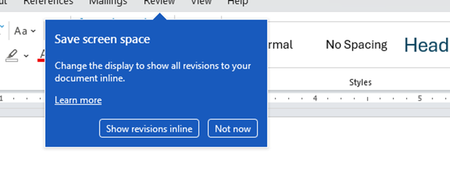
I don't know about everyone else, but I am sick and tired of the nagware pop ups in Word, Excel, PowerPoint, Outlook, etc. Every single product harasses me with pop ups trying to tell me "hey, did you know this feature was here?", "you can do this if you click that", "let me hold your hand through using products you've used for decades even though you don't want daddy Microslop to do that". This is a prime example. I keep getting the same ones again and again and again and everything I've read indicates they should only appear once. But they don't. They keep coming back like a psychotic stalker ex who wants alimony even though you were never married. How do I get this nagware to stop?!411Views1like2Comments
Standard red no longer standard in Word - oops or worse?
The "Standard" colour red, which has forever been defined as #FF0000 (or if you prefer, RGB 255,0,0) is now defined as #EE0000 (238,0,0) in Word. Why? This feels unintentional, but if it was a design choice that's even more frustrating. It's still #FF0000 in PowerPoint and Excel. I hope they're not next. -------------- Optional background aka venting: I teach trades college on and off and I have hundreds of question sheets and a couple of extensive reference / workbook documents in which I put all the answers to student questions in "standard" red font colour to create an instructor's key edition. Then to create the student version all I need to do is use the Replace function to search arbitrary text with the red colour attribute and replace each occurrence with a single blank space. (The space keeps formatting from collapsing if I'm also careful to make sure the paragraph end codes are still in black.) This has been a big time-saver for keeping key and student versions matched when revisions are made, and as a bonus, the red text makes the answers pop in the key which is nice. I just made a few minor updates on one of these docs and guess what happened when I tried to replace all the text in "standard" red? Yup. None found. I opened a support session during which I managed to identify the problem and my required workaround by myself after the support tech had me try my method in a new document and it worked. In the session wrap-up this was identified as a "document formatting" (aka my) problem vs an application functionality (aka their) problem. To which my response would've been (had I turned my inner Karen loose) "and what do you suppose all that old document formatting was done with y'all?" I'm grateful that I can deal with it, but I remain mildly miffed, slightly baffled, and out a couple of hours that I will never get back.11Views0likes0Comments"Unlock additional AI credits across M365 apps by upgrading your plan..." It didn't happen
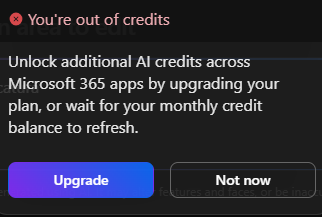
a { text-decoration: none; color: #464feb; } tr th, tr td { border: 1px solid #e6e6e6; } tr th { background-color: #f5f5f5; } I exhausted all my AI credits on Microsoft 365 Personal. I was then prompted to upgrade in order to get more AI credits. Based on that information, I upgraded to Microsoft 365 Family. However, after upgrading, I still have no AI credits available. 1. The prompt I received did not mention any specific plan needed to get more credits than I had. Simply stated that I needed to upgrade my account to get more credits (as shown here below). 2. I entered my Microsoft account and chose to upgrade. In any of the plans, the amount of AI credits included is shown. So I chose to upgrade to "365 family" 3. I did not get any credits for that as expected, and the prompt above kept showing the same. 4. The same day (Oct,10th) I contacted support to have this cleared out. They said it was a matter of account type migration for the upgrade to charge the AI credits, and I was told to wait for that to happen. If not, to come back for them to solve it. 5. I asked copilot about that, and I was told that "365 Personal" and "365 Family" have the same credits (????). So I did not get any additional credits unlocked for having done the upgrade as suggested by Microsoft. 6. Today I came back to support saying nothing happened, and I wanted to be compensated with the promised unlocked credits that I did not get, or to be refunded for the upgrade that did not produce the expected result. This might qualify the prompt as a misleading publicity teaser. 7. Support service unexpectedly told me they are not the ones to solve this complaint, and it was supposed to be solved by you here at the discussion forum. Which I found odd, but here I am asking you to solve my problem. Had I known that upgrading from Personal to Family would not provide additional AI credits I would not have upgraded. I believe the information presented to me was misleading, as I was not clearly informed that this specific upgrade would not serve the pourpose to unlock additional AI credits.60Views0likes1CommentWhere to get support? Microsoft has the worse customer service I have ever experienced.
There is no customer support, period. I have called 12 times over the last 4 weeks to try and resolve my issue. The problem: I am the only global admin on my Office 365 account. I am locked out. I use a password manager so the password was saved. However, it doesn't work. I proceeded with the password reset. This does not work. The email it asks to send the password reset to is 'not valid'. The phone number I used to sign up is 'not valid'. Both are correct. I checked these carefully when I signed up. While the people I speak to are polite and try to assist me, I repeat myself on every call and never get to the bottom of it. Each time I am transferred to the data protection department and each time they say they will call me back 'today'. I have not had one phone call from them despite giving my phone number to the person on the phone each time. I received one email from them on the 4th of January to ask for the best number to contact me on. This is despite having provided the phone number seven times by that point. I have not had a reply to the email that I sent in response. I now simply wish to cancel everything. I never, EVER have issues with customer service with any business as I know people generally do their best to help resolve whatever the situation is. However, I cannot call this any sort of customer service or support. There is absolutely zero. As one of the world's largest companies in tech I assumed they would have better systems in place. I called three times today. The first time, a friendly enough guy answered and provided me with a phone number to call the data protection department which I later found I could not use as I'm outside the US. I've been calling from Skype. To speak with someone from the data protection team I must call from the number which I signed up for the account with. I'm not prepared to be charged astronomical international phone call fees to get through to a department I have little faith in getting a resolution from. If there an alternative number to directly call the data protection department for free, from Vietnam, I'd like to know. I cannot find it. The second time I tried calling back only to be left on the call with no response whatsoever. Someone answered because I could hear the background noise in the contact centre. I then called again. The same thing happened. Respectfully, please someone from support who can help with my situation please contact me. I am a new small business owner and this has taken countless hours to still not get a resolution. As far as I am aware, I am still paying for my 365 email accounts that I cannot access. I simply want to cancel everything at this point.1.7KViews3likes4CommentsNo acces to local Office365 apps with an account which differs from the current windows account
Hi, guys! I'm working with Windows 11 Pro using the Microsoft account ABC. Today I bought a Office 365 Family License - by using another Microsoft account XYZ. I downloaded the local apps successfully... ...but when I start the local app and tried to sign in using the XYZ account, I'm asked for the Windows Hello Pin for the XYZ account - but there is no PIN for that, because the account doesn't exist as a Windows account at this computer at all. Copilot says: "You can sign in to Windows 11 with one Microsoft account and use a different Microsoft 365/Office account for Office applications. Microsoft supports this setup." What did I wrong - what can I do? Kind regards! Sebastian85Views0likes1CommentWhat to Do When SharePoint Search Doesn’t Return the Right Results
SharePoint search is one of the platform’s most powerful features—when it works as expected. But many organizations face a common frustration: search results that don’t seem accurate, complete, or relevant. If your users are struggling to find what they need, it can quickly undermine adoption and productivity. The good news? Most search issues can be diagnosed and fixed with the right approach. Here’s a practical guide to troubleshooting when SharePoint search isn’t returning the right results. https://dellenny.com/what-to-do-when-sharepoint-search-doesnt-return-the-right-results/332Views0likes1Comment
Microsoft auto-removed a user's license is action needed?
This is a strange one. Not my domain but someone I support. A 365 tenancy was created with a trial subscription. The trial subscription was used for setup, but allowed to expire as licenses were purchased from a reseller instead. While the trial was active it showed extra unused licenses but after the trial expired only the reseller's licenses were active, as expected. However, when the date passed for the trial subscription to be permanently deleted, a user's license was removed, disabling email, while an unused license remained in the tenancy. Re-assigning the license has fixed the problem but leaves me worrying that other weird stuff might happen to the tenancy, while also being annoyed that a user with a valid paid-for license had it auto-removed by some background process and email interrupted. Is there any further action I need to take to ensure that this tenancy continues to function correctly, I worry that one day the whole tenancy might get deleted?81Views0likes2Comments