microsoft 365
5392 Topics
No acces to local Office365 apps with an account which differs from the current windows account
Hi, guys! I'm working with Windows 11 Pro using the Microsoft account ABC. Today I bought a Office 365 Family License - by using another Microsoft account XYZ. I downloaded the local apps successfully... ...but when I start the local app and tried to sign in using the XYZ account, I'm asked for the Windows Hello Pin for the XYZ account - but there is no PIN for that, because the account doesn't exist as a Windows account at this computer at all. Copilot says: "You can sign in to Windows 11 with one Microsoft account and use a different Microsoft 365/Office account for Office applications. Microsoft supports this setup." What did I wrong - what can I do? Kind regards! Sebastian26Views0likes1CommentIntroducing SharePoint News and Viva Engage cross-posting
SharePoint News can now be cross-posted directly to a Viva Engage storyline or community. The original post retains its full SharePoint experience, while comments, replies, and reactions stay synchronized across both platforms.4.4KViews13likes26Comments
What happens when attackers get AI too?
Join Microsoft's live AMA on October 27, from 9:00–10:00 AM Pacific Time, to explore how AI could reshape cyberattacks—from reconnaissance and phishing to scripting and data analysis. Hear experts unpack realistic threats, practical limits, and the security controls that help keep organizations protected.76Views0likes0CommentsHacked Microsoft Account Recovery with Semi Access
I'm at a complete loss and it is infuriatingly ridiculous. I am entirely unable to get a hold of a human being at Microsoft and am being turned down by automated responses nonstop. So here's what's happening: My Microsoft account has been hijacked (obviously not this one) for its valuable Minecraft account and has now been sold. I am logged into my account via my PC, have full access of the main email address, but I have been locked out of my account using the alias email. Whenever I want to log in to my account, it wants to instead send a code to an email address I do not own and can't access. I have tried the Sign-In Helper, the Recovery Form, the hotline, the support email without any result, let alone a non-automated response. I sadly don't have the Recovery Code of my 15 year old-ish account. Since I still have full access of my email address I get updates of security info being changed and what not. Last month a stranger sent me screenshots of someone trying to sell my Minecraft account, for which I myself have received multiple buying offers, and voila yesterday I received notification of my alias mail address changing followed by Minecraft server apps being added to my Microsoft account. While I had already given up retrieving my account, whenever I get notifications my heart sinks a new while some hope sparks up again. Do you people have any idea of what I could do? I don't even rule out legal actions at this point. While I do of course have the email address of the hijacker and the buyer, I fear that contacting them results in me being locked out permanently. I'm just begging to catch the attention of anyone involved with Microsoft. This being walled out with automated responses is killing me.Microsoft Entra and logging in
Hi there, I signed up for a free trial of M365 with my iCloud email. It showed me what my login would be, i.e. John@<companyname>.onmicrosoft.com I never received an email to my iCloud account with any type of confirmation that the trial was active or my login info. I did not screenshot the login as I thought I would get an email with it. How can I retrieve that information as I obviously cannot login with my iCloud account. Recently I have been getting emails like these to my iCloud. You have a new recommendation for Arlo inc Do not allow users to grant consent to unreliable applications See why this recommendation was generated for your tenant and how to remediate it in the https://entra.microsoft.com/#view/Microsoft_AAD_IAM/RecommendationDetails.ReactView/recommendationId/2bc392f3-b17c-44ce-bb25-b52a2b095d0b_integratedApps/source/email. https://go.microsoft.com/fwlink/?linkid=2260505. But again, I have no idea what my login is. Any help would be greatly appreciated. My trial has been active for a few days now and I am running out of tie with it. Sincerely, John33Views0likes1CommentPut multiple values in one cell with lists and arrays in Excel
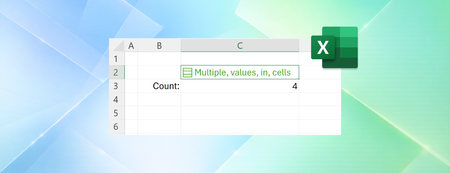
Throughout Excel's 40-year history, you've only been able to put one value per cell. In this announcement, we're excited to share how that's changing with the release of lists, arrays in cells, and nested arrays, initially to Microsoft Excel for Windows and Mac Beta Channels. Many workbooks already try to pack multiple values into one cell. A project might list "Carlos, Henrietta, Jacob" as three owners, or a Forms survey might return "2:00 PM; 2:30 PM; 3:00 PM" as one response. With lists, you can keep those values in one cell, while also keeping them separate for filtering, calculation and more. Later in this post, we'll explore arrays in cells and nested arrays in more depth. NOTE: These are preview features. Their behavior may change before general release based on your feedback. We don't recommend using them in important workbooks until they're generally available. Lists Lists let you put multiple values into one cell. You can create a list by selecting Insert > List or pressing Ctrl+J, then typing or pasting items separated by commas or semicolons, depending on your regional settings. Selecting the icon in the cell shows the individual values. You can add, remove, or edit list items by double-clicking the cell or pressing F2, just like other values. With lists, you can filter by one or more individual items instead of whole text entries. Referencing a list returns all its values for calculations. For example, =B2 spills those values into separate cells. Arrays in cells Lists are useful on their own, but they're part of a much broader change to Excel. For the first time in Excel, arrays can exist natively in cells as values or as formula results. They can be any size or shape and can even contain other arrays. You can now keep the result of any spilling formula in a single cell by "wrapping" the formula body with braces { }. Since the introduction of dynamic arrays, array results have spilled across cells – for example ={1;2;3}. Wrapping the original array with braces creates a 1x1 array around it, so instead of spilling to multiple cells, the array stays in a single cell. Braces have long been used to describe arrays in Excel and this extends that behavior by allowing multiple layers of braces. This gives you more flexibility when building spreadsheets. Instead of leaving room for a formula to spill, you can keep the result in one cell. Arrays inside arrays, or nested arrays Arrays can now also "nest" inside other arrays. For example: ={{1,2,3};{4,5,6}} Previously, a formula that produced an array of arrays would return a truncated result or #CALC! error. Now, supported formulas return the complete nested result. In the example below, you can see how TEXTSPLIT behaves with and without nested arrays. Without nested arrays, Excel only returns the first item for each row. With nested arrays, the result spills, one array per row. The arrays in each row can then be used in further calculations. Four new functions: FLATTEN, HAS, HASANY, HASALL To help you work with arrays more easily, we've added four functions. FLATTEN(array, [pad_value], [levels]) simplifies nested arrays by removing one or more levels of nesting. Continuing from the prior example, FLATTEN lets you simplify the nested array output, spilling the individual results into the grid. We used an empty string ("") for pad_value so rows with fewer items show blanks in the remaining columns. Three HAS functions check whether values are in an array: HAS(array, value) returns TRUE if value appears anywhere in array, and FALSE otherwise. HASANY(array, values) returns TRUE if any of the values appear anywhere in array, and FALSE otherwise. HASALL(array, values) returns TRUE if all of the values appear anywhere in array, and FALSE otherwise. Do more with spreadsheets using arrays in cells and nested arrays Arrays in cells open up spreadsheet designs that weren't practical before. The run tracker below captures split times (how long it takes to run each kilometer) in a table with one run per row. The number of splits depends on the length of the run. Stats for each run are calculated right in the same table. For more examples, I recommend looking to your favorite Excel communities on LinkedIn, YouTube, Reddit, or elsewhere. Enabling nested array calculations in a workbook Compatibility Version 3 will be released alongside arrays in cells and is required for most calculations involving nested arrays. You can set Compatibility Version for each workbook in by selecting Formula > Calculation Options. See compatibility versions for more information. Some existing formulas return different results in Compatibility Version 3. If your workbook doesn't behave as expected, you can keep it set to Compatibility Version 1 or 2. Known limitations As this feature rolls out to Beta Channel, the following limitations apply: Conditional formatting doesn't inspect array contents unless you use a formula Data validation can't use a list or array as dropdown items Charts don't expand an array into data points PivotTables don't read array values as source data Power Query doesn't load or emit array-valued columns Find & Replace can't replace list/array items Availability These improvements are rolling out to Beta Channel users running: Windows: Version 2610 (Build 20520.20000) or later Mac: Version 16.114 (Build 26092111) or later Features covered on this blog roll out over time to enable us to monitor quality and performance, so some preview features may not be available to you right away. Also note that features may be paused, adjusted, or removed as part of that process. Feedback Click Help > Feedback in Excel to tell us what you think.40KViews14likes62Comments
"Unlock additional AI credits across M365 apps by upgrading your plan..." It didn't happen
a { text-decoration: none; color: #464feb; } tr th, tr td { border: 1px solid #e6e6e6; } tr th { background-color: #f5f5f5; } I exhausted all my AI credits on Microsoft 365 Personal. I was then prompted to upgrade in order to get more AI credits. Based on that information, I upgraded to Microsoft 365 Family. However, after upgrading, I still have no AI credits available. 1. The prompt I received did not mention any specific plan needed to get more credits than I had. Simply stated that I needed to upgrade my account to get more credits (as shown here below). 2. I entered my Microsoft account and chose to upgrade. In any of the plans, the amount of AI credits included is shown. So I chose to upgrade to "365 family" 3. I did not get any credits for that as expected, and the prompt above kept showing the same. 4. The same day (Oct,10th) I contacted support to have this cleared out. They said it was a matter of account type migration for the upgrade to charge the AI credits, and I was told to wait for that to happen. If not, to come back for them to solve it. 5. I asked copilot about that, and I was told that "365 Personal" and "365 Family" have the same credits (????). So I did not get any additional credits unlocked for having done the upgrade as suggested by Microsoft. 6. Today I came back to support saying nothing happened, and I wanted to be compensated with the promised unlocked credits that I did not get, or to be refunded for the upgrade that did not produce the expected result. This might qualify the prompt as a misleading publicity teaser. 7. Support service unexpectedly told me they are not the ones to solve this complaint, and it was supposed to be solved by you here at the discussion forum. Which I found odd, but here I am asking you to solve my problem. Had I known that upgrading from Personal to Family would not provide additional AI credits I would not have upgraded. I believe the information presented to me was misleading, as I was not clearly informed that this specific upgrade would not serve the pourpose to unlock additional AI credits.13Views0likes0CommentsWhat to Do When SharePoint Search Doesn’t Return the Right Results
SharePoint search is one of the platform’s most powerful features—when it works as expected. But many organizations face a common frustration: search results that don’t seem accurate, complete, or relevant. If your users are struggling to find what they need, it can quickly undermine adoption and productivity. The good news? Most search issues can be diagnosed and fixed with the right approach. Here’s a practical guide to troubleshooting when SharePoint search isn’t returning the right results. https://dellenny.com/what-to-do-when-sharepoint-search-doesnt-return-the-right-results/279Views0likes1Comment