microsoft 365 apps for enterprise
95 TopicsAutoSave disabled when opening SharePoint-synced files from Finder after macOS Tahoe 26.6 update
Files stored in SharePoint Online and synchronized locally through OneDrive are opened as local documents when launched from Finder. Office applications display "Saved to my Mac" and AutoSave is turned off by default. However, opening the exact same files through Word/Excel > Open > Sites, or via SharePoint "Open in Desktop App", correctly identifies them as cloud documents. In that scenario, AutoSave is enabled and collaboration/version history features work as expected. Troubleshooting already performed: OneDrive reset and re-linked SharePoint library re-synced Signed out and back into both Office and OneDrive Removed Microsoft credentials from macOS Keychain and re-authenticated Recreated local OneDrive sync relationships Verified OneDrive File Provider extensions are enabled Verified Office applications and OneDrive are fully up to date Tested with newly created files and existing files Tested "Always Keep on This Device" with no change in behavior The issue appears to be specific to the Finder-to-Office launch path after upgrading to macOS Tahoe 26.6. Before upgrading to macOS Tahoe 26.6, opening the same SharePoint-synchronized files directly from Finder correctly preserved cloud document identity and AutoSave was enabled as expected. I discussed this issue in detail with Apple Support, but they quickly dismissed it, saying that the problem is not on Apple's side and that I should contact Microsoft instead.2.7KViews11likes28Comments
Microsoft 365 Outlook Classic Latest Update Copilot issues
Hello to all, we are currently using the Microsoft 365 Outlook Classic, using version Version 2604 Build 16.0.19929.20172 (Current Channel) Copilot works as expected; However ever since the next update was released (Version 2605 (Build 20026.20076)) some users including me, have been getting the below error: I have tried uninstalling and installing the latest version directly, with the same issue. Scanned for any corrupted system files with no issues,but still get the error; I have tried the update Licence from the Outlook application, with no issues but the copilot something went wrong error keeps on persisting. Internet searches are very vague and the I have found some registry suggestions which I have also tried with no solution. The only way to get Copilot working on Outlook Classic was to revert to a previous working version, only then Copilot works as expected. This only happens in Outlook Classic; Copilot works fine on the latest version of Microsoft Office 365 with Word, Excel, etc. For those that maybe might ask why not switch to the New Outlook, we have had issues with it and it has been recommended to use the Classic Outlook for the time being. Has anyone been experiencing such issues please? Thanks for any help.4.9KViews5likes14Comments
Is there a way to create role-specific competency frameworks in Microsoft 365?
We already have a lot of employee information in Entra ID, like job title, department, manager, location, and other user attributes. What I’m trying to figure out is whether we can use those attributes to automatically assign different competency frameworks to different groups of employees. For example, engineers would have one set of competencies, sales another, and managers would have additional leadership competencies. Ideally this would update automatically when someone changes role or department in Entra rather than HR maintaining everything manually. Has anyone built something like this with Entra + SharePoint/Power Automate, or is there a better way to manage competency frameworks while still keeping Microsoft 365 as the source of employee data?232Views0likes2Comments
Tracking whether managers actually complete their review cycles on time
Every quarter our HR team has to chase managers who havent finished their performance reviews. Right now they literally track it in an Excel spreadsheet and send reminder emails manually. Its embarrassing honestly. We're an M365 shop and I feel like there should be a way to automate this or at least get some visibility into completion rates without it being a manual process. Whats everyone else doing?247Views0likes3Comments
Teams Client, Guest User access, Separate Tenant
Hey Team, I am trying to figure out what i am missing here. This is what we have. 2x Tenants with Enterprise E3 licenses Some user accounts are sync'd between the 2 tenants, not all users We have added a guest user, and we need his account to be able to access our Tenants teams. When he goes to the Teams Web Client, he sees his org and ours. However in the teams fat client, he is not able to switch from his home tenant (tenant.com) to our tenant (tenant-business.com). My question is how do i get our tenant to show up in his teams client? I tried having him login using his #EXT# guest account, but it requires a password. Thanks, Robert781Views1like2CommentsHow much of your Microsoft 365 environment can you actually see at once?
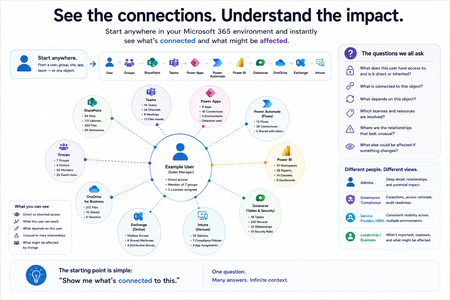
Not how many users you have. Not how many sites, teams, apps or flows you have. How much of it can you actually see connected together? I've been working across Microsoft 365 environments for a while, and I kept running into the same thing. There is no shortage of information. If anything, there is probably too much of it. Users, groups, permissions, SharePoint, Teams, Power Apps, Power Automate, Power BI, Dataverse, OneDrive, Exchange, Intune, licensing, configuration... It's all there. But when you're actually trying to understand how everything fits together, it can be a different story. You open one blade. Find something. Open another. Cross-check it. Go back. Open something else. Before long, you're jumping between different parts of the tenant trying to build the bigger picture in your head. And if you're working with larger environments, that gets difficult pretty quickly. The information isn't necessarily missing. The relationships between the information are what can be difficult to see. That got me thinking about a slightly different question: Instead of "where do I find this information?" "Show me what's connected to this." That's where VisibleState started. Start anywhere. Follow the connections. Imagine starting with a single user. Instead of seeing that user simply as a record with a list of properties, imagine being able to explore the relationships around them: User → Groups → SharePoint → Teams → Power Apps → Power Automate → Power BI → Dataverse → OneDrive → Exchange → Intune Then the questions become different: What does this user have access to? Is that access direct or coming through a group? What resources are connected to them? What depends on something they're associated with? Which licenses are involved? Are there relationships that look unusual? If something changes, what else might be affected? Those questions aren't necessarily about finding another piece of information. They're about putting information that already exists into context. A report can tell you that something exists. A connected view helps you understand what it is connected to. Illustrative example below — not a real customer environment. I'm not suggesting Microsoft 365 doesn't already give us this information Quite the opposite. Microsoft 365 already gives administrators an incredible amount of information and tooling. The thing I've been thinking about is what happens when you want to look across those boundaries. Sometimes I don't want another export. I don't want another list. I don't necessarily want another dashboard. I want to start with something I'm looking at and ask: "What's connected to this?" And then keep following the trail. That's the idea I'm exploring with VisibleState. The interesting part is what happens when you change the viewpoint The same relationships can be useful for completely different reasons. For example: Administrators may want to understand access, permissions and dependencies. Security and governance teams may want to find unusual relationships or exceptions. Compliance teams may need to understand who can access something and why. People managing multiple environments may want a consistent way to understand what's there without rebuilding the picture manually every time. Leadership may not need to see the graph at all. They may simply want to know what's important, what's exposed and what could be affected. It's still the same underlying environment. You're just looking at it from a different angle. And that's where I think things get interesting. Where I'm at with it VisibleState started as something I was building to make my own work easier. I was spending a lot of time investigating environments, tracing access and putting information together for reports. The individual tasks weren't necessarily difficult. It was the jumping between different places and reconstructing the bigger picture that took the time. So I started building something that would let me approach the environment through the relationships instead. It's grown quite a bit from where it started, and I'm continuing to build it. I'm not posting this as a product launch, and I'm not looking for people to sign up. I'm genuinely interested in whether the problem I'm seeing is familiar to other people working with Microsoft 365. So I'm curious... If you could start with any object in your Microsoft 365 environment and immediately see what it's connected to, where would you start? Would it be: Users and access Groups and permissions SharePoint and Teams Power Apps, Power Automate, Power BI and Dataverse Licensing and resources Governance and unusual relationships Something completely different Maybe you've already got a good way of doing this. Maybe you still find yourself jumping between different services and piecing things together manually. Or maybe I'm looking at the problem from the wrong direction. What's the one relationship in your Microsoft 365 environment that you wish you could see instantly?177Views0likes0Comments
Employee performance management tools in Microsoft 365?
So we are a relatively large organization and in drastic move, we've decided to shift from Google Workspace to Microsoft, primarily centering our employees around Microsoft Teams while trying to encourage them to use Copilot as effectively as possible. In this transition, one of the platforms we will be saying goodbye to will be our performance management software. Are there any Microsoft native performance management tools that can help us go through goal-setting, performance reviews, and feedback? Third party suggestions would also be good but only if they fit into the whole Microsoft workflow well.255Views0likes4CommentsWhat are people using to measure manager effectiveness across the org?
Our CHRO wants to start tracking how effective managers are, things like do they hold regular 1:1s, do they give timely feedback, are their team's goals on track. Right now we have zero visibility into any of this. We can pull some data from Teams usage reports but that just tells us who's chatting a lot, not who's actually managing well. Anyone found a tool or approach within the M365 ecosystem that gives you a real picture of manager effectiveness?186Views0likes3CommentsBest way to run pulse surveys inside Teams?
I’m looking for a lightweight way to run recurring pulse surveys directly in Teams. Forms works fine for basic questions, but follow-up, reminders, anonymity, and reporting become manual pretty quickly. Curious what others are using for short employee check-ins or sentiment surveys inside the Microsoft ecosystem. Or am I not using Forms to its full potential?168Views0likes2Comments