account management
175 Topics
Help me recover my account.
Hi, My other Microsoft account was recently compromised but it was compromised before as well. When it was compromised before, the hacker added a recovery email for verification and to remove that I added my another email and the request was sent and it was supposed to change in October and I was not able to change the password or use other features of Microsoft because at some point it keep redirecting me to the page that I have sent a request but during that time period, my account was compromised again and I keep receiving emails of unusual sign-in activity by the hacker and I wanted to change the password but I couldn't because of that request so I was being patient. Now I received an email that someone accessed my Microsoft account and now I have to verify my identity to log in and to log in it ask me to type the email that the hacker set up because it's not changed and since I don't know what that is it takes me to the account recovery page where I put all the information that I know, I write in my postal code, my old and current passwords, date of birth etc. I have never used skype, Hotmail or outlook and Xbox so I just uncheck those boxes and then it asks me if I have ever bought any product but since I didn't so I uncheck that as well but then I just receive the email that the information I provided is nonsufficient even thou I provided all the information that is correct. Unfortunately Sign-in helper didn't work. Kindly help me resolve the issue. Looking forward to your positive response. Yours sincerely.51Views0likes0Comments
How do I stop onedrive from looking at my photos
I uploaded images to onedrive, but I want onedrive to treat them as files for storage and regard the content as private - not looking for faces, not anything else. Its not about synching, nor about upload from camera. Its about privacy.Solved454Views0likes1Comment
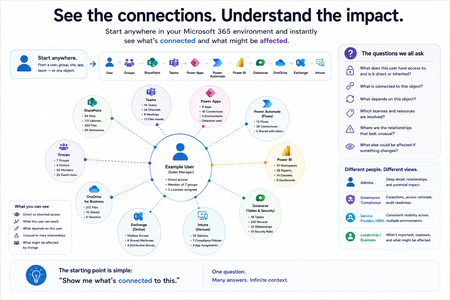
How much of your Microsoft 365 environment can you actually see at once?
Not how many users you have. Not how many sites, teams, apps or flows you have. How much of it can you actually see connected together? I've been working across Microsoft 365 environments for a while, and I kept running into the same thing. There is no shortage of information. If anything, there is probably too much of it. Users, groups, permissions, SharePoint, Teams, Power Apps, Power Automate, Power BI, Dataverse, OneDrive, Exchange, Intune, licensing, configuration... It's all there. But when you're actually trying to understand how everything fits together, it can be a different story. You open one blade. Find something. Open another. Cross-check it. Go back. Open something else. Before long, you're jumping between different parts of the tenant trying to build the bigger picture in your head. And if you're working with larger environments, that gets difficult pretty quickly. The information isn't necessarily missing. The relationships between the information are what can be difficult to see. That got me thinking about a slightly different question: Instead of "where do I find this information?" "Show me what's connected to this." That's where VisibleState started. Start anywhere. Follow the connections. Imagine starting with a single user. Instead of seeing that user simply as a record with a list of properties, imagine being able to explore the relationships around them: User → Groups → SharePoint → Teams → Power Apps → Power Automate → Power BI → Dataverse → OneDrive → Exchange → Intune Then the questions become different: What does this user have access to? Is that access direct or coming through a group? What resources are connected to them? What depends on something they're associated with? Which licenses are involved? Are there relationships that look unusual? If something changes, what else might be affected? Those questions aren't necessarily about finding another piece of information. They're about putting information that already exists into context. A report can tell you that something exists. A connected view helps you understand what it is connected to. Illustrative example below — not a real customer environment. I'm not suggesting Microsoft 365 doesn't already give us this information Quite the opposite. Microsoft 365 already gives administrators an incredible amount of information and tooling. The thing I've been thinking about is what happens when you want to look across those boundaries. Sometimes I don't want another export. I don't want another list. I don't necessarily want another dashboard. I want to start with something I'm looking at and ask: "What's connected to this?" And then keep following the trail. That's the idea I'm exploring with VisibleState. The interesting part is what happens when you change the viewpoint The same relationships can be useful for completely different reasons. For example: Administrators may want to understand access, permissions and dependencies. Security and governance teams may want to find unusual relationships or exceptions. Compliance teams may need to understand who can access something and why. People managing multiple environments may want a consistent way to understand what's there without rebuilding the picture manually every time. Leadership may not need to see the graph at all. They may simply want to know what's important, what's exposed and what could be affected. It's still the same underlying environment. You're just looking at it from a different angle. And that's where I think things get interesting. Where I'm at with it VisibleState started as something I was building to make my own work easier. I was spending a lot of time investigating environments, tracing access and putting information together for reports. The individual tasks weren't necessarily difficult. It was the jumping between different places and reconstructing the bigger picture that took the time. So I started building something that would let me approach the environment through the relationships instead. It's grown quite a bit from where it started, and I'm continuing to build it. I'm not posting this as a product launch, and I'm not looking for people to sign up. I'm genuinely interested in whether the problem I'm seeing is familiar to other people working with Microsoft 365. So I'm curious... If you could start with any object in your Microsoft 365 environment and immediately see what it's connected to, where would you start? Would it be: Users and access Groups and permissions SharePoint and Teams Power Apps, Power Automate, Power BI and Dataverse Licensing and resources Governance and unusual relationships Something completely different Maybe you've already got a good way of doing this. Maybe you still find yourself jumping between different services and piecing things together manually. Or maybe I'm looking at the problem from the wrong direction. What's the one relationship in your Microsoft 365 environment that you wish you could see instantly?215Views0likes0Comments
How do I Speak with Microsoft Support?
1=<8.88>`70.4<05.75> Although, as a moderator, I'm not directly responding to customer calls with problems, I can offer you strategic guidance on how to contact a real person in Microsoft Support.1=<8.88>`70.4<05.75> This is a common problem, and the key is understanding the prompts and steps to bypass the automated system. to your Microsoft 365256Views0likes0CommentsUpgrading from Personal to Family
The support in have read says to upgrade from Personal to Family I buy the new plan and any remaining subscription will be converted to the Family plan but I will lose some of the remaining time. I have 18 months to go on my Personal plan so does that mean if I buy a year of Family now I will be charged the full yearly price for 12 months then have the remainder of the Personal plan added so my next yearly subscription payment would be in about 2 years? Also does anyone know how the remaining conversation works and how much I would get for my 18 months of Personal?2.5KViews0likes4Comments
Locked out of Microsoft 365 Admin Account
Hello, until recently, logging into our admin account always worked without any problems. Now, however, in addition to the password, we’re always being asked for an MFA code that’s supposedly been sent to the Microsoft Authenticator app. Neither I nor my colleagues are aware that we ever set up MFA authentication. Consequently, we don’t have an MFA code to enter. This concerns the global administrator account. None of our other users can reset it. I’ve already called Microsoft Support about this, but I’m only connected to an AI that, on several calls, kept hanging up after a while. Can anyone help me with this problem?332Views0likes3CommentsHow to Find Inactive (Stale) User Accounts
Inactive accounts can soak up a lot of paid-for but unused product licenses. With increases for Microsoft 365 licenses due to come into effect from 1 July 2026, it’s time to find and remove unused licenses from inactive user accounts. We discuss two approaches by using the Microsoft 365 Licensing Report or a PowerShell script that assesses inactivity based on sign-in dates and refresh token baselines. https://office365itpros.com/2026/06/09/find-inactive-accounts/264Views0likes1CommentThe Great Loop Departed User Process
When employees leave a Microsoft 365 tenant, they might leave a user-owned Loop workspace behind which contains some valuable information that the organization wants to retain. Two years or so after announcing that a workflow to handle user-owned workspaces was coming, Microsoft is rolling out the update to tenants worldwide. The process is manual, but not much automation is possible to review and preserve workspace content. https://office365itpros.com/2026/06/04/user-owned-loop-workspaces/115Views0likes0Comments