application management
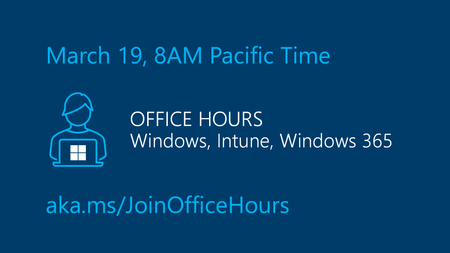
878 TopicsSave the date: Windows Office Hours – March 19, 2026
Join us for the next Windows Office Hours on March 19, from 8:00–9:00 AM PT! Our broad group of product experts, servicing specialists, and engineers—from Windows, Microsoft Intune, Configuration Manager, Windows 365, Windows Autopilot, security, public sector, FastTrack, and more—will be online and ready to help. This one‑hour session is fully chat‑based: no video, no meeting link—just real‑time guidance, best‑practice discussions, and answers to your questions right in the comments. Can’t join live? No problem. Visit the March 19th – Windows Office Hours event page and post your questions in advance—we’ll review them during the session. We look forward to connecting with you!12Views0likes0Comments
[BUG] Windows 11 Taskbar thumbnail live previews show previously closed dialogs
When hovering over the taskbar icon of some applications then hovering over a window's thumbnail, the "live preview" will show dialogs that were previously open but have since been closed on some machines/setups. Obviously, it's a bug of Taskbar under Windows 11, due to WS_DLGFRAME which is using by dialogs in question. The POC file can be downloaded here: https://github.com/user-attachments/files/17412665/PreviewBugPOC.zip More detail can be found in GitHub: https://github.com/notepad-plus-plus/notepad-plus-plus/pull/15703193Views0likes2CommentsProblems with Belarusian localization for Windows 11
I tried changing the interface language to Belarusian back in Windows 10, but the interface wasn't fully translated and was half Russian and half Belarusian. I installed Windows 11 and immediately changed the language to Belarusian, but the system became half English and half Belarusian. I contacted support, and they insisted on reinstalling Windows according to the instructions, assuring me that the translation was fine and that it was my problem. After that, nothing changed, and the language also became half English and half Belarusian. I asked my friends to install the Belarusian language, and they did so, and they had the same problem as me, exactly the same. But when I decided to change the language to Ukrainian to see if the same thing would happen, everything returned to normal, and the system became fully translated. The problem still exists. Finally, even in the comments for the Belarusian localization, people write that their system is also not fully translated. Please fix the localization issue. I see that the localization is updated in the Microsoft Store and the time of the last update is indicated, but nothing changes. Maybe there is some mistake?97Views1like7Comments
UNKNOWN PROGRAM/APP FROM WINDOWS/MICROSOFT
About a week ago I discovered a new app/program on my computer and have never seen it before (see picture). It was installed on 20.05.25 and it was the same day I reinstalled Windows 11 home. Everything was then completely deleted so that I had clean hard drives and cleaned them afterwards with Revo uninstaller. 20.05.25 and the next few days only Windows 11+upgrades to Windows were installed. This app/program was not there then and only appeared about a week ago, when I saw it for the first time. I think it was after one of the upgrades for Windows. The strange thing about this app/program is that it has no "size". It only says 3 dots there and therefore I can't find out where it is. It can't be uninstalled and it changes name every time I start the computer. Mostly Japanese letters/text. I have run Windows Defender both via Windows and at startup. Nothing is found. I have run Malwarebytes and Super antispyware in full scan. Can't find anything. From the date on the app/program, I see that it must be a Windows or Microsoft app. Only from those that were installed that day and the next few days. The computer is not used very often, as it is a work machine where I mainly just write articles and do genealogy research. So not much with programs on it. Mainly Office 365, upgraded drivers, Google Chrome, Legacy, which is a genealogy program, and some tools that came with the purchase of the computer. Everything is upgraded to the latest. Wondering if this could be a Windows program/app that Windows has removed and that was not completely uninstalled? I have another computer and a laptop. Neither of them have this. So wondering if anyone else has experienced this and possibly knows what causes it and how it can be removed?3Views0likes0Comments
HEIC converter to jpg that will retain creation/modification date
My fiancé passed away several months ago. His aunt was the Executor of his will so I had to send his iPhone to her so she would have access to his financial information. Before I sent it to her I copied all his pictures onto my computer. I'm not an iPhone user. I was trying to do some editing of some of the photos yesterday and realized they had some other extension .HEIC, not jpg. I had to do some research to even figure out what that was. The creation date is showing the date I uploaded them to my computer. The modification date is the date the photo was taken. All I really care about is maintaining the original date of the photos, the date modified. I have done research and tried several different options but none seem to retain the data I want. I did find one program that I downloaded, i Mazing Convertor, which is retaining the creation date but that is not the date modified, the date of the photo. And that date is the day I uploaded the photos to my computer. What can I do to retain the modification date (the date of the photo) and convert them to jpg? Reminder I do not have the phone, I'm not an iPhone user nor am I real technologically savvy. Maintaining the original date (modification date) is very important to me as this is the only copy of these photos I will ever have.4Views0likes0CommentsMicrosoft Account Already Exists (Windows 11)
While trying to change from account A to account B, I switched to a local account to make the transition smoother (as recommended). However, despite various attempts—including clearing the Credential Manager—I always receive the error: "Microsoft account already exists." I realize this issue has never been properly resolved in various forums (learn), and other users have experienced the same problem over time, with the suggested solution often being to restore Windows 11. Is this really how defect management is handled at Microsoft? Have other users faced similar issues? And this does not work either : https://learn.microsoft.com/fr-fr/office/troubleshoot/activation/another-account-already-signed-in262Views1like5Comments
DESIGNER only mkes 1 design not 4
I use ms ai image designer to make images and i makew ai videos ,, but for a week now it only makes 1 image not 4,, and it doesnt follow the propsat as per usual,. and it makes images in 3:2 not 16:9. I updateed my subscription for this tool and depend onm it.. SO please help me fix this214Views1like8CommentsInternal RDP vs Self-Hosted RustDesk
Hi everyone, I am looking for some guidance and real-world experiences around choosing the best approach for remote access in a Windows environment. Right now, we are considering two main options: - Continue using Microsoft Remote Desktop Protocol (RDP), but strictly for internal use only (no direct exposure to the public internet). - Deploy a self-hosted instance of RustDesk as an alternative or complement to RDP for remote access and remote support. Our main concern is security. RDP has historically been a common attack vector, especially when exposed externally or misconfigured, and we want to avoid introducing unnecessary risk to our endpoints. Even if we restrict RDP to internal networks or VPN-only access, we are still cautious about potential vulnerabilities, credential theft, lateral movement, and abuse of remote access. What we are trying to understand better is: 1. In environments where RDP is used only inside the LAN or over VPN (no open RDP from the internet), what are the recommended hardening practices and controls you would consider mandatory today? Examples might include: Network Level Authentication (NLA), strong account policies, just-in-time access, firewall restrictions, RDP Gateway, MFA, monitoring/logging, etc. 2. From a security and operational perspective, is it generally considered acceptable to keep RDP enabled only for internal administrative tasks, while avoiding using RDP for end-user remote support scenarios? 3. For those who have deployed self-hosted RustDesk (or similar remote support tools) in a Windows/Active Directory environment, how has it compared to RDP in terms of: - Security model (encryption, authentication, access control, exposure to the internet) - Ease of deployment and maintenance - User experience and performance - Logging, auditing, and integration with existing security monitoring 4. Are there any best practices or architectural patterns you would recommend when combining these approaches? For example: - Keeping RDP only on jump servers / bastion hosts inside the network - Using RustDesk (self-hosted) for remote support and helpdesk use cases - Enforcing least privilege, MFA, and strong authentication for all remote access paths - Segmentation and limiting which machines are even allowed to receive RDP connections 5. Have you encountered any specific security pitfalls, misconfigurations, or "gotchas" when relying on RDP internally or when rolling out RustDesk self-hosted that we should be aware of before committing to a design? Our goal is to design a remote access strategy that: - Minimizes attack surface and reduces the likelihood of compromise via remote access. - Separates administrative access from end-user remote support where it makes sense. - Remains manageable for a small IT/security team in terms of configuration, patching, and monitoring. If you have any references to Microsoft documentation, hardening guides, or community best practices for RDP (especially internal-only scenarios), as well as any detailed write-ups or lessons learned from using RustDesk self-hosted in production, those would be extremely helpful. Thank you in advance for any guidance, recommendations, or examples you can share. Best regards, Juan221Views0likes4Comments