Forum Discussion

Utilizing Excel's turing capabilities to create Conway's 'Game of Life'
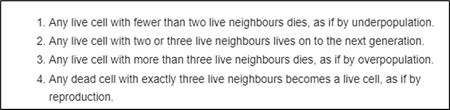

If I was allowed to write a Fast Fourier Transform algorithm in Excel, I don't see why you shouldn't play with Matrix Flow!

I've been working on Matrix Flow Accumulation on and off and have a rough draft solution. The most difficult part was correctly identifying the type of problem it presents and developing a function to trace the flow for a given cell in the grid. The second challenge is finding legitimate examples as some of the grids I've encountered contain mistakes in the Flow direction matrix (Making the Flow accumulation totals incorrect). On to testing and refinement!
- PeterBartholomew1Apr 22, 2025Silver Contributor
This is a stab at a solution!
StepHydroλ = LAMBDA(board, days, LET( m, ROWS(board), n, COLUMNS(board), // Initial uniform precipitation initial, SEQUENCE(n, m, 1, 0), iteration, SEQUENCE(days), // Increment until precipitation is balanced against outflow from region solution, REDUCE(initial, iteration, LAMBDA(step_k, k, MAKEARRAY(m, n, LAMBDA(r, c, IF(AND(r>1, r<m, c>1, c<n), //ignore border regions LET( // Calculate water movement day by day mask, SIGN(TAKE(DROP(board, r-2, c-2), 3, 3) = patch), neighbourhood, TAKE(DROP(step_k, r-2, c-2), 3, 3), 1 + SUM(mask * neighbourhood) ), 1 ) ) ) ) ), solution - initial ) );- Patrick2788Apr 24, 2025Silver Contributor
This function is inspired by the spatial analysis tools provided by ArcGIS. I saw some screen captures and it looked interesting. The demo I've built shows the directional arrows with the help of conditional formatting while the cells contain the integers (e.g. 1, 2, 4, 8, etc.).
// --- Workbook module ---

//Direction vector
direction = {32,64,128,1,2,4,8,16};

//Directional offsets
x = {-1,-1,-1,0,1,1,1,0};
y = {-1,0,1,1,1,0,-1,-1};

//Matrix flow accumulation
Flow.Accumulateλ = LAMBDA(flow_matrix,
        LET(
        //Create mesh grid coordinates for flow matrix.
            r, MGridλ(flow_matrix),
            c, MGridλ(flow_matrix, 1),
        //Obtain the directional offsets for each cell: Where is the cell pointing?
            i, XLOOKUP(flow_matrix, direction, x,0),
            j, XLOOKUP(flow_matrix, direction, y,0),
        //Obtain the address of these cells - row and col joined with pipe
            cells_with_precedents, TOCOL(i + r) & "|" &
                TOCOL(j + c),
        //Convert row and col matrix to vector - row and col joined with pipe
            cells, TOCOL(r) & "|" & TOCOL(c),
        //If the cell contains no direction integer, return 1, else check coordinates
        //to see if any cells are pointing to it. Count those cells and count
        //the cells pointing to those cells, etc.
            CountPrecedentsλ, LAMBDA(r₁, c₁,
                LET(
                    active,INDEX(flow_matrix,r₁,c₁),
                    no_direction,NOT(XOR(active=direction)),
                    p, IF(no_direction,1,Treeλ(
                        r₁ & "|" & c₁,
                        cells_with_precedents,
                        cells
                    )),
                    ROWS(p) - 1
                )
            ),
            return, MAP(r, c, CountPrecedentsλ),
            return
        )
    );

//Create a mesh grid for a matrix.
MGridλ =
LAMBDA(matrix,[omit_for_rows_include_for_cols],
    LET(
        h,ROWS(matrix),
        w,COLUMNS(matrix),
        i,SEQUENCE(h)*SEQUENCE(,w,1,0),
        j,TRANSPOSE(i),
    IF(ISOMITTED(omit_for_rows_include_for_cols),i,j)));

//Create a rudimentary 'tree' vector through recursion
//Stack limit: 2,340
Treeλ =
LAMBDA(root,lookup_arr,return_arr,
    LET(
        next,CHOOSECOLS(root,COLUMNS(root)),
        check,IF(XMATCH(lookup_arr,next),return_arr,NA()),
        halt,AND(ISNA(next)),
    IF(halt,TOCOL(root,2),Treeλ(HSTACK(root,check),lookup_arr,return_arr))))
;
The challenge with performance has been with the 18x18 board when Flow.Accumulateλ must contend with an exciting input matrix:
The result:
The results are accurate but the calculation speed is typically 2-5 seconds (Much, much more with the "lazy river" input matrix!).
PeterBartholomew1- It's impressive you arrived a solution based on a picture with no written direction provided. I'm wondering if your solution can be used with this workbook.
I've spent a good amount of time trying variations of the recursive Treeλ but the calculation results are either roughly the same or much worse (Recursive FILTER 'n stack is much slower).
- PeterBartholomew1Apr 26, 2025Silver Contributor
This is what I got from your dataset. The 8 days wasn't how long the program took! The display was chosen to suggest that the 8 iterations might represent the time that rainfall might take to be carried away from the region.
- Patrick2788Apr 23, 2025Silver Contributor
I think you may have inadvertently solved it (and them some) following a slightly different set of rules. I'm currently tinkering with a 16x16 board where optimization is paramount. Currently, most calculations are taking 2-4 seconds so it needs some work. I hope to share it when I've had some time to further refine.