transactable apps
222 TopicsBuild your SaaS offer with the modernized SaaS Accelerator to sell on Marketplace
Build your SaaS offer for Microsoft Marketplace with coding agent guidance and the modernized SaaS Accelerator. Explore resources that help simplify Marketplace integration and move from development to publishing faster.90Views4likes0CommentsHeaviside AI, OneTrust, and NKUSI-IT deliver transactable partner offers in Microsoft Marketplace
Microsoft partners like Heaviside AI, OneTrust, and NKUSI-IT deliver transact-capable offers, which allow you to purchase directly from Microsoft Marketplace. Learn about these offers in this post.89Views2likes0CommentsWork IQ Cost and Pricing Model for Agents published in Marketplace
I would very much like to ask for assistance and input in regards of "Consumption, cost forecasting, break-even analysis and recommended customer pricing. " I believe a bit of context is required. We are about to publish two Work IQ MCP Agent in Marketplace. Both agents will be integrated to our existing Apps that are published in Marketplace. 1. iGlobe CRM for Teams and 2. iPlanner Pro for Outlook and Teams. Both Apps are multitenant Apps running on customers own tenant. The Apps can only be deployed from Marketplace. Lets use iPlanner Pro Agent as an example. In short, iPlanner Pro Agent uses Work IQ and MCP tools to understand emails, meetings and Microsoft 365 context, while iPlanner Pro turns that intelligence into structured Planner execution, including the appropriate plan, bucket, assignment, priority and supporting email context. Including saving the email or attachments on the task. A prompt could look like this "Find the latest email from email address removed for privacy reasons. Create a task for in Planner, put it in the correct Plan and bucket, assign it to the appropriate owner, set a due date for next week and save the email on the Planner Task" Work IQ and MCP provide context and intelligence, iPlanner Pro executes the structured actions, and Microsoft Planner remains the source of truth. To my understanding Work IQ API usage is billed through Copilot Credits rather than a separate per-user Work IQ license. Microsoft 365 Copilot includes Work IQ functionality within native Microsoft Copilot experiences, but third-party solutions such as iPlanner Pro consume Copilot Credits when they call Work IQ APIs. Work IQ does not require a separate API subscription, SKU or per-user licence. API usage is consumption-based and is measured in Copilot Credits. Work IQ operation Credit consumption Planning note Chat API Variable Depends on grounding, retrieval and reasoning complexity. Context API Variable Depends on the scenario and the sources used. Tool API 0.1 credit per API call Static component: $0.001 per call at $0.01 per credit. Example: 1,000 Tool API calls consume 100 credits, equivalent to $1.00 at the planning rate. Now here comes my confusion. 1. How do we know how many credits we are using with a prompt like the example I showed? the consumption is 0.1 credit per API call. 2. If I understand the above correct, the total consumption is calculated on the customer tenant. That consumption includes much more than just iPlanner Pro. Is that correct? 3. OR, will the sum of all customer using iPlanner Pro Agent be direct to us and we will be billed based on the total consumption of all our customers? If that is the case ( I don't think it is) then how do we know how much each customer consumed? 4. If consumption and billing is on the customer, how can the customer see what iPlanner Pro cost in consumed credits? This is important in regards of giving a cost forecast for customers. I am sure they would want that before start using the Agent. It is also important in regards of the question of if we should charge or offer it as a free agent? If we are billed then we will need to change for it. If the customer is billed then we probably will not be able to charge for it. I hope I have been able to explain my confusion. I tried asking contacts I have at Microsoft, but unfortunately haven't heard anything. That is why I am asking in the community. Have any one else the same challenge? what have you done? Can Microsoft assist here? I will be happy to take a Teams call and others are welcome to join. Thank you140Views0likes0Comments
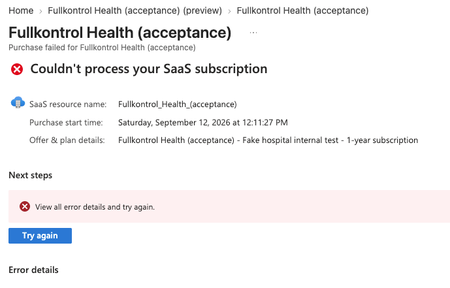
Preview SaaS offer purchase fails at subscription creation
I'm publishing a transactable SaaS offer and testing the purchase flow in preview. Test purchases used to work, and then stopped working with no change on our side that would explain it. The purchase now fails at the final step: "Couldn't process your SaaS subscription" Earlier attempts also returned "400 Bad Request" from the marketplace SaaS service during checkout. Important: this offer previously accepted preview test purchases successfully. Several went through and created subscriptions. The same flow now fails every time, for no apparent reason and with no configuration change on our part. Setup: - Transactable SaaS offer, tested via the Azure portal preview link at the Publisher signoff stage. - Private test plan priced at $0, 1-year term, restricted to my own tenant. What I have already verified and ruled out: - The plan resolves and is selectable. The failure page even shows the correct plan name, so the preview audience and private-plan tenant restriction are working. The failure is at subscription creation, not plan visibility. - Buying subscription is Pay-As-You-Go, spending limit off, Enabled. - Microsoft.SaaS, Microsoft.Marketplace, and Microsoft.MarketplaceOrdering resource providers are all registered. - A valid payment method (credit card) is on the billing profile. - The buyer's market (country) is included in the plan's markets. - Azure Private Marketplace store exists but is disabled, so it is not blocking. - I republished the offer to regenerate a fresh preview link. Preview creation completed successfully. - It fails identically for the Azure account owner, not just a delegated tester. So purchases worked before, every setting I can find is still correct, and it now fails at Microsoft's subscription-creation step. Questions: 1. Has anyone had preview test purchases work and then suddenly start failing with "Couldn't process your SaaS subscription," and found the cause? 2. Is this a known platform-side issue? The republish-with-a-small-edit workaround did not help.Close more custom deals on Marketplace with private offers and App Advisor guidance
This is part of a series where we look at improvements to negotiated deals in Microsoft Marketplace and how App Advisor helps you choose the right negotiated deal types for your business. Marketplace customers don’t just buy according to the pricing, terms, billing, and procurement structure of a standard public offer. Sometimes, they need a more customized option. A to-customer private offer gives you more flexibility to meet those requirements, negotiate directly with a specific customer, and keep the transaction in Microsoft Marketplace. Let's look at questions that businesses like you may be asking. Why would I use a to-customer private offer? Private offers give flexibility to particular customers. A private offer can be a good fit when a specific customer: Requires customer-specific terms, Wants to negotiate custom pricing, Needs a billing structure aligned with its budgeting or procurement process. They also give you, the seller, some flexibility because you can: Negotiate directly with my customer without involving a channel partner, Include supported professional services as part of the Marketplace transaction, Keep the negotiated transaction completely in Marketplace (while gaining benefits). For eligible offers, the purchase can also count toward the customer’s Azure cloud consumption commitment, while the sale can contribute toward unlocking benefits after publishing, Certified Software Designations, and Azure IP co-sell. To see more about the benefits of to-customer private offers, go to this deep dive in App Advisor Who can I sell to with a private offer? To-customer private offers support a broad range of Marketplace opportunities. Private offers are: Available globally, Available to all Microsoft partners, Available to MOSA, Enterprise Agreement (EA), and Microsoft Customer Agreement (MCA) customers. How can I find more customers for private offers? Your existing sales pipeline is one place to start. But Marketplace now also helps customers signal when they’re interested in a negotiated deal. With the new Request private offer enabled on an eligible Marketplace listing, customers can initiate a conversation about customized pricing and terms directly from your product page. On your "Offer setup" page, toggle the "Would you like to enable private offer requests from customers?" ON to have a button appear on your listing that interested viewers can initiate a conversation with you. You still own the sales conversation and create the private offer. The difference is that interested customers now have another way to raise their hand. For software companies asking how to generate more app leads, this creates a clearer path: Marketplace discovery → customer interest → negotiated deal → purchase. How do I create a to-customer private offer? Once you have an interested customer, the basic process starts in Partner Center: Gather the customer’s billing information and identify who can accept and purchase the offer. Create a new private offer using your published Marketplace offer as a base. Define the customer, terms, contacts, negotiated pricing, and other deal requirements. Review and submit the private offer. Share the private-offer link so your customer can accept and purchase. Want all the details to consider (from customer permissions and prerequisites to offer setup and acceptance)? That’s where App Advisor can help. Use App Advisor to move your Marketplace deal forward App Advisor brings the detailed, curated guidance together in one place. You can use it to understand: When to use a negotiated deal, Which type of negotiated deal to choose, What you need to know about your customer to start, How to move through the process with customer checklists, walkthroughs, and supporting resources. Ready to customize and close your next deal? Use App Advisor to learn how to create a to-customer private offer and turn customer interest into a Marketplace sale. Next, we’ll look at resale enabled offers (REO) and how they can help you expand your Marketplace sales motion through channel partners.256Views4likes0CommentsCould Marketplace Become an AI Discovery Agent?
Today, customers still find apps in Marketplace by searching keywords or browsing categories. In a large catalog like the Marketplace, that often feels like guesswork. Publishers describe similar solutions differently, and customers rarely know the exact keywords to use. Many customers end up scrolling through listings, getting tired, and leaving. When that happens, we as publishers never get the chance to connect with them. What if Marketplace used AI to change that? Instead of searching, customers could simply describe what they need: “I need a time-tracking app that works natively in Microsoft 365 and Microsoft Teams, has light project management, follows our security policies, and keeps all company data inside our tenant in line with General Data Protection Regulation (GDPR).” An AI agent could instantly suggest the best matching apps and guide the customer directly to Get it now. And maybe the next step is even bigger: What if Marketplace became an agent or coworker for Microsoft Copilot, helping users discover and install the right apps simply by asking? Curious what others think—could this be the future of Marketplace discovery?Ant Media, WeTransact, and IDECSI deliver transactable partner offers in Microsoft Marketplace
Microsoft partners like Ant Media, WeTransact, and IDECSI deliver transact-capable offers, which allow you to purchase directly from Microsoft Marketplace. Learn about these offers.185Views4likes0Comments