onedrive
2211 TopicsOneDrive Just Got a Major Upgrade: New Copilot Capabilities, Simpler Sharing, and Smarter Photos
Files have always been at the heart of how we work. They're where we create, collaborate, and share ideas. And now, with Copilot and agents, they're taking on an even bigger role, providing the knowledge and context that AI needs to understand our work, connect ideas, and help us get things done. And beyond work, AI is also transforming how we experience our most important memories. Our photos and videos hold the moments that matter most to us. With AI, we're making it easier than ever to find those memories, relive them, and create something new to share with the people we love. Today at our event, OneDrive + Copilot: Your file system and photo solution for the AI era, we showed how we're bringing that vision to life, with experiences that make your files more useful, your everyday work simpler, and your personal memories easier to enjoy. We showed Copilot turning files into finished outcomes, a faster and simpler file system across web, desktop, and mobile, easier and more secure sharing and collaboration, and new ways to rediscover, create with, and share your favorite memories. Let's take a closer look at what's new in OneDrive. Turning files into outcomes with Copilot in OneDrive Copilot is embedded in the Microsoft 365 apps where you already work, like Word, Excel, and PowerPoint. Now, with the general availability of Copilot in OneDrive and SharePoint, we’re bringing AI directly to where your files and shared content live. Instead of piecing together information file by file, Copilot can help you understand your content, uncover insights, take action, and create something new. Here are just a few ways to put Copilot to work: NEW - Analyze across files: Select a number of spreadsheets, and ask Copilot to analyze the files, including generating charts and graphs and highlighting trends. NEW - Organize your projects: Point Copilot at a crowded folder of reports, research, notes, and plans, and it can sort everything into a structure that makes sense. NEW - Create from what you have: Turn current files and past work into something new, like an interactive HTML report, and keep refining it with follow-up prompts. NEW - Custom skills in Copilot: Capture a process you repeat as a personal skill, saved as a Markdown file, so Copilot runs it the same way every time. NEW - OneDrive Prompt Gallery: Get started with Copilot using ready-to-use prompts that help you explore what’s possible with your files. And that's just the beginning. Copilot in OneDrive goes well beyond these examples, helping you reason across your content, take action on your files, and get work done simply by describing what you want to accomplish. Copilot in Action on OneDrive HTML and Markdown, built for AI-created content HTML and Markdown are becoming essential formats for Copilot and agents. But creating these files is only the beginning. OneDrive makes it easy to open, edit, and collaborate with them, turning AI-generated content into something you can work with, share, and build on with your team. NEW - HTML comes alive in OneDrive: Just like in the Microsoft 365 Copilot experience, you can use Copilot directly in OneDrive to create interactive reports, dashboards, and bring experiences to life. Then edit them directly on the canvas or switch to source/html with a live preview right alongside. Present your HTML output in full screen for an immersive viewing experience. Collaborate with others through anchored comments and live presence, including comments placed directly within slides. NEW – Markdown, ready for teamwork: Turn Markdown files into collaborative work. Edit with a familiar rich-text experience while preserving the native .md file underneath. Then refine it together with anchored comments, live presence, real-time coauthoring, and autosave. Collaboration is seamless when you bring people and agents into the same document. Whether your HTML or Markdown file was created with Copilot or another tool, OneDrive gives you the same rich experience to open, edit, share, and collaborate on it. These files become a natural part of your everyday workflow, right alongside the rest of your content. Viewing, Editing, Collaborating with HTML and Markdown files in OneDrive Example using Copilot in OneDrive: So many of us spend hours, sometimes days, pulling together that monthly business report. Gathering spreadsheets, sorting through notes, finding last month's report, and trying to make sense of it all. Now imagine putting Copilot to work. Ask it to analyze your spreadsheets, uncover trends, and organize the files you need. Then have it bring everything together into a beautiful, interactive HTML report that you can refine and share with your team. And here's the best part: save the process as a personal skill, and next month's report is just a prompt away. Actions to try: Select several spreadsheets in OneDrive and ask Copilot to compare trends across them. Ask Copilot to organize a cluttered project folder. Select one or more spreadsheets, your notes stored in a Word document and ask Copilot to create an HTML dashboard/report summarizing all it. Share it and then edit it in real time with your team. Ask Copilot to save a workflow as a personal skill Watch the full demo deep dives of Copilot in OneDrive and HTML and Markdown in OneDrive. Stay in flow everywhere: The core file system, reimagined for AI Work doesn’t sit still. It moves between your personal files, team libraries, desktops, and mobile devices throughout the day. OneDrive helps you stay in the flow by making shared work easier to find, organize, and access wherever you are. With refreshed library navigation, modern views and filters, improved shortcuts, and expanded sync capabilities, we're making the core file system simpler and more seamless across web, desktop, and mobile. NEW - Libraries view: Get to the SharePoint libraries you use most, right from OneDrive. Move between recently visited libraries, Teams, and favorite sites, or open My sites to see every site you're a member or owner of, including ones you haven't visited recently. NEW - Search for libraries and lists: Find the right library or list without hunting through sites. NEW - Modern views and filters: Filter and navigate the same way everywhere, so finding content feels familiar. NEW - Add to OneDrive, with a dedicated folder: Shared folders or libraries that you add now land in a dedicated Shortcuts folder, so they're easy to find. NEW - Sync up to one million items on Windows and MacOS: Large libraries sync reliably on Windows and MacOS with as little as 8GB of RAM. NEW - Longer file paths: Handle long file paths smarter to reduce sync errors. Libraries in OneDrive Web Example using the Libraries view and Add to OneDrive: You're working across several project sites and a dozen document libraries. In your browser, from OneDrive, you open the Libraries view, access the library you need, filter it the same way you filter your own files, and add the folder you use every day to OneDrive, where it lands in your Shortcuts folder and syncs to your PC or Mac. Actions to try: Open Libraries from the left pane, then browse your recent, Teams, and favorite libraries. Use the filter control to quickly find the exact library you need. Add a shared folder or library to OneDrive using the Add shortcut to My files. Save it to My files or the new Shortcuts folder – your choice! Built for team flow: Share, collaborate, and stay in control Sharing and collaboration should be effortless, without compromising security or control. That's why we're making it easier than ever to share files and work together across Microsoft 365, while giving organizations the tools they need to protect and manage their data. Hero Links are here Sharing a file has often meant creating multiple links for different people with different permissions. Over time, that can leave you unsure of which link gives what level of access, forcing you to spend extra time ensuring permissions are set up right, and making access harder to manage. Hero Links, now rolling out, change that, giving you one link per file or folder by default. If you need to change access, you simply update permissions, and the same URL obeys the new permissions. No need for new links! It’s sharing made simple, while keeping you in full control. You can also use the browser link to share the file, with the same permissions applied. Hero Links in Action Coming Soon: Expiring hero link access With hero links rolling out, we know that managing the lifecycle of permissions on your files is also essential to your work. That’s why we’re developing new, expiring hero link controls. These controls let you automatically expire your organization’s hero links on a schedule that meets your needs. For instance, you can configure a policy that requires hero links shared to your entire organization to expire after 90 days. The file’s hero link will work just the way people expect, but when 90 days elapse, the link changes back to the secure default: Only People Added. Stronger admin controls As your content grows across OneDrive and SharePoint, admins need simpler ways to secure, govern, archive, and manage it all at scale. Our latest updates bring you more intelligence and control to content governance, file lifecycle management, and sync administration. Here’s what’s new: SharePoint Admin Agent: Use natural language to assess content across SharePoint and OneDrive, including site cataloging, and take guided action to keep content secure and AI-ready. Learn more in the SharePoint Admin Agent overview. File archive in SharePoint document libraries: Archive inactive files with a policy, and use what-if analysis to see the impact before you turn it on. NEW - OneDrive Sync management: Exclude specific folders from sync with a folder-level policy, and view accounts, configuration, policy, and status from the command line with the OneDrive Sync Command Line Interface (CLI). Available in private preview. Sign up here SharePoint Admin Agent Actions to try: Share a file with a Hero Link, then change its permissions without resharing the link. Admins: ask the SharePoint Admin Agent, "Which sites are overshared and what are the risk levels for these sites?" Watch the full demo deep dive of OneDrive Sync CLI. More than a place to store photos: An intelligent home for your memories Our photos and videos capture the people, places, and moments that matter most to us, from life's biggest milestones to the little moments in between. OneDrive has always helped keep those memories safe and accessible, wherever you go. Now, we're taking the next step. With new experiences across Windows, web, and mobile, OneDrive is becoming a more intelligent and personal home for your photos. From AI-powered Moments that bring forgotten memories back to life, to natural-language search, AI-powered editing, and new ways to create and share, we're helping you do more with the memories you love. NEW - Microsoft Photos on Windows: Microsoft’s all-new desktop experience for your photos brings together images and videos from OneDrive, your PC, and iCloud Photos in one unified Gallery. Rediscover memories through Moments, explore with People, and use natural language to find the photos you’re looking for, all through a consistent experience across devices. NEW - Copilot in OneDrive photos: Quickly find moments by simply describing them in your own words, then ask Copilot to turn them into something new to enjoy and share. With a prompt like, “See the photos of my kids through the years and turn it into a slideshow”, Copilot will quickly bring years of photos together and create a share-able slideshow from the results. NEW - AI-curated and seasonal Moments: Automatically created collections, bringing your best moments back to you. NEW - Map view: Browse your photos on the go by their location. NEW - Edit with AI: Fix, refine, and reimagine your photos with easy-to-use AI-powered editing tools. From practical corrections like background cleanup to restyling your photos into something new, like crochet or graffiti art, these editing tools help you to easily enhance your photos. NEW - Create: Brings a dedicated creation experience to OneDrive, with new ways to use your photos to create personalized, shareable content like collages, holiday cards, and more. Creating with Copilot in OneDrive Mobile Example using the Create hub: Your wedding anniversary is coming up and you want to make something special for your partner. You find some photos you want to include in a card and edit one of them to remove that pesky object in the background. Then you create a collage of photos from your engagement and wedding day and add a “Happy Anniversary” message to it. Spruce it up with some flowers and color and share the image directly with your loved one. Simple tasks that would’ve taken hours of hunting and multiple app switches, all done from one place! Actions to try: Open the Windows Photos app to see your PC, OneDrive, and iCloud photos in one place. Search your photos by describing a memory. Fix your photos by auto enhancing the colors or removing an object in the background Explore your photos on the map in the OneDrive Android app. Use Copilot in photos to create a new collage of photos from last year’s holiday season in the OneDrive Android app. Create a new social media post using a preset template for Diwali in the OneDrive iOS app. Watch the full demo deep dive of Windows Photos app. The future of OneDrive: Building on what you saw today We've shared a lot of exciting innovations today, with some available now and others rolling out over the coming months. And we're just getting started. Looking ahead, we're building on these innovations across Copilot, the core file system, collaboration, and photos and video. Here are a few highlights from the OneDrive roadmap for the coming year. Copilot: Bringing agents into file collaboration As Copilot evolves from individual assistance to teamwork with agents, the files we work with remain central to how that collaboration happens. We're exploring ways to bring agents into familiar file collaboration experiences, making it possible to share a file with an agent, @mention it, and continue working together through comments, just as you would with a colleague. AutoPilots Working [for You] in OneDrive Core file system: A home for AI-created content As more content is created by Copilot and agents, OneDrive will make it easier to find, understand, and manage that work alongside your own. You'll be able to quickly identify files AI helped create, see which agents contributed to them, and understand what changed. OneDrive, a Natural Home for AI Created Work File collaboration: Simpler access, stronger security As people and agents collaborate across more files, managing access becomes increasingly complex. Knowing who can access what, understanding why permissions aren't working, and preventing oversharing are more important than ever. Future Copilot experiences will make it easier to diagnose and resolve access issues directly from the sharing experience. Copilot will help identify problems such as broken permission inheritance, recommend corrections, and let owners review and apply fixes. It will also proactively help to uncover oversharing risks, including Anyone links that expose content more broadly than intended. That way your teams can collaborate with confidence while keeping their information protected. Copilot Diagnosing and Fixing Sharing Permissions Photos and video: Easier media workflows for teams So much of our work relies on photos and video, but finding the right media, keeping it organized, and managing feedback and approvals can be difficult. We're building new experiences that make it easier for you to find photos and videos by describing their contents, without needing to know filenames or folder locations. Teams will be able to review, comment, and edit together in context, with approvals that stay with the asset, so everyone knows what's ready to use. Future Support for Commercial Media Everything we shared today reflects our vision for the next chapter of OneDrive. The file system is one of computing's most enduring concepts, and in the AI era, it's more important than ever. As people and agents create and collaborate in new ways, they need a durable home for their work and knowledge. That's why we're evolving OneDrive to operate at agent scale, support the formats AI uses naturally, and make the knowledge in your files easier to find, manage, and put to work. At the same time, we're bringing that same spirit of innovation to your personal photos and videos, helping you rediscover the moments that matter, relive your favorite memories, and create new ways to share them. That's the future we're building: OneDrive, your file system and photo solution for the AI era. Resources & next steps To help you get started and dive deeper: Watch the full event, AMA, and demos on YouTube: https://aka.ms/OneDriveEvent/Playlist OneDrive adoption resources Feature deep dives: OneDrive CLI | Photos App | Copilot in OneDrive | HTML / Markdown OneDrive Customer Office Hours Sync Up podcast Windows Blog SharePoint Admin Agent overview Ready to take action? Bookmark the OneDrive blog at https://aka.ms/OneDriveBlog for the latest tips and feature updates.757Views0likes0Comments
OneDrive + Copilot event — Your file system and photo solution for the AI era
Your files are more than documents. They're the ideas, projects, and moments that move work and life forward. Discover how OneDrive is evolving for the AI era, helping you move from files to outcomes with intelligence built into the experiences you use every day. 🔴 LIVE AMA INCLUDED This event includes a live Ask Microsoft Anything (AMA). To submit your question, login or create an account and submit your question below as a Comment. Register here and explore OneDrive resources: https://aka.ms/OneDriveEvent Additional links: OneDrive Customer Office Hours: https://aka.ms/OneDriveOfficeHours Listen to the Sync Up podcast: https://aka.ms/SyncUp Explore the OneDrive community: https://aka.ms/OneDriveBlog #Microsoft #OneDrive #Copilot #DigitalEvent #OneDriveEvent4.1KViews11likes66Comments
OneDrive won't reinstall after Force Removal with Geek Uninstaller: existing OneDrive instance"error
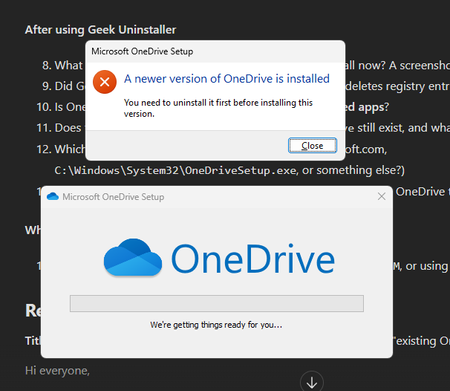
a { text-decoration: none; color: #464feb; } tr th, tr td { border: 1px solid #e6e6e6; } tr th { background-color: #f5f5f5; } Hi everyone, I have a OneDrive problem that started as a sign-in issue and has now turned into an install issue. At this point OneDrive won't reinstall on my laptop at all. Setup Laptop: my own personal device (not managed by my school), about 2 years old, Windows reinstalled several times OS: Edition Windows 11 Pro Version 25H2 Installed on 15.04.2026 OS build 26200.9457 Experience Windows Feature Experience Pack 1000.26100.360.0 Account: school Microsoft 365 account OneDrive: downloaded from the official Microsoft website The original problem When I tried to sign in to OneDrive with my school account, it got stuck in a loading loop right after I entered my email address. It never got any further, so I could never sync my files locally. We don't know what caused it, and no error code ever came up. Signing in with the same school account works fine in other apps like Teams and Outlook. Only OneDrive has the problem. I wasn't able to test with any account other than my own. What we tried with the school IT office Disconnected my school account from Windows (Settings → Accounts → Access work or school) and signed in again Uninstalled and reinstalled OneDrive Reset OneDrive with: %localappdata%\Microsoft\OneDrive\onedrive.exe /reset None of this fixed the sign-in loop. Where it broke completely Next, the IT staff removed OneDrive with Geek Uninstaller using "Force Removal". Since then, the OneDrive installer from the Microsoft website won't run. It says there is already a OneDrive instance on the PC that has to be removed first: Current state OneDrive is not listed under Settings → Apps → Installed apps The folder %localappdata%\Microsoft\OneDrive no longer exists So I can't find any visible trace of OneDrive, but the installer still thinks it's installed I haven't run sfc /scannow or DISM yet, and I haven't tested with a new Windows user What I'm looking for I'd really like to avoid reinstalling Windows again, especially since OneDrive might fail the same way afterwards. I'm hoping for either: A way to clean up whatever is left of OneDrive so it installs properly again, or A workaround to use my OneDrive files locally (in File Explorer, not only in the browser) Thanks to everyone who reads this. I hope it helps others with the same problem too. -Kemal :)Solved207Views0likes6CommentsMy OneDrive with for Developer that associate with MCT, has been force from 1TB to 10GB
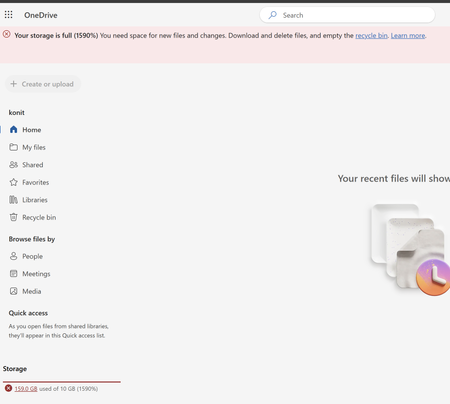
Hello Everyone, I have some issue with my OneDrive Developer, it has been force from current storage 1TB to 10GB without notify. it what happen or something wrong on my account.. thanks Soksamrong41Views0likes2CommentsPlanning a Google Workspace to Microsoft 365 Migration? What Should You Consider?
Hi everyone, Has anyone recently migrated from Google Workspace to Microsoft 365? I’m interested in knowing what challenges you faced during the migration, especially around mailbox data, calendars, contacts, user mapping, or the final cutover process. For those planning the migration, what are the key things you recommend preparing before getting started? Would like to hear your experiences and suggestions.518Views0likes5CommentsIntroducing Markdown support in SharePoint and OneDrive
Today, we’re introducing native Markdown support in SharePoint and OneDrive, now rolling out to general availability across both consumer and commercial audiences. As AI and agents increasingly create and update Markdown files to carry out work, teams need a reliable place to manage that content. SharePoint and OneDrive make it easy to view and edit these files in the browser when precision, intent, or changes are required, with built‑in versioning and governance. Markdown files are now fully integrated into the Microsoft 365 file experience, behaving like any other file in your workflow.53KViews4likes17Comments
New Family Subscription: Flexibility is nice, axing storage (5=>2 TB) is NOT
As you likely all know, MS just announced to change the storage model for Office 365 family subscriptions. Instead of having 5 users with 1TB each there will be 2TB shared space. The email announcement did not talk about families that use more than 2TB. In a chat with the support I just learned: The new flexibilty is nice... but axing storage more than half is terrible! What makes it even worse is that neither I nor ChatGPT could find information what it will cost if I want to continue using 5TB. I do understand that prices are increased from time to time. But making it so shady and intransparent is not what I would expect from a firm like MS...13Views0likes0CommentsAutoSave disabled when opening SharePoint-synced files from Finder after macOS Tahoe 26.6 update
Files stored in SharePoint Online and synchronized locally through OneDrive are opened as local documents when launched from Finder. Office applications display "Saved to my Mac" and AutoSave is turned off by default. However, opening the exact same files through Word/Excel > Open > Sites, or via SharePoint "Open in Desktop App", correctly identifies them as cloud documents. In that scenario, AutoSave is enabled and collaboration/version history features work as expected. Troubleshooting already performed: OneDrive reset and re-linked SharePoint library re-synced Signed out and back into both Office and OneDrive Removed Microsoft credentials from macOS Keychain and re-authenticated Recreated local OneDrive sync relationships Verified OneDrive File Provider extensions are enabled Verified Office applications and OneDrive are fully up to date Tested with newly created files and existing files Tested "Always Keep on This Device" with no change in behavior The issue appears to be specific to the Finder-to-Office launch path after upgrading to macOS Tahoe 26.6. Before upgrading to macOS Tahoe 26.6, opening the same SharePoint-synchronized files directly from Finder correctly preserved cloud document identity and AutoSave was enabled as expected. I discussed this issue in detail with Apple Support, but they quickly dismissed it, saying that the problem is not on Apple's side and that I should contact Microsoft instead.4.1KViews13likes39Comments
OneDrive Shared Files Not Appearing in “Shared” or Windows 11 File Explorer
Hi everyone, I'm experiencing some issues with shared files in my personal OneDrive and was wondering if anyone has encountered a similar problem or knows how to fix it. Here's the situation: I've shared several Excel files with a friend. Whenever I share a file, she receives an email with a link that allows her to open and edit it without any problems. However, despite the sharing process being successful, the files don't appear in her “Shared” or “Shared with you” section, either on the OneDrive website or in the OneDrive folder on her Windows 11 PC. The only way she can access the files is by going back to the original sharing emails and clicking the links each time. I've already checked the permissions, and both read and write access are correctly configured. However, I haven't been able to find a way to make the files appear directly in her OneDrive or have them synced to her PC. Does anyone have any suggestions or know how to resolve this issue? Thanks in advance for your help!69Views0likes1Comment