office 365
100 Topics
Retrieve all Teams transcripts a bot has attended to using Graph API
Hi there, I've been struggling for a lot of time trying to get this done. Has anyone been able to achieve something like this ? I wanted to : 1- Get all the meetings and transcripts of the tenant 2- Filter on those where the bot was attending 3- Get the transcripts when available. 4- Add rules to restrict the bot's access Right now I am stuck with the OAuth : The application 'bot-transcript' asked for scope 'OnlineMeetings.Read.All' that doesn't exist on the resource '00000003-0000-0000-c000-000000000000'. But this permission was added, and really seems to exist. Right ? Thanks in advance for any kind of help you could give me.430Views0likes1Comment
Microsoft Graph: Private channel SharePoint site URL naming appears to have changed
📄 Question We are creating private channels using the Microsoft Graph API: POST https://graph.microsoft.com/v1.0/teams/{team-id}/channels With the following payload: { "@odata.type": "#microsoft.graph.channel", "displayName": "Project-Channel-001", "description": "Sample private channel for testing", "membershipType": "private", "members": [ { "@odata.type": "#microsoft.graph.aadUserConversationMember", "******@odata.bind": "https://graph.microsoft.com/v1.0/users/{user-id}", "roles": ["owner"] } ] } 🔍 Observed Behavior When the private channel is created, the associated SharePoint site is provisioned automatically (as expected). However, the URL format appears to have changed. Previously observed behavior: https://{tenant}.sharepoint.com/sites/ProjectTeamURL-Project-Channel-001 Current behavior: https://{tenant}.sharepoint.com/sites/ProjectTeamName-Project-Channel-001 ❗ Impact This change introduces several issues: Breaks deterministic URL generation logic Produces longer and less predictable URLs Introduces dependency on display name, which is mutable and may contain unexpected characters Impacts existing automation and integrations relying on the previous pattern ❓ Questions Has there been a recent change in how SharePoint site URLs are generated for private channels? Is this behavior intentional and documented, or a regression? Is there any way (via Graph or otherwise) to: Control the generated SharePoint site URL, or Retrieve the final site URL deterministically without relying on pattern assumptions? Is the previous {ParentTeamUrl}-{ChannelName} format still expected in some scenarios, or has it been deprecated? 🧪 Additional Notes This behavior is observed when creating channels via Microsoft Graph (v1.0) The issue is reproducible across multiple test scenarios 🙏 Any clarification from Microsoft or others encountering this would be appreciated.234Views0likes0Comments
Slow UI update for deleted events
I've built an integration that continuously syncs events between an external scheduling system and Exchange Online using Microsoft Graph. I'm observing a recurring issue when deleting calendar events via Graph: A DELETE request to Graph returns success (204 No Content). A subsequent GET /events/{id} returns 404, confirming the event is deleted server-side. However, the event continues to appear in the Outlook UI (both Outlook Web and desktop) for an extended period (sometimes hours), even after page reloads or app restarts. The odd behaviour The event is still displayed in the user interface for up to several hours The event persist through page reloads If the user clicks the event it opens briefly and immediately closes, the event disappears from the UI afterward. Additional details Delete endpoint: /users/{id}/events/{id} Graph response: 204 No Content Verified deletion via GET → 404 Reproduces in both Outlook Web and Outlook desktop Questions Is this a known Outlook client caching or calendar view indexing issue? Is there a way to force client reconciliation after deletes? Are there Graph or Exchange constraints around rapid create/update/delete cycles that could cause this UI inconsistency?440Views2likes1Comment
O365 Group email settings
I am in the middle of trying to create some automated routines that create groups in O365 and add/remove members from them as needed. One of things I ran into is that when an email is sent to the group, the emails are not going into each members' inbox and are only visible in Outlook through "Go to groups" in the left hand menu. I can see the settings that need to be set but can't set them because either, A: it just doesn't do it or B: says I don't have permission. Doing this through C# and the Graph SDK The two items I think I need to turn on are below. What permissions are needed to be able to manage those settings but NOT be able to have access to anyone and everyones' email boxes, emails, etc or is there another way to do this? IsSubscribedByMail AutoSubscribeNewMembers407Views0likes1CommentThe requesting principal is not authorized to set group preferred data location
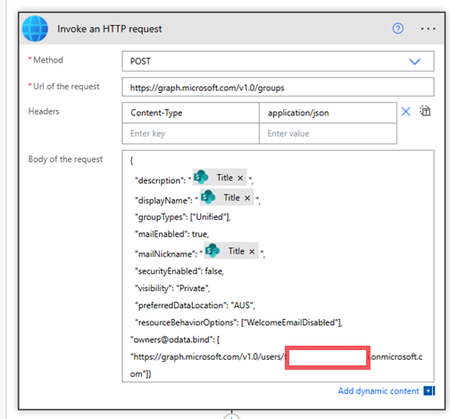
We have our tenant with 4 Geo locations. And inside power automate flow I am sending this Graph Api to create a new security group under specific Geo location:- but I am getting this error:- The requesting principal is not authorized to set group preferred data location. Now if i remove this parameter:- "preferredDataLocation": "AUS", the Office 365 group will get created under the default location, but I need to add it to the specific location. the service account running the graph Api call has SharePoint, group and teams admin permissions. any advice? Thanks159Views0likes0Comments
Query Regarding Duplicate Message IDs from Microsoft Graph API
Hello Microsoft Support Team, I am currently using the Microsoft Graph API to fetch email messages from the inbox of a my support email in my PHP application. However, I am encountering an issue where the API returns duplicate message IDs for emails. This is causing problems as emails with the same id are being processed multiple times, which results in duplicate ticket creation in my CRM system. To avoid this, I am currently checking and skipping duplicate IDs manually in my application. However, I would like to understand the root cause of these duplicates and whether there is an official recommendation or best practice to handle such cases effectively. Here are some additional details: API Endpoint: GET graph.microsoft.com/beta/users/$userEmailEncoded/mailFolders/Inbox/messages?\$top=20&\$orderby=receivedDateTime%20desc Issue: Duplicate message IDs (id) returned for the same email. Current Handling: I am skipping already processed emails using a tracking for message IDs to prevent duplicate ticket creation. Additionally, I have a few more queries regarding the use of internetMessageId and fetching attachments: Problem with internetMessageId: When I use internetMessageId, the internetMessageId of a replied message returns null. How can I use this ID effectively to manage or track message threads and replies? Attachments with internetMessageId: Is it possible to fetch attachments for a message using the internetMessageId? I am trying to retrieve attachments for a specific email using this ID, but I am not sure how to do this efficiently. Could you please advise on the following: Is there a recommended way to handle or filter out duplicate emails when fetching email data from the Graph API? Is there any mechanism in the API to ensure unique messages, especially when calling this endpoint frequently? How can I properly use internetMessageId for tracking message threads and replies, and why is it returning null for replied messages? Can I retrieve attachments using internetMessageId or is there another method for doing so? I would greatly appreciate any guidance or suggestions you can provide. Thank you for your time and assistance. Best regards, Krishna Adroja email address removed for privacy reasons329Views1like2Comments
Mail delivery fail when I Add events to Calendar
Hello I have a Contoso tennant for Developer tasks We are creating one web app for room reservations in a corporation using 365 accounts After some "ok" tests, the reservation has started to fail because the sender has been put in Spam list the fail message email that the sender email account get is Your message wasn't delivered because the recipient's email provider rejected it. Remote server returned '550 5.7.501 Service unavailable. Spam abuse detected from IP range... The api we are using use the calendar var res = await graphClient.Users[currUserId].Calendar.Events .Request() .AddAsync(evento); Any trick to avoid this problem? Thank you in advance Bruno429Views0likes1CommentUnexpected 429 Errors from SharePoint /list and /content APIs – Not Near Documented Limits
Hi everyone, I'm currently working with the Microsoft Graph /list API to retrieve files from a SharePoint document library and then using the /content endpoint to download each file. After processing approximately 1000 records, I began receiving 429 Too Many Requests errors. On reviewing the API traffic from my application, I found that we're only making about 150 API calls per minute, which is well below the documented thresholds. According to Microsoft’s guidance on avoiding throttling in SharePoint Online (link to docs), the usage is nowhere near the stated API or egress limits — especially the tenant-level thresholds like 1,200 API calls/min or 100GB/hour egress. What’s puzzling is the lack of transparency — I’m unable to find any dashboards, logs, or reports in Microsoft 365 or Entra that show how many API requests are being made or what limits are being approached. My questions: Are there any hidden or undocumented limits (e.g., per-user, per-app, or per-site collection)? Could /content downloads have higher cost per call or impact the limit differently? Is there any way to monitor detailed API usage against SharePoint or Graph API from the Microsoft portal? Would appreciate any guidance or insights from others who’ve faced similar issues! Thanks in advance!125Views0likes0CommentsHow to get a user P.O. Box from Active directory using Graph API
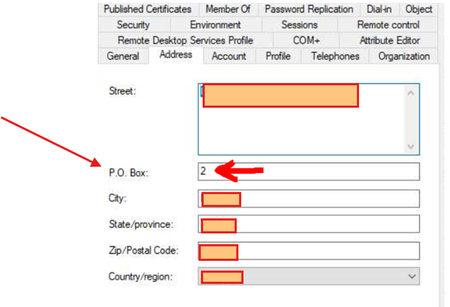
Inside our Active Directory, we have this value for the P.O Box:- now i want to get this value based on the user's email address using graph api, i tried those endpoint, but never able to get the P.O. Box value, here what i tried:- 1) https://graph.microsoft.com/beta/users/<useremail>/profile/ I got this as part of the response, "company": { "displayName": "****", "pronunciation": null, "department": "***", "companyCode": null, "officeLocation": "****", "webUrl": null, "secondaryDepartment": null, "address": { "type": "business", "postOfficeBox": null, "street": "****", "city": "***", "state": "***", "countryOrRegion": "**", "postalCode": "***" } } } there there is postOfficeBox but it is null 2) https://graph.microsoft.com/v1.0/users/<email address> this does not include P.O. Box any advice?272Views0likes4Comments- 238Views0likes2Comments