microsoft teams
31 Topics
Identifying Inactive Teams
Hello, I am trying to identify inactive Teams, I work for a reasonably sized company so we have hundreds of Teams setup. I have tried running a Usage Report but that only shows Teams that have had activity within the last 7, 28 or 90 days, if a Team has had no activity for over 90 days it does not seem to appear within the report. So far the only way in which I have come up with identifying these inactive Teams is to compare the Usage report with the list of Teams manually which is less than ideal. Are there any alternatives that I am missing? I have read about running some kind of Powershell script but I am not that familiar with using Powershell. Thanks for any suggestions.8.9KViews1like5CommentsTeams created in Teams have Group Privacy: HiddenMembers
Since I could not create Class Teams from existing Groups (the option never appears), I tried creating the Teams in Teams first. This works, but now I can’t edit the Groups in the Admin Center because they have a Group Privacy setting that the Admin Center doesn’t seem to understand (HiddenMembers). The drop-down stays on “Loading” forever and it’s not possible to save any changes to the group. I’ve tried editing in Teams admin center too, but it helpfully says: We can't save the team. Please try again. If you continue to have problems, contact {SupportLink}. Is there any way to fix this???5.2KViews1like2Comments
Where does Teams get its user list from? I can't make sense of which accounts I see vs which I can't
OK, so I have a currently rather unusual situation. I am looking at a 365 Tenant. A number of users have four accounts on the same tenant (let's not even get into why, cleaning things up is part of the reason I got called in). When you start typing their name into teams it comes up with three of them as a suggestion (I only want one) Account 1: has just been used for ActiveDirectory for permissions to the company's Distributed File System (stored in on on premises servers in various locations). This account has to the best of my knowledge never had a license or mailbox associated with it, and so has never been on the global address list, it's also never had the teams app enabled for it. I don't want this one to show, but it does Account 2: A now defunct account which used to have a Business Standard license assigned to it, but has now had the licensed removed. Before the license was removed this account was hidden from the GAL and its teams app disabled. I don't want this one to show, but it does Account 3: An now defunct account which still has a Business Standard license, but with Teams deselected in the Apps. I don't want this one to show... and it doesn't Account 4: An account shared via a multi tenant organization (the users in question have been migrated to a new tenant). So these are members (not guests) but external ones. I want this to show, and it does. Now, accounts 2 and 3 will be deleted soon, whether we can get rid of account 1 depends on whether the necessary access to the DFS can be done using account 4 (which I need to look into next). However for the time being they are all there so I was trying to hide accounts I don't want users trying to message on teams from teams, and I cannot make any sense of which I see which I don't. To sum up. Account that has never been on the Global Address List and never been activated for Teams - Shows Account that used to have a license and was on the GAL, and used in teams - Shows Account that still has a license, but has been removed from GAL and had teams app disabled - Doesn't show Account that has no license and is not on the GAL, but has teams on it's host tenant - Shows After a previous inquiry I set "Scope directory search using an Exchange address book policy" in the teams setup, but I have not set up any specific address book policy as yet. I have tried showing and hiding people from the global address list, and also the "ShowInAddressList" setting in Entra (which seems to only be available through graph?). Nothing seems to make a difference (it doesn't help that Teams takes forever to update its local cache for this stuff, so maybe a change DID make a difference at some point and I missed it). I cannot find any logic as to which of these accounts is showing in the auto suggests and which not, most notably that account 1 shows but account 3 doesn't. So, where is Teams getting its list of contacts from?3.1KViews0likes4CommentsI've set up a Multi Tenant Organization, but I'm not sure if the user contact information is correct
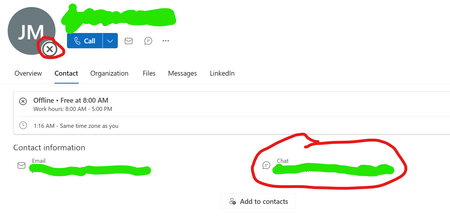
I have two 365 tenants (divisions of the same company) that want to be able to communicate as seamlessly as possible without merging the tenants. Now from what I could read and see on videos, a Multi Tenant Organization was the way to achieve this. I've found a number of YouTube videos explaining how to set one up (easy enough it seemed) but none that really showed the effects of this (I think they are pitched at people who probably have experience of B2B collaboration in 365) so I'm not sure exactly what I should expect. Anyway, I set up the MTO, shared a few users, and also found the "External Access With Trial Tenants" setting (one of the tenants is new, and so still in the trial period). I see the users show in the user lists, with the expected EXT address and a "No" for the "Guest" column, and they appear in each other's "Default Global Address List" in Outlook.. so far, so good I seem to be able to instigate chats within Teams, which is good. But if I look at their profiles in outlook or teams, then they always seem to show as offline unless I've got an active chat going on with one, and there is "chat" link for them. I don't know because so far I haven't found anything that shows, from the user perspective, the result of a correctly set up MTO. So should I expect the status of a synced user to show their actual connection status to their tenant"? So far they haven't unless I've instigated a chat, and in that case the recognition of the other party being connected only seem to go one way, so only one of the two parties in a cross tenant chat shows as connected in their respective tenants. And should there be a "Chat" link? (there isn't) Note: the above is the profile of a local user who was actually offline not one synchronized in from another tenant. I just used that as it could illustrate the two parts I have questions about.2.9KViews0likes3Comments
Cannot see guest account in Teams
I created a bunch of guest accounts, all for the same 3rd party vendor/company. Only one guest account is giving us issues - we cannot see this one guest account in Teams. We search for their name but the guest account doesn't show up. The guest itself has accepted the invitation, and when they log into Teams, they cannot see us either. 1. Yes, they accepted the guest account/invitation 2. I go into O365 Admin Portal, under guest accounts, I can see their account successfully 3. I checked all properties of that guest account with the other guest accounts, and I don't see any differences 4. We have a on-prem exchange server, I verified the guest account does not exist in exchange server I've deleted/re-created the guest account multiple times, but still cannot get this one particular account to show up in Teams. I don't believe it's a replication issue, as it's been almost two weeks and the account doesn't show up. We haven't requested that the vendor try deleting/re-creating their account, I can do this if someone suspects it's an issue on that side as opposed to our side.2.1KViews0likes0CommentsCannot create Information Barrier Policy
Hi, I have created two segments within Information Barriers in Microsoft Purview. I have then tried to create a Policy that blocks one segment from the other using both the UI and PowerShell, but I get the same error every time. "Could not run the command New-InformationBarrierPolicy. Cause of the problem: The parameter(s) ModerationAllowed of the cmdlet New-ExoInformationBarrierPolicy is not allowed for the app 00000007-0000-0ff1-ce00-000000000000" Am I missing something? Is anyone else seeing this, or is it just me? Right now, I can create many policies at all.Solved1.9KViews0likes4CommentsM365 - Demo licensing
Hi Does anyone have any recommendations about licensing a demo tenant? We have a tenant which is just used for the purposes of demonstrating Microsoft Teams, some 3rd party apps and other funcitonality. I was wondering if there is some kind of discounted license, or some free 'demo' licenses that can be ordered and used for this. Main user licenses we are using at the moment: -Microsoft Business Basic -Microsoft Teams Phone Standard Seems a bit silly to be paying monthly fees for environment created to sell additional microsoft products. Thanks MartinSolved1.9KViews0likes3CommentsTeams - Powershell for admin center reports
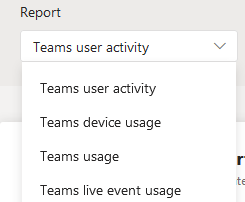
Hello, I am looking for a way to automate getting report info from admin center via powershell for Microsoft Teams So far the teams cmdlet seems to not have anything like this If anyone can help me out or point me in the right direction i would appreciate it. Thank you!Solved1.9KViews0likes1Comment
Users' password has expired in AD but they are still able to access Teams and Outlook
Good morning everyone! I had a user whos password expired in AD, but they were still able to access their Teams and Outlook. Is this because they were not logged out when their password expired? If so, how do I log the user out of everything upon password expiration. If there is another reason please let me know! Thanks everyone 🙂1.8KViews0likes2Comments