microsoft 365 defender
594 TopicsDeclutter and Defend: Reducing promotional mail noise with Microsoft Defender
Enterprise inboxes are overwhelmed with graymail — legitimate, bulk email like newsletters, vendor promotions, and product updates that isn't malicious but buries the messages that matter. When high volumes of these mails land in the inbox, it crowds out priority communications and can dull security vigilance. Employees conditioned to ignore repetitive emails may miss signs of a real threat. It also creates recurring work for admins and security teams who must continuously tune filters, manage exception requests, and chase noise from user reports for email that isn’t malicious. Because graymail passes every spam filter check, traditional defenses don't separate it — leaving this signal-to-noise gap unaddressed. Today we’re excited to announce that Microsoft Defender now includes built-in graymail filtering. It is delivered natively through a new Promotions experience in Outlook that automatically classifies and separates bulk email, so it no longer competes with business-critical communication in the inbox. Now in Public Preview, this capability learns from how users interact with graymail to become more accurate over time. Coupled with the existing Bulk Senders Insight report, Defender brings data-driven bulk classification and control into the security workflows you already use. What Is Graymail? Graymail is legitimate bulk email that isn't malicious—product newsletters, event announcements, marketing promotions, and software update notifications from reputable, authenticated senders. It is distinct from spam and from phishing - graymail comes from real organizations with proper authentication and traditional spam filters aren't designed to handle it. Graymail handling in Microsoft Defender Microsoft Defender's approach is built on three principles: classify intelligently, deliver natively, and learn continuously. Promotions Folder — Intelligent Inbox Organization A dedicated Promotions folder, natively provisioned in Outlook, now keeps legitimate bulk mail out of the primary inbox. Promotional content is separated from priority emails without being sent to Junk, which means users can still access and browse newsletters and updates at their own pace. The folder appears at the top level of the mailbox for easy discovery and is visible across all Outlook experiences. Non-spam bulk mail below the organization's configured Bulk Complaint Level threshold is automatically routed to the Promotions folder. Messages from senders the user has explicitly allowed continue to land in the Inbox. Messages identified as spam continue to go to Junk. To enable the Promotions folder administrators need to enable the "Bulk Moves Enabled" setting in their anti-spam policy. The Promotions folder is then created for all users and used for routing only when this setting is ON. Existing mail flow is unaffected. Promotional mail tagging and Mailbox Rule Support Messages classified as graymail will automatically be labeled with a "Promotions" system tag in Outlook. The tag provides instant visual context without requiring users to open each message and is visible in Outlook on the Web and the native Outlook desktop apps for Windows and Mac. During Public Preview, the tagging component is opt-in, requiring administrators to enable it by configuring an Exchange Transport Rule. Once generally available, it will be enabled by default. Because this classification is integrated at the client level, the Promotions tag can also be used as a condition in Outlook mailbox rules. This enables custom routing logic for advanced scenarios like moving all promotions-tagged messages from a specific sender to a custom folder, flagging certain promotional emails for follow-up, or auto-forwarding or deleting promotions that meet specific criteria. This transforms the Promotions classification from a one-way filter into a flexible building block for personal and organizational workflows—particularly valuable for power users and teams with compliance or archival requirements. Adaptive Learning Microsoft Defender's graymail filtering gets smarter with every interaction. The system learns directly from how users handle their mail. When a user moves a message out of the Promotions folder and back to the Inbox, future emails from that sender will no longer be placed in the Promotions folder. When a user moves a message from the Inbox into the Promotions folder, future emails from that sender will be routed to the Promotions folder automatically. This creates a personalized, self-improving experience that becomes more accurate over time - no manual rule configuration required, no safe-sender lists to maintain, and no filtering rules for IT teams to manage on behalf of individual employees. Built into existing Security Workflows Administrators also gain visibility through the Bulk Senders Insight report, which provides data-driven guidance on what your organization actually receives and can help tune your bulk mail filtering. Graymail has long been the unsolved middle ground of email security—too legitimate to block, too noisy to ignore. Microsoft Defender now handles it where it should be handled: inside the platform, inside the mailbox, and inside the security workflows your organization already relies on. No new portals, no new vendors, no compromise between security and user experience. Get Started Configure promotions tagging and the promotions folder today - Bulk email detection documentation on Microsoft Learn. Monitor the experience using the Bulk Senders Insight report.Authorization and Governance for AI Agents: Runtime Authorization Beyond Identity at Scale
Designing Authorization‑Aware AI Agents at Scale Enforcing Runtime RBAC + ABAC with Approval Injection (JIT) Microsoft Entra Agent Identity enables organizations to govern and manage AI agent identities in Copilot Studio, improving visibility and identity-level control. However, as enterprises deploy multiple autonomous AI agents, identity and OAuth permissions alone cannot answer a more critical question: “Should this action be executed now, by this agent, for this user, under the current business and regulatory context?” This post introduces a reusable Authorization Fabric—combining a Policy Enforcement Point (PEP) and Policy Decision Point (PDP)—implemented as a Microsoft Entra‑protected endpoint using Azure Functions/App Service authentication. Every AI agent (Copilot Studio or AI Foundry/Semantic Kernel) calls this fabric before tool execution, receiving a deterministic runtime decision: ALLOW / DENY / REQUIRE_APPROVAL / MASK Who this is for Anyone building AI agents (Copilot Studio, AI Foundry/Semantic Kernel) that call tools, workflows, or APIs Organizations scaling to multiple agents and needing consistent runtime controls Teams operating in regulated or security‑sensitive environments, where decisions must be deterministic and auditable Why a V2? Identity is necessary—runtime authorization is missing Entra Agent Identity (preview) integrates Copilot Studio agents with Microsoft Entra so that newly created agents automatically get an Entra agent identity, manageable in the Entra admin center, and identity activity is logged in Entra. That solves who the agent is and improves identity governance visibility. But multi-agent deployments introduce a new risk class: Autonomous execution sprawl — many agents, operating with delegated privileges, invoking the same backends independently. OAuth and API permissions answer “can the agent call this API?” They do not answer “should the agent execute this action under business policy, compliance constraints, data boundaries, and approval thresholds?” This is where a runtime authorization decision plane becomes essential. The pattern: Microsoft Entra‑Protected Authorization Fabric (PEP + PDP) Instead of embedding RBAC logic independently inside every agent, use a shared fabric: PEP (Policy Enforcement Point): Gatekeeper invoked before any tool/action PDP (Policy Decision Point): Evaluates RBAC + ABAC + approval policies Decision output: ALLOW / DENY / REQUIRE_APPROVAL / MASK This Authorization Fabric functions as a shared enterprise control plane, decoupling authorization logic from individual agents and enforcing policies consistently across all autonomous execution paths. Architecture (POC reference architecture) Use a single runtime decision plane that sits between agents and tools. What’s important here Every agent (Copilot Studio or AI Foundry/SK) calls the Authorization Fabric API first The fabric is a protected endpoint (Microsoft Entra‑protected endpoint required) Tools (Graph/ERP/CRM/custom APIs) are invoked only after an ALLOW decision (or approval) Trust boundaries enforced by this architecture Agents never call business tools directly without a prior authorization decision The Authorization Fabric validates caller identity via Microsoft Entra Authorization decisions are centralized, consistent, and auditable Approval workflows act as a runtime “break-glass” control for high-impact actions This ensures identity, intent, and execution are independently enforced, rather than implicitly trusted. Runtime flow (Decision → Approval → Execution) Here is the runtime sequence as a simple flow (you can keep your Mermaid diagram too). ```mermaid flowchart TD START(["START"]) --> S1["[1] User Request"] S1 --> S2["[2] Agent Extracts Intent\n(action, resource, attributes)"] S2 --> S3["[3] Call /authorize\n(Entra protected)"] S3 --> S4 subgraph S4["[4] PDP Evaluation"] ABAC["ABAC: Tenant · Region · Data Sensitivity"] RBAC["RBAC: Entitlement Check"] Threshold["Approval Threshold"] ABAC --> RBAC --> Threshold end S4 --> Decision{"[5] Decision?"} Decision -->|"ALLOW"| Exec["Execute Tool / API"] Decision -->|"MASK"| Masked["Execute with Masked Data"] Decision -->|"DENY"| Block["Block Request"] Decision -->|"REQUIRE_APPROVAL"| Approve{"[6] Approval Flow"} Approve -->|"Approved"| Exec Approve -->|"Rejected"| Block Exec --> Audit["[7] Audit & Telemetry"] Masked --> Audit Block --> Audit Audit --> ENDNODE(["END"]) style START fill:#4A90D9,stroke:#333,color:#fff style ENDNODE fill:#4A90D9,stroke:#333,color:#fff style S1 fill:#5B5FC7,stroke:#333,color:#fff style S2 fill:#5B5FC7,stroke:#333,color:#fff style S3 fill:#E8A838,stroke:#333,color:#fff style S4 fill:#FFF3E0,stroke:#E8A838,stroke-width:2px style ABAC fill:#FCE4B2,stroke:#999 style RBAC fill:#FCE4B2,stroke:#999 style Threshold fill:#FCE4B2,stroke:#999 style Decision fill:#fff,stroke:#333 style Exec fill:#2ECC71,stroke:#333,color:#fff style Masked fill:#27AE60,stroke:#333,color:#fff style Block fill:#C0392B,stroke:#333,color:#fff style Approve fill:#F39C12,stroke:#333,color:#fff style Audit fill:#3498DB,stroke:#333,color:#fff ``` Design principle: No tool execution occurs until the Authorization Fabric returns ALLOW or REQUIRE_APPROVAL is satisfied via an approval workflow. Where Power Automate fits (important for readers) In most Copilot Studio implementations, Agents calls Power Automate (agent flows), is the practical integration layer that calls enterprise services and APIs. Copilot Studio supports “agent flows” as a way to extend agent capabilities with low-code workflows. For this pattern, Power Automate typically: acquires/uses the right identity context for the call (depending on your tenant setup), and calls the /authorize endpoint of the Authorization Fabric, returns the decision payload to the agent for branching. Copilot Studio also supports calling REST endpoints directly using the HTTP Request node, including passing headers such as Authorization: Bearer <token>. Protected endpoint only: Securing the Authorization Fabric with Microsoft Entra For this V2 pattern, the Authorization Fabric must be protected using Microsoft Entra‑protected endpoint on Azure Functions/App Service (built‑in auth). Microsoft Learn provides the configuration guidance for enabling Microsoft Entra as the authentication provider for Azure App Service / Azure Functions. Step 1 — Create the Authorization Fabric API (Azure Function) Expose an authorization endpoint: HTTP Step 2 — Enable Microsoft Entra‑protected endpoint on the Function App In Azure Portal: Function App → Authentication Add identity provider → Microsoft Choose Workforce configuration (enterprise tenant) Set Require authentication for all requests This ensures the Authorization Fabric is not callable without a valid Entra token. Step 3 — Optional hardening (recommended) Depending on enterprise posture, layer: IP restrictions / Private endpoints APIM in front of the Function for rate limiting, request normalization, centralized logging (For a POC, keep it minimal—add hardening incrementally.) Externalizing policy (so governance scales) To make this pattern reusable across multiple agents, policies should not be hardcoded inside each agent. Instead, store policy definitions in a central policy store such as Cosmos DB (or equivalent configuration store), and have the PDP load/evaluate policies at runtime. Why this matters: Policy changes apply across all agents instantly (no agent republish) Central governance + versioning + rollback becomes possible Audit and reporting become consistent across environments (For the POC, a single JSON document per policy pack in Cosmos DB is sufficient. For production, add versioning and staged rollout.) Store one PolicyPack JSON document per environment (dev/test/prod). Include version, effectiveFrom, priority for safe rollout/rollback. Minimal decision contract (standard request / response) To keep the fabric reusable across agents, standardize the request payload. Request payload (example) Decision response (deterministic) Example scenario (1 minute to understand) Scenario: A user asks a Finance agent to create a Purchase Order for 70,000. Even if the user has API permission and the agent can technically call the ERP API, runtime policy should return: REQUIRE_APPROVAL (threshold exceeded) trigger an approval workflow execute only after approval is granted This is the difference between API access and authorized business execution. Sample Policy Model (RBAC + ABAC + Approval) This POC policy model intentionally stays simple while demonstrating both coarse and fine-grained governance. 1) Coarse‑grained RBAC (roles → actions) FinanceAnalyst CreatePO up to 50,000 ViewVendor FinanceManager CreatePO up to 100,000 and/or approve higher spend 2) Fine‑grained ABAC (conditions at runtime) ABAC evaluates context such as region, classification, tenant boundary, and risk: 3) Approval injection (Agent‑level JIT execution) For higher-risk/high-impact actions, the fabric returns REQUIRE_APPROVAL rather than hard deny (when appropriate): How policies should be evaluated (deterministic order) To ensure predictable and auditable behavior, evaluate in a deterministic order: Tenant isolation & residency (ABAC hard deny first) Classification rules (deny or mask) RBAC entitlement validation Threshold/risk evaluation Approval injection (JIT step-up) This prevents approval workflows from bypassing foundational security boundaries such as tenant isolation or data sovereignty. Copilot Studio integration (enforcing runtime authorization) Copilot Studio can call external REST APIs using the HTTP Request node, including passing headers such as Authorization: Bearer <token> and binding response schema for branching logic. Copilot Studio also supports using flows with agents (“agent flows”) to extend capabilities and orchestrate actions. Option A (Recommended): Copilot Studio → Agent Flow (Power Automate) → Authorization Fabric Why: Flows are a practical place to handle token acquisition patterns, approval orchestration, and standardized logging. Topic flow: Extract user intent + parameters Call an agent flow that: calls /authorize returns decision payload Branch in the topic: If ALLOW → proceed to tool call If REQUIRE_APPROVAL → trigger approval flow; proceed only if approved If DENY → stop and explain policy reason Important: Tool execution must never be reachable through an alternate topic path that bypasses the authorization check. Option B: Direct HTTP Request node to Authorization Fabric Use the Send HTTP request node to call the authorization endpoint and branch using the response schema. This approach is clean, but token acquisition and secure secretless authentication are often simpler when handled via a managed integration layer (flow + connector). AI Foundry / Semantic Kernel integration (tool invocation gate) For Foundry/SK agents, the integration point is before tool execution. Semantic Kernel supports Azure AI agent patterns and tool integration, making it a natural place to enforce a pre-tool authorization check. Pseudo-pattern: Agent extracts intent + context Calls Authorization Fabric Enforces decision Executes tool only when allowed (or after approval) Telemetry & audit (what Security Architects will ask for) Even the best policy engine is incomplete without audit trails. At minimum, log: agentId, userUPN, action, resource decision + reason + policyIds approval outcome (if any) correlationId for downstream tool execution Why it matters: you now have a defensible answer to: “Why did an autonomous agent execute this action?” Security signal bonus: Denials, unusual approval rates, and repeated policy mismatches can also indicate prompt injection attempts, mis-scoped agents, or governance drift. What this enables (and why it scales) With a shared Authorization Fabric: Avoid duplicating authorization logic across agents Standardize decisions across Copilot Studio + Foundry agents Update governance once (policy change) and apply everywhere Make autonomy safer without blocking productivity Closing: Identity gets you who. Runtime authorization gets you whether/when/how. Copilot Studio can automatically create Entra agent identities (preview), improving identity governance and visibility for agents. But safe autonomy requires a runtime decision plane. Securing that plane as an Entra-protected endpoint is foundational for enterprise deployments. In enterprise environments, autonomous execution without runtime authorization is equivalent to privileged access without PIM—powerful, fast, and operationally risky.
Security Admin Center Tenant Allow/Block List Not Able to Block IPv4?
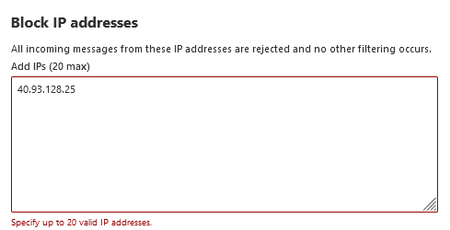
While using the Security Admin Center Tenant Allow/Block List we have been able to block specific email addresses and IPv6 IP addresses but are unable to block IPv4 IP addresses. We have tried both using the console and the CLI but have turned up unsuccessful both times when it comes to IPv4. A large majority of the phishing attempts that we encounter come from IPv4 addresses but we have been unable to block any of these. Will there ever be functionality for IPv4 within the Tenant Allow/Block list or is the only option to use conditional access policies? Also why is this enterprise tool only functional with IPv6 and without documentation stating that it does not work for IPv4?1.9KViews4likes6Comments
Feature Request: Extend Security Copilot inclusion (M365 E5) to M365 A5 Education tenants
Background At Ignite 2025, Microsoft announced that Security Copilot is included for all Microsoft 365 E5 customers, with a phased rollout starting November 18, 2025. This is a significant step forward for security operations. The gap Microsoft 365 A5 for Education is the academic equivalent of E5 — it includes the same core security stack: Microsoft Defender, Entra, Intune, and Purview. However, the Security Copilot inclusion explicitly covers only commercial E5 customers. There is no public roadmap or timeline for extending this benefit to A5 education tenants. Why this matters Education institutions face the same cybersecurity threats as commercial organizations — often with fewer dedicated security resources. The A5 license was positioned as the premium security offering for education. Excluding it from Security Copilot inclusion creates an inequity between commercial and education customers holding functionally equivalent license tiers. Request We would like Microsoft to: Confirm whether Security Copilot inclusion will be extended to M365 A5 Education tenants If yes, provide an indicative timeline If no, clarify the rationale and what alternative paths exist for education customers Are other EDU admins in the same situation? Would appreciate any upvotes or comments to help raise visibility with the product team.786Views13likes3CommentsWindows defender is having a lot of problems.
So I have a Microsoft 365 Family subscription, and Dark Web Monitoring shows 0 monitored items. SSN verification fails and advises you to contact support. I was also unable to delete the monitored information. I’m receive the error "Something went wrong, try again in a bit." The issue occurs in the Microsoft Defender app, web portal, and across devices. Is there anyway that I can get help with this?Securing AI Agents at Runtime: Real-Time Protection and Threat Detection for Microsoft Agent 365
Organizations are rapidly adopting AI agents to automate workflows, access enterprise data, invoke tools, and take actions on behalf of users. This autonomy creates a fundamentally new security challenge. Unlike traditional AI applications, agents operate across dynamic execution flows, interacting with external content, calling tools, and accessing sensitive resources. These interactions create new attack paths that traditional security controls were not designed to address. Today, we're announcing two major milestones for Security for AI in Microsoft Defender for Microsoft Agent 365: Threat detection for Microsoft Agent 365 agents — now in public preview. Real-time protection for Microsoft Agent 365 tooling servers — now generally available. Together, these capabilities help security teams detect, investigate, and block attacks targeting AI agents, extending Microsoft Defender's threat protection capabilities into the agent runtime. Threat detection for Microsoft Agent 365 Agents (Public Preview) Threat detection provides SOC teams with detailed visibility into attacks and suspicious activity targeting AI agents. By analyzing runtime signals across agent interactions, tool usage, and execution patterns, Microsoft Defender identifies suspicious and malicious behavior throughout the agent execution lifecycle and surfaces actionable security alerts for SOC teams. Threat detection supports cloud agent types that emit observability logs to Microsoft Agent 365, including: Microsoft Copilot Studio Microsoft Foundry Microsoft 365 Copilot Agent Builder Agents integrated through the Microsoft Agent 365 SDK This provides consistent threat visibility across supported Microsoft Agent 365 agent experiences, regardless of how the agent was built. Fig. 1. Microsoft Security for AI alerts in Microsoft Defender XDR (Preview) Microsoft Defender identifies a broad range of AI-specific threats, including: Indirect prompt injection (XPIA) — malicious instructions embedded in external content designed to manipulate agent behavior. Evasion techniques — attempts to bypass agent instructions or security controls. Malicious content propagation — attempts to use agents to generate or distribute malicious content. Secret leakage — exposure of credentials, API keys, or other sensitive information through agent interactions. LLM reconnaissance — attempts to probe agent capabilities, instructions, or security boundaries. Suspicious IP access — agent access originating from anonymized or suspicious IP addresses. Alerts are surfaced directly in Microsoft Defender, enabling SOC analysts to investigate and respond using familiar workflows, Advanced Hunting queries, and the Defender XDR investigation experience. Real-time protection for WorkIQ and Custom MCP servers (General Availability) Real-time protection moves beyond detection by blocking threats inline when AI agents interact with WorkIQ and custom MCP servers (see Microsoft Agent 365 tooling servers). When an agent invokes a registered tool or receives a tool response, Defender evaluates the interaction against configured security policies and determines whether to allow or block it directly within the agent's execution flow. This helps prevent malicious actions and data leakage in real time, without requiring agent developers to implement custom security logic. Fig. 2. Microsoft Security for AI Real-Time Protection policy in Defender Real-time protection currently guards against high-impact threats, including: Evasion techniques — attempts to bypass agent guardrails or security controls. Malicious content propagation — preventing agents from spreading malicious content through tool actions. Secret leakage — blocking agents from inadvertently exposing credentials or sensitive data through tool calls. Communication with untrusted domains — preventing agents from sending email or data to high-risk or untrusted email domains. Better Together: Detection and Protection Threat detection and real-time protection address complementary parts of the agent security lifecycle. Real-time protection provides inline enforcement to block malicious interactions during execution, while threat detection gives SOC teams the visibility and investigation context needed to identify attack patterns, assess impact, and respond to suspicious activity. Together, they provide a defense-in-depth approach that combines runtime enforcement with SOC-driven detection and investigation, purpose-built for AI agents. Getting Started Both capabilities are available through Microsoft Defender, using a dedicated Security for AI workload experience that brings together AI threat detections, investigations, and runtime protection policies. To learn more: Enable security for AI agents using Microsoft Defender Detect and investigate threats to AI agents using Microsoft Defender (Preview) Protect AI agents in real time using Microsoft Defender As AI agents become more autonomous and gain access to enterprise data and tools, securing their runtime behavior becomes critical. With Threat Detection and Real-Time Protection, Microsoft Defender helps organizations adopt AI agents with security controls designed for how agents actually operate—detecting attacks, enabling SOC investigation, and blocking malicious interactions at runtime.1.2KViews1like0CommentsCustom Detection Rules as Code in Sentinel Repositories: What Your Pipeline Owns Now
While going through the June Sentinel updates I almost scrolled past this one, and I think that would have been a mistake: custom detection rules can now be managed as code in Sentinel Repositories, the same way analytics rules, playbooks, parsers and workbooks already are. You connect a GitHub or Azure DevOps repo, enable the Custom Detection Rules content type, and rules are synced on every commit. There is also a standalone path via the Bicep CLI for teams running their own pipelines. The feature is in preview per the Learn documentation, and in my view it matters more than the low-key rollout suggests. Microsoft has been positioning custom detections as the unified experience for building rules over both Defender XDR and Sentinel data since late 2025. If custom detections are becoming the primary detection type, then this preview is the moment your primary detection type becomes pipeline-managed. I spent some time in the documentation to understand what that actually means, and there is one implication I have not seen anyone talk about yet. How it works Custom detection rules use a different mechanism than every other content type in Repositories. Analytics rules deploy as Microsoft.OperationalInsights/workspaces/providers/alertRules resources, with the Microsoft.SecurityInsights provider sitting in the resource name. Custom detection rules instead use a dedicated Bicep extension. You declare it in a `bicepconfig.json` at the repo root: { "extensions": { "MicrosoftSecurity": "br:mcr.microsoft.com/bicep/extensions/microsoftsecurity:v1.0.1" } } The rule itself is a `Microsoft.Security/detectionRules` resource. This is the structure from the Microsoft documentation: extension MicrosoftSecurity resource detectionRule 'Microsoft.Security/detectionRules@2026-06-01-preview' = { id: 'custom-rule-id' displayName: 'Custom Rule Display Name' status: 'enabled' queryCondition: { queryText: 'DeviceProcessEvents | take 10 | project DeviceId, Timestamp, FileName' } schedule: { frequency: 'PT1H' } detectionAction: { alertTemplate: { title: '<ruleTitle>' description: 'Custom detection rule' severity: 'medium' tactics: [ { tactic: 'Execution' techniques: [ { technique: 'T1059' } ] } ] entityMappings: { hosts: [ { id: 'h' deviceIdColumn: 'DeviceId' } ] } } } } Rules are uniquely identified by the `id` property, which you provide in the template. Deployment is either the automatic Repositories sync or a plain `az deployment group create` against a resource group. That last part is what I like most about the design: any CI/CD system that can run Azure CLI can ship these rules. Prerequisites beyond the standard Repositories setup: a Microsoft 365 E5 license or equivalent that includes Defender XDR, and a Sentinel workspace onboarded to the Defender portal. Two preview limitations are documented: custom frequency for Sentinel-only data is not supported yet, and neither are custom details. The part that made me stop reading and think Repositories are designed as the single source of truth. The documentation is explicit that content in your repo overwrites changes made through the portal. That is the whole point of the feature, and for analytics rules it has been mostly harmless. For custom detections I see a wrinkle. When Microsoft renames tables or columns in the advanced hunting schema, those naming changes are applied automatically to queries saved in Microsoft Defender, including the queries inside custom detection rules. The docs are equally explicit that this automatic migration does not cover queries run via API or saved anywhere outside Defender. A Git repo is outside Defender. Play that forward with a current example. The `AIAgentsInfo` table stopped being accessible on July 1, 2026, replaced by the unified `AgentsInfo` table with a changed column set. A portal-managed custom detection referencing the old table got migrated automatically. The same rule managed as code did not, because the authoritative copy of the query now lives in your repo, and nothing in the sync path rewrites your Bicep files. Your repo is now the thing standing between Microsoft's server-side fix and your production detection. Either the sync starts failing, or the stale query gets reasserted over the migrated rule. The documentation does not say which of the two happens, and honestly, neither is good. No alert fires for either. And if smart deployments, which skip files that have not changed since the last deployment, apply to this content type the same way they do to the rest of Repositories, it gets slightly worse in a way I find almost funny: a stale rule would sit untouched until someone happens to edit it. What I would put in front of the merge To be clear, none of this is an argument against the feature. I want detections in Git, and I suspect most people reading this do too. It is an argument that moving custom detections into a repo moves the schema lifecycle responsibility into your review process, because the portal safety net explicitly does not reach into source control. Concretely, a PR touching detection content should be checked for references to deprecated or transitioning advanced hunting tables, for the result columns the custom detection docs recommend (`Timestamp` or `TimeGenerated`, plus `DeviceId` or `DeviceName` for Defender for Endpoint tables, plus `Timestamp` and `ReportId` from the same event for the other Defender tables), and for complete entity mappings, since entities drive how alerts group into incidents. One more detail from the custom detection docs that I suspect will trip up people coming from analytics rules, because it goes against years of muscle memory: avoid filtering on `Timestamp` or `TimeGenerated` in the query itself. The service prefilters data based on the detection lookback using ingestion time. The scheduled-analytics-rule reflex of always pinning a time window works against you here. Whether you enforce these checks with a homegrown script or a linting step in the pipeline matters less than doing it before merge rather than discovering it in the alert queue. The deployment mechanics are now solved. The content governance is yours. Full transparency: I have worked through the documentation and the sample content, but I have not yet run a retired-table scenario through the sync myself. So if you are testing the preview, I would genuinely like to hear how it behaves in your environment when a repo-managed rule references a table like `AIAgentsInfo`. That failure mode is the one I want to understand before this reaches GA. Beyond that specific case, I am curious where you all stand: are you moving custom detections into Git now, or waiting for GA? And if you already run detections as code for analytics rules, what checks have earned a permanent place in your PR pipeline? My used references: Manage content as code with Microsoft Sentinel repositories: https://learn.microsoft.com/en-us/azure/sentinel/ci-cd-custom-content Advanced hunting schema naming changes: https://learn.microsoft.com/en-us/defender-xdr/advanced-hunting-schema-changes Create custom detection rules in Microsoft Defender XDR: https://learn.microsoft.com/en-us/defender-xdr/custom-detection-rules Custom detections as the unified detection experience: https://techcommunity.microsoft.com/t5/microsoft-defender-threat-protection/custom-detections-are-now-the-unified-experience-for-creating/ba-p/4463875Solved
Microsoft Defender for Office 365 Plan 1 is now rolling out to Microsoft 365 E3 and Office 365 E3
Starting today, Microsoft Defender for Office 365 Plan 1 is rolling out to customers with Microsoft 365 E3/G3 and Office 365 E3/G3 licenses, with rollout expected to complete by Fall 2026. For security teams, this means added protection against phishing, malware, and malicious links across email and collaboration, without needing to purchase or deploy a separate email security solution. It also means some protections will turn on automatically, so now is the right time to review your configuration and prepare for any changes to mail flow, policies, and end-user experience. What E3 customers are getting Previously, these subscriptions included built-in security to help filter spam and known malware. Defender for Office 365 Plan 1 builds on that foundation with additional protections designed to catch more sophisticated phishing attempts, malicious links, and zero-day threats, while giving your team better visibility into what is happening in your environment. Safe Links: Helps protect users with time-of-click protection by checking URLs and blocking malicious destinations, including QR code-based attacks. Safe Attachments: Helps stop unknown and zero-day malware before harmful files reach users. Advanced anti-phishing: Helps detect impersonation attacks that target your users, executives, and trusted domains. Expanded visibility and reporting: Gives security teams more actionable detections, alerts, and reporting in the Microsoft Defender portal. What changes automatically As the plan rolls out, protection will turn on automatically for licensed users. That is good news from a security perspective, but it is still important to understand what is changing in your environment. New protections can affect how messages are processed, how suspicious links are handled, what users see when they click blocked content, and how your team monitors and tunes policy settings after rollout. Read more about it here: https://learn.microsoft.com/en-us/defender-office-365/preset-security-policies#use-the-microsoft-defender-portal-to-add-exclusions-to-the-built-in-protection-preset-security-policy. How to prepare for the rollout Review your current mail flow and security configuration. If you know how mail is routed today and which protections are already in place, it will be easier to spot what changes once Defender for Office 365 Plan 1 is active. Decide how you want to manage policies. When the plan becomes available in your tenant, built-in protection is applied automatically for licensed users. If you want Microsoft recommended settings beyond that baseline, consider enabling the Standard or Strict preset security policies. Prepare your help desk and users. Users may start seeing warning or block experiences when Safe Links identifies a malicious destination. A simple heads-up can reduce confusion and support tickets. For more details and how to customize user notification, see Set up Safe Links policies. Plan for exceptions and tuning. If you have specific users, domains, or workflows that need exclusions, review those requirements early so your team is ready to adjust policies after rollout. Monitor what changes. Use the Microsoft Defender portal and Microsoft Secure Score to track new detections, review improvement actions, and prioritize follow-up configuration work. If you use a third-party secure email gateway If your organization routes email through a third-party secure email gateway such as Proofpoint, Mimecast, or Barracuda before it reaches Microsoft 365, you should review your configuration now. In many environments, it is recommended to configure Enhanced Filtering for Connectors, preserve original sender details in Exchange Online, and decide which service will handle link rewriting to avoid unnecessary overlap. If you are evaluating a broader consolidation of your email security stack, our guides on defense in depth and migration to Defender for Office 365 can help. Protection also extends to Microsoft Teams The plan also extends protection to Microsoft Teams chats and channels. That includes protection for shared links and files, post-delivery removal of malicious content, admin controls to manage enforcement, and user reporting to help your security team investigate suspicious messages faster. For practitioners, this adds another layer of coverage across the collaboration tools users rely on every day. Learn more For implementation guidance, visit the Microsoft Defender for Office 365 security documentation, review the step-by-step guides, and use the preset policy, defense in depth, migration, and connector configuration resources linked above to plan your rollout.
No way to automate restoring user‑reported emails after “no threats found”
When a user reports an email as phishing in Defender, the message gets moved to Deleted Items. After we triage it, if we mark it as “no threats found,” there’s no way to push it back to the user’s inbox as part of that workflow. That creates a bit of a broken experience: User is told the email is safe with our customized email response, but has to go find it themselves In a lot of cases they don’t (Outlook search won’t find it) We end up with follow‑ups like “where did it go?” Technically we could restore the email as part of our triage process, but that just shifts the effort onto the SOC. It doesn’t scale, and it’s not really the right place for that work. We have tried to create an automation to do this, but we have not been able to create an advanced hunting query based on our triage result that can then trigger an action to restore it to the mailbox. So we end up choosing between: Users having a bad experience, or Analysts doing manual mailbox work Neither is ideal. Other platforms (like Proofpoint) handle this end‑to‑end — once something is confirmed clean, it can be returned to the user automatically. Right now Defender stops at classification instead of completing the workflow. Is there a reason this isn’t wired in, or anything on the roadmap to address it?Sentinel to Defender Portal Migration - my 5 Gotchas to help you
The migration to the unified Defender portal is one of those transitions where the documentation covers "what's new" but glosses over what breaks on cutover day. Here are the gotchas that consistently catch teams off-guard, along with practical fixes. Gotcha 1: Automatic Connector Enablement When a Sentinel workspace connects to the Defender portal, Microsoft auto-enables certain connectors - often without clear notification. The most common surprises: Connector Auto-Enables? Impact Defender for Endpoint Yes EDR telemetry starts flowing, new alerts created Defender for Cloud Yes Additional incidents, potential ingestion cost increase Defender for Cloud Apps Conditional Depends on existing tenant config Azure AD Identity Protection No Stays in Sentinel workspace only Immediate action: Within 2 hours of connecting, navigate to Security.microsoft.com > Connectors & integrations > Data connectors and audit what auto-enabled. Compare against your pre-migration connector list and disable anything unplanned. Why this matters: Auto-enabled connectors can duplicate data sources - ingesting the same telemetry through both Sentinel and Defender connectors inflates Log Analytics costs by 20-40%. Gotcha 2: Incident Duplication The most disruptive surprise. The same incident appears twice: once from a Sentinel analytics rule, once from the Defender portal's auto-created incident creation rule. SOC teams get paged twice, deduplication breaks, and MTTR metrics go sideways. Diagnosis: SecurityIncident | where TimeGenerated > ago(7d) | summarize IncidentCount = count() by Title | where IncidentCount > 1 | order by IncidentCount desc If you see unexpected duplicates, the cause is almost certainly the auto-enabled Microsoft incident creation rule conflicting with your existing analytics rules. Fix: Disable the auto-created incident creation rule in Sentinel Automation rules, and rely on your existing analytics rule > incident mapping instead. This ensures incidents are created only through Sentinel's pipeline. Gotcha 3: Analytics Rule Title Dependencies The Defender portal matches incidents to analytics rules by title, not by rule ID. This creates subtle problems: Renaming a rule breaks the incident linkage Copying a rule with a similar title causes cross-linkage Two workspaces with identically named rules generate separate incidents for the same alert Prevention checklist: Audit all analytics rule titles for uniqueness before migration Document the title-to-GUID mapping as a reference Avoid renaming rules en masse during migration Use a naming convention like <Severity>_<Tactic>_<Technique> to prevent collisions Gotcha 4: RBAC Gaps Sentinel workspace RBAC roles don't directly translate to Defender portal permissions: Sentinel Role Defender Portal Equivalent Gap Microsoft Sentinel Responder Security Operator Minor - name change Microsoft Sentinel Contributor Security Operator + Security settings (manage) Significant - split across roles Sentinel Automation Contributor Automation Contributor (new) New role required Migration approach: Create new unified RBAC roles in the Defender portal that mirror your existing Sentinel permissions. Test with a pilot group before org-wide rollout. Keep workspace RBAC roles for 30 days as a fallback. Gotcha 5: Automation Rules Don't Auto-Migrate Sentinel automation rules and playbooks don't carry over to the Defender portal automatically. The syntax has changed, and not all Sentinel automation actions are available in Defender. Recommended approach: Export existing Sentinel automation rules (screenshot condition logic and actions) Recreate them in the Defender portal Run both in parallel for one week to validate behavior Retire Sentinel automation rules only after confirming Defender equivalents work correctly Practical Migration Timeline Phase 1 - Pre-migration (1-2 weeks before): Audit connectors, analytics rules, RBAC roles, and automation rules Document everything - titles, GUIDs, permissions, automation logic Test in a pilot environment first Phase 2 - Cutover day: Connect workspace to Defender portal Within 2 hours: audit auto-enabled connectors Within 4 hours: check for duplicate incidents Within 24 hours: validate RBAC and automation rules Phase 3 - Post-migration (1-2 weeks after): Monitor incident volume for duplication spikes Validate automation rules fire correctly Collect SOC team feedback on workflow impact After 1 week of stability: retire legacy automation rules Phase 4 - Cleanup (2-4 weeks after): Remove duplicate automation rules Archive workspace-specific RBAC roles once unified RBAC is stable Update SOC runbooks and documentation The bottom line: treat this as a parallel-run migration, not a lift-and-shift. Budget 2 weeks for parallel operations. Teams that rushed this transition consistently reported longer MTTR during the first month post-migration.