meetings
2998 Topics
Has anyone found a good way to use Teams transcripts as a record of manager-employee commitments?
Has anyone found a good way to use Teams transcripts as a record of manager-employee commitments? We’ve started using transcription more consistently in recurring 1:1s and manager check-ins, and Copilot is pretty good at pulling out action items from the conversation. What I’m struggling with is what happens after the meeting. If a manager and employee agree on something like “I’ll finish this by next Friday” or “we’ll revisit this goal next month,” is there a clean way to keep those commitments somewhere structured instead of having to go back through the transcript every time?33Views0likes3Comments
Meeting chats visible for only one month in Microsoft Teams
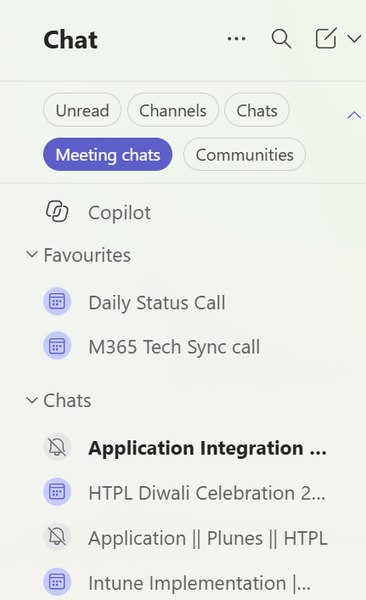
Hi Community, In Microsoft Teams, under Chat > Meeting chats, I am currently able to see meeting chats from only the last one month. Is there any way or setting to extend this so that I can see meeting chats from the last two months (60 days) in the Meeting chats section? Please let me know if this can be configured through Teams settings or the Teams Admin Center. Please find the below screenshot: Thanks!155Views0likes2Comments
The designs we didn't ship: How user feedback shaped the new Teams meeting controls
Some of the most important product decisions we've made weren't about what to ship. They were about what not to ship. When we began rethinking the meeting controls in Microsoft Teams, the challenge was clear. Meetings had become more capable, and the interface had grown along with them. As Teams meetings became more capable, we saw an opportunity to make controls simpler to navigate and easier to adapt to different meeting needs. And simply adding another button every time Teams gained a capability wasn’t the experience we wanted to carry forward. So we started with a question: Could we make meeting controls simpler today while creating room for Teams to become more capable tomorrow? It took more than one attempt to answer it. First idea: Spread things out An early concept divided the controls across more of the meeting window. The idea made sense on paper: reduce crowding, establish clearer groups, and create additional separation between actions such as Share and Leave. Initial research gave us reasons to keep exploring it. Participants responded positively to aspects of the cleaner layout and clearer grouping. But repeated use revealed tradeoffs. In our first longitudinal study, supplemented by feedback from early users and customer sessions, we identified tradeoffs in control placement, discoverability, and Leave separation that informed the next iteration. It looked cleaner. But looking cleaner wasn't enough. A meeting toolbar isn't something people simply look at. It's something they operate quickly while concentrating on a conversation, presentation, or task. So we kept going. Next, we tested very different answers Instead of debating design philosophies, we decided to test them. We developed three approaches: All centered: Put controls together in one predictable place. Three columns: Separate families of controls and use more of the available screen. Cleaned-up current: Reduce clutter while preserving more of the familiar structure. We gave those experiences to for a large cohort for a month, with participants responding to surveys twice a week. We looked at signals including findability, efficiency, confidence, effort, satisfaction, and perceived value. Just as importantly, we looked at how participants' reactions developed as they became familiar with each design. The findings exposed an important tradeoff. The lesson wasn't simply that one design had "won." It was that visual simplicity and operational simplicity aren't necessarily the same thing. Then users challenged the idea of a perfect toolbar We had been approaching the toolbar partly as an optimization problem: determine which controls belong there, identify the best order, and create the right default. What we learned from participants led us to reconsider that assumption. People use Teams differently. A presenter may have different priorities from someone participating in a large group discussion. Someone who records frequently may want Record immediately accessible. Another person may prioritize Notes, Copilot, People, reactions, or something else. Across the research, we heard a clear desire for more control over that experience. Let me customize it. That changed our thinking. Instead of trying to create one perfect toolbar, we focused on creating a system people could adapt. Pin. Unpin. Rearrange. Bring forward the controls that matter to you. The goal became a simpler starting point without assuming that everyone's definition of "simple" is the same. Finding the problems that still remained By early 2026, the design had converged substantially. But before expanding the rollout, we conducted a structured review around nine meeting tasks. Could participants mute? Add and remove controls? Take notes? Raise their hand? Record? Start transcription without recording? That final task exposed an issue we needed to fix. The capability existed, but some participants weren't reliably finding or understanding it. That's an important distinction in product design: A capability delivers the most value when people can easily discover and use it. The review surfaced other opportunities too. Relying on right-click wasn't enough to make customization discoverable for everyone, and the difference between temporary and permanently pinned controls needed to be clearer. So we iterated again. Listening to more than one signal There wasn't a single metric that could tell us whether we had the design right. We combined what people told us through research and surveys with aggregated product usage insights. We looked at questions such as whether participants could find what they needed, how confident they felt, and how they perceived different designs. We also examined how early users interacted with controls and menus, and we listened closely to people who chose to return to the previous experience during testing. When someone told us a control was difficult to find, an interaction took too long, or a change disrupted something familiar, that feedback helped us understand where the design still needed work. Predictability matters As more people tried the experience, their preferences weren't always the same. Some participants wanted Raise hand visible at all times. Others liked its association with reactions. Some preferred fewer visible controls. Others wanted to make fuller use of a large display. Some appreciated additional separation between Leave and Share. Others noticed even small changes to locations they knew well. One particularly useful lesson came from feedback about dynamic controls. A toolbar can become harder to operate when controls move unexpectedly during an interaction. That reinforced a design principle that stayed with us: Simplicity isn't only about reducing clutter. It's also about predictability. People in meetings have better things to think about than where their interface went. Where we landed After the prototypes, longitudinal research, surveys, experience reviews, telemetry, card sorting, diary studies, and a lot of iteration, the principles behind the final direction became relatively straightforward: Keep frequently needed actions accessible. Separate Leave from common controls. Make the broader toolbox easier to navigate. Let people personalize their controls. And build an information architecture with room to evolve. The finished experience can make those decisions seem obvious. What you don't see are the designs that didn't survive the research. That's the part of this work I'm most proud of. We didn't need to have the right answer on the first try because we built a process that allowed users to help us find a better one. Shipping is another beginning The new Microsoft Teams meeting controls are becoming broadly available. Learn more about how to set up and use. That gives us something our prototypes and studies couldn't: feedback from a much broader range of real-world meetings and ways of working. So if you've tried the new controls, tell us what you think in the blog comments. What did we get right? What could we make even better? And what's the next thing we should simplify? Some of the most valuable moments in this journey began when user feedback challenged our assumptions. We're still listening.475Views0likes0Comments
Share content didn't appear or freeze during teams meeting.
Hi Everyone, I having an issue where when participant trying to share content during microsoft teams meeting, the content didn't show on the display and sometime the content is freeze. We join the meeting from Cisco Room Bar Pro on Cisco Room OS Platform. This issue also happen intermittently. Have reboot the device but it's still occurred. Anyone encounter this issue before? Thanks,193Views0likes3Comments
Microsoft Teams Calendar - maximum number of events for meetings
Effective today, 11/13/2026, my Microsoft Teams is limiting the number of meetings I can put on my calendar. Does any one know why this is happening and how to fix it? This is the error that I get when I hit "Save" after creating a meeting.200Views0likes1CommentMTR - Microphone drops during calls. Speaker works.
Dear experts, I'm using Microsoft Teams Rooms (Rally/Rally Plus + Logitech tap cat5e) with the latest version on Windows 11 25H2, and I'm experiencing the following issue: Problem: microphone drops during calls. Speaker works. Symptoms: - You hear occasional glitches or unexpected noise (such as clicking or popping) in the audio stream. - You might also see momentary visible glitches in a video stream. - and occasionally a USB audio or video device might stop working. Workaround - Unplug the device, and then reattach it to the computer. - If step 1 doesn't work, restart the computer. Kinda points me to a windows problem or a driver problem and not a teams problem, but still unclear on the cause I followed the steps described in this topic, but the issue still persists. https://learn.microsoft.com/en-us/troubleshoot/windows-client/setup-upgrade-and-drivers/usb-audio-video-devices-malfunction?source=docs#resolution Has anyone experienced the same issue? If so, could you please help me resolve it? Thank you in advance.502Views0likes1Comment
Teams co-organizers can’t access meeting engagement data: a gap for centrally managed meetings
Hi everyone, We’ve run into what seems to be a gap in the Microsoft Teams co-organizer model while working on moving our enterprise virtual learning delivery from a dedicated virtual-classroom platform to Teams. Our requirement is fairly straightforward: we run a large number of centrally administered learning sessions, with multiple facilitators who need to be able to step in and deliver a session when required. The model we’d ideally use is: A shared calendar/mailbox for central visibility and administration. The relevant facilitator group automatically added as co-organizers. Facilitators can run the session, manage participants, breakout rooms, recordings, etc. Co-organizers can access the standard attendance report after the session. This gets us almost everything we need. The gap is the richer meeting engagement data. Teams provides engagement information such as reactions, raised hands, camera usage and other engagement measures, but this appears to remain restricted to the meeting organizer, rather than being available to co-organizers. That creates an awkward problem for centrally administered meeting scenarios. A co-organizer can be trusted to run the meeting and access its attendance reporting, but not access all of the post-meeting engagement reporting. It becomes particularly problematic if a shared mailbox is the meeting organizer, because there may be no actual person able to retrieve that organizer-only data. What I’d love to see I’d like Microsoft to allow explicitly assigned co-organizers to access the same post-meeting engagement data as the organizer. I’ve submitted this as a feature request here, which I'd love for you to vote for at the link below please if you think it would help you too: https://feedbackportal.microsoft.com/feedback/idea/28182268-f7d9-f111-bda3-6045bd78a526 I’d be really interested to hear: Is anyone else running centrally managed Teams meetings at scale and hitting this same limitation? Have you found another supported way of retrieving this engagement data? If this would be useful for your organization too, would you consider voting/commenting on the feature request? It feels like a relatively small permissions gap in an otherwise very capable co-organizer model, but closing it would make a big difference for centrally managed training, events and similar enterprise scenarios. Thanks!200Views0likes1CommentHow are people keeping manager notes private in Teams without creating a mess of separate files?
We’re trying to get managers to keep better notes from 1:1s, performance conversations, development discussions, etc., but the privacy side gets messy pretty quickly. If everything goes into OneNote, Loop, or Word docs, managers end up with a bunch of separate files and folders for different employees. If they keep notes in Teams chats or meeting notes, it becomes harder to control what’s private, what’s shared with the employee, and what HR should actually be able to see. Has anyone found a clean setup in Microsoft 365 where managers can keep private employee notes without turning SharePoint/OneDrive into a filing cabinet?222Views0likes2Comments
Best External Access configuration
I’m looking for guidance on the best Microsoft Teams configuration for the following goal: Objective Prevent random external domains from: Looking up users in Teams Sending 1:1 chats Making direct audio/video calls At the same time: External users invited to Teams meetings should not appear as Anonymous477Views0likes3CommentsMicrosoft Teams updates : Two presenters can share their screens
Summary Starting in late November 2026, Microsoft Teams will support simultaneous screen sharing by two Microsoft Teams will allow two presenters to share screens simultaneously in meetings starting late November 2026. This feature enhances collaboration by displaying both shared contents at once. Tenant admins can control this setting, and meeting organizers can enable or disable it per meeting. No compliance issues identified. Rollout Schedule: General Availability (Worldwide): We will begin rolling out in late November 2026 and expect to complete by mid-December 2026. Impact on Your Organization: This capability will be enabled for all meetings by default, allowing a second presenter to start sharing without requiring the first presenter to stop. When enabled, participants can see both shared content streams at the same time, creating a more seamless experience for scenarios such as comparing documents, presenting complementary information, or collaborating across multiple sources. Meeting organizers will also have a meeting option to control whether multiple presenters can share simultaneously in an individual meeting. Action Required/Recommendations: Organizations will have tenant-level admin control to determine whether simultaneous sharing is available to their users. Review your organization's sharing policies and inform users and support teams about the new experience.1.9KViews4likes2Comments