copilot
36 Topics
What replaces the Copilot in SharePoint site exclusion list after 1 November 2026
Disclosure: I work on M365 Scouts, a vendor that makes read-only audit scripts for Microsoft 365. This post is about Microsoft's own controls and doesn't need our tools. If you excluded SharePoint sites from Copilot using the preview cmdlets (KnowledgeAgentScope, KnowledgeAgentSelectedSitesList, KnowledgeAgentSelectedSitesListOperation), those settings are only honoured until 1 November 2026. The cmdlets are retired. Microsoft says general availability of Copilot in SharePoint begins rolling out on 30 September 2026. What replaces them: Site AI settings. Set by the site owner (Settings > Site AI). They hide the Copilot button on that site for visitors. Restricted Content Discovery. Set by a SharePoint admin, for example Set-SPOSite -Identity <site-url> -RestrictContentOrgWideSearch $true. It limits discovery of the site in organization-wide search and Copilot responses, and removes the AI entry points on that site. It needs a Copilot licence and SharePoint Advanced Management, and it covers SharePoint sites only, not OneDrive. On sites over 500,000 items an update can take more than a week. Neither control changes permissions. People who already have access can still open the files, and Microsoft describes Restricted Content Discovery as a temporary control to use selectively. Restricted SharePoint Search is also retiring, and new enablement has been blocked since 31 July 2026. So the real work before 1 November is knowing which sites are overshared: Anyone links, Everyone except external users, broken inheritance, ownerless sites and missing sensitivity labels. Copilot in SharePoint also needs a Microsoft 365 Copilot licence for each user. Sources: Microsoft Learn pages on Copilot in SharePoint, Restricted Content Discovery and Restricted SharePoint Search. Please check them against your tenant, because the GA page is still changing.77Views0likes0Comments
Build AI-powered apps without creating a vector database
How do you build AI-powered applications that can reason over enterprise content while maintaining security, compliance, and governance? The latest SharePoint Embedded post explores how the https://devblogs.microsoft.com/microsoft365dev/build-ai-powered-apps-without-creating-a-vector-database?utm_source=social-M365dev can make it easier to ground AI experiences in content stored within customers' Microsoft 365 tenants. We also look at the SharePoint Embedded MCP Server (preview), an open-source developer tool that enables AI coding assistants like GitHub Copilot in Visual Studio Code or the CLI, Claude, Cursor, and Azure AI Foundry to help provision, configure, and manage SharePoint Embedded applications using natural language. Together, these capabilities help developers: Ground AI on enterprise content Avoid managing a separate vector database Respect Microsoft 365 security and compliance controls Accelerate development with AI-powered tooling https://devblogs.microsoft.com/microsoft365dev/build-ai-powered-apps-without-creating-a-vector-database?utm_source=social-M365dev to learn how to build the next generation of intelligent, enterprise-ready applications.44Views0likes0CommentsGetting Started with Copilot Skills in SharePoint: Reusable AI Workflows Without Code
Copilot in SharePoint is getting an interesting new capability: custom Skills. Instead of relying only on one-off prompts, Skills let us define reusable, multi-step instructions that Copilot can apply to common business processes within a SharePoint site. Some of the key capabilities I find particularly interesting: ✅ Create Skills using natural language ✅ Turn repeatable business processes into reusable AI instructions ✅ Store Skills as SKILL.md files in the site's Agent Assets library ✅ Allow Copilot to automatically select a relevant Skill based on the user's request, or invoke a Skill explicitly by name ✅ Reuse native Copilot in SharePoint capabilities for working with content, lists, files and folders ✅ Continue respecting existing SharePoint permissions From an administration and governance perspective, there are also some important considerations. Skills are stored under: /Agent Assets/Skills/<skill-name>/SKILL.md By default, users with Edit permissions on the site can create Skills, while standard SharePoint permissions and governance controls continue to apply. Skills also don't provide a way to execute custom code or connect directly to external systems. 💡 Why I think this is interesting For me, the real value isn't simply creating another AI prompt. It's the possibility of taking a process that an organization performs repeatedly and turning the instructions for that process into something reusable. For example: 📄 Reviewing documents against organizational standards 📋 Running repeatable document-review processes 📁 Organizing SharePoint content 🔄 Standardizing common Copilot workflows across a site 🎥 I created a hands-on video where I explore how Copilot Skills in SharePoint work, how a Skill is created, where it is stored, and some of the governance considerations administrators should be aware of. Watch the walkthrough here: 👉 https://youtu.be/TO8CyeC5fO0 Official Microsoft documentation: 👉 https://learn.microsoft.com/en-us/sharepoint/copilot-in-sharepoint-skills I'm particularly interested in how the Microsoft 365 community plans to use this capability. 💬 What business process would you turn into your first SharePoint Copilot Skill? I'd love to hear your ideas and use cases in the comments.290Views1like2CommentsJoin Microsoft and M-Files on Sept 23: Content readiness for AI and Agents webinar
What does it take to get your content ready for Microsoft Copilot and Agentic AI? Join M-Files and Microsoft for the “https://aka.ms/SPEmbedded/Webinar/M-Files-20260923” webinar on September 23, 2pm ET, to find out. Ian Story, Principal Product Manager, Microsoft, will be presenting with Cheryl McKinnon (Principal Analyst, Forrester) and Ryan Barry (Vice President of Strategic Operations & Corporate Development, M-Files). Together they'll explore what it takes to make enterprise content ready for the next generation of AI-powered applications and agents. https://aka.ms/SPEmbedded/Webinar/M-Files-20260923 In this webinar, you’ll hear practical perspectives on how to: Assess content readiness: Identify the quality, governance, access, and discoverability gaps that can limit Copilot and agent outcomes. Build a trusted knowledge foundation: Keep content secure, compliant, and permission-aware while making it easier for AI to retrieve the right information. Reduce fragmentation: Bring content and context together so users and agents can work with higher precision. Prepare for agentic workflows: Move beyond static document storage toward intelligent, adaptive content experiences that support reasoning and action. See you there!176Views0likes0Comments
Recycle Bin and Site Content Hidden for Site Members and Site Visitors
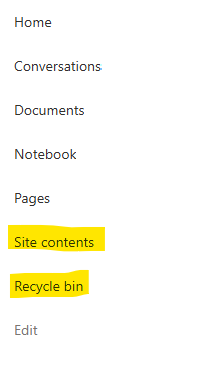
I posted this before but made a mistake with my write up, so I am reposting. I have a requirement that the Recycle bin and Site Contents should be be hidden from the Site Members and Site Visitors. Please how can I achieve this because the Server Infrastructure activation is not working for me. Any workarounds? Please help788Views0likes1Comment
Copilot answers in Sharepoint search results?
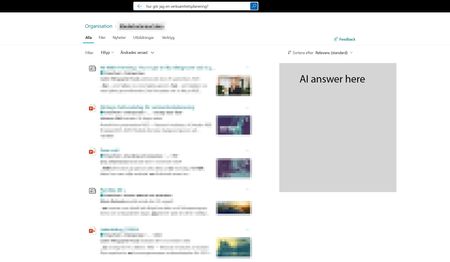
I would really like to add a copilot AI answer in the Sharepoint search result page, mainly for the intranet hub, to help our users better find answers across the intranet and also make the search bar a more complete search experience. Something we could toggle on and maybe we could point out a specific agent we've created for the intranet. I feel people are quickly starting to expect to have an AI summary in their search. Would also make sense when so many use the search bar i Sharepoint to incorporate it there, instead of having to go to a different place to use Copilot. It would make search easier.308Views0likes1CommentFeedback : building the foundations for AI adoption with AI itself
I would like to share some feedback on the recent SharePoint Copilot improvements. As a consultant, trainer, and Microsoft MVP working daily with Microsoft 365 Copilot customers, I am genuinely impressed by the direction SharePoint is taking. For years, we have told customers that successful AI adoption requires strong information architecture, metadata, governance, content organization, and naming conventions. What I find particularly interesting today is that SharePoint Copilot is starting to help organizations build these foundations instead of simply depending on them. Features that assist with site creation, page creation, content organization, metadata generation, metadata enrichment, and automation significantly reduce the effort required to establish a well-structured SharePoint environment. This is a meaningful shift. AI is no longer only consuming well-organized knowledge. It is increasingly helping users create and maintain that organization. From my perspective, this may become one of the most important accelerators for Microsoft 365 Copilot adoption because many organizations struggle more with content structure than with AI itself.105Views0likes0CommentsDynamic Mandatory Fields
In a SharePoint library, I have folders which are = a. Admin b. Events c. Furniture and Moves d. Janitorial and Maintenance e. Parking and Transportation f. Shipping and Receiving g. Supplies and Equipment h. Waste and Recycling I have Meta data across the library whose data type are all choices and are: a. Document Type = Contract, Financial, planning b. Building = Gym, Garage, Heating c. Asset Category = Office, Playground d. Fiscal Year = FY23, FY24, FY25, FY26, FY27 e. Vendor = Maple Leaf, Canadian Tire, Home Depot f. Status = Active, Pending, Not Active g. Retention Label = 3 years, 5 years h. Service Type = Admin, Events, Furniture and Moves, Janitorial and Maintenance, Parking and Transportation, Shipping and Receiving, Supplies and Equipment, Waste and Recycling Service Type and Retention Label are mandatory fields, with the Rule below for all the files in the various folders: IF Folder Name = Admin, then Service Type = Admin and Retention Label = 5 years; the mandatory fields should be Document Type, Status and Fiscal Year IF Folder Name = Events, then Service Type = Events and Retention Label = 3 years; the mandatory fields should be Document Type, Status and Fiscal Year, Building and Vendor IF Folder Name = Furniture and Moves, then Service Type = Furniture and Moves and Retention Label = 3 years; the mandatory fields should be Document Type, Status and Building IF Folder Name = Janitorial and Maintenance, then Service Type = Janitorial and Maintenance and Retention Label = 3 years; the mandatory fields should be Document Type, Status and Fiscal Year IF Folder Name = Parking and Transportation, then Service Type = Parking and Transportation and Retention Label = 3 years; the mandatory fields should be Document Type, Status and Fiscal Year IF Folder Name = Shipping and Receiving, then Service Type = Shipping and Receiving and Retention Label = 3 years; the mandatory fields should be Document Type, Status IF Folder Name = Supplies and Equipment, then Service Type = Supplies and Equipment and Retention Label = 3 years; the mandatory fields should be Document Type, Status and Fiscal Year IF Folder Name = Waste and Recycling, then Service Type = Waste and Recycling and Retention Label = 3 years; the mandatory fields should be Document Type, Status and Vendor I have used Column Default Value Settings for SharePoint to display Auto-Display the Service Type and Retention Label, but I cannot seem to perform the conditional mandatory fields using Validations setting for the other requirements. Please help642Views0likes1CommentSharePoint & AI (Knowledge Agent)
In my tenant, I cannot use some of the basic AI features of the Knowledge Agent. I tried to use the "Create list" prompt, but every call failed with the message: "Something went wrong, and I couldn't complete your request. Please try again later." I have a Copilot license, and some other features are working as expected. I encountered many errors in the browser console that violate the following Content Security Policy directive: "script-src 'unsafe-eval'" (see attached image). "violates the following Content Security Policy directive: "script-src 'unsafe-eval'" I tried an inPrivate browser session already without any changes in the behavior.115Views0likes0CommentsWhat Are the Best Practices for Implementing Microsoft Power Automate in a Growing Organization?
Hello Everyone, We’re planning to scale Microsoft Power Automate across our growing organization and would appreciate your expert insights. What are the best practices for implementing Microsoft Power Automate effectively — especially regarding governance, security, environment management, licensing, and user adoption? If you’ve implemented Microsoft Power Automate in a mid-sized or scaling company, please share: Key lessons learned Common mistakes to avoid Governance and CoE strategies Tips for managing citizen developers Looking forward to your valuable suggestions. Thank you!341Views0likes1Comment