copilot
60 TopicsCopilot or Copilot Cowork - Which tool to use - and When
Microsoft 365 Copilot vs Copilot Cowork: Choosing the Right AI for Work As organizations expand their use of AI to improve productivity and automate business processes, understanding which tool to use—and when—is critical. Microsoft offers two complementary capabilities: Microsoft 365 Copilot and Copilot Cowork. While they both leverage AI to support work, they are designed for fundamentally different types of tasks. Two Different Models of AI Assistance Microsoft 365 Copilot is designed as a day-to-day productivity assistant embedded within familiar Microsoft 365 applications such as Word, Excel, PowerPoint, Outlook, and Teams. It works alongside users in real time, helping them create, summarize, analyze, and refine content. The user remains in control of each interaction, guiding the AI step by step. Typical use cases include: Drafting and improving documents Summarizing emails and meetings Preparing presentations Analyzing information across work content This model is optimized for frequent, interactive assistance where the user actively directs the workflow. Copilot Cowork, by contrast, is designed for execution-based workflows. Instead of responding one step at a time, users define a desired outcome, and Cowork independently plans and executes the necessary steps to complete the task. It can operate across multiple tools, gather information, and produce finished outputs such as documents, emails, or Teams posts. It is especially suited for: Multi-step workflows Scheduled or recurring tasks Event-triggered processes (such as responding to incoming emails or messages) Longer-running automated business processes Key Difference: Interaction vs Execution The primary distinction between the two lies in control and autonomy: Microsoft 365 Copilot supports guided, interactive work where the user drives each step. Copilot Cowork executes defined workflows end-to-end with minimal intervention, pausing only for approvals when needed. In short: Copilot = assist in doing the work Cowork = do the work Pricing and Usage Model The two systems also differ in how they are consumed: Microsoft 365 Copilot is licensed per user, providing a predictable cost structure for ongoing everyday productivity assistance. Copilot Cowork operates on a usage-based model using Copilot credits. These credits are pooled at the tenant level and consumed based on task complexity, frequency, and execution requirements. Organizations can manage usage through budgets, alerts, and governance controls. Choosing the Right Tool A simple decision approach helps determine which tool to use: If the task involves creating, summarizing, analyzing, or understanding information within normal work activities, Microsoft 365 Copilot is the appropriate choice. If the task requires multi-step execution, automation, scheduling, or event-driven workflows, Copilot Cowork is more suitable. If Microsoft 365 Copilot can complete the task effectively under user direction, it should remain the default option. Cowork should be reserved for higher-value, process-oriented automation where autonomous execution delivers clear business value. Governance and Responsible Use Because Copilot Cowork consumes metered credits, organizations are encouraged to implement governance controls before scaling usage. This includes: Spending policies and budgets Usage alerts and monitoring Credit limits and cost management strategies This ensures that automation is aligned with business value and resource consumption is properly managed. Summary Microsoft 365 Copilot enhances everyday productivity by assisting users within their workflow, while Copilot Cowork extends AI into autonomous execution of structured business processes. Together, they provide a layered approach to AI in the workplace—balancing human-guided assistance with scalable automation. Choosing the right tool depends on the nature of the work: interactive support versus end-to-end execution. When used appropriately, both can significantly improve efficiency and operational effectiveness across modern organizations.Notes and documents – the way clinicians want them
The moment after the visit There is a moment in every patient encounter when the clinical story needs to become something more than a note. It may become a referral letter, a set of patient instructions, a school or work note, or a summary that helps a patient remember what was discussed. These documents matter as much as the note itself. A patient needs clear instructions they can understand and follow. A referring physician needs concise context and clinical reasoning. A specialist needs relevant background. Each audience is different; each document has a different purpose. For clinicians, these documents are not administrative leftovers. They are part of care itself. They carry the reasoning, reassurance, precision, and next steps that help patients and care teams move forward with confidence. And yet, creating them often happens under pressure and requires clinicians to rely on memory, whether they are documenting in between patients or after clinic hours. Introducing custom document templates in Dragon Copilot Dragon Copilot's custom document templates are designed to solve this problem by allowing the clinician to create these documents directly in the workflow. A custom document template is a reusable, AI-generated structure that turns a clinical encounter into the right finished document — a referral letter, after-visit summary, work note, pre-operative instructions — in the format the clinician defines. How it works A clinician describes what they need in plain language: "Create a patient-friendly follow-up letter after a cardiology visit." Dragon Copilot generates a draft template from that description. The clinician can then refine it — by speaking naturally— to adjust the tone, the structure, or the level of clinical detail until it reflects how they communicate. The finished template is saved and reusable, and ready to populate from the next encounter's notes. Templates can be built from scratch with a prompt, from a pasted sample, or from an uploaded file, with a preview before the template is used with real patient data. Built around how each clinician works Imagine a clinician finishing a consultation. The conversation was nuanced. The patient asked thoughtful questions. The next step requires a referral letter that reflects not only the diagnosis, but also the clinical reasoning behind it. Traditionally, that letter may be written later, when the clinician is already thinking about the next patient, the next inbox message, or the next task. With custom documents, the clinician can define the structure they need, save it, and generate the right type of output directly in the workflow. Referral letters are just one example. Clinicians create a wide range of documents every day, each designed for a different audience and purpose. A pediatrician needs parent-friendly discharge instructions — plain language, no jargon, clear next steps. A surgeon needs structured pre-operative guidance that follows a consistent format every time. A general practitioner needs a concise work note that takes seconds, not minutes. A specialist needs a referral response that reflects both the diagnosis and the clinical reasoning behind it. Each of these is a different template, built once, refined in conversation, and reused whenever it is needed. The AI adapts to the clinician's specialty, communication style, and intended audience — not the other way around. Clinical impact in real-world workflows Custom documents can create value where clinicians feel pressure most: in the moments after the encounter, when the clinical conversation needs to become clear, actionable communication. In practice, this means less time spent on repetitive drafting, manual rework, switching between documentation tasks, reconstructing details after the visit, creating routine letters, instructions, or summaries from scratch. Custom documents help make documentation more flexible, reusable, and aligned with how care is delivered. A step toward a more human future Less time spent drafting, reworking, and reconstructing details after the visit. More consistency across documents. And clinical communication that reflects how care was delivered — not a generic approximation of it. Custom documents help turn the conversation in the exam room into the right document for the right moment, with less friction and more consistency The goal is a future where clinicians do not have to choose between being present in the room and being precise in the record. Custom document templates in Dragon Copilot are a step toward that future. ------------- Click here to learn more about Dragon Copilot.249Views2likes0CommentsUsing Copilot in Sensitive Healthcare Teams Meetings - Without Recording or Transcription
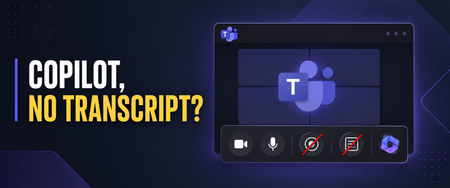
Healthcare organizations want the productivity benefits of Microsoft 365 Copilot, but those benefits must be balanced with privacy, security, and compliance requirements. I recently worked with a healthcare customer whose compliance team was concerned about persistent meeting artifacts. They wanted users to benefit from Copilot during Microsoft Teams meetings, but they did not want every conversation recorded or a transcript available afterward—especially for meetings involving sensitive operational, workforce, legal, compliance, or patient-related discussions. Microsoft Teams provides an option that can help with this scenario: allowing Copilot only during the meeting while disabling recording and transcription. Important: This article describes a technical configuration and customer scenario. It is not legal or compliance advice. Your privacy, security, compliance, records-management, and legal teams should determine whether this configuration is appropriate for your organization and specific meeting types. Why This Matters in Healthcare Healthcare organizations conduct many meetings where the discussion may include sensitive information: Patient care coordination Quality and safety reviews Compliance investigations Workforce and employee matters Security incidents Legal or risk-management discussions Research and clinical program planning A recording or transcript can become an additional persistent information asset that must be appropriately protected, retained, governed, and eventually disposed of. The HIPAA Security Rule requires covered entities and business associates to implement reasonable and appropriate administrative, physical, and technical safeguards for electronic protected health information. This includes evaluating risk, controlling access, implementing audit controls, and periodically reviewing security measures. The U.S. Department of Health and Human Services provides an overview of these requirements here. HIPAA’s minimum necessary standard also generally calls for organizations to limit unnecessary access to protected health information, although important exceptions apply—including certain disclosures for treatment. HHS provides additional guidance on the minimum necessary requirement. Turning off recording and transcription does not automatically make a meeting compliant. However, reducing the creation of unnecessary meeting artifacts can be one useful part of a broader, risk-based healthcare data-governance strategy. Copilot Without a Persistent Transcript When a Teams meeting is configured for Only during the meeting, Copilot can use temporary speech-to-text data to understand the active conversation. A traditional meeting transcript does not need to be started. Users can ask Copilot to: Summarize what has been discussed Identify decisions List open questions Capture action items Explain areas of disagreement Help someone catch up after joining late Microsoft explains that Copilot must be manually started by a participant in this configuration. Copilot can then provide insights based on the conversation taking place while it is active. See Microsoft’s guidance for using Copilot without recording or transcribing a Teams meeting. There are two important limitations users must understand. First, Copilot does not automatically start when the meeting begins. If someone activates it five minutes into the meeting, it will not have the same context it would have had if it had been started at the beginning. Second, users should capture anything they need before leaving the meeting. Without transcription, they will not have the same post-meeting Copilot conversation history or transcript-based recap. Microsoft recommends copying any Copilot content users want to keep before the meeting ends. Watch the Complete Walkthrough In the following video, I demonstrate the user experience, the corresponding Teams administrative policies, the Facilitator consideration, and several lessons I learned while implementing this for a healthcare customer. How to Use Copilot in Teams Without Recording or Transcription: Admin Setup & Gotchas The Administrative Configuration For this scenario, the goal was to create a scoped Teams meeting policy that: Prevented users from recording meetings Prevented users from starting transcription Allowed Copilot to operate during the meeting Avoided enabling a transcript-dependent post-meeting Copilot experience The settings are managed through Teams meeting policies in the Teams admin center. In the video, I walk through the relevant recording, transcription, and Copilot controls and show the resulting experience from a user’s perspective. For a healthcare organization, I would normally begin with a limited population instead of immediately applying a new policy globally. A pilot group gives the organization an opportunity to test the technical behavior and evaluate it with stakeholders from: Privacy and compliance Information security Legal and risk management Records management Clinical or operational leadership Microsoft 365 administration End-user training and adoption The appropriate configuration may differ between clinical, administrative, research, legal, HR, and general collaboration scenarios. A single organization-wide meeting policy may not be the right answer for every healthcare meeting. “No Transcript” Does Not Mean “No Compliance Data” This distinction is critical. Although participants may not receive a traditional meeting recording or transcript, Copilot prompts and responses can still be subject to Microsoft Purview retention policies. Depending on the organization’s configuration, those interactions may also be discoverable through Microsoft Purview eDiscovery. Microsoft explicitly notes that Copilot prompts and responses may be retained for compliance purposes even when recording and transcription are disabled. Microsoft’s Purview training covers auditing, retention, eDiscovery, and compliance controls for Copilot interactions. Healthcare organizations should therefore evaluate more than the visible Teams recap. The governance review should include: Copilot interaction retention Microsoft Purview Audit eDiscovery requirements Data Loss Prevention policies Sensitivity labels Records-management obligations Access to saved notes or exported Copilot responses Organizational policies governing the entry of PHI into AI-assisted experiences The user experience may feel temporary, but the organization’s compliance controls can still operate behind the scenes. The Lesson We Almost Missed: Facilitator Still Creates Loop Artifacts This was one of the most important lessons from my recent engagement. While working to Copilot to operate only during the meeting. Recording was disabled, transcription was disabled, and users did not receive the traditional transcript-based recap we were trying to avoid. But Loop files were still appearing. That initially seemed inconsistent with the policy design. After investigating, we discovered that the files were not being created by the personal Copilot experience—they were being generated because Microsoft Facilitator was enabled. This distinction is easy to miss: Copilot only during the meeting gives an individual user private, real-time assistance without requiring a persistent transcript. Facilitator is a shared meeting agent that can generate collaborative notes and other meeting artifacts. Microsoft documents that Facilitator’s meeting data is stored as a .loop file in the Meetings folder of the OneDrive account belonging to the user who initiated Facilitator. The data is treated as meeting transcript data for governance purposes. Facilitator notes may also be available to meeting participants through Notes and the meeting recap. Microsoft documents Facilitator’s behavior, storage, and administrative controls here. For a healthcare organization, that Loop file is not simply a convenient set of notes. Depending on what was discussed, it could contain sensitive operational information, workforce information, security details, or protected health information. It becomes another persistent artifact that must be considered in the organization’s access, sharing, retention, eDiscovery, lifecycle-management, and data-protection strategy. Copilot and Facilitator Require Separate Governance Decisions Disabling recording and transcription while allowing Copilot during the meeting does not automatically prevent Facilitator from producing shared meeting content. Healthcare organizations should make separate decisions about: Whether users should have access to Copilot during meetings. Whether users should be allowed to initiate Facilitator. Which meeting types are appropriate for shared AI-generated notes. Which users or groups should be allowed to use Facilitator. How the resulting Loop files should be stored, accessed, retained, labeled, and disposed of. Facilitator can be extremely useful for approved operational meetings where collaborative notes, decisions, and follow-up actions are valuable. However, it may not be appropriate for every sensitive clinical, compliance, legal, HR, or incident-response meeting. Microsoft allows administrators to control whether Facilitator is available across the organization or only to selected groups of users through Teams app policies and app-centric management. One important administrative nuance is that access to Facilitator can be scoped, while Microsoft’s control for turning off AI-generated meeting notes is currently tenant-wide rather than user-specific. That makes intentional scoping particularly important. Instead of assuming every Copilot-licensed user should also be able to initiate Facilitator, organizations can identify the populations and meeting scenarios where persistent collaborative notes have a defined business purpose and an approved governance model. The practical lesson is simple: If your goal is to use Copilot without creating persistent meeting artifacts, do not stop after validating the recording, transcription, and Copilot policies. Verify whether Facilitator is enabled and inspect the resulting Loop behavior as part of your testing. The Meeting Option That Can Cause Confusion and Broke Things For Us One of the most important lessons from this implementation involved the meeting organizer’s Copilot setting. If an organizer changes the meeting from Only during the meeting to During and after the meeting, Copilot expects transcription to be available. If the organization’s policy prevents transcription, the user may receive an error indicating that Copilot cannot access the meeting. From the user’s perspective, that can look like a licensing problem or a broken Copilot deployment. In reality, it may simply be a mismatch between: The organization’s transcription policy The Copilot meeting option selected by the organizer The type of Copilot experience the user is attempting to start Microsoft’s meeting guidance confirms that During and after the meeting requires transcription, while Only during the meeting can operate without it. Review the current Copilot behavior in Microsoft Teams meetings. This is why user education is just as important as the policy itself. A Healthcare Deployment Checklist Before introducing this configuration more broadly, consider the following: Classify the meeting scenarios. Determine where in-meeting Copilot is appropriate and where AI assistance should be restricted entirely. Engage compliance early. Validate the design with privacy, security, legal, records-management, and compliance stakeholders. Use scoped policies. Pilot with specific users or groups before considering a broader rollout. Review more than recordings and transcripts. Evaluate Purview retention, auditing, eDiscovery, DLP, sensitivity labels, and exported Copilot content. Evaluate and scope Facilitator separately. Determine which users should be able to initiate Facilitator and which meeting scenarios justify shared AI-generated notes. Test where the resulting Loop files are stored, who can access them, and how retention, sensitivity labels, eDiscovery, sharing, and lifecycle controls apply. Test for unexpected artifacts. After a pilot meeting, inspect the organizer’s and initiator’s OneDrive, the meeting chat, Notes, Recap, Loop, and relevant Purview experiences. Confirm that the meeting produces only the artifacts your governance team expects. Train meeting organizers. Explain the difference between Only during the meeting and During and after the meeting. Prepare users for the temporary experience. Users should capture approved action items or summaries before the meeting ends. Test the complete workflow. Validate the experience using representative accounts, policies, licenses, meeting types, and organizational controls. Review the configuration periodically. Microsoft Teams and Copilot capabilities continue to evolve, and healthcare organizations should reassess their controls as features change. Finding the Right Balance Healthcare organizations do not necessarily have to choose between disabling Copilot completely and generating a recording and transcript for every meeting. The Only during the meeting option provides another path: users can receive real-time assistance while the organization limits the creation of traditional post-meeting artifacts. It is not a substitute for a complete healthcare compliance strategy. It is a technical control that can support a broader strategy built around risk assessment, appropriate access, retention, auditing, training, and clearly defined meeting scenarios. The Facilitator lesson also demonstrates why organizations must test the entire meeting experience—not just the most visible policy settings. Copilot may be operating as expected while another enabled capability is still creating shared, persistent content. For the healthcare customer that inspired this video, the technical settings were only part of the solution. The real success came from understanding the user experience, finding the unexpected Loop artifacts, separating Copilot governance from Facilitator governance, and teaching organizers how the different options behave. That is the lesson I hope this walkthrough helps other healthcare organizations apply.How to Set Up Copilot Skills in PowerPoint (and Build Your Own)
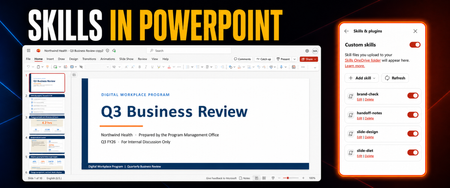
How to Set Up Copilot Skills in PowerPoint (and Build Your Own) You have a deck you rebuild every month. The business review, the project update, the readout for leadership. Every time, the same work. Cut the bullets down. Fix the capitalization someone else broke. Take 20 slides down to 7 so an executive will read it. Copilot in PowerPoint does all of that, and it's good at it. Then next month you open a new deck and type the whole thing out again, because Copilot doesn't remember how you like it done. That's the problem skills solve. I help organizations roll out Copilot in front of thousands of users, and skills are the feature I see the fewest people using. Plenty of teams are paying for it and have never turned it on. What a skill is A skill is a pattern you wrote down once. Take the thing you explain to Copilot over and over. Put it in a file with a name, a description, and a set of instructions. Save it. From then on you point Copilot at the skill instead of retyping the prompt, and you get the same result without rebuilding it. Monthly business review formatting. Your team's deck standards. The way you like speaker notes written. All of it becomes something you call by name. Two things before you start A Microsoft 365 Copilot license. Skills live in the Copilot pane inside PowerPoint. No Copilot in your Office apps, no skills. Choose Your Model. Open the Copilot pane, you can leave the model to "Auto" or find the model picker, and switch to your preferred GPT or Claude model. **Update** Skills in PowerPoint should now work with both OpenAI and Anthrophic models Turning skills on Open Copilot in PowerPoint. Hit the plus button at the bottom of the pane, then Choose skills. You'll already have a few there from Microsoft. Run one before you build anything of your own. You can also call a skill by name. Type @ and the skill name in your prompt, the same way you'd mention a person, and Copilot runs that one. Once you know what you have, it beats going through the menu every time. I opened Background and context on a text-heavy slide and asked it to visualize the slide. It created a new slide and generated an image that carried the same information in a format I could read at a glance. Side by side with the original, it wasn't close. Skill plus prompt The image was good, and it was an image, so I couldn't edit any of it. So I asked, in plain language: I like this, can you make it more native PowerPoint so I can edit it? Keep the structure. It rebuilt the whole thing with real PowerPoint objects and kept the layout that made it work. I wasn't running any branding at that point and it still came out clean. Skill first, then prompt. That combination is where most of the value sits. The skill gets you 80 percent of the way with no typing, and the prompt handles the part only you know. Building your own Go back to the plus button, Choose skills, then Manage skills. There's a Custom skills section, and it'll be greyed out until you have skills of your own. Don't hand-write the skill file. Grab Microsoft's documentation page, the one PowerPoint links to from the Manage skills pane: https://support.microsoft.com/en-us/powerpoint/copilot/copilot-in-powerpoint-skills Paste that URL into Copilot and say: using this link, help me build a PowerPoint skill that does X. Copilot reads the requirements and writes a file that fits the format. You're using AI to build AI, and it saves you more than typing. Skill files have real formatting rules, and Copilot will meet them instead of you finding each one through a failed upload. The format itself is short. A skill is a folder with a SKILL.md file in it. The file opens with a frontmatter block between three-dash delimiters holding a name and a description, and everything below that is your instructions. Spend your time on the description. That's the part telling Copilot when to reach for the skill, so a vague one means it never fires. If somebody sent you a skill, paste that in too and let Copilot clean it up. Where skills live In Manage skills, if you've never set this up, you'll see an option to create your skills library. Click it and Copilot creates the folder in your OneDrive. Pay attention to the path, because you'll need it: OneDrive > Documents > Copilot > Microsoft PowerPoint > skills Each skill is its own folder with a SKILL.md file inside. Drop new skills in there and they show up in PowerPoint. One catch: after you add something to OneDrive, refresh PowerPoint. It has to reload the folder. If you added a skill and it isn't showing, that's usually why. The other one that will bite you is the folder name. It has to match the name inside the SKILL.md file. Copilot skips any folder where those two don't line up, and it skips it quietly. No error, no warning, the skill is missing. If you refreshed and it's still not there, check that next. Two ways to add a skill, and the limit on one of them You don't have to touch OneDrive at all. In Manage skills, Add skill lets you upload an .md file, or type a skill in by hand with a name, description, and instructions. PowerPoint builds the folder structure and the file for you. I lost time on this one. The box where you type or paste a skill in caps at 1024 characters. I had Copilot write me a few skills, they came out longer than that, and I got errors that didn't explain themselves. I built them with Copilot, so I assumed they were fine. That cap is on the typed box. Uploading an .md file, or dropping the folder straight into OneDrive, doesn't have it. So if you have a long skill, don't cut it down to fit. Upload it as a file instead. Three skills on one bad deck Here's what I have built: Brand check. Reviews wording, terminology, and capitalization against our team's deck standards. No layout changes. Handoff notes. Writes speaker notes for someone else to deliver. I write the deck knowing I might not be the one presenting it, and my notes are useless to anybody but me. Slide diet. Takes a long deck, cuts the fluff, consolidates what's left. Slide design. The visual pass. I ran three of them on a plain deck, in order. Brand check went first. Text only. It consolidated some lines, rewrote a few, and fixed capitalization. Slide diet went second. It broke walls of text into bullets and cut what wasn't earning its place. Five bullets beat a paragraph block, and it made that call without being told. Slide design went last. This is the one where you sit back and let it work. Black text on white turned into something branded and visual, with the information in an order that reads. Three skills, and a deck I didn't want to read became one I'd present. Brand kits One more thing in that same plus menu: Brand. A brand kit holds your colors, fonts, and icons. You can build one for yourself, or your organization can publish one for everybody in the tenant. Pair a brand kit with a design skill and decks come out on-brand without anyone checking hex codes by hand. What it cost and what it saved The full run took 30 to 40 minutes, and the design pass was about 10 of that. Copilot needs time to work through a deck. This isn't instant. Building that by hand, at the quality it came out at, is 4 to 8 hours. A full day. The documentation Microsoft's page for all of this is here: https://support.microsoft.com/en-us/powerpoint/copilot/copilot-in-powerpoint-skills It has the format requirements, the three ways to add a skill, and how to edit or delete one. Worth a read before you build your second skill. One thing that page points to is worth knowing: the SKILL.md format is an open spec, not a PowerPoint invention. So the skills you write here aren't stuck in PowerPoint. Where to start Pick the pattern you repeat most, not the hardest deck you own. Write down what you'd tell a new hire about how you do it. That's your first skill. Hand it to Copilot, let it write the file, drop it in the folder, refresh PowerPoint. Then be curious, and go push some buttons.1.2KViews0likes2CommentsOrganizational Prompts: Publish Copilot Prompts to Your Whole Org in Minutes
If you rolled out Microsoft 365 Copilot and then watched most of your people ignore it, this one's for you. I help organizations deploy Copilot in front of thousands of users, and the pattern is almost always the same. A company buys Copilot, starts the rollout, and then watches it sit there. It's easy to blame the tool. Most of the time we handed everyone a blank box and expected them to figure out what to type. Your people aren't prompt engineers. They're nurses, knowledge workers, and HR. They open Copilot, see a blank screen, type something like "summarize this email," don't love what comes back, and quietly walk away. Do that across thousands of users and adoption stalls. There's an admin setting that helps with exactly this. It's called organizational prompts, and if you own Copilot for your org, don't sit on it. What organizational prompts do Organizational prompts let you load a library of ready-to-use prompts straight into Copilot for your whole organization. You create and publish them once, and they show up for your users across Copilot Chat, Microsoft Edge, and Teams, suggested automatically as people type. Instead of a blank screen, your users open a menu and pick from prompts you already wrote for them, sorted by department. It gives people a starting point, which is the thing most of them are missing. One heads-up before you go looking for it. This is rolling out right now, so if you don't see Prompts under Copilot yet, that's likely why, but most are already seeing it in their tenants, so it should be there soon. You'll also need the AI Administrator or Search Editor role to manage them. How to set it up Head to the Microsoft 365 admin center. On the left, drop down Copilot and open Prompts. That's where your organizational prompts live. You've got two ways to add them: Create them one at a time with the Create prompt button. Import them in bulk. Download the CSV template, fill in one row per prompt, save it as CSV UTF-8, and import the set. You can import up to 100 prompts at a time (5 MB max per file), and publish up to 1,000 in your tenant. If you already have a prompt catalog in a spreadsheet, this is the fast path. When you create or edit a prompt, you'll set a few fields: Title and display prompt. The title is the label on the prompt lab card (35 characters). The display prompt is the short version shown on the pill suggestions and autosuggest (132 characters). Prompt. The actual text sent to Copilot when someone picks it. This is required and gives you room to write a real prompt (up to 8,000 characters). Supported apps. Pick where the prompt shows up. This one matters. Not everyone has a premium license, but everyone has Copilot Chat on the web, so you can make a prompt available there too. Department. Heads up: departments don't map to a security group. They're free-text filters for the end user. Tag prompts with IT, Finance, HR, and so on so people can sort the library by their team. Task type. These come from Microsoft (Analyze, Create, Edit, and so on). You can't make your own, but tagging them helps users filter. Language. Set the language for the prompt. There's no auto-translation, so if you need a prompt in multiple languages, create a separate one for each. Hit publish and it's live. Give it about 3 hours to show up in the prompt lab. You can also pin your most important prompts, up to four, and those pinned ones show up as suggested prompts on the Copilot home screen. Check the analytics There's an Analytics tab that's worth your time. Once the data populates, you can see active users and submissions per prompt over the last 7, 14, or 28 days. That tells you which prompts people actually use, which ones to fix, and where adoption is landing. It's a straight read on what's working. Where your users find them Setup is half the job. Users need to know where these live. They show up in three spots: The Suggested button on the Copilot home screen, which opens your pinned prompts. The prompt lab, where users search by keyword and filter by department or task type. Picking a prompt drops it into the message box so they can tweak it before sending. Autosuggest right in the Copilot input box as someone starts typing. So someone on IT can search "IT," grab a prompt that rewrites a help desk reply so it doesn't read like "did you try restarting your computer," and send something that sounds a lot nicer. Pre-made prompts, sorted by team, ready to go. Do these two things after you turn it on Tell people it exists. Send a note to your communication channel. You've got a prompt library, it's sorted by department, here's where to find it. A library nobody knows about doesn't move adoption. Give people a way to submit prompts. Set up a channel where users can send you good prompts to add. When someone finds a prompt that works for Finance or IT, they should have a clear path to say "add this one." That keeps the library growing from the people actually using it. Organizations have been asking for this because they want to hand users a foundation for getting started with Copilot. Organizational prompts are one of the cleanest ways to do it, and it takes minutes. If you're an admin, this is a quick win with real impact. Set it up, tell your people, and give them a way to add to it. For the full field reference and character limits, here's Microsoft's official documentation: Organizational prompts for Microsoft 365 Copilot. Go push some buttons.
Why nursing needs a different kind of AI—and how Dragon Copilot delivers
The Dragon Copilot experience for nurses was made generally available (GA) in December 2025 with a clear mission: help nursing staff focus on care, not the computer. From the start, the goal was to create a comprehensive AI clinical assistant—one that works alongside nurses throughout their shift, reduces cognitive load, captures the full scope of care delivered, and translates real clinical work into automated next steps, including documentation—fundamentally transforming workflows to keep patient care at the center. Microsoft has continued to execute on that vision. Recent enhancements include extended mobile access with Android support—enabling nurses to record care in Epic Rover on Android devices—as well as significant expansion in ambient documentation coverage. Together, these advances reflect a consistent approach: adoption follows when technology aligns with how nurses work. Expansive nursing documentation coverage Nursing work spans multiple flowsheet templates, assessments, state changes, and, at times, narrative notes. When solutions support only a subset of this work, nurses are left filling gaps after the fact—reintroducing cognitive load and eroding the value of this technology. Microsoft has expanded Dragon Copilot’s ambient documentation capabilities by broadening the range of supported nursing value types—and by extending it to deliver complete coverage across all flowsheet templates in supported departments and settings. The result is comprehensive documentation generated from each recording including: Lines, Drains, Airways, and Wounds (LDAs) documentation, including assessments, additions, and removals Nurse notes, automatically generated from natural nurse-patient conversations and voice memos captured on the go Full flowsheet template coverage—not just a subset—including admission and discharge flowsheets, blood administration, CIWA-Ar, and care plan-related flowsheets Adaptations to each organizations charting philosophy, including macros support, chart-by-exception, pertinent positives, and more This breadth matters because nursing work is rarely captured within only a narrow set of flowsheets—nor does it typically result in just narrative notes. Yet many solutions labeled “for nurses” prioritize what is easiest to automate, rather than what nurses need. The result can be a false sense of completeness, with nurses still managing gaps across their shift. Why nursing ambient documentation is hard—and what makes Dragon Copilot unique Achieving comprehensive, high‑quality nursing documentation has required specialized technology designed to address the structural, workflow, and feedback challenges unique to nursing—challenges that general narrative ambient models and physician‑oriented solutions are not built to solve: Flowsheets are messy, complex, and frequently changing Flowsheets are large, hospital-specific, internally ambiguous, and constantly evolving under governance. Complex logic—such as cascading rows, documentation‑by‑exception patterns, and duplicative or overlapping rows—makes it far from straightforward to accurately map a clinical observation to the correct field and value. Microsoft works directly with real hospital schemas, handling hierarchy, ambiguity, and multiple valid documentation destinations—without requiring flowsheet redesign or sacrificing quality. Nurses don’t speak for documentation Bedside language is optimized for care delivery, not chart completeness. Critical details are often implied or never spoken aloud. Microsoft’s technology translates natural nursing communication into accurate documentation without changing nurse behavior. Built on industry‑leading transcription accuracy and decades of speech recognition expertise, Dragon Copilot is informed by real‑world integration across diverse EHR environments, preserving accurate translation and clinical intent that directly impact downstream documentation accuracy. Nursing audio is diverse Recordings mix shorthand, dialogue, monologue, and unit-specific language. Dragon Copilot accounts for mixed speaking modes instead of flattening audio through a generic pipeline or requiring nurses to speak in constrained ways. Feedback loops are noisy Nurse corrections to AI output often reflect hindsight or personal preferences rather than model error. Microsoft’s approach analyzes correction patterns with clinical context, enabling calibration at the institution, department, and even individual user level. Bedside workflows demand predictability Baseline LLMs are not suited for real-world nursing accuracy, latency, and cost requirements — especially with tens-of-thousands of possible flowsheet values. Dragon Copilot is optimized for consistent performance across real nursing environments, exceeding the reliability and latency characteristics of baseline models. Beyond specialized nursing architecture, Dragon Copilot enforces strict quality and safety gates for new documentation outputs—including oversight by Microsoft’s internal, nurse-led Clinical Integrity team, phased validation, and Responsible AI review—ensuring new documentation covered meets defined nursing standards before being introduced at scale. Dragon Copilot represents a fundamental shift in how nursing work is supported by AI by meeting the full complexity of bedside care head-on. By delivering comprehensive ambient documentation across live inpatient care environments, Dragon Copilot helps ensure that the care nurses provide is accurately captured, trusted, and usable downstream. The result is an AI clinical assistant that keeps nurses focused on what matters most: their patients.Compliance Meets AI: Wrapping Up an Incredible Series and Looking Ahead
Over the past six sessions, the Compliance Meets AI webinar series has taken us on a journey through the evolving landscape of compliance, security, and generative AI. From SharePoint advanced management and data security posture for AI to eDiscovery, auditing, and communication compliance, we’ve explored how Microsoft Purview and Copilot can transform governance strategies. Today’s final session, Deep Dive: Insider Risk for Copilot, was a powerful close to the series. Led by Kevin Uy and supported by our team, we unpacked how Insider Risk Management (IRM) helps organizations detect and mitigate risky behaviors—intentional or accidental—before they become costly incidents. Key highlights included: Risky AI Usage Policies: How to monitor prompts and responses for sensitive data exposure across Copilot and third-party AI tools. Policy Templates & Indicators: Leveraging built-in templates for data leaks, health record misuse, and AI-specific risks. Integration with DLP: Understanding how IRM complements real-time blocking by providing investigative context. Adaptive Protection: Moving from passive monitoring to proactive enforcement by linking IRM insights with DLP policies. If you missed today's session: No worries you can watch the recording here https://aka.ms/Compliance-Meets-Ai-Session-Six We also shared practical tips on policy configuration, threshold tuning, and privacy controls, plus a sneak peek at forensic evidence and case escalation workflows. Why This Series Matters Compliance isn’t just about meeting regulatory requirements—it’s about building trust in an era of AI-driven innovation. This series brought together experts and practitioners to demystify complex topics and provide actionable strategies for safeguarding sensitive data while enabling productivity. What’s Next? The conversation doesn’t stop here. We’re thrilled to announce that Compliance Meets AI will return in 2026 with new topics, deeper demos, and fresh insights into governance for emerging technologies. Expect sessions on advanced AI risk scenarios, cross-cloud compliance, and automation strategies that redefine security operations. Stay tuned for registration links early next year—and in the meantime, revisit all six recorded sessions here and follow me on LinkedIn for ongoing updates. Thank you to everyone who joined us for this series. Your engagement and feedback shape what comes next. Here’s to a future where compliance and AI work hand in hand to empower secure innovation.🚀 Compliance Meets AI: Communication Compliance for Copilot – What You Missed!
Last Friday’s session was a game-changer for anyone looking to keep AI use safe, ethical, and compliant. We didn’t just talk theory—we showed real-world strategies for monitoring Copilot interactions and protecting sensitive data with Microsoft Purview Communication Compliance. Missed the session? No worries we have you covered. You can watch it here https://aka.ms/Compliance-Meets-Ai-Session-Five 🔥 Top Highlights The Big Picture Copilot is transforming productivity—but with great power comes great responsibility. Communication Compliance helps you spot risky prompts, prevent data leaks, and enforce ethical AI use across Copilot, Copilot Chat, Agents and Copilot Studio. Policy Power Moves Learn how to build smart policies that detect sensitive info like MRNs, credit card numbers, or custom keywords. We explored trainable classifiers for prompt injection attacks and inappropriate content—plus tips for scoping policies to specific teams or roles. From Alerts to Action Tag it. Resolve it. Escalate it. Even kick off Power Automate workflows for instant notifications. We showed how to turn alerts into actionable compliance steps that keep your organization secure. Insights That Matter Dive into dashboards that reveal top triggered policies, sensitive data trends, and user activity—so you can make informed decisions and strengthen governance. ✅ Next Up: Insider Risk Management for Copilot 📅 Date: 11.7.25 🎤 Host: Kevin Uy 👉 https://aka.ms/ComplianceMeetsAI Don’t miss this one—we’re taking compliance to the next level!1.4KViews0likes0Comments