configuration
2294 Topics
Microsoft support KB5124010, KB5124008: Known issues in this update, Highlights: semantic ambiguity
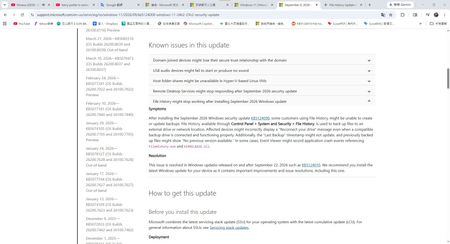
Hello, I have a question regarding Microsoft is announcement. Hi everyone,I was reviewing the Microsoft support pages for the September 2026 Windows updates and got quite confused by the wording regarding the File History bug fix. Furthermore, my actual experience after updating doesn't seem to align with the official description. I'd like to hear your thoughts on this. Question 1: Does the word after in KB5124008 imply a phased/partial fix? https://support.microsoft.com/en-us/servicing/os/windows-11/2026/09/kb5124008-windows-11-24h2-25h2-security-update In the Known issues section of KB5124008, Microsoft lists a few specific symptoms: Incorrectly displaying a Reconnect your drive message. The Last Backup timestamp might not update, and previously backed-up files might show No previous version available. Application crash events referencing FileHistory.exe. However, in the Resolution section, Microsoft states: This issue is resolved in Windows updates released on and after September 22, 2026 such as KB5124010. What exactly does after mean in this context? Does it imply that KB5124010 did not completely fix all symptoms, and the remaining issues (like the timestamp bug) will not be fully resolved until the October 13th Patch Tuesday? Question 2: Why did the KB5124010 release notes omit the timestamp issue? https://support.microsoft.com/en-us/servicing/os/windows-11/2026/09/kb5124010-windows-11-24h2-25h2-update I then checked the Highlights section for KB5124010, which states: File History Fixed: This update addresses an issue where File History might fail to back up or restore files... Affected devices might incorrectly display a Reconnect your drive message... Noticeably, it completely omits any mention of fixing the Last Backup timestamp might not update symptom. Does this omission mean that this specific part of the bug has not been fixed yet? My Actual Experience: My suspicions seem to be confirmed in my actual usage. After installing the latest KB5124010 update, my File History can now successfully find the backup drive, run properly, and back up new files (Symptom 1 is resolved). However, the Last Backup date/timestamp still has not changed at all (Symptom 2 remains). To summarize my questions: Based on Microsoft is wording, is KB5124010 only a partial fix? For the lingering issues regarding the timestamp not updating and no previous version available, do I just have to wait for the October update? Has anyone else experienced this exact situation?1KViews1like4CommentsAfter updating KB5127648, only half of the archive history was restored.
For Microsoft engineers After fixing the update from Windows 11 KB5124010/Windows 10 KB5120249 to Windows 11 KB5127648/Windows 10 KB5126657, the File History can find and run the backup drive, but the last copy date of the files has not changed, and any new files can be backed up. This is my question: Click in and read carefully. File History timestamp sync bug still broken in KB5124010 - Anyone else? | Microsoft Community Hub After updating KB5127648, only half of the archive history was restored. | Microsoft Community Hub This is my opinion response center report. https://aka.ms/AA13n2f3 https://aka.ms/AA13n22w https://aka.ms/AA13ucfz https://aka.ms/AA13urx3 https://aka.ms/AA13ukxv Please click here. If you have the same problem as me, please agree, add a comment, or ask your question in the feedback post. You can also paste the URL in the comments section.82Views0likes1Comment
File History has stopped functioning
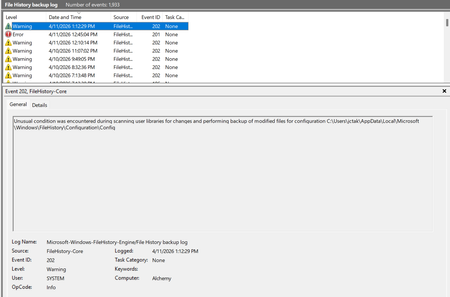
My file history program has stopped functioning. I tried searching the internet for some of these error messages and I have not found anything that has a solution that works. I tried deleting the backup on my backup drive, and also deleting the file history data/configuration folders so it would "start fresh" and I still keep getting errors. Here are some of the errors: Also have gotten a bunch of different errors for "reparse points". This is one example. I tried to exclude some of these folders from the backup but it didn't seem to help. But how do I find and eliminate a "reparse point" so it doesn't cause the file history to fail? And why doesn't file history just ignore those folders and go on and back up everything else?5.7KViews7likes55CommentsTitle: Severe Font Rendering Issue After Installing KB5122385 and KB5120998 on Windows 11 25H2
Hello Microsoft Team, I would like to report a significant font rendering issue that appeared immediately after installing Windows updates KB5122385 and KB5120998. Issue Description After installing these updates, text rendering became noticeably degraded across multiple web browsers, including: Google Chrome Microsoft Edge Mozilla Firefox The issue included: Blurry text rendering. Distorted fonts. Reduced text sharpness and clarity. Overall degradation of readability and user experience. System Information Operating System: Windows 11 Version 25H2 Processor: Intel Core i9-13900HK Memory: 32 GB RAM Graphics Adapter: Intel Iris Xe Graphics Graphics Driver Version: 32.0.101.7088 Troubleshooting Performed I spent a considerable amount of time diagnosing the issue and tested several common solutions, including: Resetting Windows font settings to default. Reconfiguring and recalibrating ClearType. Disabling Hardware Acceleration in the affected browsers. Restarting the system multiple times. Reviewing display and graphics-related settings. None of these actions resolved the problem. Verified Resolution After extensive testing, I determined that the only solution that completely restored normal font rendering was: Uninstalling KB5122385. Uninstalling KB5120998. Restarting Windows. Immediately after removing these updates, font rendering in Chrome, Edge, and Firefox returned to normal. Text became sharp, clear, and properly rendered again. Request for Investigation Based on my testing, there may be a compatibility issue within Windows components responsible for font rendering, text display, graphics handling, or related system functions introduced by these updates. Because the issue affects multiple browsers, including Firefox, it does not appear to be limited to Chromium-based browsers and may be related to Windows itself. I recommend that the Windows engineering team investigate this issue, as other users may be experiencing: Blurry text. Distorted fonts. Reduced display quality in browsers. The need to remove Windows updates as a temporary workaround. The issue was consistently reproducible on my system, and uninstalling the updates was the only action that restored normal behavior. Thank you for your time and attention. I hope this report helps identify and resolve the root cause of the problem. Best regards, Hossam Soliman924Views0likes5Comments
Win11 Run as different user option missing from the Start menu right-click context menu
When you right-click an app in the Start menu, the Run as different user option no longer appears. The option is still available when you right-click an executable file directly in File Explorer, but it is not available in the Start menu. Even when using the workaround of pressing Shift + right-click, the option still does not appear in the Start menu.39Views0likes1Comment
Full-screen video freezing issue
한국어와 영어로 글을 남깁니다. 이 글을 남기기 이전에 기술 지원을 24시간 대기 중이라는 분에게서 받았습니다. 그 분은 가장 해결 확률이 높고 가장 해결이 완벽에 가까운 방식을 제안했습니다. 그건 코덱을 업데이트하거나 코덱을 설치하라는 것이었습니다. 전 이 방법이 해결방법에 가깝다고 느낍니다. 제가 드리려는 말은 우연히 이 문제를 해결했다고 생각하기에 그 해결 방법을 공유하는 것입니다. 윈도우 제품에는 사소한 버그가 있고 서로 다른 프로그램이 충돌하는 경우가 있을 수 있으며 특정 프로그램이 버그를 만들 때도 있기 때문입니다. 전 전체화면으로 영상을 시청할 때에 멈추는 증상이 해결이 안 되었어요. 신기한 건 다른 회사의 그래픽 카드를 사용할 때엔 이런 문제가 발생하지 않는다는 점이었습니다. 인텔 ARC 그래픽 카드는 이런 문제가 없어요. AMD의 라데온 그래픽 카드를 사용할 때에 다 좋은데 이 문제 때문에 좀 불편했습니다. 지금도 인텔 CPU와 인텔 GPU를 쓰면 문제가 없고, 인텔 CPU와 AMD GPU 혹은 AMD CPU와 AMD GPU를 쓰면 전체화면 영상이 멈춥니다. 모니터는 상관이 없던 것 같아요. 그래서 결론은 코덱을 찾아볼 수도 있는데 어떤 코덱이 필요한지 제가 정확하게 모르거든요. 우연하게 찾은 해결책은 윈도우 설정에 작업 표시줄 옵션이 있습니다. 거기서 작업 표시줄 단추 합치기 및 레이블 숨기기 / 작업 표시줄 단추 합치기 및 다른 작업 표시줄의 레이블 숨기기 / 더 작은 앱 아이콘 표시 옵션을 조절하는 것이었습니다. 항상-작업 표시줄이 꽉 찼을 때-안 함 중에 문제가 해결되는 옵션을 고르세요. 전 작업 표시줄이 꽉 찼을 때를 3개 모두 설정해 두니 전체화면 영상이 더 이상 멈추지 않아요. 라데온 그래픽카드 드라이버 문제일 수도 있고 이 라데온 프로그램이 윈도우와 우연하게 충돌이 일어나는 것일 수도 있을 것 같아요. 전 전문가가 아니라 우연히 옵션 조정으로 방법을 찾았다는 점만 말하고 싶습니다. 그러므로 이 문제는 해결이 될 수도 사용자에 따라서 해결이 되지 않을 수도 있습니다. 제가 지내던 커뮤니티에선 라데온 그래픽카드 드라이버 프로그램이 이전부터 전문적이지 않다는 이야기가 돌았는데 전 그 때 그 말을 믿지 않았지만 지금은 그 말에 신빙성이 있다는 생각도 듭니다. 엔비디아 지포스에서도 동일한 증상이나 멈춤 현상이 있는 것 같기는 합니다. 윈도우의 호환성 문제일 수도 있겠지요. 잘은 모르겠지만요. 도움이 되시길 바랍니다. I am posting this in both Korean and English. Before writing this, I received assistance from a technical support representative who was available around the clock. They suggested a solution that was highly likely to work and offered the most complete fix: updating or installing the necessary codecs. I believe this is the right approach. I am sharing this because I managed to resolve the issue—albeit somewhat by chance—and want to pass on the solution. Windows products can have minor bugs, conflicts between different programs can occur, and specific programs can sometimes trigger these issues. I wasn't able to resolve the issue where the video would freeze during full-screen playback. Interestingly, this problem didn't occur when using graphics cards from other manufacturers; Intel Arc graphics cards, for instance, don't have this issue. While AMD Radeon graphics cards are otherwise excellent, this specific problem was a bit of a hassle. Even now, I experience no issues when using an Intel CPU with an Intel GPU, but the video freezes in full-screen mode if I pair an Intel CPU with an AMD GPU or use an AMD CPU with an AMD GPU. The monitor didn't seem to be a factor. I suppose I could look into codecs, but I'm not exactly sure which ones are needed. I stumbled upon a solution within the Windows taskbar settings. The fix involved adjusting options such as "Combine taskbar buttons and hide labels," "Combine taskbar buttons and hide labels on other taskbars," and "Use small taskbar buttons." You should experiment with the available settings—"Always," "When taskbar is full," or "Never"—to find the one that resolves the issue. For me, setting all three options to "When taskbar is full" stopped the full-screen videos from freezing. This could be an issue with the Radeon graphics card driver, or perhaps a random conflict between the Radeon software and Windows. I am not an expert; I simply wanted to share a method I discovered by chance while tweaking settings. Consequently, this solution might work for some users but not for others. In the online community I frequent, there had long been talk that Radeon graphics card driver software wasn't exactly professional-grade; I didn't believe it at the time, but now I’m starting to think there might be some truth to it. That said, it seems like similar symptoms or freezing issues occur with Nvidia GeForce cards as well. It could be a Windows compatibility issue, though I’m not entirely sure. I hope this helps.105Views0likes2Comments
win re wim file
I have NOT played with any system files on my Windows 11 PC but have found that under "create a restore point", there is a line that says "WinRETools (Missing)". It has been there for years in an uncorrupted status and I don't understand why it is now missing. it appears I need a file called Winre.wim and that it can be extracted from a Windows 11 ISO file. I have downloaded 2 ISO files, one in "English (United States)" and one in "English (Great Britain)". There was also an option for "English (International)". BUT none of these match the region shown by my Control Panel which says my PC is English (Australia). Web searches say this language mismatch is a problem and I've posted a separate query to the Community regarding this. Nevertheless I have proceeded to follow the various instructions on the web / Microsoft website about: download a zip extraction software. find install.win within the ISO file, and open it/extract/find the file winre.wim. BUT this is where I'm stuck - no matter how many times I've tried, there is NO winre.wim file within the ISO file. It appears that if my PC crashes and I need to recover/rebuild from the ISO file, and I won't be able to because the winre.wim file is missing from my computer's C drive, under Windows\System 32\Recovery. Help!!47Views0likes1Commentwin re wim file
When this file is missing from C-Windows-System Recovery, what are the exact steps for setting it up again please? I have found various suggestions on the web, but they seem to be incomplete as one are working. I'd appreciate a detailed and complete step by step instruction.22Views0likes0CommentsHow do I stop Windows 11 from reinstalling Copilot and widgets after every update?
I keep removing Copilot, widgets, and other stuff I never asked for, but after almost every major Windows 11 update, they come right back. I've disabled them in Settings and even used group policy for some, but it doesn't seem to stick long-term. It's frustrating having to clean up the same bloat over and over. Is there a reliable way to block these permanently, like a registry tweak or a script that survives updates? Or is this just something we have to deal with now? I'm on 25H2 and would rather not do a clean install just to get a leaner system.104Views0likes1Comment