configuration
2415 TopicsWin11 Taskbar system tray icons randomly rearrange after a display resolution change
After changing the display resolution or refresh rate, the icons in the system tray are rearranged randomly. The custom arrangement is lost, and even after restoring the display settings, these icons do not return to their original positions. This issue occurs more frequently when connecting or disconnecting an external monitor.7Views0likes0Comments
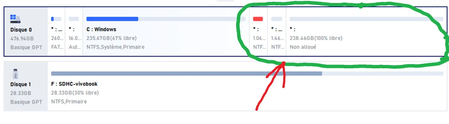
Can I safely delete these three extra partitions after a clean Windows 11 install?
Can I delete the three partitions circled in green without risking another crash or boot failure? I'm on a Surface Pro 7 with an 11th Gen i5-1135G7, 16GB RAM, and Windows 11 Pro build 26200.9550. I did a clean reinstall using Rufus after a Windows Hello crash locked me out of the system, and now I want to reclaim that space for my C: drive. Is it safe to remove them, or are any of them required for booting or recovery? And if they can be deleted, what's the correct order to do it in without breaking the EFI or recovery setup?14Views0likes1CommentWhy Can't I Copy the Text of an Error Message in Windows 11?
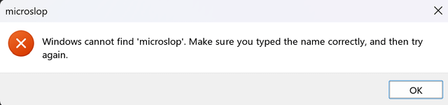
With 2026 almost over, I sincerely suggest that Microsoft step up its game and finally add a feature that should have been available back in the late 1990s: the ability for users to copy all text from error messages.127Views0likes2Comments802.1x wired network profiles missing after upgrade to Windows 11 24H2
Issue Description: During the upgrade of workstations to Windows 11 24H2, the IEEE 802.1X wired network security profiles are occasionally not restored after the upgrade process completes. As a result, affected devices fail to authenticate against Cisco ISE, leading to a loss of LAN connectivity. The issue appears to occur randomly and does not show any clear correlation with specific hardware models or workstation configurations. We are using Feature Updates to upgrade workstations to Windows 11 24H2, deployed through SUP in SCCM/MECM. This approach works best for us because it does not require any user interaction during the upgrade process. I developed a remediation script that is triggered by a scheduled task based on a specific event ID generated when Cisco ISE rejects authorization. The script successfully restores the locally stored 802.1X profiles and resolves the issue. However, I am wondering whether there is a better or more native way to handle this scenario. Has anyone experienced a similar issue with Windows 11 24H2 and 802.1X profiles? Any advice before we open a support case with Microsoft Support?146Views0likes3CommentsFile History timestamp sync bug still broken in KB5124010 - Anyone else?
To the Microsoft technical team Hi everyone,Quick post to see if anyone else is still running into File History timestamp sync issues on the latest builds. Test Environments: Laptop: Windows 11 25H2 (OS Build 26200.8973) Desktop: Windows 10 22H2 (OS Build 19045.7725) Home version The Issue:This problem started back in July (KB5101684 / KB5120249). While KB5124010 fixed the scheduled backup failure and Reconnect drive prompt from KB5124008, the timestamp and version sync bugs remain unfixed: Triggering Run now manually in Control Panel does not update the Last backed up timestamp to the current time. For newly created files (such as Word files), File Properties > Previous Versions displays: No previous versions are available. Changes to the contents of older files will not display the latest timestamp version; only the date and time of the previous version will be shown. A new entity version of the file has been created without any modifications. Other users (including community members in Japan and previous discussion threads) have confirmed identical behavior. File History is essential for daily backups, so getting this sorted out is critical.I'm really on the verge of a breakdown... Hopefully, the security patch will be completed in October. If you are experiencing this issue, please upvote and comment on my Feedback Hub report so the Windows engineering team prioritizes a fix: Feedback Hub Link: https://aka.ms/AA13n22w187Views0likes6Comments
Microsoft Print to PDF Missing
Hi, In the last couple of weeks the Microsoft Print to PDF has dropped off my laptop. I have tried everything suggested online already but I cannot get it to work. I have a Samsung Galaxy Book 4 Edge with Windows 11 ARM64 and Snapdragon which I have only had since the beginning of Jan. I am not very techie but I have tried the following based on other forums I have looked at: Checked it is turned on in windows features - it is Turned it off in windows features and restarted then turned it back on and restarted Tried to reinstall in via add device but when I go to the list of drivers it isn't there so I cannot select it Checked the print queue but it's not in there Various things on command prompt including: dism /Online /Disable-Feature /FeatureName:”Printing-PrintToPDFServices-Features” /NoRestart dism /Online /Enable-Feature /FeatureName:”Printing-PrintToPDFServices-Features” /NoRestart Updates to the powershell including: Disable-WindowsOptionalFeature -online -FeatureName Printing-PrintToPDFServices-Features Enable-WindowsOptionalFeature -online -FeatureName Printing-PrintToPDFServices-Features I just get an error code: 0x800f0922 I also did a full factory rest of my laptop and NOTHING!!!!!! I have just done a screen share with Microsoft and they reinstalled my office 365 but that did nothing and then I was told they couldn't help and to post here. PLEASE can someone help me fix this as it is driving me crazy? I need to create PDF's of my invoices to make sure I get paid each month.55KViews6likes30Comments
When does running an AI model locally make more sense than using a cloud API?
Hi everyone, With local AI capabilities becoming increasingly accessible on modern PCs, I'm curious about how developers are deciding between local inference and cloud-based AI APIs. For a developer building an AI-powered application, there are now at least three possible approaches: 1. Use a cloud-hosted model through an API 2. Run a smaller model locally 3. Use a hybrid approach where local and cloud models are selected depending on the workload The local approach has some obvious advantages: • Data can remain on the device. • No per-request API cost. • Potentially lower latency for certain workloads. • Applications can continue working with limited or no internet connectivity. • Developers can experiment with models without depending entirely on a cloud service. However, there are also limitations: • Limited GPU/NPU resources. • Model size and memory requirements. • Potentially lower-quality results from smaller models. • Hardware compatibility. • Model updates and maintenance. • Power consumption for sustained workloads. Cloud inference has almost the opposite trade-offs. It provides access to significantly larger models and potentially better capabilities, but introduces network dependency, API costs, latency, and data-governance considerations. So I'm interested in how developers are approaching this today. For example, would you use: A. Local models for development and experimentation, cloud models for production B. Local models for privacy-sensitive workloads and cloud models for complex reasoning C. Cloud models almost exclusively because maintaining local models isn't worth the effort D. A hybrid routing approach where the application automatically chooses local or cloud inference depending on the request I'm particularly interested in real-world examples rather than theoretical advantages. What workloads have you found to be genuinely useful to run locally, and where does cloud inference still provide a significant advantage?29Views0likes1CommentFull-screen video freezing issue
한국어와 영어로 글을 남깁니다. 이 글을 남기기 이전에 기술 지원을 24시간 대기 중이라는 분에게서 받았습니다. 그 분은 가장 해결 확률이 높고 가장 해결이 완벽에 가까운 방식을 제안했습니다. 그건 코덱을 업데이트하거나 코덱을 설치하라는 것이었습니다. 전 이 방법이 해결방법에 가깝다고 느낍니다. 제가 드리려는 말은 우연히 이 문제를 해결했다고 생각하기에 그 해결 방법을 공유하는 것입니다. 윈도우 제품에는 사소한 버그가 있고 서로 다른 프로그램이 충돌하는 경우가 있을 수 있으며 특정 프로그램이 버그를 만들 때도 있기 때문입니다. 전 전체화면으로 영상을 시청할 때에 멈추는 증상이 해결이 안 되었어요. 신기한 건 다른 회사의 그래픽 카드를 사용할 때엔 이런 문제가 발생하지 않는다는 점이었습니다. 인텔 ARC 그래픽 카드는 이런 문제가 없어요. AMD의 라데온 그래픽 카드를 사용할 때에 다 좋은데 이 문제 때문에 좀 불편했습니다. 지금도 인텔 CPU와 인텔 GPU를 쓰면 문제가 없고, 인텔 CPU와 AMD GPU 혹은 AMD CPU와 AMD GPU를 쓰면 전체화면 영상이 멈춥니다. 모니터는 상관이 없던 것 같아요. 그래서 결론은 코덱을 찾아볼 수도 있는데 어떤 코덱이 필요한지 제가 정확하게 모르거든요. 우연하게 찾은 해결책은 윈도우 설정에 작업 표시줄 옵션이 있습니다. 거기서 작업 표시줄 단추 합치기 및 레이블 숨기기 / 작업 표시줄 단추 합치기 및 다른 작업 표시줄의 레이블 숨기기 / 더 작은 앱 아이콘 표시 옵션을 조절하는 것이었습니다. 항상-작업 표시줄이 꽉 찼을 때-안 함 중에 문제가 해결되는 옵션을 고르세요. 전 작업 표시줄이 꽉 찼을 때를 3개 모두 설정해 두니 전체화면 영상이 더 이상 멈추지 않아요. 라데온 그래픽카드 드라이버 문제일 수도 있고 이 라데온 프로그램이 윈도우와 우연하게 충돌이 일어나는 것일 수도 있을 것 같아요. 전 전문가가 아니라 우연히 옵션 조정으로 방법을 찾았다는 점만 말하고 싶습니다. 그러므로 이 문제는 해결이 될 수도 사용자에 따라서 해결이 되지 않을 수도 있습니다. 제가 지내던 커뮤니티에선 라데온 그래픽카드 드라이버 프로그램이 이전부터 전문적이지 않다는 이야기가 돌았는데 전 그 때 그 말을 믿지 않았지만 지금은 그 말에 신빙성이 있다는 생각도 듭니다. 엔비디아 지포스에서도 동일한 증상이나 멈춤 현상이 있는 것 같기는 합니다. 윈도우의 호환성 문제일 수도 있겠지요. 잘은 모르겠지만요. 도움이 되시길 바랍니다. I am posting this in both Korean and English. Before writing this, I received assistance from a technical support representative who was available around the clock. They suggested a solution that was highly likely to work and offered the most complete fix: updating or installing the necessary codecs. I believe this is the right approach. I am sharing this because I managed to resolve the issue—albeit somewhat by chance—and want to pass on the solution. Windows products can have minor bugs, conflicts between different programs can occur, and specific programs can sometimes trigger these issues. I wasn't able to resolve the issue where the video would freeze during full-screen playback. Interestingly, this problem didn't occur when using graphics cards from other manufacturers; Intel Arc graphics cards, for instance, don't have this issue. While AMD Radeon graphics cards are otherwise excellent, this specific problem was a bit of a hassle. Even now, I experience no issues when using an Intel CPU with an Intel GPU, but the video freezes in full-screen mode if I pair an Intel CPU with an AMD GPU or use an AMD CPU with an AMD GPU. The monitor didn't seem to be a factor. I suppose I could look into codecs, but I'm not exactly sure which ones are needed. I stumbled upon a solution within the Windows taskbar settings. The fix involved adjusting options such as "Combine taskbar buttons and hide labels," "Combine taskbar buttons and hide labels on other taskbars," and "Use small taskbar buttons." You should experiment with the available settings—"Always," "When taskbar is full," or "Never"—to find the one that resolves the issue. For me, setting all three options to "When taskbar is full" stopped the full-screen videos from freezing. This could be an issue with the Radeon graphics card driver, or perhaps a random conflict between the Radeon software and Windows. I am not an expert; I simply wanted to share a method I discovered by chance while tweaking settings. Consequently, this solution might work for some users but not for others. In the online community I frequent, there had long been talk that Radeon graphics card driver software wasn't exactly professional-grade; I didn't believe it at the time, but now I’m starting to think there might be some truth to it. That said, it seems like similar symptoms or freezing issues occur with Nvidia GeForce cards as well. It could be a Windows compatibility issue, though I’m not entirely sure. I hope this helps.14Views0likes0Comments
Unable to remove an inactive/old linked PC from Link to Windows Android app
Hi everyone, I currently have two PCs linked to the Link to Windows Android app. One of them is no longer active, but it still appears in the app, and I’m unable to remove it. I have already tried the usual troubleshooting steps, including resetting the Link to Windows app, but the inactive PC continues to be listed. Interestingly, when I check Devices under my Microsoft Account, only my currently active PC is shown. The inactive PC does not appear there. This issue has been ongoing for more than two years. I recently contacted Microsoft Support regarding this issue, and after further troubleshooting, I was advised to seek assistance from the Microsoft Community. Has anyone experienced a similar issue or knows how to remove an old/inactive PC that is still listed in the Link to Windows Android app? Any advice would be appreciated. Thank you.60Views0likes2CommentsSave the date: Windows office hours - October 15, 2026
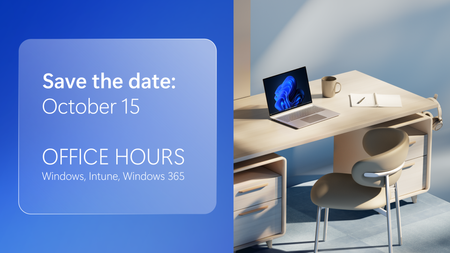
Need answers from the people behind the products you manage every day? Join us for Windows Office Hours on October 15th from 8:00–9:00 AM PT, where experts from Windows, Microsoft Intune, Configuration Manager, Windows 365, Windows Autopilot, security, public sector, FastTrack, and more will be available to answer your questions. This is a live, chat-based event with no video and no meeting link. Simply join the discussion, ask your questions, and participate in conversations with Microsoft engineers and specialists. If you can't attend live, post your questions on the event page in advance and we'll address them during the session.54Views0likes0Comments