community
3185 TopicsWhen I right-click an app icon pinned to the taskbar, the jump list doesn't appear.
When I right-click the icon of a pinned app on the taskbar, the list of recently opened files that should appear does not show up. Restarting File Explorer temporarily resolves the issue, but it recurs.817Views0likes10CommentsWhere the Road Leads, Community Grows: The Caravana Cloud Story
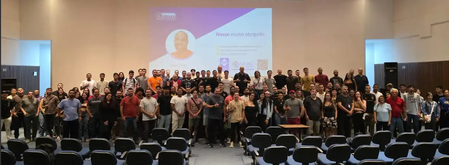
Sometimes, creating change starts simply: by bringing people together and giving them a place to learn, connect, and imagine new possibilities. This is the spirit behind Caravana Cloud, an event series organised by Maycon Alves in collaboration with Microsoft MVPs and community friends. Across Brazil, the initiative brings cloud knowledge closer to local communities while creating connections, encouraging new opportunities, and helping technology ecosystems grow from within. MVP Francisco Ferreira and community expert Ivanildo Gonçalves are part of the organization team led by the former MVP and community leader Maycon Alves and embody the community spirit that makes a positive change in society. The newest Caravana Cloud cycle is the sixth edition of the initiative and is planned from December 2025 through October 2026. The route includes: December 2025: Fortaleza, Ceara March 2026: Campina Grande, Paraiba July 2026: Natal, Rio Grande do Norte Upcoming stops: Jundiai, Sao Paulo; Rio de Janeiro, Rio de Janeiro; and Porto Alegre, Rio Grande do Sul For Maycon and the other community leaders involved, the goal is bigger than a single event. Caravana Cloud is about taking knowledge to different regions, opening doors for people who may not otherwise have access to in-person technical events, and planting the seed of community wherever the road takes them. More than a technical event Caravana Cloud has already reached more than 19 cities over the course of its journey. Each stop creates an opportunity for attendees to meet speakers, ask questions, learn from real-world experience, and connect with others who are building careers around Microsoft technologies. The format is community-led by design. MVPs and experienced professionals share what they know, but the value also comes from the conversations around the sessions: students meeting mentors, professionals discovering new possibilities, and local organizers seeing that they can continue the momentum after the caravan leaves. That is one of the strongest outcomes of community events. A session may introduce a product, a platform, or a new technical approach, but the lasting impact often comes from the confidence people gain when they realize they are not learning alone. A social project behind the scenes Caravana Cloud also includes a social impact effort. At event stops, the organizers collect non-perishable food and donate it to local institutions. Maycon has intentionally kept that part of the project low profile. The point is not promotion, photos, or marketing. It is a quiet commitment to make each event useful beyond the technical agenda. That choice says a lot about the values behind the initiative. Sharing knowledge already creates opportunity; combining that with local giving turns a technology event into something broader: a contribution to the community hosting it. The personal commitment behind community work Community leadership often looks simple from the outside: a venue, an agenda, a few speakers, and a group photo at the end. In reality, much of the work happens before anyone enters the room. Maycon describes organizing Caravana Cloud as difficult but deeply rewarding. Like many community organizers, he has invested time, energy, travel, and personal resources to make events happen because he believes in the value of sharing knowledge. He continues writing, speaking, organizing, and helping others because community contribution is something he loves. That commitment reflects what many Microsoft MVP communities around the world know well: the most meaningful impact often comes from people who keep showing up, even when it requires personal sacrifice. Why regional events matter Brazil's technology community is large, diverse, and geographically distributed. Bringing cloud learning to different cities helps expand access beyond the largest technology centers and gives local communities a chance to build their own networks. Events like Caravana Cloud help Microsoft technologies become more tangible for people who want practical guidance, local language conversations, and examples from professionals working in similar contexts. They also create a path for new speakers and organizers to emerge. Each city adds something different to the story. Fortaleza, Campina Grande, Natal, Jundiai, Rio de Janeiro, and Porto Alegre are not only stops on a schedule; they are communities with their own audiences, challenges, and opportunities. Continuing the journey As Caravana Cloud moves through its 2025-2026 edition, the series continues to show how community can connect technical learning with local impact. The project is a reminder that MVP-led and community-led initiatives do more than share product knowledge. They build confidence, create relationships, support local ecosystems, and sometimes quietly help families and institutions through social action. More information and evidence from the Caravana Cloud journey are available on Maycon's blog. Want to Learn More About the MVP Program? To find an MVP and learn more about the Microsoft MVP Program, visit the MVP Communities website and follow program updates on LinkedIn or through #MVPBuzz. Join us for a future live session through the Microsoft Reactor where we walk through what the MVP program is about, what we look for, and how nominations work. These sessions are designed to help you connect the dots between the work you’re already doing and the impact the MVP Program recognizes - with time for questions, examples, and real conversations.
Revised Full User Vision for Next-Generation Windows 27H2 (OS 12.0.0.0)
Dear Microsoft Windows Product & Engineering Team, As an active Windows Insider and long-time ecosystem follower, I am submitting this revised, fully detailed user vision for the next-generation Windows operating system. This proposal is built in full recognition that the ongoing global shortages of DDR4, DDR5, SSDs, CPUs and graphics cards are reshaping current Windows development priorities. Instead of pushing for higher unnecessary hardware thresholds, this blueprint is designed to deliver a more powerful, human-friendly system that runs smoothly on both legacy existing devices and upcoming new hardware, while respecting the workflow habits of hundreds of millions of long-time Windows users. Below is the complete structured vision covering interface design, interaction logic, app ecosystem, AI capabilities and full upgrade strategies: Redesigned "Start" Menu Clear 4-zone structural innovation: User account anchored at top-left, far-left quick access bar for frequent folders, left app list (with "Most Used" and "Suggested" categories, supporting pinned apps), and the right fixed tile area that can hold up to 4 medium tiles or 8 small tiles horizontally. New rainbow glow effect added, with draggable tile edges for free resizing. Full-screen Start Screen returns, combining the easy-to-navigate traditional Windows 7 app list and information-rich Windows 8.1 live tiles, with tiles supporting both horizontal and vertical arrangement. 6 exclusive tile sizes available: Small (1×1), Medium (2×2), Long (4×1), Wide (4×2), Large (4×4), Tall (4×6), paired with smooth new tile resizing animations. Highly customizable tile styles: Solid color, gradient, light mode, dark mode, transparent (default) and semi-transparent tones. Full migration compatibility: All pinned apps and websites from Windows 7, 8.1, 10 and 11 will be automatically preserved during system upgrades. Taskbar and New Top Status Bar Dual-style taskbar: Users can freely switch between Floating (suspended) and Docked (fixed) layouts. Reorganized zones: Left side for system entries (Cortana, mobile device management, Search), middle section for Start button, Search, Task View, Timeline, Chat and running apps, right side for system tray and notification area. Resizable rectangular search box replaces the current circular design. New top status bar integrated with real-time weather, streamlined system tray, date and time display. Scene-adaptive behavior: When a window is maximized or snapped, the top bar auto-hides, and the bottom taskbar retains only simplified information (weather, time, notifications) to enter full focus mode. Search Menu The search menu supports free height adjustment, maintaining a fully consistent visual style with the redesigned Start Menu. Personalized Lock Screen Date and time alignment offers two selectable options: left-aligned and center-aligned. New photo layering effect: The main subject of the lock screen photo can be displayed in front of the time text. Windows Hello face recognition adds native support for reliable login while wearing a face mask. Widget System All widgets can be pinned directly to the desktop. In full-screen mode, the interface is split into the left widget display area and the right information source area, supporting up to 6 vertical columns of content. New exclusive widgets: Schedule widget, People widget, Microsoft Edge widget, and Cortana Suggestions widget. Full Application Ecosystem Refresh The new Mail, Calendar and People apps are fully redesigned. The new Outlook app adds native support for QQ Mail and NetEase Free Mail. The new Cortana app supports multiple languages, brings back full consumer skills including music control, connected smart home device management and third-party skill extensions, with two visual forms available: "Circle" and "Dough", paired with the exclusive Cortana Suggestions widget. Task View and Window Management The classic Windows 10 Task View experience is fully restored, with the Timeline feature making a return to support cross-device operation history sync. Enhanced drag-and-drop interaction: Users can drag a window to the Task View icon and assign it to multiple virtual desktops; users can also drag files or text directly to background apps on the taskbar, and transfer content across different windows seamlessly. The classic Windows 10 window switching experience is brought back in full. The Snap Assistant restores the classic Windows 10 window snapping experience, and is optimized for multiple horizontal snap layouts on 21:9 and 32:9 ultra-wide monitors. Microsoft Store Innovation The store introduces brand-new Fluent Design applications, multiple classic UWP apps are re-launched, and Metro-style apps make a long-awaited return. All Progressive Web Apps (PWA) in the existing Microsoft Store are migrated to the UWP application system. New exclusive sections are added: the PlayStation app, the Nintendo Switch app and a dedicated Nintendo game zone, paired with the exclusive Microsoft Store widget. Beloved Classic Features Restored We bring back the fan-favorite features from previous Windows versions: Windows 7 Desktop Gadgets (for real-time information display), the full MSN app suite, Tips app, Maps app, Microsoft Edge Legacy, cross-device Timeline, HomeGroup, Desktop Messaging app, Windows Media Center (for home entertainment), the new Groove Music, and all native Windows 8.1 classic apps. Other Detail Optimizations The iconic Windows 11 startup sound is fully retained. System avatars are adjusted from circular shapes to rounded rectangles. The Windows Subsystem for Android makes a return, with native full-screen support for landscape Android apps. Native controller compatibility is added for DualShock 4, DualShock 5, Joy-Con and Joy-Con 2. The Notification Center and Calendar flyout controls are fully separated. Window transparency effects are upgraded, with a brand-new liquid glass effect added. Next-Generation Windows 12 PCs and Tablets The new Windows 12 hardware lineup will deliver doubled memory, larger storage space, longer battery life, stronger performance and enhanced system security and stability. Backup and Data Transfer Windows Backup is expanded to more countries and regions, adding native support for backing up personal files and installed apps directly to external storage devices. One-click data transfer is supported: users can fully move personal files and installed apps from an old PC to a new device, or transfer data to a new hard drive via partition migration. AI Capabilities The system is built with cutting-edge AI features including context-aware AI and Agentic mode, with more practical AI experiences waiting to be explored. Version and Upgrade Strategy Launch build number: 27H2, with the internal OS version reset to 12.0.0.0. Free upgrade coverage: All devices running Windows 11 (including SE), Windows 10 (including S), Windows 8/8.1 (including RT) and Windows 7 can upgrade to Windows 12 / 12e completely for free. Hardware requirements by edition: For Home, Pro and Pro Workstation editions: All previous strict hardware restrictions are removed, with minimum requirements of 4GB RAM, 64GB SSD and DirectX 11 or higher. For Windows 12e (Lite edition): Minimum requirements of 2GB RAM and 32GB storage, to support entry-level legacy devices. For Windows 12 Ultra (Flagship edition): Minimum requirements of 8GB RAM, 128GB SSD, NPU support, TPM 2.0 and DirectX 12 or higher, for high-end productivity devices. Extended Lifecycle Support For Home, Pro and Pro Workstation editions: Official support period is extended from 2 years to 4 years. For Enterprise, Education and IoT Enterprise editions: Official support period is extended from 3 years to 6 years. This full proposal is designed to align perfectly with the current hardware supply reality, ensuring the new system can run smoothly on billions of existing Windows devices while delivering modern, innovative experiences. I hope this user-centric vision can provide valuable reference for your team's next-generation Windows development planning. Thank you for your time and consideration. Sincerely, A Dedicated Windows Insider & User1.2KViews1like5Comments
Can't edit cells in Excel 2010 since Sept 2026 patch Tuesday
I can't edit cells in Excel 2010 spreadsheets since Sept 2026 patch Tuesday. How do I reverse this back to the former working software. There was one comment that said it might be caused by a Windows 10 security update. Since Windows 10 isn't supposed to get security updates anymore, how can that be an issue? Ron8Views0likes0Comments
Full-screen video freezing issue
한국어와 영어로 글을 남깁니다. 이 글을 남기기 이전에 기술 지원을 24시간 대기 중이라는 분에게서 받았습니다. 그 분은 가장 해결 확률이 높고 가장 해결이 완벽에 가까운 방식을 제안했습니다. 그건 코덱을 업데이트하거나 코덱을 설치하라는 것이었습니다. 전 이 방법이 해결방법에 가깝다고 느낍니다. 제가 드리려는 말은 우연히 이 문제를 해결했다고 생각하기에 그 해결 방법을 공유하는 것입니다. 윈도우 제품에는 사소한 버그가 있고 서로 다른 프로그램이 충돌하는 경우가 있을 수 있으며 특정 프로그램이 버그를 만들 때도 있기 때문입니다. 전 전체화면으로 영상을 시청할 때에 멈추는 증상이 해결이 안 되었어요. 신기한 건 다른 회사의 그래픽 카드를 사용할 때엔 이런 문제가 발생하지 않는다는 점이었습니다. 인텔 ARC 그래픽 카드는 이런 문제가 없어요. AMD의 라데온 그래픽 카드를 사용할 때에 다 좋은데 이 문제 때문에 좀 불편했습니다. 지금도 인텔 CPU와 인텔 GPU를 쓰면 문제가 없고, 인텔 CPU와 AMD GPU 혹은 AMD CPU와 AMD GPU를 쓰면 전체화면 영상이 멈춥니다. 모니터는 상관이 없던 것 같아요. 그래서 결론은 코덱을 찾아볼 수도 있는데 어떤 코덱이 필요한지 제가 정확하게 모르거든요. 우연하게 찾은 해결책은 윈도우 설정에 작업 표시줄 옵션이 있습니다. 거기서 작업 표시줄 단추 합치기 및 레이블 숨기기 / 작업 표시줄 단추 합치기 및 다른 작업 표시줄의 레이블 숨기기 / 더 작은 앱 아이콘 표시 옵션을 조절하는 것이었습니다. 항상-작업 표시줄이 꽉 찼을 때-안 함 중에 문제가 해결되는 옵션을 고르세요. 전 작업 표시줄이 꽉 찼을 때를 3개 모두 설정해 두니 전체화면 영상이 더 이상 멈추지 않아요. 라데온 그래픽카드 드라이버 문제일 수도 있고 이 라데온 프로그램이 윈도우와 우연하게 충돌이 일어나는 것일 수도 있을 것 같아요. 전 전문가가 아니라 우연히 옵션 조정으로 방법을 찾았다는 점만 말하고 싶습니다. 그러므로 이 문제는 해결이 될 수도 사용자에 따라서 해결이 되지 않을 수도 있습니다. 제가 지내던 커뮤니티에선 라데온 그래픽카드 드라이버 프로그램이 이전부터 전문적이지 않다는 이야기가 돌았는데 전 그 때 그 말을 믿지 않았지만 지금은 그 말에 신빙성이 있다는 생각도 듭니다. 엔비디아 지포스에서도 동일한 증상이나 멈춤 현상이 있는 것 같기는 합니다. 윈도우의 호환성 문제일 수도 있겠지요. 잘은 모르겠지만요. 도움이 되시길 바랍니다. I am posting this in both Korean and English. Before writing this, I received assistance from a technical support representative who was available around the clock. They suggested a solution that was highly likely to work and offered the most complete fix: updating or installing the necessary codecs. I believe this is the right approach. I am sharing this because I managed to resolve the issue—albeit somewhat by chance—and want to pass on the solution. Windows products can have minor bugs, conflicts between different programs can occur, and specific programs can sometimes trigger these issues. I wasn't able to resolve the issue where the video would freeze during full-screen playback. Interestingly, this problem didn't occur when using graphics cards from other manufacturers; Intel Arc graphics cards, for instance, don't have this issue. While AMD Radeon graphics cards are otherwise excellent, this specific problem was a bit of a hassle. Even now, I experience no issues when using an Intel CPU with an Intel GPU, but the video freezes in full-screen mode if I pair an Intel CPU with an AMD GPU or use an AMD CPU with an AMD GPU. The monitor didn't seem to be a factor. I suppose I could look into codecs, but I'm not exactly sure which ones are needed. I stumbled upon a solution within the Windows taskbar settings. The fix involved adjusting options such as "Combine taskbar buttons and hide labels," "Combine taskbar buttons and hide labels on other taskbars," and "Use small taskbar buttons." You should experiment with the available settings—"Always," "When taskbar is full," or "Never"—to find the one that resolves the issue. For me, setting all three options to "When taskbar is full" stopped the full-screen videos from freezing. This could be an issue with the Radeon graphics card driver, or perhaps a random conflict between the Radeon software and Windows. I am not an expert; I simply wanted to share a method I discovered by chance while tweaking settings. Consequently, this solution might work for some users but not for others. In the online community I frequent, there had long been talk that Radeon graphics card driver software wasn't exactly professional-grade; I didn't believe it at the time, but now I’m starting to think there might be some truth to it. That said, it seems like similar symptoms or freezing issues occur with Nvidia GeForce cards as well. It could be a Windows compatibility issue, though I’m not entirely sure. I hope this helps.80Views0likes2Comments
The Surface Phone 2.0: The way to revive the past in a way everyone profits.
The tech industry is currently facing a massive user-experience crisis, particularly in mobile and tablet computing. As a student regularly using iPadOS for schoolwork, I experience this firsthand. Apple's 'walled garden' has become an unnecessary complication: transferring a simple file requires uploading it to an unreliable third-party cloud storage service and downloading it on the target device. Multitasking is deeply flawed—windows crush, stretch, and break UI layouts, while the system frequently lags and crashes. This artificial lock-in forces user dependency through restriction, rather than delivering genuine utility. Microsoft has a historic opportunity to counter this by introducing an 'open-loop' ecosystem that respects the user’s intelligence. A system where users stay not because they are trapped by a hardware lock, but because they simply don't want to leave. Microsoft's core strength has always been treating the user as an administrator of their own device—embracing a 'if you break it, you can easily reinstall it and learn from your mistakes' philosophy. This concept is proven by long-term device stability: my 2015 Lumia 430 Dual SIM, despite being packed to capacity with photos, music, and videos, still runs smoothly and navigates flawlessly. This is a testament to the unmatched core optimization Microsoft is capable of. The market does not need another restricted tablet or a repetitive Android skin. We need the revival of the Universal Windows Platform (UWP) and 'One Windows' philosophy under a new hardware standard: The Microsoft Surface Phone 2.0. Here is a structured business and technical blueprint for how Microsoft can commercialize its past innovations and deliver a truly seamless ecosystem: 1. Unified Interface Architecture (Versatility over Restrictions) Instead of forcing a single mobile layout, the device should adapt dynamically to the user's workload, bridging past achievements with current innovations: • Tile Mode: A modernized revival of the legendary Live Tiles interface for quick, glanceable mobile data. • Desktop Mode: A complete desktop environment with unconstrained floating windows, fully exploiting the capabilities of Windows on ARM. • Console Layout (XBOX Mode): Out-of-the-box integration of the newly introduced XBOX Mode (Compact Home Experience). When paired with a controller or running Xbox Cloud Gaming, the phone instantly transforms into a fully-fledged portable gaming console. 2. Commercializing Past 'Failures' and Abandoned Innovations Microsoft has spent billions developing revolutionary technologies that were abandoned prematurely due to market timing, rather than technical failure. The Surface Phone 2.0 should consolidate and ship these features directly to consumers: • The Revival of Continuum: This remains Microsoft's most powerful concept. Plugging the phone into a monitor should instantly launch a full desktop Windows 11 environment. The modern processing power of ARM chips makes this transition flawless today. • Reclaiming Abandoned Shells: The modular interface designs from Windows 10X, the user experience of Project Andromeda, and the spatial computing foundations of Windows Mixed Reality should be reintegrated. If a user wears an XR headset, the phone should seamlessly project UWP apps into a 3D environment. 3. Cross-Platform Infrastructure Integration The Surface Phone 2.0 must serve as the universal anchor for a frictionless, continuous workflow under a single Microsoft Account: • Windows in the Car: A native dashboard interface to directly challenge Apple CarPlay and Android Auto, linking Bing Maps, Outlook calendars, and media seamlessly. • Frictionless Cloud & Local Continuity: True cross-device synchronization. If a user is modifying a Word or PowerPoint document on their PC and needs to leave, a native 'Continue working from...' notification should instantly appear on the Surface Phone, opening the exact file at the precise position it was left. • Hardware Tiering: Maintaining a stable, highly-optimized mid-range hardware line alongside flagship devices. The Windows ecosystem has historically proven that superb software optimization beats a raw hardware spec race. 4. Solving the 'App Gap' with Multi-Layered Architecture To prevent the ecosystem stagnation that affected Windows 10 Mobile, the device must support a versatile environment: • Native ARM64 UWP & Win32 applications for full-scale desktop performance. • A Built-in Android APK Subsystem (a revived, optimized iteration of virtualization) as a fallback mechanism, ensuring users have immediate access to mainstream applications while developers transition to native tools. 5. Next-Generation System-Wide AI Utilizing modern hardware-level Neural Processing Units (NPUs), a deeply integrated Copilot must replace old voice assistants. A reliable, context-aware, system-wide 'Hey, Copilot' assistant that works locally to manage scheduling, cross-device file tracking, and automation would instantly differentiate this device from competitors. Conclusion By unifying XBOX Mode, enterprise continuity through Continuum, and an open infrastructure that trusts the user, Microsoft can deliver a device that scales from a phone to a desktop, a car dashboard, and a console. The hardware and cloud infrastructure are finally ready. It is time to execute. (compressed and turned into human text by AI)36Views0likes0CommentsAfter updating KB5127648, only half of the archive history was restored.
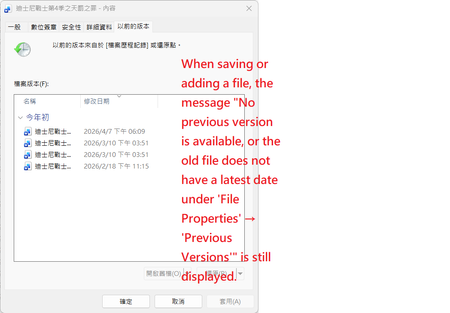
After updating my laptop to KB5127648, only half of the file history was restored. Post-update status: Files were successfully backed up to drive D, but after clicking the Execute Now button under Control Panel > System and Security > File History, the last copied date and time still cannot be updated to the latest storage time.Currently, you can only temporarily select the disk drive (D drive) by going to Control Panel > All Console Items > Archive History > Select Disk Drive. Folders in the User Folders and regular folders display the latest timestamp version, but the displayed time of the last backup is different from the actual backup time, even though the backup to drive D was successful. However, newly added or updated files, images, etc., do not display the latest timestamp version; only the date and time of the previous version are displayed. This also causes newly added or updated files, images, etc., to not appear when opening regular folders, although the latest timestamp version is displayed. For newly created files (such as Word files), File Properties > Previous Versions displays: No previous versions are available. The contents of older files will not display the latest timestamp version; only the date and time of the previous version will be shown. Serious problem: Although backups have been made to the D drive, not all data is displayed correctly; several files are missing. When attempting to execute the Clear Versions function, the system immediately displays the error message Element not found Even after updating Windows 10 to KB5126657, while file history can be backed up to the D drive, the last copy date of the files remains unchanged. This issue has existed since the KB5101684 update on July 29th. I did not perform any actions before updating KB5101684. I have submitted this issue through the Feedback Center and the Microsoft Community Center. Some users have reported that the last backup time was not updated after the KB5124010/KB5120249 update. Japanese media and computer repair shops have also mentioned similar issues. If you have the same problem, please let me know. Feel free to ask in the Feedback Center.Hopefully Microsoft will fix it soon. my feedback hub :https://aka.ms/AA13ucfz Screenshot of the problematic screen; Folders and general folders in the "Users" folder display the latest timestamp version Serious problem: Although backups have been made to the D drive, not all data is displayed correctly; several files are missing.86Views0likes0Comments
VMware Workstation Error: Virtualized AMD-V/RVI Is Not Supported on Windows 11
I am trying to run Cisco Modeling Labs (CML) using VMware Workstation on a Lenovo laptop running Windows 11 Pro. When I power on the VMware virtual machine, I receive this exact message: Virtualized AMD-V/RVI is not supported on this platform. Continue without virtualized AMD-V/RVI? I need nested hardware virtualization for my CML environment. Continuing without virtualized AMD-V/RVI is not an acceptable solution for my intended setup. Microsoft Support previously recommended resetting Windows. I completed the reset, but the problem persists. System information Manufacturer: Lenovo Model: 21CRS10100 Operating system: Windows 11 Pro OS build: 10.0.26200 RAM: 16 GB Device is a standalone workstation. Troubleshooting and evidence 1. Microsoft hypervisor is still present Command: Get-CimInstance Win32_ComputerSystem | Select-Object Manufacturer, Model, HypervisorPresent Result: HypervisorPresent = True 2. Virtualization-based security remains active The Win32_DeviceGuard query returns: VirtualizationBasedSecurityStatus = 2 SecurityServicesConfigured = {2, 3} SecurityServicesRunning = {0} RequiredSecurityProperties = {1, 2, 3} System Information also reports that virtualization-based security is running and that a hypervisor has been detected. Memory Integrity is Off. 3. Microsoft VBS platform policy remains enforced CiTool.exe --list-policies lists the following policy: Friendly name: Microsoft Windows Virtualization Based Security Policy Policy ID: a072029f-588b-4b5e-b7f9-05aad67df687 Platform policy: True Signed: True Authorized: True Currently enforced: True This policy was present before and after the Windows reset. I am not assuming that the policy alone is responsible for starting the hypervisor. 4. Other checks No Group Policy Objects are applied. No work or school account is shown in Windows Settings. VBS is enabled in the system and policy registry locations. The current Windows boot entry does not explicitly list hypervisorlaunchtype or vsmlaunchtype. Previously setting both BCD options to Off did not resolve the problem.22Views0likes0Comments
Why is there a SoftwareDistribution folder in ProgramData dated before I even got the PC?
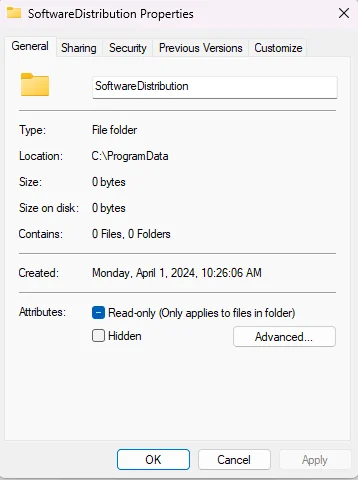
Why is there a SoftwareDistribution folder sitting in my ProgramData directory when it's supposed to live in the Windows folder, and why does it show a creation date of April 1st, 2024—before I even received this PC on April 20th? The folder is completely empty, and I only noticed it while organizing things. I also did a clean Windows install a few months ago, so I don't understand why it's still there. There are two other folders in ProgramData with the same April 1st date: "ssh" and "USOShared." The ssh folder is empty too, and USOShared contains logs, which seems normal, but the 2024 creation date is odd. Could all three be leftovers from the prebuilt image, from the Ubuntu install that was on the machine before I wiped it, or from something else entirely? Is this just a harmless artifact of how the system was imaged, or could it mean something didn't get fully cleaned up during my reinstall? And is it safe to delete these folders, or should I leave them alone?25Views0likes0Comments