authentication
103 Topics
How much of your Microsoft 365 environment can you actually see at once?
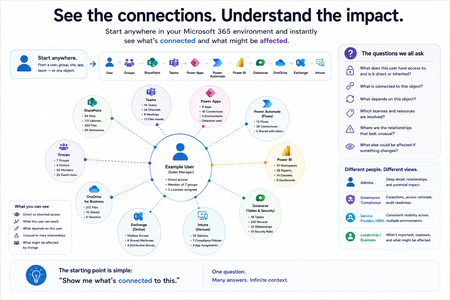
Not how many users you have. Not how many sites, teams, apps or flows you have. How much of it can you actually see connected together? I've been working across Microsoft 365 environments for a while, and I kept running into the same thing. There is no shortage of information. If anything, there is probably too much of it. Users, groups, permissions, SharePoint, Teams, Power Apps, Power Automate, Power BI, Dataverse, OneDrive, Exchange, Intune, licensing, configuration... It's all there. But when you're actually trying to understand how everything fits together, it can be a different story. You open one blade. Find something. Open another. Cross-check it. Go back. Open something else. Before long, you're jumping between different parts of the tenant trying to build the bigger picture in your head. And if you're working with larger environments, that gets difficult pretty quickly. The information isn't necessarily missing. The relationships between the information are what can be difficult to see. That got me thinking about a slightly different question: Instead of "where do I find this information?" "Show me what's connected to this." That's where VisibleState started. Start anywhere. Follow the connections. Imagine starting with a single user. Instead of seeing that user simply as a record with a list of properties, imagine being able to explore the relationships around them: User → Groups → SharePoint → Teams → Power Apps → Power Automate → Power BI → Dataverse → OneDrive → Exchange → Intune Then the questions become different: What does this user have access to? Is that access direct or coming through a group? What resources are connected to them? What depends on something they're associated with? Which licenses are involved? Are there relationships that look unusual? If something changes, what else might be affected? Those questions aren't necessarily about finding another piece of information. They're about putting information that already exists into context. A report can tell you that something exists. A connected view helps you understand what it is connected to. Illustrative example below — not a real customer environment. I'm not suggesting Microsoft 365 doesn't already give us this information Quite the opposite. Microsoft 365 already gives administrators an incredible amount of information and tooling. The thing I've been thinking about is what happens when you want to look across those boundaries. Sometimes I don't want another export. I don't want another list. I don't necessarily want another dashboard. I want to start with something I'm looking at and ask: "What's connected to this?" And then keep following the trail. That's the idea I'm exploring with VisibleState. The interesting part is what happens when you change the viewpoint The same relationships can be useful for completely different reasons. For example: Administrators may want to understand access, permissions and dependencies. Security and governance teams may want to find unusual relationships or exceptions. Compliance teams may need to understand who can access something and why. People managing multiple environments may want a consistent way to understand what's there without rebuilding the picture manually every time. Leadership may not need to see the graph at all. They may simply want to know what's important, what's exposed and what could be affected. It's still the same underlying environment. You're just looking at it from a different angle. And that's where I think things get interesting. Where I'm at with it VisibleState started as something I was building to make my own work easier. I was spending a lot of time investigating environments, tracing access and putting information together for reports. The individual tasks weren't necessarily difficult. It was the jumping between different places and reconstructing the bigger picture that took the time. So I started building something that would let me approach the environment through the relationships instead. It's grown quite a bit from where it started, and I'm continuing to build it. I'm not posting this as a product launch, and I'm not looking for people to sign up. I'm genuinely interested in whether the problem I'm seeing is familiar to other people working with Microsoft 365. So I'm curious... If you could start with any object in your Microsoft 365 environment and immediately see what it's connected to, where would you start? Would it be: Users and access Groups and permissions SharePoint and Teams Power Apps, Power Automate, Power BI and Dataverse Licensing and resources Governance and unusual relationships Something completely different Maybe you've already got a good way of doing this. Maybe you still find yourself jumping between different services and piecing things together manually. Or maybe I'm looking at the problem from the wrong direction. What's the one relationship in your Microsoft 365 environment that you wish you could see instantly?162Views0likes0Comments
Need to Restore PST Files to Office 365 Mailboxes - What's the Best Approach
Hey everyone, I have a task coming up where I need to restore several PST files back into Office 365 mailboxes. Haven't done this before at this scale and honestly not sure where to begin. I've looked at Microsoft's native import service through Purview but I have a few concerns: Some of the PST files are quite large — not sure how well it handles that I need to restore only specific folders for some users, not the entire PST I'm worried about data consistency after the restore Would prefer something that doesn't require too many admin roles or complex setup For those who have done PST to Office 365 restores — what approach worked best for you? Any tools, tips, or things to watch out for that you wish you knew before starting?400Views0likes4CommentsMicrosoft Authenticator not working, after getting a new phone
I've been using MIcrosoft Authenticator for a couple years. Yesterday I purchased a new Samsung phone, I performed the Smart Switch to move everything off my old Samsung phone to my new Samsung phone. I just tried accessing a resource (my work MS Teams account), which requires me to authenticate using MS Authenticator. It said that I was supposed to go to MS Authenticator, to authenticate my login to my work MS Teams. Only, there was nothing in Authenticator. Nothing for me to approve. Nothing. So, what's wrong? How do I fix this? This is a showstopper, so it's got to be fixed TODAY!Solved10KViews0likes2CommentsI built a free, open-source M365 security assessment tool - looking for feedback
I work as an IT consultant, and a good chunk of my time is spent assessing Microsoft 365 environments for small and mid-sized businesses. Every engagement started the same way: connect to five different PowerShell modules, run dozens of commands across Entra ID, Exchange Online, Defender, SharePoint, and Teams, manually compare each setting against CIS benchmarks, then spend hours assembling everything into a report the client could actually read. The tools that automate this either cost thousands per year, require standing up Azure infrastructure just to run, or only cover one service area. I wanted something simpler: one command that connects, assesses, and produces a client-ready deliverable. So I built it. What M365 Assess does https://github.com/Daren9m/M365-Assess is a PowerShell-based security assessment tool that runs against a Microsoft 365 tenant and produces a comprehensive set of reports. Here is what you get from a single run: 57 automated security checks aligned to the CIS Microsoft 365 Foundations Benchmark v6.0.1, covering Entra ID, Exchange Online, Defender for Office 365, SharePoint Online, and Teams 12 compliance frameworks mapped simultaneously -- every finding is cross-referenced against NIST 800-53, NIST CSF 2.0, ISO 27001:2022, SOC 2, HIPAA, PCI DSS v4.0.1, CMMC 2.0, CISA SCuBA, and DISA STIG (plus CIS profiles for E3 L1/L2 and E5 L1/L2) 20+ CSV exports covering users, mailboxes, MFA status, admin roles, conditional access policies, mail flow rules, device compliance, and more A self-contained HTML report with an executive summary, severity badges, sortable tables, and a compliance overview dashboard -- no external dependencies, fully base64-encoded, just open it in any browser or email it directly The entire assessment is read-only. It never modifies tenant settings. Only Get-* cmdlets are used. A few things I'm proud of Real-time progress in the console. As the assessment runs, you see each check complete with live status indicators and timing. No staring at a blank terminal wondering if it hung. The HTML report is a single file. Logos, backgrounds, fonts -- everything is embedded. You can email the report as an attachment and it renders perfectly. It supports dark mode (auto-detects system preference), and all tables are sortable by clicking column headers. Compliance framework mapping. This was the feature that took the most work. The compliance overview shows coverage percentages across all 12 frameworks, with drill-down to individual controls. Each finding links back to its CIS control ID and maps to every applicable framework control. Pass/Fail detail tables. Each security check shows the CIS control reference, what was checked, what the expected value is, what the actual value is, and a clear Pass/Fail/Warning status. Findings include remediation descriptions to help prioritize fixes. Quick start If you want to try it out, it takes about 5 minutes to get running: # Install prerequisites (if you don't have them already) Install-Module Microsoft.Graph, ExchangeOnlineManagement -Scope CurrentUser Clone and run git clone https://github.com/Daren9m/M365-Assess.git cd M365-Assess .\Invoke-M365Assessment.ps1 The interactive wizard walks you through selecting assessment sections, entering your tenant ID, and choosing an authentication method (interactive browser login, certificate-based, or pre-existing connections). Results land in a timestamped folder with all CSVs and the HTML report. Requires PowerShell 7.x and runs on Windows (macOS and Linux are experimental -- I would love help testing those platforms). Cloud support M365 Assess works with: Commercial (global) tenants GCC, GCC High, and DoD environments If you work in government cloud, the tool handles the different endpoint URIs automatically. What is next This is actively maintained and I have a roadmap of improvements: More automated checks -- 140 CIS v6.0.1 controls are tracked in the registry, with 57 automated today. Expanding coverage is the top priority. Remediation commands -- PowerShell snippets and portal steps for each finding, so you can fix issues directly from the report. XLSX compliance matrix -- A spreadsheet export for audit teams who need to work in Excel. Standalone report regeneration -- Re-run the report from existing CSV data without re-assessing the tenant. I would love your feedback I have been building this for my own consulting work, but I think it could be useful to the broader community. If you try it, I would genuinely appreciate hearing: What checks should I prioritize next? Which security controls matter most in your environment? What compliance frameworks are most requested by your clients or auditors? How does the report land with non-technical stakeholders? Is the executive summary useful, or does it need work? macOS/Linux users -- does it run? What breaks? I have tested it on macOS, but not extensively. Bug reports, feature requests, and contributions are all welcome on GitHub. Repository: https://github.com/Daren9m/M365-Assess License: MIT (free for commercial and personal use) Runtime: PowerShell 7.x Thanks for reading. Happy to answer any questions in the comments.4.9KViews2likes2CommentsLocked Out of Global Admin – Lost Authenticator – Case 2602060010000939 – Need Escalation
I am locked out of my Global Administrator account because my phone broke on February 5, 2026 and I no longer have access to Microsoft Authenticator. There is no alternative authentication method configured. Case ID: 2602060010000939. I contacted support on February 6 and the ticket was set as Severity C with an 8-hour response expectation. After several days, I have only received generic replies and no contact from an engineer. This account is critical for my business operations, and I have now been without access for five days. I understand it was my responsibility to maintain backup methods, but I urgently need help from Microsoft to recover access. Please contact me. Samuel LeoSolved460Views1like2CommentsMigration from Hosted Exchange (Hybrid) to M365 Classic Outlook Client Problems and Solutions
Hello Everyone, I'm a tech who started on a 8088 processor in the 80's. Not mentioning the Vic20 and C64 since that hardly seem relevant! I'm posting here to hopefully help the next person with the issues I've had over the last few weeks. My client had to port his email from a provider with an on-perm Exchange server in a Hybrid setup with M365 to his own M365 environment. I expected this was to be about 3 hours of work for me - setup M365 environment, plan the cut-over window, update the Outlook clients on each PC. It ended up being roughly 20 hours of my time and at least 10 hours of dedicated time for my client. For those wanting to jump directly to what mostly fixed it use this link, it should get you past the dreaded "an encrypted connection to your mail server is not available" when trying to add the mail account into a clean profile. Use https://support.microsoft.com/en-us/windows/classic-outlook-troubleshooters-086e3d66-5404-4034-9cc5-545909dcc166 and pick "Classic Outlook Profile Setup Troubleshooter" Most hits are going to tell you its an autodiscovery issue, but if you're reading this I'm going to assume you've already confirmed that. Our issue was some ghost configuration, only on the PCs previously setup for mail on the old server. A new PC could add the same account without issue. Some of the research suggested this would not happen if the proper Microsoft migration process is followed to move the account - but in our case the previous provider was unable to perform the migration. I'll skip over the research we tried along the way, such as New Outlook Profiles, Registry entry changes, MS Personal users with the same email as MS Business Users, Autodiscover problems (including concerns that the base website for the client was offering invalid data), and so on. After each hit where we applied a fix we again had to try adding the mail to the profile, and each time we sat watching the little circle for up to 5 minutes only to get the same error. Now, once we found the link above - which did not come up in most searches - things got better, but not 100%. We added the profile ok but then Outlook gave a permission error while starting. To fix that, the user signed in must have administrative access and you use File Explorer to navigate to the folder identified in the error. In our case it was in folders kept under \Windows\System32\. When prompted that we need to grant permanent access we said yes. In our case this is where Outlook was storing the ost files. That worked for most of the clients, but we had one additional issue where the error was pointing to a folder that didn't exist. Just creating the folder was not enough, the final fix was to hold CTRL-SHIFT down while opening Outlook to start in administrative mode to allow it to create the ost file in the newly created folder. Finally 3 weeks after our cut over window, while the client had to use OWA, we were able to get outlook running. This was critical for my client because they did not have access to the mail history since the migration didn't happen - they had to open a copy of their PST in Outlook and use mail in OWA and constantly bounce back and forth. I hope this helps someone avoid the pain we went though!91Views0likes0CommentsSole Microsoft 365 Admin Locked Out After Phone Replacement / Lost MFA Device
I am the sole admin for a Microsoft 365 tenant and I am currently locked out after replacing my phone. The old phone was wiped before Microsoft Authenticator was fully re-registered on the new device. Authenticator was the only MFA method configured on the account. Current situation: password is known, Teams desktop sessions are still active, Authenticator cloud backup restored successfully, but all Microsoft security and admin pages still require approval from the old Authenticator registration. I cannot access Security Info, Entra Admin, or Microsoft 365 Admin Center because every path loops back to the dead MFA registration. I have already attempted Microsoft business support phone lines, Authenticator restore and recovery, and existing desktop sessions, but support queues are disconnecting and I cannot open business support tickets because the admin account itself is MFA locked. Tenant: lowepfg.onmicrosoft.com What is the fastest recovery or escalation path to force MFA reset or re-register Microsoft Authenticator for the tenant admin account?137Views0likes2CommentsMacOS platform SSO deployment issues
Hello, We tried to deploy MacOS platform SSO but the devices are having problems with their authentication. The devices are connected through company portal but keep asking for logins and authentication, especially on reboot. Some users are prompted to sign-in to their entra account several times per hour. To Deploy it we used the configuration setting template: Authentication > Extensible Single Sign On (SSO) Settings: Extension Identifier: com.microsoft.CompanyPortalMac.ssoextension Authentication Method: Password Token To User Mapping: Account Name: preferred_username Full Name: name Use Shared Device Keys: Disabled Team Identifier: UBXXXXXX Type: Redirect Has anyone here experienced similar issues or found a fix for these constant re-authentication prompts? Thanks!185Views0likes1CommentSecuring the Modern Workplace: Transitioning from Legacy Authentication to Conditional Access
Authored by: Gonzalo Brown Ruiz, Senior Microsoft 365 Engineer & Cloud Security Specialist Date: July 2025 Introduction In today’s threat landscape, legacy authentication is one of the weakest links in enterprise security. Protocols like POP, IMAP, SMTP Basic, and MAPI are inherently vulnerable — they don’t support modern authentication methods like MFA and are frequently targeted in credential stuffing and password spray attacks. Despite the known risks, many organizations still allow legacy authentication to persist for “just one app” or “just a few users.” This article outlines a real-world, enterprise-tested strategy for eliminating legacy authentication and implementing a Zero Trust-aligned Conditional Access model using Microsoft Entra ID. Why Legacy Authentication Must Die No support for MFA: Enables attackers to bypass the most critical security control Password spray heaven: Common vector for brute-force and scripted login attempts Audit blind spots: Limited logging and correlation in modern SIEM tools Blocks Zero Trust progress: Hinders enforcement of identity- and device-based policies Removing legacy auth isn’t a nice-to-have — it’s a prerequisite for a modern security strategy. Phase 1: Auditing Your Environment A successful transition starts with visibility. Before blocking anything, I led an environment-wide audit to identify: All sign-ins using legacy protocols (POP, IMAP, SMTP AUTH, MAPI) App IDs and service principals requesting basic auth Users with outdated clients (Office 2010/2013) Devices and applications integrated via PowerShell, Azure Sign-In Logs, and Workbooks Tools used: Microsoft 365 Sign-In Logs Conditional Access insights workbook PowerShell (Get-SignInLogs, Get-CASMailbox, etc.) Phase 2: Policy Design and Strategy The goal is not just to block — it’s to transform authentication securely and gradually. My Conditional Access strategy included: Blocking legacy authentication protocols while allowing scoped exceptions Report-only mode to assess potential impact Role-based access rules (admins, execs, vendors, apps) Geo-aware policies and MFA enforcement Service account handling and migration to Graph or Modern Auth-compatible apps Key considerations: Apps that support legacy auth only Delegates and shared mailbox access scenarios BYOD and conditional registration enforcement Phase 3: Staged Rollout and Enforcement A phased approach reduced friction: Pilot group enforcement (IT, InfoSec, willing users) Report-only monitoring across business units Clear communications to stakeholders and impacted users User education campaigns on legacy app retirement Gradual enforcement by department, geography, or risk tier We used Microsoft Entra’s built-in messaging and Service Health alerts to notify users of policy triggers. Phase 4: Monitoring, Tuning, and Incident Readiness Once policies were in place: Monitored Sign-in logs for policy match rates and unexpected denials Used Microsoft Defender for Identity to correlate legacy sign-in attempts Created alerts and response playbooks for blocked sign-in anomalies Results: 100% of all user and app traffic transitioned to Modern Auth Drastic reduction in brute force traffic from foreign IPs Fewer support tickets around password lockouts and MFA prompts Lessons Learned Report-only mode is your best friend. Avoids surprise outages. Communication beats configuration. Even a perfect policy fails if users are caught off guard. Legacy mail clients still exist in vendor tools and old mobile apps. Service accounts can break silently. Replace or modernize them early. CA exclusions are dangerous. Every exception must be time-bound and documented. Conclusion Eliminating legacy authentication is not just a policy update — it’s a cultural shift toward Zero Trust. By combining deep visibility, staged enforcement, and a user-centric approach, organizations can securely modernize their identity perimeter. Microsoft Entra Conditional Access is more than a policy engine — it is the architectural pillar of enterprise-grade identity security. Author’s Note: This article is based on my real-world experience designing and enforcing Conditional Access strategies across global hybrid environments with Microsoft 365 and Azure AD/Entra ID. Copyright © 2025 Gonzalo Brown Ruiz. All rights reserved.Solved1.5KViews0likes1CommentPrimer: How to Use RBAC for Applications to Control App Use of the Mail.Send Permission
The temptation to use the Mail.Send application permission in scripts can lead PowerShell developers into trouble because the permission allows access to all mailboxes, including sensitive executive and financial mailboxes. Fortunately, RBAC for Applications allows tenants to control the access that apps have to mailboxes and other Exchange content. All explained here with an example script to test RBAC of Applications. https://office365itpros.com/2026/02/17/mail-send-rbac-for-applications/774Views3likes4Comments