api
99 Topics
Microsoft SSO SAML Assertion Claims
While getting the assertions back from SAML Assertion Claims, I have configured the user.country & assigned some value in the field. But while getting the claim we are reading the some different value like "IN" ? can I know does the user.country claim supports or not during the claim?316Views0likes4Comments
How much of your Microsoft 365 environment can you actually see at once?
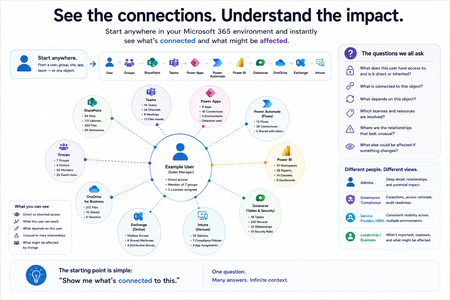
Not how many users you have. Not how many sites, teams, apps or flows you have. How much of it can you actually see connected together? I've been working across Microsoft 365 environments for a while, and I kept running into the same thing. There is no shortage of information. If anything, there is probably too much of it. Users, groups, permissions, SharePoint, Teams, Power Apps, Power Automate, Power BI, Dataverse, OneDrive, Exchange, Intune, licensing, configuration... It's all there. But when you're actually trying to understand how everything fits together, it can be a different story. You open one blade. Find something. Open another. Cross-check it. Go back. Open something else. Before long, you're jumping between different parts of the tenant trying to build the bigger picture in your head. And if you're working with larger environments, that gets difficult pretty quickly. The information isn't necessarily missing. The relationships between the information are what can be difficult to see. That got me thinking about a slightly different question: Instead of "where do I find this information?" "Show me what's connected to this." That's where VisibleState started. Start anywhere. Follow the connections. Imagine starting with a single user. Instead of seeing that user simply as a record with a list of properties, imagine being able to explore the relationships around them: User → Groups → SharePoint → Teams → Power Apps → Power Automate → Power BI → Dataverse → OneDrive → Exchange → Intune Then the questions become different: What does this user have access to? Is that access direct or coming through a group? What resources are connected to them? What depends on something they're associated with? Which licenses are involved? Are there relationships that look unusual? If something changes, what else might be affected? Those questions aren't necessarily about finding another piece of information. They're about putting information that already exists into context. A report can tell you that something exists. A connected view helps you understand what it is connected to. Illustrative example below — not a real customer environment. I'm not suggesting Microsoft 365 doesn't already give us this information Quite the opposite. Microsoft 365 already gives administrators an incredible amount of information and tooling. The thing I've been thinking about is what happens when you want to look across those boundaries. Sometimes I don't want another export. I don't want another list. I don't necessarily want another dashboard. I want to start with something I'm looking at and ask: "What's connected to this?" And then keep following the trail. That's the idea I'm exploring with VisibleState. The interesting part is what happens when you change the viewpoint The same relationships can be useful for completely different reasons. For example: Administrators may want to understand access, permissions and dependencies. Security and governance teams may want to find unusual relationships or exceptions. Compliance teams may need to understand who can access something and why. People managing multiple environments may want a consistent way to understand what's there without rebuilding the picture manually every time. Leadership may not need to see the graph at all. They may simply want to know what's important, what's exposed and what could be affected. It's still the same underlying environment. You're just looking at it from a different angle. And that's where I think things get interesting. Where I'm at with it VisibleState started as something I was building to make my own work easier. I was spending a lot of time investigating environments, tracing access and putting information together for reports. The individual tasks weren't necessarily difficult. It was the jumping between different places and reconstructing the bigger picture that took the time. So I started building something that would let me approach the environment through the relationships instead. It's grown quite a bit from where it started, and I'm continuing to build it. I'm not posting this as a product launch, and I'm not looking for people to sign up. I'm genuinely interested in whether the problem I'm seeing is familiar to other people working with Microsoft 365. So I'm curious... If you could start with any object in your Microsoft 365 environment and immediately see what it's connected to, where would you start? Would it be: Users and access Groups and permissions SharePoint and Teams Power Apps, Power Automate, Power BI and Dataverse Licensing and resources Governance and unusual relationships Something completely different Maybe you've already got a good way of doing this. Maybe you still find yourself jumping between different services and piecing things together manually. Or maybe I'm looking at the problem from the wrong direction. What's the one relationship in your Microsoft 365 environment that you wish you could see instantly?200Views0likes0Comments
Is Warehouse management APIs are available in business central?
Hi Team, I have use case like to enter goods item level and need to store it in business central.Like i need to do like to create purchase order from invoice document and do inventory put Away through API .Create PO API is there.Please guide me to get inventory put-away API? Thanks, Ardra717Views1like5CommentsPrimer: How to Use RBAC for Applications to Control App Use of the Mail.Send Permission
The temptation to use the Mail.Send application permission in scripts can lead PowerShell developers into trouble because the permission allows access to all mailboxes, including sensitive executive and financial mailboxes. Fortunately, RBAC for Applications allows tenants to control the access that apps have to mailboxes and other Exchange content. All explained here with an example script to test RBAC of Applications. https://office365itpros.com/2026/02/17/mail-send-rbac-for-applications/897Views3likes4Comments
Automating CRUD operations in MS Places
Hi, Has anyone been able to automate CRUD operations in MS Places yet? Given that the Places API calls support user access tokens only currently and Application access tokens isn't yet supported? We were able to do Get operations using App tokens but when run anything to modify, For Ex: Create a building using Set-Placev3 cmdlet it gives error. When raised an MS ticket they confirmed that the calls doesn't support application tokens yet.. We have a showstopper kind of situation.59Views0likes0CommentsUnable to get Primary Keys in the tables
I am not able to get primary key in EmailDelivered , EmailOpened , EmailSent , FormSubmitted , FormVisited , WebsiteVisited . Below is the reference of one of the Table nad other tables are also present in this : https://learn.microsoft.com/en-us/common-data-model/schema/core/applicationcommon/foundationcommon/crmcommon/solutions/customerinsightsjourneys/emaildelivered Could you please help me in finding primary key in these tables. Have you ever faced this issue? what should you suggest in this case.101Views0likes1CommentExtracting attachments from Business Central via API early 2024
Hi all According to the API documentation, the pdf or images attached to e.g. purchase invoices can be found using /attachments endpoint. This works very well for late 2024 and 2025 invoices, but finance says an update was applied mid 2024 and all invoices before july 2024, do not have any attachments. Also, instead of using the /puchaseInvoices endpoint, the early entries can instead be found under /generalLedgerEntries. I have tried, what seems to be, all options, but finance can show the PDF for a posting in the system, but for some reason, it seems impossible for me to find it using the API. In conclusion, the data (PDFs) exist, they can be found using the system but I do not know where to look when using the API. Do anyone have a recommendation on how to proceed or solve the issue? Thanks in advance! Best, Victor97Views0likes1Comment
How to filter JSON data to a specific result?
Hi all, I am trying to get JSON data from the IEX API and have used the WEBSERVICE() function, but I can't seem to filter it down to the values I need. For example: If I want the "total cash" for the first year financials of Apple; I have tried this formula: =VALUE(WEBSERVICE("https://api.iextrading.com/1.0/stock/AAPL/financials?period=annual/0/totalcash")) Which gives an error. I think the incorrect part is the "/0/" but I don't see how to specify which year I want. Any help is really appreciated. Thanks,3.1KViews0likes1Comment