Forum Widgets
Latest Discussions

Exempt a specific container in MDC
You don't need a full exemption for this — the built-in policy behind "Immutable (read-only) root filesystem should be enforced for containers" already supports per-container and per-image exclusions natively, which is more precise than exempting at the resource/cluster level. This recommendation is implemented via the Azure Policy Add-on for Kubernetes (Gatekeeper constraint) as part of Defender for Cloud's data plane hardening. The underlying policy definition supports these parameters: excludedContainers — exclude by container name excludedImages — exclude by image (supports prefix matching, e.g. myregistry.azurecr.io/legacy-app:*) excludedNamespaces — exclude entire namespaces (e.g., kube-system, useful for system pods that legitimately can't run read-only) To configure: Defender for Cloud → Recommendations → select this recommendation → Take action tab, where you can set these parameters directly without touching raw policy JSON. Alternatively, if you manage policy via Environment Settings → Security policies → Standards, you can set the same parameters on the standard assignment. Given you said multiple containers across airflow/db1, airflow/sql1, etc. show "Unhealthy" — if these are legitimate exceptions (e.g., a database container that needs to write to its filesystem by design, not just a misconfiguration), excludedContainers naming each container is the cleanest fix and keeps the recommendation enforcing everywhere else in the cluster. I'd reserve a full policy exemption (Azure Policy exemption resource) for cases where you need it tracked for compliance/audit purposes specifically — the parameter-based exclusion is the more "native" and maintainable fix for ongoing operational cases like this.gokhantatarJun 25, 2026Copper Contributor41Views0likes0CommentsExempt - Azure CSPM Recommendation" (Terraform exemption
The reason you're not finding a standalone policyAssignmentId/policyDefinitionId for this specific recommendation is that it isn't a standalone assignment — it's one control inside the built-in CSPM initiative (the "ASC Default" / Microsoft Cloud Security Benchmark assignment). That initiative does have an assignment ID; you just need to target the specific control within it, not look for a separate one. In azurerm_resource_policy_exemption (or the subscription/resource-group variants), the relevant fields are: policy_assignment_id → the ID of the initiative assignment (ASC Default / MCSB), not a per-recommendation assignment policy_definition_reference_ids → an array scoping the exemption to just this one control instead of the whole initiative resource "azurerm_resource_policy_exemption" "function_app_network_exemption" { name = "exempt-function-network-restriction" resource_id = azurerm_linux_function_app.example.id policy_assignment_id = data.azurerm_subscription_policy_assignment.asc_default.id policy_definition_reference_ids = [ "<reference-id-for-the-specific-control>" ] exemption_category = "Waiver" # or "Mitigated" if an equivalent control exists expires_on = "2026-12-31T00:00:00Z" } To find the policy_definition_reference_id for this specific control: in the Azure Portal, go to Policy → Definitions, search for "Restricted network access should be configured on Internet exposed Function app" to get its definition ID, then open the initiative definition (ASC Default) and find the matching entry in its policyDefinitions[].policyDefinitionReferenceId array — that string is what goes in the array above. Two things worth deciding upfront before automating this: Waiver vs Mitigated — if you've genuinely restricted access another way (e.g., Private Endpoint), use Mitigated so it's distinguishable from accepted risk in reporting. Consider whether the exemption belongs at the resource scope (just this Function App) vs resource group/subscription — narrower is safer, but if you have a pattern of similar apps, a tagged-based resourceSelectors block can scale this without per-resource blocks.gokhantatarJun 25, 2026Copper Contributor62Views0likes0CommentsAsk Microsoft Anything: Microsoft Defender expands protection to AWS RDS
Hey all! We are currently answering questions over on the event page here: https://aka.ms/DefenderAWSExpansionAMA Come join and learn something about Defender for Cloud and the expansion of protection!Trevor_RusherJun 09, 2026Community Manager52Views0likes0CommentsExempt a specific container in MDC
I have this recommendation showing in defender. Immutable (read-only) root filesystem should be enforced for containers There are multiple containers inside AKS that are showing as "Unhealthy" airflow/db1 airflow/sql1 airflow/scheduler1 Is there a way to exempt a specific container or the whole recommendation has to be exempted. ThanksABhatia610Jun 09, 2026Copper Contributor44Views0likes0Comments
Microsoft.Security/policies GET endpoint returning 404 — deprecated? What is the replacement?
Hi, We are using the Azure Security Center REST API (api-version=2015-06-01-preview) to retrieve security policies for a subscription. We are hitting a 404 Not Found error on the Get endpoint while the List endpoint works fine. Looking for clarification on whether this resource type has been deprecated and what the modern replacement is. --- Endpoints in use List Security Policies (WORKING): GET https://management.azure.com/subscriptions/{subscriptionId}/providers/microsoft.Security/policies?api-version=2015-06-01-preview This returns a valid JSON response with an array of policies, each having an id, name, type, and a properties object containing policyLevel, recommendations, pricingConfiguration, securityContactConfiguration, etc. Get Security Policy by Name (BROKEN): GET https://management.azure.com/subscriptions/{subscriptionId}/resourceGroups/{resourceGroupName}/providers/Microsoft.Security/policies/{policyName}?api-version=2015-06-01-preview --- Error received Not Found for url: https://management.azure.com/subscriptions/<sub-id>/resourceGroups/AzureEventHubIT-resource-group/providers/Microsoft.Security/policies/AzureEventHubIT-resource-group?api-version=2015-06-01-preview HTTP Status: 404 Not Found --- What we've observed - The List endpoint works and returns policies whose id values follow this exact structure: /subscriptions/{sub-id}/resourceGroups/{rg-name}/providers/microsoft.Security/policies/{policy-name} - The policy name in the List response matches the resource group name (1:1 mapping), so we are passing the correct value to the Get endpoint. - Despite using the exact name and resource group from the List response, the Get endpoint returns 404. - We also checked the https://learn.microsoft.com/en-us/rest/api/defenderforcloud/operation-groups?view=rest-defenderforcloud-2015-06-01-preview and noticed that Security Policies does not appear as a documented operation group in any version — including 2015-06-01-preview. The only documented groups for that version are: Discovered Security Solutions, Locations, Operations, and Tasks. --- Questions 1. Has the Microsoft.Security/policies resource type at the resource group scope been officially deprecated or removed? If so, is there a migration guide or announcement? 2. Why does the List endpoint still respond successfully while the individual Get endpoint returns 404? Is the List endpoint returning legacy/cached data? 3. What are the recommended replacement APIs for the functionality that was in the old policies resource? Specifically we need equivalents for: - properties.pricingConfiguration → Is this now covered by https://learn.microsoft.com/en-us/rest/api/defenderforcloud/pricings/get?view=rest-defenderforcloud-2024-01-01? - properties.recommendations (patch, antimalware, diskEncryption, etc.) → Is this now https://learn.microsoft.com/en-us/rest/api/defenderforcloud/assessments?view=rest-defenderforcloud-2020-01-01? - properties.securityContactConfiguration → Is this now Microsoft.Security/securityContacts (2020-01-01-preview)? 4. Is there any announced retirement date for the List endpoint as well? Any official documentation links or migration guides would be very helpful. Thank you.mahendra_kamble_sumoMay 15, 2026Copper Contributor61Views0likes0CommentsMicrosoft Defender for Cloud
For security operations teams managing Microsoft 365 and Azure environments, knowing which event logs to monitor in the Defender portal is fundamental. The right logs give you visibility into identity threats, device compromise, and policy violations before they escalate. Here are the most critical event log categories: ## 1. Sign-In Logs (Entra ID) **Location:** Microsoft Entra ID > Sign-in logs Monitor failed sign-ins, unfamiliar locations, Conditional Access failures, and risky sign-ins flagged by Identity Protection. Identity is the primary attack surface—these logs detect credential compromise and lateral movement. ## 2. Audit Logs (Entra ID) **Location:** Microsoft Entra ID > Audit logs Track changes to user accounts, privilege escalations, Conditional Access modifications, and application consent grants. Unauthorized administrative changes can bypass security controls. ## 3. Device Compliance Logs (Intune) **Location:** Microsoft Intune > Devices > Monitor Monitor non-compliant devices, enrollment failures, and policy errors. Non-compliant endpoints represent unmanaged risk. ## 4. Threat & Vulnerability Management **Location:** Microsoft Defender > Endpoints > TVM Track critical vulnerabilities, missing updates, and exposed credentials. Proactive vulnerability management prevents exploitation. ## 5. Alerts and Incidents (Defender XDR) **Location:** Microsoft Defender > Incidents & Alerts Your central SOC dashboard—monitor high-severity alerts for ransomware, credential theft, and lateral movement across endpoints, identities, email, and apps. ## 6. Cloud App Activity Logs **Location:** Defender for Cloud Apps > Activity log Detect unusual file downloads, admin activity from unmanaged devices, and OAuth app permissions. These logs reveal unauthorized data exfiltration and risky SaaS behavior. ## 7. Email Threat Logs **Location:** Microsoft Defender > Email & Collaboration > Threat Explorer Monitor phishing attempts, malware attachments, and spoofed emails. Email remains the most common attack vector. ## 8. Cloud Security Alerts **Location:** Microsoft Defender for Cloud > Security alerts Track misconfigurations, policy violations, and threats across Azure subscriptions and hybrid workloads. Essential for cloud infrastructure protection and compliance monitoring. ## How to Use These Logs Effectively 1. Set up automated alerts in Sentinel 2. Establish baselines to detect anomalies 3. Correlate across sources for full attack context 4. Automate response with AIR features 5. Review high-severity logs weekly **Microsoft Defender XDR Documentation:** https://learn.microsoft.com/en-us/microsoft-365/security/defender/ **Entra ID Monitoring:** https://learn.microsoft.com/en-us/entra/identity/monitoring-health/ **Microsoft Defender for Cloud:** https://learn.microsoft.com/en-us/azure/defender-for-cloud/ Monitoring the right logs is the foundation of a strong security posture. Start here, tune your alerts, and build the visibility your SOC needs. #MicrosoftDefender #CyberSecurity #SOC #DefenderXDR #ThreatHunting #SecurityOperations #EntraID #Microsoft365 #ZeroTrust #DefenderForCloud280Views0likes0Comments
Updating SDK for Java used by Defender for Server/CSPM in AWS
Hi, I have a customer who is Defender for Cloud/CSPM in AWS. Last week, Cloud AWS Health Dashboard lit up with a recommendation around the use of AWS SDK for Java 1.x in their organization. This version will reach end of support on December 31, 2025. The recommendation is to migrate to AWS SDK for Java 2.x. The issue is present in all of AWS workload accounts. They found that a large amount of these alerts is caused by the Defender CSPM service, running remotely, and using AWS SDK for Java 1.x. Customer attaching a couple of sample events that were gathered from the CloudTrail logs. Please note that in both cases: assumed-role: DefenderForCloud-Ciem sourceIP: 20.237.136.191 (MS Azure range) userAgent: aws-sdk-java/1.12.742 Linux/6.6.112.1-2.azl3 OpenJDK_64-Bit_Server_VM/21.0.9+10-LTS java/21.0.9 kotlin/1.6.20 vendor/Microsoft cfg/retry-mode/legacy cfg/auth-source#unknown Can someone provide guidance about this? How to find out if DfC is going to leverage AWS SDK for Java 2.x after Dec 31, 2025? Thanks, TerruterruahmadDec 29, 2025Microsoft197Views0likes0Comments
Automate Defender for Cloud settings: FIM, Vulnerability Assessment, and Guest Configuration Agent
I’m working on automating the configuration of Microsoft Defender for Cloud – Server Plans across multiple subscriptions (100+), including any newly deployed subscriptions. The goal is to avoid manual changes and ensure compliance from day one. Current Setup: I’ve used the built-in policy: Configure Microsoft Defender for Servers plan, which successfully enables: Defender for Cloud Plan P2 Endpoint Protection Agentless scanning I attempted to copy this policy and add parameters for Vulnerability Assessment, but the assignment fails with an error. What I’ve Tried: For File Integrity Monitor: Policy name → Configure ChangeTracking Extension for Windows virtual machines For Vulnerability Assessment: Policy name → Configure machines to receive a vulnerability assessment provider Assigning these policies works on my non-prod subscription, but the toggle in Defender for Cloud → Environment Settings remains No. Challenge: How can I ensure these options (File Integrity Monitoring, Vulnerability Assessment, and preferably Guest Configuration Agent) are automatically enabled for: All existing subscriptions Any new subscriptions created in the future Goal: No manual intervention in Defender for Cloud portal Fully automated via Azure Policy or another recommended approach uestions: Is there a way to extend the built-in policy or create a custom initiative that enforces these settings at the subscription level? Are there ARM templates, Bicep modules, Powershell scripts or REST API calls that can toggle these settings programmatically? Any best practices for ensuring compliance across multiple subscriptions? Any help is much appreciated and looking forward to your expertise! Thank you in advance. Best Regards, Pascal Slot261Views1like0CommentsAbout Defender for Cloud aggregated logs in Advanced Hunting
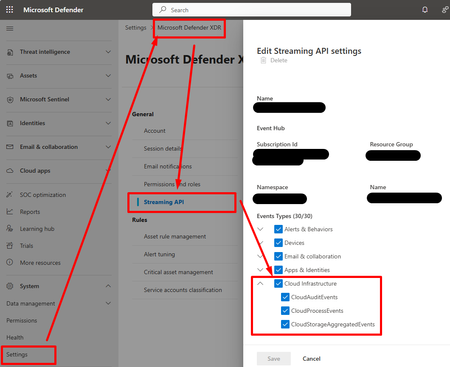
Hi, I create this threat hoping that the Microsoft team will read and hopefully provide insights about future changes and roadmap. When SOC teams use a non-Microsoft SIEM/SOAR, they need to export logs from M365 and Azure, and send them to the third-party SIEM/SOAR solution. • For M365 logs, there is the M365XDR connector that allows exporting logs using an Event Hub. • For Azure logs, we used to configure diagnostics settings and send them to an Event Hub. This began to change with new features within Defender for Cloud (c.f. picture).: • Defender for Resource Manager now sends Azure Activity logs to M365XDR portal, and can be exported using M365XDR Streaming API • Defender for Storage now sends logs to M365XDR portal, and can be exported using M365XDR Streaming API (c.f. https://www.youtube.com/watch?v=Yraeks8c8hg&t=1s). This is great as it is easy to configure and doesn't interfere with infrastructure teams managing operational logs through diagnostic settings. I have two questions : • Is there any documentation about this? I didn't find any? • What can we expect in the future weeks, months regarding this native logs collection feature through various Defender for Cloud products? For example, can we expect Defender for SQL to send logs to M365XDR natively? Thanks for you support!101Views1like0CommentsMISRA support in Defender
I want to check for MISRA C code compliance. The idea is to check for MISRA C compliance when asking for a Pull Request. If the code fails on those checks, the PR will not be created. This way, we enforce MISRA compliance before integrating the code to the repository. I am not seeing MISRA in the list of standards under - Regulatory Compliance>>Subscriptions>> Security Po;iciesyogisrivastavaJun 10, 2025Microsoft84Views0likes0Comments


Tags
- cloud security101 Topics
- cloud security posture management39 Topics
- security36 Topics
- Azure Defender for Servers30 Topics
- microsoft defender for endpoint28 Topics
- azure27 Topics
- threat protection20 Topics
- vulnerabilities17 Topics
- best practices13 Topics
- security controls13 Topics