Why Enterprise AI’s Next Moat Isn’t the Model As frontier models become broadly available, competitive advantage is shifting from access to intelligence toward the context surrounding it. The next challenge for enterprise AI is not simply building smarter agents, but giving them the right understanding of the business.
A strange thing happens when enterprises upgrade their AI models. The model gets smarter. The benchmarks improve. The demos become more impressive. And sometimes, the business outcome barely moves.
The agent still asks questions the organization answered months ago. It recommends something policy doesn't allow. It treats a strategic customer like any other customer. It proposes an architecture your engineering team rejected six months ago. The problem isn't necessarily intelligence. It is ignorance of the business.
That distinction matters because the world's most capable models are becoming available to almost everyone. Your competitors can increasingly access the same frontier intelligence you can. What they cannot access is your customer history, operating knowledge, organizational memory or understanding of how decisions actually get made.
Models are becoming shared. Context remains proprietary. And that may be where the next enterprise AI advantage is built.
Intelligence Without Context is Surprisingly Ordinary
Consider a simple enterprise question: Can we offer this customer a larger discount?
A powerful model can reason about discounts. But answering that question properly may require the customer's lifetime value, current contract, payment history, margins and approval thresholds and perhaps a conversation yesterday in which the account executive learned that a competitor had entered the deal.
The model isn't missing intelligence. It is missing context.
Humans rarely make important decisions from one piece of information. We combine data, experience, relationships, history and situational awareness almost unconsciously. Agents need a version of the same capability.
That is why enterprise AI is moving from an era dominated by prompt engineering toward one increasingly shaped by context engineering. Satya Nadella recently described the emerging market simply as “a world of context engineering.”
Prompt engineering asks: What should I tell the model?
Context engineering asks the larger question: What does the model need to understand before it can act well?
That difference becomes critical as AI moves from answering questions to performing work.
The Enterprise Context Stack
In discussions about enterprise agents, “context” can easily become shorthand for giving a model access to more data. That definition is too narrow.
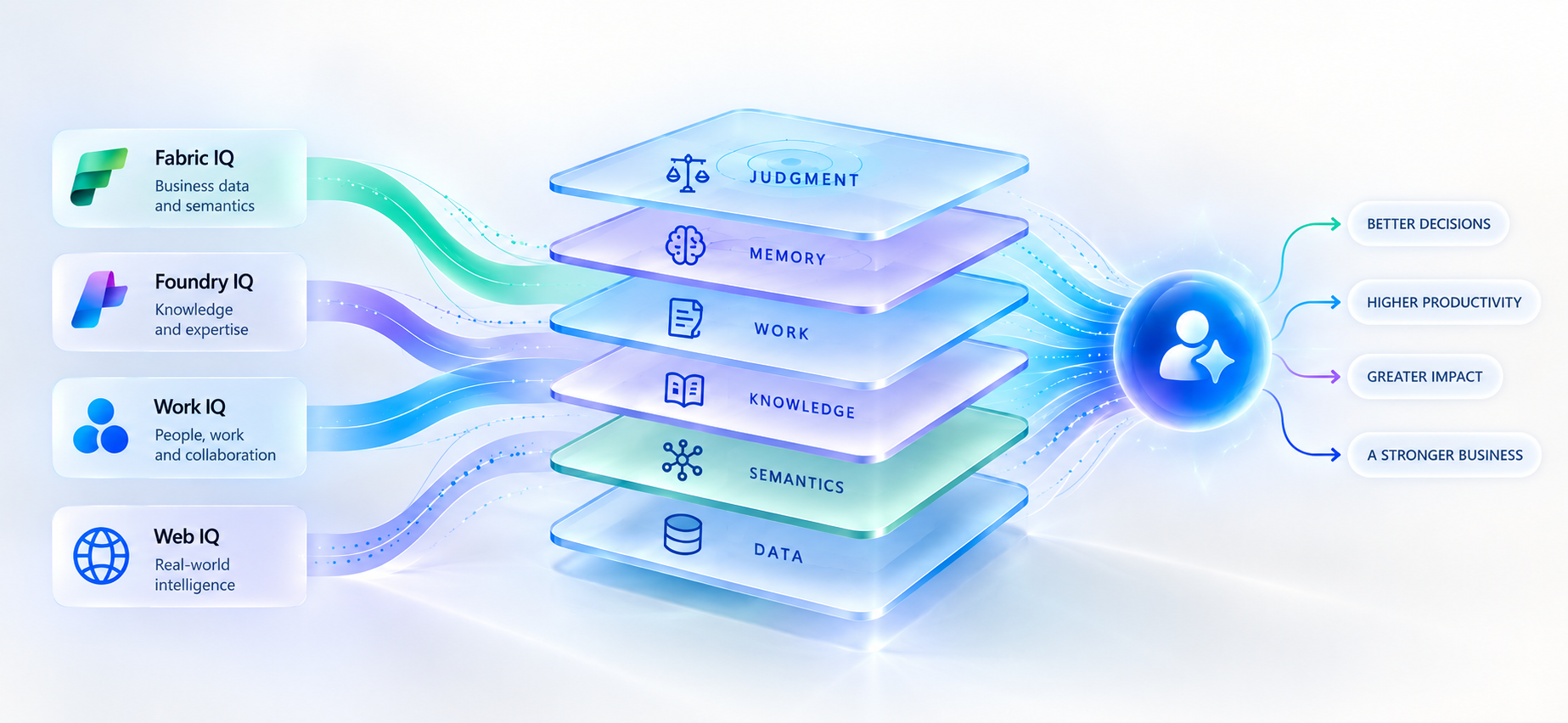
I think about enterprise context as a stack: DATA → SEMANTICS → KNOWLEDGE → WORK → MEMORY → JUDGMENT
Data tells the agent what happened: orders, transactions, inventory, claims and customer records.
Semantics tells it what that data means to the business: what constitutes a strategic customer, how margin is calculated, which assets belong to which production line.
Knowledge tells it what the organization knows: policies, contracts, procedures, research and accumulated expertise.
Work tells it what is happening now: who is involved, what has been discussed and which commitments already exist.
Memory tells it what happened before: previous interactions, decisions, exceptions and outcomes.
And judgment helps determine what should happen next.
Memory deserves particular attention because it is context agents can accumulate through experience. Microsoft Foundry now distinguishes between session, user and procedural memory - moving agents beyond remembering a conversation toward remembering preferences and learning how work gets done across repeated interactions.
Sometimes the cheapest way to make an agent meaningfully better may not be a bigger model. It may be a better memory.
Not every agent needs every layer. But the more consequential its responsibility, the richer, and more carefully governed, its context usually needs to become. This is where context stops being a retrieval problem and starts becoming an enterprise architecture problem.
Context Is Becoming Infrastructure
This shift is now visible well beyond any one technology platform. Gartner increasingly describes a context layer as an architectural foundation for agentic AI - bringing together semantics, operational state, provenance and other enterprise signals so agents can act reliably. Anthropic, approaching the problem from AI engineering, argues that context should be treated as a finite resource that must be carefully curated rather than simply expanded.
Microsoft's recent direction is particularly interesting through this lens.
Work IQ, Fabric IQ, Foundry IQ and Web IQ increasingly form a shared intelligence layer across Microsoft's stack.
Work IQ provides context about how work happens. Fabric IQ brings business semantics and relationships. Foundry IQ provides reusable enterprise knowledge and agentic retrieval. Web IQ extends that understanding with fresh external intelligence.
The architectural implication matters more than the product names. Instead of every new agent rebuilding connectors, retrieval logic, semantic definitions and permissions, context becomes reusable infrastructure from which many agents can reason.
Microsoft captured the shift particularly well: As agents become the new application model, context becomes critical infrastructure.
Your Data Estate Is Not Automatically Your AI Moat
For years, organizations have been told their data is a competitive advantage. Sometimes it is.
But possessing data and making that data useful to an agent are very different things. Most enterprises don't suffer from a shortage of information. They suffer from an abundance of it -scattered across databases, documents, emails, meetings, applications and people's heads. The advantage doesn't come from connecting an agent to all of it.
It comes from turning information into usable context: preserving business meaning, understanding relationships, distinguishing authoritative knowledge from convenient information, respecting permissions and retrieving what matters when a decision is being made.
The enterprise with the most data may not build the best AI. The enterprise that makes its context most usable might.
The Context Budget
There is a trap on the other side too. If context improves AI, the natural instinct is to give the agent as much as possible. That is the wrong objective.
Context consumes attention and compute. Irrelevant information creates noise. Stale information can mislead. Conflicting context can degrade reasoning rather than improve it.
The objective should therefore not be maximum context. It should be minimum sufficient context the smallest trusted, relevant and permission-aware set of information required to produce the right outcome.
In Beyond Tokens, I introduced the idea of an Intelligence Budget: How much intelligence does this outcome deserve?
Enterprise agents increasingly need a companion concept. The Context Budget. How much context does this decision deserve?
A scheduling agent may need calendars and preferences. A pricing agent may need customer economics, margins, commitments and approval policies. A clinical agent requires an entirely different level of completeness, provenance and governance. Every unnecessary token of context is cost. Every missing piece of necessary context is risk.
Which gives us a useful way to think about enterprise agents: Right Intelligence × Right Context → Right Outcome
Spend more intelligence where the outcome warrants it. Provide more context where the decision requires it. Do neither indiscriminately.
What An Agent May Know Matters Too!
There is another dimension to the Context Budget: permissions.
Enterprise context belongs to someone. A system that retrieves the right answer but ignores whether the agent is entitled to see it isn't intelligent. It is a security problem.
Enterprise context must therefore remain identity-aware and permission-aware as it moves from source systems into agent reasoning. This becomes especially important as agents gain persistent identities and greater autonomy.
What an agent may know is as much a part of its job description as what it may do.
Autonomy defines the boundary of action. Context defines the boundary of understanding.
From RAG Projects To Context Architecture
The first generation of enterprise GenAI often started with RAG: connect documents to a model and retrieve relevant passages. That was an important step. But an agentic enterprise cannot become a collection of hundreds of independent RAG pipelines, each separately rediscovering the organization's customers, products, policies, terminology and permissions. That risks creating another generation of technology fragmentation.
The opportunity is to move from agent-specific retrieval toward reusable enterprise context.
What knowledge should agents inherit? Which business entities should have common definitions? Which sources are authoritative? Which memories should persist—and which should be forgotten?
And perhaps the hardest question: Who owns enterprise context?
Today, responsibility is scattered across data teams, application teams, knowledge management, security, business functions and increasingly AI teams. In an agentic enterprise, context may need to be managed as a product, not everyone's side project.
The Moat Is Not The Model
Imagine two competing organizations using exactly the same frontier model. One connects it to fragmented documents and a handful of applications. The other has strong data foundations, shared business semantics, governed knowledge, connected workflows and organizational memory. They have access to the same AI. They do not have the same intelligence system.
The second organization's agents understand customers more deeply, interpret signals more accurately and act with greater awareness of how the organization actually works. And that advantage compounds. Every workflow creates more context. Every interaction adds organizational memory. Every decision creates another signal from which future agents can reason.
Models depreciate the moment a better one ships. Context appreciates every day you operate.
That may be the most important strategic shift of all. Anyone can rent intelligence. No one can rent your context.
Intelligence Is Becoming Abundant. Understanding Isn't.
The first wave of enterprise AI taught us how powerful models could be. The next may teach us that models were only one part of the equation.
An agent needs intelligence to reason. But it needs context to understand your business.
As frontier intelligence becomes more accessible, enterprises may discover that their most defensible AI asset was never the model. It was everything the organization had learned before the model arrived: its data, semantics, knowledge, relationships, history, workflows and judgment. The organizations that turn those assets into trusted, reusable context will give every agent they build an advantage from day one.
So perhaps the strategic question is no longer simply: Which model should we use?
It is: What does our organization know that our competitors don't and can our AI actually use it?
Because in a world where everyone can access intelligence, context may be what makes that intelligence uniquely yours.
References
Microsoft — FY2026 Q2 Earnings Conference Call
Microsoft — FY2026 Q4 Earnings Conference Call
Microsoft Learn — What is Foundry IQ?
Microsoft Foundry — What's New in Microsoft Foundry | Build 2026
Gartner — Context Engineering Is the New Prompt Engineering
Gartner — Market Overview for AI Context Platforms
Gartner — The 3 Core Components of the Context Layer for AI Agents
