fabric
10 TopicsThe Context Advantage
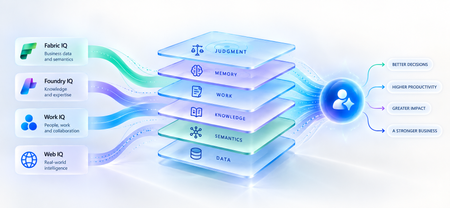
A strange thing happens when enterprises upgrade their AI models. The model gets smarter. The benchmarks improve. The demos become more impressive. And sometimes, the business outcome barely moves. The agent still asks questions the organization answered months ago. It recommends something policy doesn't allow. It treats a strategic customer like any other customer. It proposes an architecture your engineering team rejected six months ago. The problem isn't necessarily intelligence. It is ignorance of the business. That distinction matters because the world's most capable models are becoming available to almost everyone. Your competitors can increasingly access the same frontier intelligence you can. What they cannot access is your customer history, operating knowledge, organizational memory or understanding of how decisions actually get made. Models are becoming shared. Context remains proprietary. And that may be where the next enterprise AI advantage is built. Intelligence Without Context is Surprisingly Ordinary Consider a simple enterprise question: Can we offer this customer a larger discount? A powerful model can reason about discounts. But answering that question properly may require the customer's lifetime value, current contract, payment history, margins and approval thresholds and perhaps a conversation yesterday in which the account executive learned that a competitor had entered the deal. The model isn't missing intelligence. It is missing context. Humans rarely make important decisions from one piece of information. We combine data, experience, relationships, history and situational awareness almost unconsciously. Agents need a version of the same capability. That is why enterprise AI is moving from an era dominated by prompt engineering toward one increasingly shaped by context engineering. Satya Nadella recently described the emerging market simply as “a world of context engineering.” Prompt engineering asks: What should I tell the model? Context engineering asks the larger question: What does the model need to understand before it can act well? That difference becomes critical as AI moves from answering questions to performing work. The Enterprise Context Stack In discussions about enterprise agents, “context” can easily become shorthand for giving a model access to more data. That definition is too narrow. I think about enterprise context as a stack: DATA → SEMANTICS → KNOWLEDGE → WORK → MEMORY → JUDGMENT Data tells the agent what happened: orders, transactions, inventory, claims and customer records. Semantics tells it what that data means to the business: what constitutes a strategic customer, how margin is calculated, which assets belong to which production line. Knowledge tells it what the organization knows: policies, contracts, procedures, research and accumulated expertise. Work tells it what is happening now: who is involved, what has been discussed and which commitments already exist. Memory tells it what happened before: previous interactions, decisions, exceptions and outcomes. And judgment helps determine what should happen next. Memory deserves particular attention because it is context agents can accumulate through experience. Microsoft Foundry now distinguishes between session, user and procedural memory - moving agents beyond remembering a conversation toward remembering preferences and learning how work gets done across repeated interactions. Sometimes the cheapest way to make an agent meaningfully better may not be a bigger model. It may be a better memory. Not every agent needs every layer. But the more consequential its responsibility, the richer, and more carefully governed, its context usually needs to become. This is where context stops being a retrieval problem and starts becoming an enterprise architecture problem. Context Is Becoming Infrastructure This shift is now visible well beyond any one technology platform. Gartner increasingly describes a context layer as an architectural foundation for agentic AI - bringing together semantics, operational state, provenance and other enterprise signals so agents can act reliably. Anthropic, approaching the problem from AI engineering, argues that context should be treated as a finite resource that must be carefully curated rather than simply expanded. Microsoft's recent direction is particularly interesting through this lens. Work IQ, Fabric IQ, Foundry IQ and Web IQ increasingly form a shared intelligence layer across Microsoft's stack. Work IQ provides context about how work happens. Fabric IQ brings business semantics and relationships. Foundry IQ provides reusable enterprise knowledge and agentic retrieval. Web IQ extends that understanding with fresh external intelligence. The architectural implication matters more than the product names. Instead of every new agent rebuilding connectors, retrieval logic, semantic definitions and permissions, context becomes reusable infrastructure from which many agents can reason. Microsoft captured the shift particularly well: As agents become the new application model, context becomes critical infrastructure. Your Data Estate Is Not Automatically Your AI Moat For years, organizations have been told their data is a competitive advantage. Sometimes it is. But possessing data and making that data useful to an agent are very different things. Most enterprises don't suffer from a shortage of information. They suffer from an abundance of it -scattered across databases, documents, emails, meetings, applications and people's heads. The advantage doesn't come from connecting an agent to all of it. It comes from turning information into usable context: preserving business meaning, understanding relationships, distinguishing authoritative knowledge from convenient information, respecting permissions and retrieving what matters when a decision is being made. The enterprise with the most data may not build the best AI. The enterprise that makes its context most usable might. The Context Budget There is a trap on the other side too. If context improves AI, the natural instinct is to give the agent as much as possible. That is the wrong objective. Context consumes attention and compute. Irrelevant information creates noise. Stale information can mislead. Conflicting context can degrade reasoning rather than improve it. The objective should therefore not be maximum context. It should be minimum sufficient context the smallest trusted, relevant and permission-aware set of information required to produce the right outcome. In Beyond Tokens, I introduced the idea of an Intelligence Budget: How much intelligence does this outcome deserve? Enterprise agents increasingly need a companion concept. The Context Budget. How much context does this decision deserve? A scheduling agent may need calendars and preferences. A pricing agent may need customer economics, margins, commitments and approval policies. A clinical agent requires an entirely different level of completeness, provenance and governance. Every unnecessary token of context is cost. Every missing piece of necessary context is risk. Which gives us a useful way to think about enterprise agents: Right Intelligence × Right Context → Right Outcome Spend more intelligence where the outcome warrants it. Provide more context where the decision requires it. Do neither indiscriminately. What An Agent May Know Matters Too! There is another dimension to the Context Budget: permissions. Enterprise context belongs to someone. A system that retrieves the right answer but ignores whether the agent is entitled to see it isn't intelligent. It is a security problem. Enterprise context must therefore remain identity-aware and permission-aware as it moves from source systems into agent reasoning. This becomes especially important as agents gain persistent identities and greater autonomy. What an agent may know is as much a part of its job description as what it may do. Autonomy defines the boundary of action. Context defines the boundary of understanding. From RAG Projects To Context Architecture The first generation of enterprise GenAI often started with RAG: connect documents to a model and retrieve relevant passages. That was an important step. But an agentic enterprise cannot become a collection of hundreds of independent RAG pipelines, each separately rediscovering the organization's customers, products, policies, terminology and permissions. That risks creating another generation of technology fragmentation. The opportunity is to move from agent-specific retrieval toward reusable enterprise context. What knowledge should agents inherit? Which business entities should have common definitions? Which sources are authoritative? Which memories should persist—and which should be forgotten? And perhaps the hardest question: Who owns enterprise context? Today, responsibility is scattered across data teams, application teams, knowledge management, security, business functions and increasingly AI teams. In an agentic enterprise, context may need to be managed as a product, not everyone's side project. The Moat Is Not The Model Imagine two competing organizations using exactly the same frontier model. One connects it to fragmented documents and a handful of applications. The other has strong data foundations, shared business semantics, governed knowledge, connected workflows and organizational memory. They have access to the same AI. They do not have the same intelligence system. The second organization's agents understand customers more deeply, interpret signals more accurately and act with greater awareness of how the organization actually works. And that advantage compounds. Every workflow creates more context. Every interaction adds organizational memory. Every decision creates another signal from which future agents can reason. Models depreciate the moment a better one ships. Context appreciates every day you operate. That may be the most important strategic shift of all. Anyone can rent intelligence. No one can rent your context. Intelligence Is Becoming Abundant. Understanding Isn't. The first wave of enterprise AI taught us how powerful models could be. The next may teach us that models were only one part of the equation. An agent needs intelligence to reason. But it needs context to understand your business. As frontier intelligence becomes more accessible, enterprises may discover that their most defensible AI asset was never the model. It was everything the organization had learned before the model arrived: its data, semantics, knowledge, relationships, history, workflows and judgment. The organizations that turn those assets into trusted, reusable context will give every agent they build an advantage from day one. So perhaps the strategic question is no longer simply: Which model should we use? It is: What does our organization know that our competitors don't and can our AI actually use it? Because in a world where everyone can access intelligence, context may be what makes that intelligence uniquely yours. References Microsoft — FY2026 Q2 Earnings Conference Call Microsoft — FY2026 Q4 Earnings Conference Call Microsoft Learn — What is Foundry IQ? Microsoft Foundry — Foundry IQ: Build Smarter Agents Faster with Unified Knowledge and Serverless Retrieval Microsoft Foundry — What's New in Microsoft Foundry | Build 2026 Gartner — Context Engineering Is the New Prompt Engineering Gartner — Market Overview for AI Context Platforms Gartner — The 3 Core Components of the Context Layer for AI Agents40Views0likes1CommentPartner Case Study | Prescan
Today, preventive healthcare plays an increasingly important role in helping people live longer, healthier lives. But as demand grows, clinics and providers face a difficult challenge: how to scale and coordinate their services while tracking complex data like patient and financial information, scheduling, and clinical outcomes. These are often recorded in different systems, and stitching them together into a single source of truth is no small feat. All too often, healthcare providers are held back by limited access to reliable, real-time insights. In sectors where precision and trust are everything, organizations need a partner who understands the nuances of regulated, data-heavy environments. With more than 30 years of experience developing business-critical IT solutions, Conclusion specializes in building bespoke, data-driven applications for sectors where reliability, auditability, and security are nonnegotiable. As a Microsoft partner for more than a decade, Conclusion’s deep expertise in cloud migration, semantic modeling, and data intelligence makes them a trusted advisor for organizations across Europe in healthcare, logistics, government, and beyond. When Prescan, a market leader in preventive medical diagnostics in the Netherlands, wanted to build a future-proof data platform, Conclusion was the logical partner to help make it happen. Prescan’s growing demand for intelligent insights Since 2003, Prescan has pioneered preventive health diagnostics, giving individuals and corporate clients early insights into their health. With multiple clinics and offices, the company guides patients through every step of the journey, from orientation and preparation to the day of examination and into aftercare. Their mission is to empower people with early insights into their health through high-quality, accessible medical examinations. While their mission is straightforward, their operations are complex. Prescan used a number of systems to manage business operations and stages of the patient journey. These systems operated largely in silos, making it difficult to combine information into a clear, unified picture of business performance and patient journeys. Prescan saw an opportunity to take their operations to the next level. By connecting insights into performance, capacity, and patient flows, they could move beyond siloed views and gain holistic insights to guide strategy, accelerate decision-making, and simplify planning. Recognizing the need for a unified, secure, intelligent data environment—and knowing that they needed it quickly—Prescan turned to Conclusion for their engineering expertise and experience delivering critical Azure-based data solutions. Continue reading here Explore all case studies or submit your own Subscribe to case studies tag to follow all new case study posts. Don't forget to follow this blog to receive email notifications of new stories!101Views1like0Comments
Unleashing New Business Opportunities for Microsoft Partners with PostgreSQL & MySQL on Azure
The latest innovations announced at Microsoft Ignite 2025 for PostgreSQL and MySQL running on Azure are more than just technical upgrades—they’re a launchpad for new business growth, deeper customer engagement, and accelerated digital transformation. Here’s how these advancements can help you deliver greater value and unlock new opportunities for your clients. 1. Introducing Azure HorizonDB: Built for Performance and AI Workloads We’re excited to unveil Azure HorizonDB in private preview—a new, fully managed PostgreSQL service engineered for business and developers alike. HorizonDB is designed for ultra-low latency, high read scale, and built-in AI capabilities, offering seamless scaling up to 192 virtual cores and 128 TB of storage. Deep integration with developer tools, including GitHub Copilot, delivers performance, resilience, and simplicity at any scale. With HorizonDB, teams can: Build AI apps at scale using advanced DiskANN vector indexing, pre-provisioned AI models, semantic search, and unified support for both relational and graph data. Accelerate app development with built-in extensions, including the PostgreSQL extension for Visual Studio Code integrated with GitHub Copilot. Copilot in VS Code is context-aware for PostgreSQL and enables one-click performance debugging. Unlock data insights through deep integrations with Microsoft Fabric and Microsoft Foundry. Expect reliability with enterprise-ready features from day one, including Entra ID integration, Private Link networking, and Azure Defender for Cloud. Business Opportunity: Position your practice as an early adopter and expert in next-generation database solutions. Position your practice as an early adopter and expert in next-generation database solutions by introducing customers to Azure HorizonDB. Use this conversation to offer migration, modernization, and AI-powered application development services leveraging Azure Database for PostgreSQL with future migrations to HorizonDB. Help clients build resilient, high-performance, and intelligent data platforms—driving new revenue streams and deeper customer engagement. 2. Modernize Data Infrastructure with Limitless Scale and Performance Azure’s new Elastic Clusters in Azure Database for PostgreSQL enable organizations to scale their databases horizontally across multiple nodes, supporting virtually unlimited throughput and storage. This means you can help clients build and grow multi-tenant SaaS applications and large-scale analytics solutions without the complexity of manual sharding or the limitations of legacy infrastructure. Azure’s managed service automates shard management, tenant isolation, and cross-node query coordination, freeing up your teams to focus on innovation instead of administration. Business Opportunity: Position your practice as the go-to partner for scalable, future-proof data platforms. Offer migration services, architecture consulting, and managed solutions that leverage Azure’s unique scale-out capabilities. 3. Accelerate Innovation with AI-Ready Databases Azure is leading the way in AI integration for open-source databases. With the PostgreSQL extension for Visual Studio Code and native Microsoft Foundry support, developers can build smarter apps and AI agents leveraging advanced AI capabilities directly in the database. Features like natural language querying, vector search, and seamless Copilot integration mean your clients can unlock new insights and automate processes faster than ever. Business Opportunity: Expand your offerings to include AI-powered analytics, intelligent agent development, and custom Copilot solutions. Help organizations harness their data for real-time decision-making and enhanced customer experiences. 4. Simplify and Accelerate Migrations from Legacy Systems The new AI-assisted Oracle to PostgreSQL migration tool dramatically reduces the effort and risk of moving off expensive, proprietary databases. Integrated into the PostgreSQL extension for VS Code, it automates schema and code conversion, provides inline AI explanations, and ensures secure, context-aware migrations. Business Opportunity: Lead migration projects that deliver rapid ROI. Offer assessment, planning, and execution services to help clients escape legacy costs and embrace open-source flexibility on Azure. 5. Enable Seamless Analytics and Real-Time Insights With support for Parquet in the Azure storage extension for PostgreSQL and Fabric zero-ETL mirroring for Azure Database for MySQL and Azure Database for PostgreSQL, Azure is bridging operational databases and analytics platforms. Business Opportunity: Build solutions that unify data estates, streamline analytics workflows, and deliver actionable intelligence. Position your team as experts in data integration and real-time analytics. 6. Drive Industry-Specific Transformation Ignite 2025 showcases real-world success stories from industries like healthcare (Apollo Hospitals), automotive (GM), and finance (Nasdaq), demonstrating how Azure’s open-source databases power resilient, scalable, and AI-driven solutions. Business Opportunity: Use these case studies to inspire clients in regulated or complex sectors. Offer tailored solutions that meet strict compliance, security, and performance requirements. Why Partners Win with Azure’s Latest Innovations Faster time-to-value: Help clients adopt the latest tech with minimal downtime and risk. Expanded service portfolio: From migration to AI, analytics to managed services, the new capabilities open doors to new revenue streams. Trusted platform: Azure’s enterprise-grade security, compliance, and high availability mean you can deliver solutions with confidence. Ready to help your customers achieve more? Dive deeper into the Ignite 2025 announcements and start building the next generation of intelligent, scalable, and AI-powered solutions on Microsoft Azure. Learn more here: https://ignite.microsoft.com/en-US/home333Views2likes0CommentsPartner Blog | Microsoft & Oracle: The future of enterprise cloud data for partners
In today’s fast-changing cloud and AI landscape, our partnership with Oracle represents the power of collaboration to drive customer transformation at scale. Microsoft and Oracle share a common goal: to enable organizations to modernize their data estates, accelerate AI innovation, and deliver measurable business outcomes. Oracle Database@Azure brings this vision to life by combining the best of both platforms and putting our partners at the center of that transformation. Announcements from Oracle AI World At Oracle AI World, we introduced a new set of advancements that expand what’s possible for our customers and partners. Azure Accelerate, within the Microsoft AI Cloud Partner Program, support now includes Oracle Database@Azure workloads, offering partners funding, credits, and the Cloud Accelerate Factory for zero-cost deployment assistance. This allows partners to move customers to Azure faster, reduce migration risks, and increase delivery speed. Partners will also be able to resell Oracle Database@Azure directly through Microsoft Marketplace, making it easier to package, license, and deploy solutions globally while building new revenue streams. The platform itself also continues to evolve quickly. Oracle Database@Azure now supports Oracle Base Database Service, Exadata Exascale 19c, and Oracle Database 23ai across more than 28+ regions worldwide, enabling a broad multicloud hyperscaler reach. Native Oracle GoldenGate integration with Oracle Database@Azure now connects directly to Microsoft Fabric, making it easier to unify data across systems, reduce latency, and activate AI and analytics at scale. Partners can also use Copilot Studio and Azure AI Foundry to create and deploy custom agents and low-code AI solutions powered by more than 1,900 models. Security and operations are integrated across Microsoft Defender, Sentinel, and Entra ID, giving customers AI-driven threat detection, real-time monitoring, and unified identity management. Azure Arc integration adds full visibility, policy management, and automation across hybrid and multicloud environments, allowing partners to deliver consistent governance from a single control plane. The partnership between Microsoft and Oracle builds on years of co-engineering, centered on helping customers modernize mission-critical workloads without compromise. Together, we’ve brought Oracle Exadata infrastructure directly into Azure datacenters, unifying Microsoft and Oracle ecosystems through shared networking, identity, and governance. The result is a seamless cloud experience that combines Azure’s scalability and security with Oracle’s trusted database performance. Continue reading here!295Views1like0CommentsPartner Case Study | Persistent
In asset-heavy industries like manufacturing, maintenance, and on-site equipment inspection, fragmented data is a common issue. As employees across different functions feed data into multiple systems, the challenges can multiply. Disparate systems, inconsistent data formats, and siloed business units make it difficult for leaders to see the full picture, potentially leading to inefficient decisions and missed opportunities for revenue growth. This is the kind of challenge Persistent Systems was made for. As a global Microsoft Solutions Partner across every solution area and a Tier 1 Cloud Solution Provider (CSP) partner, Persistent uses their deep expertise in data modernization and engineering to break down silos, unify disparate systems, and deliver the kind of real-time insights that drive operational innovation and optimization. For one of Persistent’s customers—a market leader in industrial tank design, manufacturing, and inspection—that unified data architecture brought together multiple major business verticals. As an organization, they provide their clients with a better way to store their products; in turn, Persistent helped them discover a better way to store and unleash the power of their data. Better data storage for the energy storers With nearly 50 years in the industry and a presence around the world, the customer’s operations span manufacturing, inspection, and maintenance, and they offer a suite of products and services ranging from chemical, energy, and water tank storage to fabrication and repair. In other words, they collect a trove of data. Over the customer’s long history, though, different team members and segments of the enterprise began inputting data into different formats, models, and reporting tools. While the customer was already a Microsoft shop––relying on solutions like Microsoft Dynamics 365, Excel, and SharePoint––the siloed departments and disparate systems resulted in a patchwork of information scattered across the organization, residing in places like Microsoft Azure and Salesforce. Because of this, the team’s data pipelines were often disconnected or ran into bottlenecks that prevented team members from innovating efficiently. Leaders strove to find a way to gain a unified view of operations and use their data more effectively to, for instance, anticipate maintenance needs or respond quickly to new opportunities. And they had a concrete, ambitious goal of recovering the 10–15% of total revenue they suspected was being lost. Continue reading here Join our Fabric discussion board to stay up to date on announcements! Explore all case studies or submit your own Subscribe to case studies tag to follow all new case study posts. Don't forget to follow this blog to receive email notifications of new posts!103Views0likes0CommentsData, AI, and Opportunity: Why Microsoft Partners Should Attend the Microsoft Fabric Community Conference 2025
The Microsoft Fabric Community Conference (FabCon) is happening September 15–18, 2025, at the Austria Center in beautiful Vienna. If you're a Microsoft partner, this is a key opportunity to participate in one of the most important events in data and AI strategy. Whether you're leading solution execution or developing apps, Fabric presents a powerful unified data platform for AI transformation—and this conference is where you'll learn how to capitalize on it. Purchase a 4-day pass including our Partner Day on September 15 to learn how Microsoft partners play a central role in bringing Fabric to life for our customers, and get access to the use cases, tools, and co-sell opportunities you need to succeed. Fabric: A unified platform, built for the future Microsoft Fabric is a fully integrated data and analytics platform that brings together tools like Power BI, Azure databases, Data Factory, OneLake, and third-party apps under one umbrella. It's built to break down silos, accelerate insight, and support modern AI-driven applications—all within a single, end-to-end environment. For partners, this isn’t just a product—it’s a growth engine. Fabric enables you to expand your data offerings, connect disparate data sources, and deliver more strategic, high-impact solutions across industries. This event is your front-row seat to learn, explore, and build your Fabric advantage. Continue reading here Don't forget to follow our Fabric community discussion board for all upcoming announcements!199Views0likes0CommentsPartner Case Study | Adastra
Rapid expansion introduces new layers of complexity for any business, especially when high customer standards remain a top priority. Between 2022 and 2024, Heritage Grocers Group did just that thanks to several strategic acquisitions. Operating in six states and specializing in catering to Hispanic communities under banners such as Los Altos Ranch Market, Cardenas Markets, El Rancho Supermercado, and Tony’s Fresh Market, the company found itself growing fast. With this growth, however, came the need for a scalable, robust way to manage and analyze vast amounts of data—one that could account for the unique purchasing preferences of diverse communities and geographic locations while maintaining high data consistency and availability. Enter Adastra, a data analytics and IT consulting company and Microsoft partner with a proven track record in analytics, business intelligence, AI, and process automation. With specializations across Data & AI, Infrastructure, and Digital & App Innovation and a 2024 Partner of the Year Award for Data & AI (Americas), Adastra was uniquely positioned to help Heritage Grocers Group overcome their data challenges. Together, they embarked on a journey to transform how the group collects, organizes, and analyzes data, leveraging cutting-edge technologies like Microsoft Fabric and Azure OpenAI Service. Maintaining high standards of quality while expanding operations To maintain high quality standards and customer satisfaction across various geographic locations and customer segments throughout the acquisition process, Heritage Grocers Group recognized the need to better understand their customer data. With each newly acquired banner came large swaths of point-of-sale (POS) data from various enterprise resource planning (ERP) systems across their portfolio—and, with each banner catering to slightly different clientele and running its own reports with no standardized models or definitions, Heritage Grocers Group recognized the need for a solution that could gather, organize, and analyze vast amounts of POS data across a wide portfolio and ultimately unify their data estate and ability to generate predictive analytics. Prabash Coswatte, Chief Operating Officer of Heritage Grocers Group, said, “Understanding the unique purchasing preferences of the Texas customer compared to those of Tony’s in Chicago is crucial. The quicker we grasp this, the better we can cater to each community’s needs.” After being introduced at an event co-hosted by Microsoft, Heritage engaged Adastra to develop a scalable solution that would effectively organize large amounts of data with high availability and consistent, high-fidelity results that could process years of historical data and scale and flex with any future changes. Adding to the complexity was the timeline—Heritage recognized that while a regular engagement of this size could take a year to 18 months, they needed to get it done in six months—and the sheer volume of data, which was in the terabytes. Continue reading here Explore all case studies or submit your own Subscribe to case studies tag to follow all new case study posts. Don't forget to follow this blog to receive email notifications of new stories! Join us at the next FabCon Community Conference, register today!115Views0likes0CommentsPartner Blog | Microsoft Fabric Community Conference: Partnering for success
The Microsoft Fabric Community Conference (FabCon) 2025 wrapped up earlier this month, but the momentum continues. With over 6,200 attendees—double the previous year—this year’s event brought together customers, community members, and solution and software partners for an exciting week of innovation. To dive deeper into announcements and product news, check out the Microsoft Fabric blog. We were thrilled to welcome 360 partners to our Partner Pre-Day. If you couldn’t attend, here is a look at the key opportunity ahead—and how Microsoft can help you grow with Fabric. Generative AI adoption is accelerating. According to IDC’s 2024 AI opportunity study: Top five AI trends to watch, more organizations plan to build industry-specific AI solutions in the next two years. This translates to increased investment—and big opportunities for partners. Another IDC study on partner profitability with Microsoft AI shows that for every $1 of Microsoft revenue, service-led partners earn $8.45 and software-led partners generate $10.93. Partners using Microsoft AI are seeing faster growth and stronger profitability. Simplifying AI innovation AI innovation can be complex. Whether you are building with Microsoft Azure AI Foundry, Microsoft Copilot Studio, GitHub, Microsoft Visual Studio, or Fabric, we offer integrated tools to help you deliver faster. But AI runs on data—and data quality remains a challenge. A recent MIT Technology Review Insights Report on Customizing Generative AI identified data integrity as one of the biggest barriers to AI development. Microsoft addresses this with capabilities across Fabric, Microsoft Azure Databricks, raw storage, databases, and app services. Fabric is a unified data analytics platform designed to help customers transform with AI and rethink how they manage and analyze data. Continue reading here Join the conversation in our Fabric partner community discussion board168Views0likes0CommentsPartner Case Study | Adastra
Heritage Grocers Group, a prominent figure in the retail sector, proudly operates across six states under the banners of Cardenas Markets, El Rancho Supermercado, Tony’s Fresh Market, and Los Altos Ranch Market. Specializing in catering to Hispanic communities, the group experienced rapid growth between 2022 and 2024, expanding its territory through strategic acquisitions. In an industry as dynamic and competitive as retail, meeting the diverse expectations of customers at each new location is paramount. “Understanding the unique purchasing preferences of the Texas customer compared to those of Tony’s in Chicago is crucial,” says Prabash Coswatte, Chief Operating Officer of Heritage Grocers Group. “The quicker we grasp this, the better we can cater to each community’s needs.” To more efficiently gather, organize, and analyze vast amounts of point-of-sale (POS) data from varied enterprise resource planning (ERP) systems across its numerous outlets, Heritage Grocers Group forged a partnership with Adastra, a renowned global IT consultancy and Microsoft partner. The companies developed a scalable, robust solution aimed at achieving data consistency, ensuring high availability, organizing the large amount of data, and creating a solid foundation for future expansion. By deploying a comprehensive data analytics and AI framework on Microsoft Fabric, Heritage Grocers Group has revolutionized its approach to data unification and analytics, demonstrating what’s possible in retail data management and customer service excellence. Continue reading here Follow our Fabric Partner discussion board to learn more about workshops and weekly engineering connection calls. Explore all case studies or submit your own Subscribe to case studies tag to follow all new case study posts.144Views0likes0Comments