word
117 Topics
Latest update of Word has changed my doc format. print layout not working
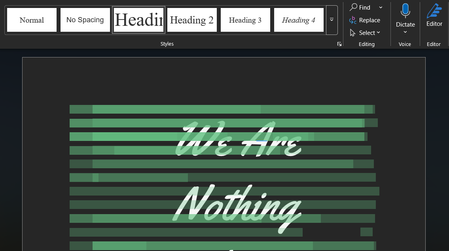
Latest update of Word has changed my doc format. first, print layout not working, i copied the text to new doc. session break-continous and justified paragraphs. inserting session breaks aligns the last line to left. using Shift+Enter justifies the paragraph but also adds a blank line after the paragraph. FYI i have composed a book in hindi language on with formatting and hyperlink. please support. screenshot of pdf shared80Views0likes2Comments
Word corruption
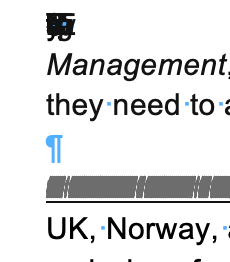
I am using Microsoft 365 on Mac running Tahoe 26.3.1. I downloaded a Google document from a client as a .docx Word document. This is something I do often. My client is also using a Mac. The Word document has corruptions in it, full lines of text are appearing as lines (like a barcode) and there seem to be letters and symbols stacked up on top of each other. Screenshots attached. I have tried saving as a .doc Word document but the corruptions are still there. If I select all of the text and change the font, the corruptions are still there. I copied the text into Text Edit and converted to plain text. The corruptions disappear in Text Edit but so does any text that was there, sentences are incomplete. If I copy and paste this plain text into a new Word document, the corruptions reappear. If I import the Plain Text into InDesign, the corruptions reappear. If I copy and paste the plain text into InDesign, the corruptions reappear. This strikes me as very odd because as far as I know Plain Text should remove any corruptions. My client says that they see no corruptions in the Word doc or in the Plain Text doc that they created. But when they send these docs in email, the corruptions are still there. I spent 4 hours with Microsoft Support yesterday trying to figure out the problem and when they couldn't figure it out, they just closed and left the chat.... I would love to let my client know what they can do to fix this on their end so that we can move forward with the project. Any suggestions are appreciated!135Views0likes4Comments
Word - Insert Key
Why doesn't the Insert key on the keyboard do anything? It's a key on the keyboard, make use of it! Most obviously, why doesn't pressing it make it change to overtype text. Why when in tables doesn't the insert key allow you to add rows to a table where you currently are? Today I found it very painful to add more than one row to a table. Even after an internet search I didn't find an easy way quickly. Surly making use of the insert key and pressing it once per new row would be the most easy? It works like this in MS Project.121Views0likes2CommentsFinding the recycling bin on Microsoft word
I have had to go on a wild goose chase, to be quite frank with you, for the recycling bin on word. I was about to lock in and have my “academic comeback”, as the bairns say on social media platforms such as TikTok and Instagram, and I was taken off my track to find this stupid recycling bin. I am still yet to find and it and I am very unhappy, not only was google no help but so was Microsoft. 1/ Micro out of 10. Very upset need I remind you. Those special documents are now swimming in the land of the meta, in the river of the Zuckerberg and I can’t do anything about it. Get with the programme Microsoft. sincerely, disappointed.152Views0likes2Comments
Just fix plural mothers in word, goodness this is offensive.
Apparently just asking this question required two hours of unpaid labor on my part, as well as running a fricking experiment for your guys. I just wanted to turn the rule off for this, but apparently you won't let me do this so please fix Word so it stops asking me for worse grammar. Because tech support sent me here, I already ran the experiments for you. Apparently you can have plural fathers, and parents, but not mothers, which is fricking great. Value judgements from word. The solutions make the grammar WORSE, and some people have more than one mother. It's not even cultural. Some people have a stepmother and a birth mother Persists in android as well: It's just fricking lame, and all I wanted was to be able to turn the rule causing this off as it was annoying for the project I was working on. Techsupport told me to come here, and if I am now your QA person I would like to be paid, thanks.82Views0likes1Comment
Word Mail Merge->PDF->Auto Name
I am trying to think of a way to automate a process. Part of this is in word and part with Adobe. Basically, here is the scenario. Every year all the staff in the company (about 350-400 employees) get evaluated and then their compensation is recalculated and an employment contract sent to them for the next year. The contract is in PDF form which they digitally sign and return to the company. Right now the process is like this: A spreadsheet is created with all the employee specific information. The spreadsheet data is merged with the standard employment agreement based on their title. The merge creates a different document for each employee which must then be saved (named with the employee name), converted to a PDF, and then a digital signature is requested via Adobe. I would like to automate this whole procedure. I would like to mail merge, save each document as a Word Doc and then a PDF under the employee's name. Once I have all of that, I would like to get PDF to send out all the documents via email (which will be in the spreadsheet too). I am a programmer so code does not scare me in the least. I am just not sure of the approach to take. Any thoughts? Thanks in advance.4.8KViews0likes3Comments
Word Document Disappeared During Copy/Paste
I experienced an unusual data-loss issue in Windows File Explorer. While copying and pasting a Microsoft Word document within the same folder on my D: drive, the original document suddenly disappeared and was not available in the Recycle Bin. A related Word temporary file (~wrl2248.tmp, 178 KB) was initially visible but subsequently disappeared as well. I restarted the computer, enabled hidden/system files, searched the drive, and checked Word recovery locations without success. I then used Microsoft Windows File Recovery in both Regular and Extensive modes. The document was recovered, but Word reported unreadable content and could not repair or open it. I would appreciate guidance on the cause and any further Microsoft-supported recovery options.271Views0likes3CommentsPLEASE HELP ME. Can't Get Formulas In Word To Work?
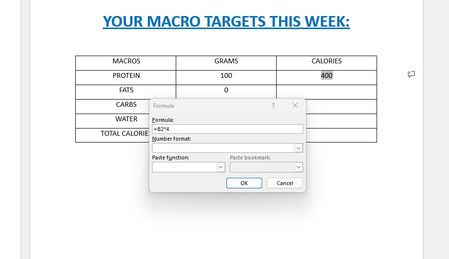
I know how to use formulas in EXCEL and I know WORD isn't EXCEL. But I'm trying to enter a very simple formula into a table in a WORD document to calculate simple macro-nutrients. The formula is very simple. Each gram of carbs is 4 calories. I'm just trying to enter a formula that automatically multiples the number of carbs by 4 so I don't have to manually do the math on my own every time. As you can see in my screenshot, I got it to work by entering (=B2*4). The problem is the formula doesn't stay there. It instantly vanishes once entered. So if I change the number of carbs from 100 which is 400 calories, to 200 which is 800 calories, the formula doesn't automatically update the total calories because the formula disappeared once entered. I just want to know if I can enter the formula in a way which causes it to permanently stay in the cell so it always updates the total calories whenever I change the number of carbs? Just like EXCEL always does? And how to do that? If it's not possible, that's okay. I will simply consider going back to EXCEL then.445Views0likes3CommentsWord Copilot attachments fail with NoTokenObtained
Word Copilot cannot read local or cloud attachments with my Microsoft account. Cloud file attachment opens OneDrive Picker but fails with NoTokenObtained, timeout, or “Sorry, something went wrong.” Local files are accepted but reported as empty/corrupted. The same files work correctly in Microsoft 365 Copilot Chat with the same account. The issue reproduces on different computers, different networks, new Edge profile, new Windows user, and Word for the web without Office desktop installed. Word Copilot can read the active document, so only the attachment pipeline appears broken. Correlation IDs: 49a92ea2-7068-2001-bf16-3cf7d0c388fd and b39b30a2-b012-f000-cf51-72bd844c5dea. Please escalate to Word Copilot / OneDrive File Picker / Microsoft 365 Copilot engineering.390Views0likes1Comment