transactable apps
59 TopicsWork IQ Cost and Pricing Model for Agents published in Marketplace
I would very much like to ask for assistance and input in regards of "Consumption, cost forecasting, break-even analysis and recommended customer pricing. " I believe a bit of context is required. We are about to publish two Work IQ MCP Agent in Marketplace. Both agents will be integrated to our existing Apps that are published in Marketplace. 1. iGlobe CRM for Teams and 2. iPlanner Pro for Outlook and Teams. Both Apps are multitenant Apps running on customers own tenant. The Apps can only be deployed from Marketplace. Lets use iPlanner Pro Agent as an example. In short, iPlanner Pro Agent uses Work IQ and MCP tools to understand emails, meetings and Microsoft 365 context, while iPlanner Pro turns that intelligence into structured Planner execution, including the appropriate plan, bucket, assignment, priority and supporting email context. Including saving the email or attachments on the task. A prompt could look like this "Find the latest email from email address removed for privacy reasons. Create a task for in Planner, put it in the correct Plan and bucket, assign it to the appropriate owner, set a due date for next week and save the email on the Planner Task" Work IQ and MCP provide context and intelligence, iPlanner Pro executes the structured actions, and Microsoft Planner remains the source of truth. To my understanding Work IQ API usage is billed through Copilot Credits rather than a separate per-user Work IQ license. Microsoft 365 Copilot includes Work IQ functionality within native Microsoft Copilot experiences, but third-party solutions such as iPlanner Pro consume Copilot Credits when they call Work IQ APIs. Work IQ does not require a separate API subscription, SKU or per-user licence. API usage is consumption-based and is measured in Copilot Credits. Work IQ operation Credit consumption Planning note Chat API Variable Depends on grounding, retrieval and reasoning complexity. Context API Variable Depends on the scenario and the sources used. Tool API 0.1 credit per API call Static component: $0.001 per call at $0.01 per credit. Example: 1,000 Tool API calls consume 100 credits, equivalent to $1.00 at the planning rate. Now here comes my confusion. 1. How do we know how many credits we are using with a prompt like the example I showed? the consumption is 0.1 credit per API call. 2. If I understand the above correct, the total consumption is calculated on the customer tenant. That consumption includes much more than just iPlanner Pro. Is that correct? 3. OR, will the sum of all customer using iPlanner Pro Agent be direct to us and we will be billed based on the total consumption of all our customers? If that is the case ( I don't think it is) then how do we know how much each customer consumed? 4. If consumption and billing is on the customer, how can the customer see what iPlanner Pro cost in consumed credits? This is important in regards of giving a cost forecast for customers. I am sure they would want that before start using the Agent. It is also important in regards of the question of if we should charge or offer it as a free agent? If we are billed then we will need to change for it. If the customer is billed then we probably will not be able to charge for it. I hope I have been able to explain my confusion. I tried asking contacts I have at Microsoft, but unfortunately haven't heard anything. That is why I am asking in the community. Have any one else the same challenge? what have you done? Can Microsoft assist here? I will be happy to take a Teams call and others are welcome to join. Thank you140Views0likes0Comments
Preview SaaS offer purchase fails at subscription creation
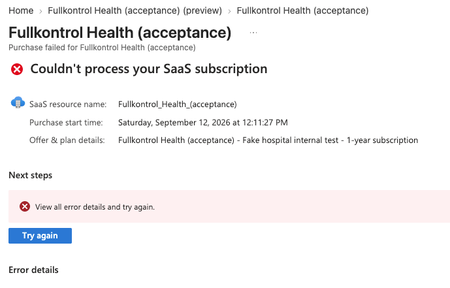
I'm publishing a transactable SaaS offer and testing the purchase flow in preview. Test purchases used to work, and then stopped working with no change on our side that would explain it. The purchase now fails at the final step: "Couldn't process your SaaS subscription" Earlier attempts also returned "400 Bad Request" from the marketplace SaaS service during checkout. Important: this offer previously accepted preview test purchases successfully. Several went through and created subscriptions. The same flow now fails every time, for no apparent reason and with no configuration change on our part. Setup: - Transactable SaaS offer, tested via the Azure portal preview link at the Publisher signoff stage. - Private test plan priced at $0, 1-year term, restricted to my own tenant. What I have already verified and ruled out: - The plan resolves and is selectable. The failure page even shows the correct plan name, so the preview audience and private-plan tenant restriction are working. The failure is at subscription creation, not plan visibility. - Buying subscription is Pay-As-You-Go, spending limit off, Enabled. - Microsoft.SaaS, Microsoft.Marketplace, and Microsoft.MarketplaceOrdering resource providers are all registered. - A valid payment method (credit card) is on the billing profile. - The buyer's market (country) is included in the plan's markets. - Azure Private Marketplace store exists but is disabled, so it is not blocking. - I republished the offer to regenerate a fresh preview link. Preview creation completed successfully. - It fails identically for the Azure account owner, not just a delegated tester. So purchases worked before, every setting I can find is still correct, and it now fails at Microsoft's subscription-creation step. Questions: 1. Has anyone had preview test purchases work and then suddenly start failing with "Couldn't process your SaaS subscription," and found the cause? 2. Is this a known platform-side issue? The republish-with-a-small-edit workaround did not help.Could Marketplace Become an AI Discovery Agent?
Today, customers still find apps in Marketplace by searching keywords or browsing categories. In a large catalog like the Marketplace, that often feels like guesswork. Publishers describe similar solutions differently, and customers rarely know the exact keywords to use. Many customers end up scrolling through listings, getting tired, and leaving. When that happens, we as publishers never get the chance to connect with them. What if Marketplace used AI to change that? Instead of searching, customers could simply describe what they need: “I need a time-tracking app that works natively in Microsoft 365 and Microsoft Teams, has light project management, follows our security policies, and keeps all company data inside our tenant in line with General Data Protection Regulation (GDPR).” An AI agent could instantly suggest the best matching apps and guide the customer directly to Get it now. And maybe the next step is even bigger: What if Marketplace became an agent or coworker for Microsoft Copilot, helping users discover and install the right apps simply by asking? Curious what others think—could this be the future of Marketplace discovery?What’s the best way to differentiate a SaaS offer from a Teams offer in Microsoft Marketplace?
Hey community! Our app is transactable, and we currently have two offers live in Marketplace: Saas and MS Teams offers. However, some of our customers find it confusing and aren’t sure which one they should choose. We also always prefer them chosing Saas so we can track everything via Partner center. What’s the recommended way to structure or differentiate the two offers so the choice is clear for customers? For example, should we use different naming, descriptions, or positioning for each offer? Would really appreciate any best practices or examples from others who have faced it!
Can Marketplace Become the Trusted Delivery Ecosystem for Specialized Microsoft Services?
Over the past several years, Azure Marketplace has become an increasingly important mechanism for connecting customers, partners, publishers, and Microsoft. As Marketplace adoption grows, I have been reflecting on one aspect of ecosystem collaboration. Many customer initiatives involve multiple organizations, each with different responsibilities, commercial models, onboarding requirements, and procurement processes. This raises an interesting question for the community: Can Azure Marketplace play a larger role in reducing operational friction between Marketplace participants who are already transacting through the platform? Potential outcomes could include: Faster customer project execution. Simpler cross-organizational collaboration. Greater adoption of Marketplace-transactable solutions. Reduced administrative overhead. Increased Marketplace transaction activity. From a Marketplace ecosystem perspective, reducing friction between participants may create value for customers, partners, publishers, and Microsoft alike. I would be interested in learning: Whether others have encountered similar challenges. Whether existing Marketplace capabilities already address this area. Which future improvements would have the greatest impact. Looking forward to hearing the community's perspective.168Views2likes0Comments
Microsoft Templates for Azure Application upload
Hi All, Are there ready to use templates for the documentation that Microsoft is requesting to upload for this offer type - such as Solution and Deployment Architecture, Customer Installation Guide, Customer Onboarding and Configuration Guide, Data Integration Guide. If yes, could someone share the links or the templates. Thank you!
GST/VAT in Microsoft-managed countries
Hi, I am in a Microsoft -managed jurisdiction and have a transactable offer in AppSource. I have only recently onboarded some customers and I don’t fully understand how GST is being managed. We are in Scenario 5 as described in https://learn.microsoft.com/en-us/partner-center/marketplace-offers/tax-details-marketplace which means Microsoft collects from the customer at the list price + GST. Ignoring store fees for this purpose, Microsoft pays the (10%) GST to the tax authority then pays out the balance. Unfortunately, the way GST works here, we have to show the amount we receive from Microsoft as gross revenue and then deduct a further 10% to pay to the tax authorities. In other words, we get no credit for the tax Microsoft has paid. As I understand it, the publisher should invoice Microsoft for the sale price + GST then Microsoft invoices the customer at the price plus GST and claims an input tax credit for the GST it pays to the publisher. There may be some specific tax ruling that overrides this. Would be very grateful if any ISV in a similar jurisdiction has encountered this issue.A cautionary tale if you have customers who use Coupa
We learned the very very very hard way that next-day Marketplace invoicing does NOT play nicely with Coupa. Here's what happened: Back in April, we closed a Marketplace transaction via private offer with one of our enterprise customers. Not a new customer, either - this was for a license extension with a current customer with which we'd transacted through Marketplace twice before. 30 days go by, and Partner Center still shows the invoice as 'uncollected.' 60 days go by, and Partner Center still shows the invoice as 'uncollected.' I open a ticket with Marketplace support. And kudos to them, they pick up my ticket within an hour. "Customer hasn't paid the invoice," they tell us. So now we are forced to take on the role of collections agency for a Microsoft invoice our customer hasn't paid and for which we don't know why they haven't paid. (Partner Center's Revenue reports are rather light on useful details.) Our buyer inside the customer also has no idea why the invoice wasn't paid: She sits far away from the folks who pay the Microsoft bills. Her colleague in IT who pushed the buttons to purchase the private offer likewise has no idea why the invoice wasn't paid: He too sits far away from accounts payable. We're baffled because never before have we had any delay in getting our payouts for this customer's Marketplace purchases. Our first thought is okay, maybe they now have custom net 60 payment terms with Microsoft. (A different issue we experienced on a different delayed payout back in January!) After ten days of intensive investigations involving nearly a dozen different people, we finally discover the source of the issue: The customer pays its Microsoft bills through Coupa, BUT: they did NOT know about nor integrate into Coupa workflow the (relatively new) next-day invoicing mechanism for Marketplace transactions. For their accounts payable team, if an invoice doesn't land in Coupa, it doesn't exist. The invoice for this Marketplace purchase was generated, but it got sent . . . nowhere, I guess? So in picking up my support ticket, Marketplace Support could only say "Customer hasn't paid the invoice." They probably had no way to know the correct response was "Customer hasn't received the invoice." Moral of the story: Ask your customers if they use Coupa. And if yes, prepare them for the possibility they might not receive the invoice for your software.How to navigate multi-currency private offers and optimize global deals in Microsoft Marketplace
Selling through Microsoft Marketplace increasingly means operating across regions, currencies, and complex billing scenarios and understanding how multi-currency private offers work is critical to successful deal execution. Multi-currency private offers enable partners to scale globally, but require a clear understanding of how FX rates, timing, and pricing conversions impact both customer costs and partner payouts throughout the transaction lifecycle. Gain practical insights into how pricing is set and converted, how timing influences outcomes, and how to structure deals more predictably across geographies. Learn how to confidently manage cross-border transactions, reduce risk from currency fluctuations, and strengthen your Microsoft Marketplace strategy for global growth. 👉 Read the full article Multi-currency private offers in Microsoft Marketplace: What partners need to know or watch the recent office hours session Multi‑currency private offers in Microsoft Marketplace60Views2likes0CommentsDiscover how Microsoft Marketplace can support your FinOps strategy and cost optimization goals
Learn how Microsoft Marketplace can help organizations streamline cloud procurement, optimize spend visibility, and simplify software purchasing through a FinOps-driven approach. This upcoming Microsoft Marketplace customer office hours session explores how partners and customers can leverage Marketplace capabilities to align cloud investments with business outcomes, improve operational efficiency, and maximize the value of Azure consumption commitments. Read the full event details and see why this session is valuable for organizations focused on cloud financial management, procurement modernization, and Marketplace growth strategies. 👉 Register Here: Microsoft Marketplace as a FinOps platform - Microsoft Marketplace customer office hours