sharepoint
1336 TopicsWhat to Do When SharePoint Search Doesn’t Return the Right Results
SharePoint search is one of the platform’s most powerful features—when it works as expected. But many organizations face a common frustration: search results that don’t seem accurate, complete, or relevant. If your users are struggling to find what they need, it can quickly undermine adoption and productivity. The good news? Most search issues can be diagnosed and fixed with the right approach. Here’s a practical guide to troubleshooting when SharePoint search isn’t returning the right results. https://dellenny.com/what-to-do-when-sharepoint-search-doesnt-return-the-right-results/253Views0likes1CommentHow to Index and Search SharePoint Online Custom Columns
SharePoint Online is basically a big Azure SQL application. Custom columns for sites and libraries enhance metadata and are even better if they’re properly indexed to become searchable. This article explores how even non-SharePoint administrators can create, index, and search custom columns. The key thing is to take your time. SharePoint cannot be rushed! https://office365itpros.com/2025/02/13/custom-columns-search/357Views0likes1CommentAutoSave disabled when opening SharePoint-synced files from Finder after macOS Tahoe 26.6 update
Files stored in SharePoint Online and synchronized locally through OneDrive are opened as local documents when launched from Finder. Office applications display "Saved to my Mac" and AutoSave is turned off by default. However, opening the exact same files through Word/Excel > Open > Sites, or via SharePoint "Open in Desktop App", correctly identifies them as cloud documents. In that scenario, AutoSave is enabled and collaboration/version history features work as expected. Troubleshooting already performed: OneDrive reset and re-linked SharePoint library re-synced Signed out and back into both Office and OneDrive Removed Microsoft credentials from macOS Keychain and re-authenticated Recreated local OneDrive sync relationships Verified OneDrive File Provider extensions are enabled Verified Office applications and OneDrive are fully up to date Tested with newly created files and existing files Tested "Always Keep on This Device" with no change in behavior The issue appears to be specific to the Finder-to-Office launch path after upgrading to macOS Tahoe 26.6. Before upgrading to macOS Tahoe 26.6, opening the same SharePoint-synchronized files directly from Finder correctly preserved cloud document identity and AutoSave was enabled as expected. I discussed this issue in detail with Apple Support, but they quickly dismissed it, saying that the problem is not on Apple's side and that I should contact Microsoft instead.4.1KViews13likes39CommentsTracking File-Level Archiving Activity in SharePoint Online with PowerShell
File-level archiving is now generally available and can be applied to files automatically, by users through the SharePoint browser UX, or via a Graph API. The big problem with Purview retention processing is its black box nature, so to discover how effective retention labels with an archiving step are, we use the Microsoft Graph PowerShell SDK to check the archiving status of files and report the results via email. All in a nice script, of course. https://office365itpros.com/2026/10/14/file-level-archiving-report/51Views0likes0Comments
SharePoint - Stop sharing - new behavior or new bug?
It used to be possible for a user with Contribute permission in a library to upload a file, share it, and the stop sharing it. The result of sharing the file would be that unique permisions then apply to the file. That is, it would no longer inherit permissions from its parent container. If the user then stopped sharing the file, permisisons would be reset and again inherit permissions. This behavior has very recently changed. The person with Contribute permission who shared it can no longer stop sharing it (the Stop sharing button is grayed out). Only someone with Full Control permission can stop sharing it, and if they do, permissions for all members are removed from the fiile except for the site owners group. A user reported this new behavior to me after accidentally sharing with the wrong person, and being unable to undo their mistake. Anyone else concur with my understanding of this being a new behavior?243Views0likes3CommentsI built a free, open-source M365 security assessment tool - looking for feedback
I work as an IT consultant, and a good chunk of my time is spent assessing Microsoft 365 environments for small and mid-sized businesses. Every engagement started the same way: connect to five different PowerShell modules, run dozens of commands across Entra ID, Exchange Online, Defender, SharePoint, and Teams, manually compare each setting against CIS benchmarks, then spend hours assembling everything into a report the client could actually read. The tools that automate this either cost thousands per year, require standing up Azure infrastructure just to run, or only cover one service area. I wanted something simpler: one command that connects, assesses, and produces a client-ready deliverable. So I built it. What M365 Assess does https://github.com/Daren9m/M365-Assess is a PowerShell-based security assessment tool that runs against a Microsoft 365 tenant and produces a comprehensive set of reports. Here is what you get from a single run: 57 automated security checks aligned to the CIS Microsoft 365 Foundations Benchmark v6.0.1, covering Entra ID, Exchange Online, Defender for Office 365, SharePoint Online, and Teams 12 compliance frameworks mapped simultaneously -- every finding is cross-referenced against NIST 800-53, NIST CSF 2.0, ISO 27001:2022, SOC 2, HIPAA, PCI DSS v4.0.1, CMMC 2.0, CISA SCuBA, and DISA STIG (plus CIS profiles for E3 L1/L2 and E5 L1/L2) 20+ CSV exports covering users, mailboxes, MFA status, admin roles, conditional access policies, mail flow rules, device compliance, and more A self-contained HTML report with an executive summary, severity badges, sortable tables, and a compliance overview dashboard -- no external dependencies, fully base64-encoded, just open it in any browser or email it directly The entire assessment is read-only. It never modifies tenant settings. Only Get-* cmdlets are used. A few things I'm proud of Real-time progress in the console. As the assessment runs, you see each check complete with live status indicators and timing. No staring at a blank terminal wondering if it hung. The HTML report is a single file. Logos, backgrounds, fonts -- everything is embedded. You can email the report as an attachment and it renders perfectly. It supports dark mode (auto-detects system preference), and all tables are sortable by clicking column headers. Compliance framework mapping. This was the feature that took the most work. The compliance overview shows coverage percentages across all 12 frameworks, with drill-down to individual controls. Each finding links back to its CIS control ID and maps to every applicable framework control. Pass/Fail detail tables. Each security check shows the CIS control reference, what was checked, what the expected value is, what the actual value is, and a clear Pass/Fail/Warning status. Findings include remediation descriptions to help prioritize fixes. Quick start If you want to try it out, it takes about 5 minutes to get running: # Install prerequisites (if you don't have them already) Install-Module Microsoft.Graph, ExchangeOnlineManagement -Scope CurrentUser Clone and run git clone https://github.com/Daren9m/M365-Assess.git cd M365-Assess .\Invoke-M365Assessment.ps1 The interactive wizard walks you through selecting assessment sections, entering your tenant ID, and choosing an authentication method (interactive browser login, certificate-based, or pre-existing connections). Results land in a timestamped folder with all CSVs and the HTML report. Requires PowerShell 7.x and runs on Windows (macOS and Linux are experimental -- I would love help testing those platforms). Cloud support M365 Assess works with: Commercial (global) tenants GCC, GCC High, and DoD environments If you work in government cloud, the tool handles the different endpoint URIs automatically. What is next This is actively maintained and I have a roadmap of improvements: More automated checks -- 140 CIS v6.0.1 controls are tracked in the registry, with 57 automated today. Expanding coverage is the top priority. Remediation commands -- PowerShell snippets and portal steps for each finding, so you can fix issues directly from the report. XLSX compliance matrix -- A spreadsheet export for audit teams who need to work in Excel. Standalone report regeneration -- Re-run the report from existing CSV data without re-assessing the tenant. I would love your feedback I have been building this for my own consulting work, but I think it could be useful to the broader community. If you try it, I would genuinely appreciate hearing: What checks should I prioritize next? Which security controls matter most in your environment? What compliance frameworks are most requested by your clients or auditors? How does the report land with non-technical stakeholders? Is the executive summary useful, or does it need work? macOS/Linux users -- does it run? What breaks? I have tested it on macOS, but not extensively. Bug reports, feature requests, and contributions are all welcome on GitHub. Repository: https://github.com/Daren9m/M365-Assess License: MIT (free for commercial and personal use) Runtime: PowerShell 7.x Thanks for reading. Happy to answer any questions in the comments.5.6KViews2likes4Comments
Tired of Excel exports, Power BI, or separate web parts for charts? Try in-place list visuals.
Hi Microsoft Tech Community, If you manage operational data in SharePoint Lists, you know the drill: your data is accurate and updated, but presenting it visually usually means leaving SharePoint entirely or navigating away from the list itself. Whether it is exporting raw data to Excel, setting up and embedding custom SPFx web parts on separate pages, or configuring full Power BI reports just for basic charts, the process often feels like overkill for quick, everyday reporting. I would love to open a discussion around Graphify—a solution designed specifically to eliminate these extra steps by bringing instant, interactive charts directly inside SharePoint Lists. Why In-Place Visual Analytics Matter: • Zero-Setup Data Decoding: Automatically reads list schemas, column types, and formatted fields to generate meaningful charts instantly—no manual dataset mapping required. • Beyond Basic List Formatting & Web Parts: Replaces clunky custom web parts and limited list formatting options with dynamic visual cards right where your data lives. • 100% Native In-Place Security: All analytics render securely within your tenant; your data never leaves your SharePoint environment. • Rich Customization & Exporting: - Automated Trend & Performance Insights: Instantly highlight highs, lows, and distribution patterns across list records. - Custom Color & Column Controls: Align chart visuals directly with your list styling and brand palette. - One-Click Export: Save chart views as images or embed them seamlessly onto SharePoint communication and team pages. Try It Out: Interactive Free Playground Instead of reading through docs or scheduling a demo, you can test how the interface and chart rendering work in real-time using simulated list data in our live playground. Explore Graphify & Test the Interactive Playground Here: https://tenantforge.cloud/sharepoint/graphify Discussion Questions for the Community: 1. What is your current go-to for list reporting: Power BI, custom SPFx web parts, standard view formatting, or Excel exports? 2. Where do existing M365 list visualization options fall short for your end users? 3. How critical is keeping visual reporting in-place within the SharePoint List experience versus sending users to separate reporting pages or dashboards? Looking forward to hearing how other admins, developers, and power users are handling list visualizations!58Views0likes0CommentsArchive Old Teams Channel Email Files with Microsoft 365 Archive
The File-level archiving API supports any file stored in a SharePoint Online document library, including the emails sent to Teams channels and stored in folders where the email files often disappear from view, occupying valuable storage quietly and without fuss. Finding and moving the email files to Microsoft 365 Archive makes sense because it saves on storage and stops AI tools using old email to generate responses. Here’s how to archive old email files with PowerShell. https://office365itpros.com/2026/10/06/file-level-archiving-teams/70Views0likes0Comments
M365 Tenant to Tenant Migration
Hi Community, One of our customer currently migrating some OneDrive DATA from their old tenant to a new one. Customer wants to keep same domain names. So they must first remove them from the old tenant to create them in the new one. But they're afraid to loose the (OneDrive) DATA associated with the accounts when they will be moved to the initial ".ONMICROSOFT.COM" domain (which will happen after domain name removal). Questions: 1. What exactly happens with the accounts of OneDrive DATA once the old domain (wherein it was originally hosted) is removed ? 2. What is the best practice in this context to retrieve any associated DATA during/after migration? They want to check the priority steps knowing that they want to keep its domain name in the new tenant, which mean they'll have to detach the domain from tenant source to create it in target tenant 3. Should they first create a temporary domain where users will be migrated to, remove the domain name from tenant source to free it and create it in target tenant, then create the users ? or can they simply remove the domain name which will cause the existing users belonging to this domain to be automatically moved the initial .ONMICROSOFT.COM domain (with all the dependencies and OneDrive Data) ? Any pointers would be of great help! Many thanks in advance!3.8KViews0likes3CommentsSharePoint Online - Copy site pages between site collections - is that possible?
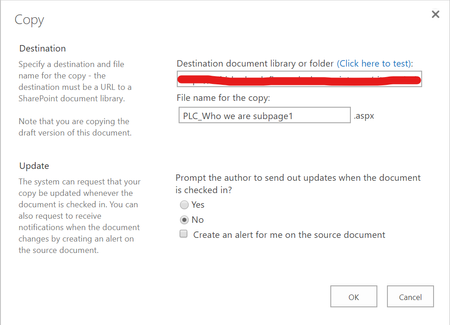
Hello everyone, I have been asked to move some site pages from a Microsoft Team to another Team. In the modern look of SharePoint Online I can select the page (example1.aspx) and when clicking on the three dots I am given the option "Copy to". As you probably know, the page can be copied only on the same site/Team. When I switch to the "classic" look/mode, I am given the option "Copy" and I can type a destination document library or folder (see the screenshot below), but when I try to copy that to another site, I always get an error (refuse to connect). I know that there's a https://sharepoint.uservoice.com/forums/329214-sites-and-collaboration/suggestions/35035618-add-the-ability-to-copy-a-modern-site-page-from-on asking specifically for this feature, but I would like to know if there is some workaround we can try in the meantime, like free migration tools or some scripts via PowerShell. Thank you in advance for your help! Francesco45KViews1like8Comments