publish
232 TopicsConnect development and Marketplace publishing
Marketplace Ingestion MCP and Product Ingestion APIs now support every Microsoft Marketplace product, giving publishers more options for incorporating publishing into development and release workflows. Explore agent-assisted publishing, direct API integration, and generally available SaaS and virtual machine APIs. Existing preview integrations continue to work, so teams can adopt the latest versions at their own pace. Read the blog: Agentic Marketplace publishing expands with broader product coverage and generally available APIs
Payout and tax profiles non-us individual, no company, no tax ID
Subject: Tax profile for an individual in the UAE: is a VAT/Tax ID mandatory? Hello, I am an individual developer (account type: Individual), permanent resident of the United Arab Emirates, creating a tax profile in order to sell a paid add-on on the Microsoft Store. At the "Tax Residence Country/Region" step, the field "Tax ID type" is required and its only option is "VAT number", which then requires a Tax ID. I am not registered for VAT in the UAE and have no Tax Registration Number (TRN). Leaving the field empty blocks the Next button (screenshot attached). In the UAE, TAX registration is only required to businesses above a set yearly revenue. I am only an individual. Questions: 1. Is a UAE VAT number (TRN) mandatory to create a tax profile as an individual seller? 2. If so, is there an alternative path for individuals who are not VAT registered? 3. If a TRN is required, is registering for VAT the only option? Thank you.Work IQ Cost and Pricing Model for Agents published in Marketplace
I would very much like to ask for assistance and input in regards of "Consumption, cost forecasting, break-even analysis and recommended customer pricing. " I believe a bit of context is required. We are about to publish two Work IQ MCP Agent in Marketplace. Both agents will be integrated to our existing Apps that are published in Marketplace. 1. iGlobe CRM for Teams and 2. iPlanner Pro for Outlook and Teams. Both Apps are multitenant Apps running on customers own tenant. The Apps can only be deployed from Marketplace. Lets use iPlanner Pro Agent as an example. In short, iPlanner Pro Agent uses Work IQ and MCP tools to understand emails, meetings and Microsoft 365 context, while iPlanner Pro turns that intelligence into structured Planner execution, including the appropriate plan, bucket, assignment, priority and supporting email context. Including saving the email or attachments on the task. A prompt could look like this "Find the latest email from email address removed for privacy reasons. Create a task for in Planner, put it in the correct Plan and bucket, assign it to the appropriate owner, set a due date for next week and save the email on the Planner Task" Work IQ and MCP provide context and intelligence, iPlanner Pro executes the structured actions, and Microsoft Planner remains the source of truth. To my understanding Work IQ API usage is billed through Copilot Credits rather than a separate per-user Work IQ license. Microsoft 365 Copilot includes Work IQ functionality within native Microsoft Copilot experiences, but third-party solutions such as iPlanner Pro consume Copilot Credits when they call Work IQ APIs. Work IQ does not require a separate API subscription, SKU or per-user licence. API usage is consumption-based and is measured in Copilot Credits. Work IQ operation Credit consumption Planning note Chat API Variable Depends on grounding, retrieval and reasoning complexity. Context API Variable Depends on the scenario and the sources used. Tool API 0.1 credit per API call Static component: $0.001 per call at $0.01 per credit. Example: 1,000 Tool API calls consume 100 credits, equivalent to $1.00 at the planning rate. Now here comes my confusion. 1. How do we know how many credits we are using with a prompt like the example I showed? the consumption is 0.1 credit per API call. 2. If I understand the above correct, the total consumption is calculated on the customer tenant. That consumption includes much more than just iPlanner Pro. Is that correct? 3. OR, will the sum of all customer using iPlanner Pro Agent be direct to us and we will be billed based on the total consumption of all our customers? If that is the case ( I don't think it is) then how do we know how much each customer consumed? 4. If consumption and billing is on the customer, how can the customer see what iPlanner Pro cost in consumed credits? This is important in regards of giving a cost forecast for customers. I am sure they would want that before start using the Agent. It is also important in regards of the question of if we should charge or offer it as a free agent? If we are billed then we will need to change for it. If the customer is billed then we probably will not be able to charge for it. I hope I have been able to explain my confusion. I tried asking contacts I have at Microsoft, but unfortunately haven't heard anything. That is why I am asking in the community. Have any one else the same challenge? what have you done? Can Microsoft assist here? I will be happy to take a Teams call and others are welcome to join. Thank youBring Marketplace publishing closer to your development workflow
Explore how AI agents can help make Microsoft Marketplace publishing a more natural part of the development workflow. Marketplace Ingestion MCP connects MCP-compatible agent tools with Partner Center APIs, helping publishers turn natural-language intent into supported publishing actions. Learn four ways teams can incorporate agent-assisted publishing into their workflows, from creating and validating offers to building repeatable processes and working from familiar developer tools such as Visual Studio Code and GitHub Copilot CLI. See how publishers can bring product development and publishing closer together while keeping people involved in reviewing and approving changes. Read the article106Views1like0CommentsHow and when do I use Frontier Accelerate for Marketplace benefits?
The latest App Advisor guidance shows how Frontier Accelerate for Marketplace can help at every stage: 🔨 Build & Publish: Create and optimize your Marketplace offer. 📈 Grow: Increase visibility and accelerate transactions. ⭐ Differentiate: Access advanced benefits that support long-term growth. Whether you're just getting started or scaling an established Marketplace business, App Advisor can help you find the right resources for your stage. 📖 Read the blog: Frontier Accelerate for Marketplace: New App Advisor Guidance for Software Companies Which stage best describes your Marketplace journey today: Build & Publish, Grow, or Differentiate?
Can a reseller set exact customer totals on an Azure private offer?
When we create a multiperiod private offer, we enter our markup as a percentage. Sometimes the customer total Azure calculates is a few cents off the signed quote, even when we use all eight decimal places. Is there a way to set the exact customer price for each period? If not, how are other resellers handling these rounding differences?
Preview SaaS offer purchase fails at subscription creation
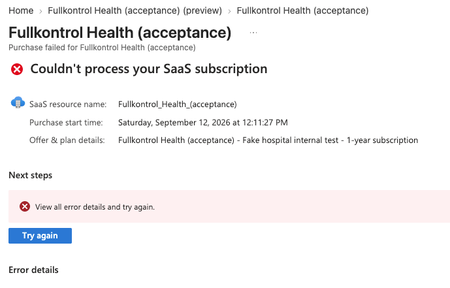
I'm publishing a transactable SaaS offer and testing the purchase flow in preview. Test purchases used to work, and then stopped working with no change on our side that would explain it. The purchase now fails at the final step: "Couldn't process your SaaS subscription" Earlier attempts also returned "400 Bad Request" from the marketplace SaaS service during checkout. Important: this offer previously accepted preview test purchases successfully. Several went through and created subscriptions. The same flow now fails every time, for no apparent reason and with no configuration change on our part. Setup: - Transactable SaaS offer, tested via the Azure portal preview link at the Publisher signoff stage. - Private test plan priced at $0, 1-year term, restricted to my own tenant. What I have already verified and ruled out: - The plan resolves and is selectable. The failure page even shows the correct plan name, so the preview audience and private-plan tenant restriction are working. The failure is at subscription creation, not plan visibility. - Buying subscription is Pay-As-You-Go, spending limit off, Enabled. - Microsoft.SaaS, Microsoft.Marketplace, and Microsoft.MarketplaceOrdering resource providers are all registered. - A valid payment method (credit card) is on the billing profile. - The buyer's market (country) is included in the plan's markets. - Azure Private Marketplace store exists but is disabled, so it is not blocking. - I republished the offer to regenerate a fresh preview link. Preview creation completed successfully. - It fails identically for the Azure account owner, not just a delegated tester. So purchases worked before, every setting I can find is still correct, and it now fails at Microsoft's subscription-creation step. Questions: 1. Has anyone had preview test purchases work and then suddenly start failing with "Couldn't process your SaaS subscription," and found the cause? 2. Is this a known platform-side issue? The republish-with-a-small-edit workaround did not help.
Print/export private offer & terms to a PDF for customer's offline processes?
Hi all, We have a situation where a customer is asking for a 'private offer' to be published to them - which is fine, we have done that. However, their procurement processes don't appears quite up to speed with using 'digital marketplaces' and so their procurement person is asking if we can send them a PDF hardcopy of the 'private offer', so they can send it onwards internally for approvals, before clicking the 'accept and then 'purchase' buttons in Marketplace. It seems that the authority within the customer that needs to approve it, is not actually a person that uses or will log onto the Azure Portal to view and accept the offer... and that a person who will logon to the Azure Portal to 'accept' it, first needs to send a PDF/hardcopy to someone to approve it. Is there a way that we as the ISV can export the 'private offer' to PDF for them, or a way for them to view the private offer in their Azure Portal and to export that to a PDF, so they can use internally for their approval processes?SolvedChoosing the right offer type for your cloud and AI solutions
Whether you're bringing a new AI solution to market or evaluating how to scale an existing application, understanding Marketplace offer types can help you choose the right path to monetization and customer adoption. Check out this short video that compares the capabilities of SaaS offers, Container offers, and Azure managed applications to understand which model best aligns with your architecture, deployment requirements, and customer needs. 206Views2likes0Comments
What’s the best way to differentiate a SaaS offer from a Teams offer in Microsoft Marketplace?
Hey community! Our app is transactable, and we currently have two offers live in Marketplace: Saas and MS Teams offers. However, some of our customers find it confusing and aren’t sure which one they should choose. We also always prefer them chosing Saas so we can track everything via Partner center. What’s the recommended way to structure or differentiate the two offers so the choice is clear for customers? For example, should we use different naming, descriptions, or positioning for each offer? Would really appreciate any best practices or examples from others who have faced it!