microsoft teams
17404 TopicsLicensing updates extend access to advanced capabilities in Microsoft Teams and Microsoft Places
UPDATE: These changes will go into effect on April 1, 2026 for customers with users on any license that includes access to the calendar in Outlook and Teams (including Microsoft 365 E3, E5, Business Basic, Business Standard, and Business Premium; Outlook 365 E1, E3, and E5; Exchange Online; various Teams licenses; additional Microsoft 365 and Office 365 licenses). Access to the Places management portal remains available for all Places customers. At Microsoft, we empower organizations to achieve more through intelligent communication, inclusive collaboration, and connected workplace experiences. Our customers are looking for scaled, widespread access to powerful tools that enable workforces to interact and communicate with more intelligence and precision. To facilitate that, we’re announcing Teams licensing updates that make it easier for customers to unlock their full communication and collaboration potential. These licensing changes simplify access to capabilities spanning across Microsoft Places and Teams town halls and webinars, so you can deliver experiences that enhance virtual and in-person collaboration. Read on to learn about the changes ahead and new ways to empower your organization. Access enhanced workplace coordination capabilities Places enables an AI-powered workplace experience by connecting employees to colleagues, spaces, and services in the office. We are expanding access to end-user functionality in Places by making it available in all licenses that include access to the calendar in Outlook and Teams (including Microsoft 365 E3, E5, Business Basic, Business Standard, and Business Premium; Outlook 365 E1, E3, and E5; Exchange Online; various Teams licenses; additional Microsoft 365 and Office 365 licenses). Functionality included in this change: Places Finder: Make more informed decisions about bookings with enriched context like images, floorplans, custom attributes, and available technology in the spaces around you. This change enables organizations to upgrade at scale from Room Finder to the full Places Finder experience by onboarding spaces to the Places Directory. Places Explorer: Enable map-based space reservations and explore details about all workplaces, including the people, spaces, and experiences in each location. Access to Places Explorer is through the Places app inside Microsoft Outlook and Teams. These changes will go into effect on April 1, 2026 for customers with users on any license that includes access to the calendar in Outlook and Teams (including Microsoft 365 E3, E5, Business Basic, Business Standard, and Business Premium; Outlook 365 E1, E3, and E5; Exchange Online; various Teams licenses; additional Microsoft 365 and Office 365 licenses). Manage shared spaces more efficiently Across our AI-powered workplace solutions, we’re continually looking for ways to streamline how organizations manage their inventory of shared desks, spaces, and assets. The newly renamed Teams Shared Space license (formerly Teams Shared Devices license) will be the way that organizations manage this inventory of assets, adding the ability to manage up to four desks with a single license (in addition to the previous ability to manage either a common area phone, a Teams panel, shared space like a room, or a hotdesking device included in the Teams Shared Device license). IT admins will be able to assign licenses to bookable shared spaces individually and control which workspaces are available for employees to use with this new functionality. This license will provide space management capabilities, including: Desk booking: Employees can reserve desks in advance before arriving at a location. Space management: Admins can manage advance reservation policies for desks and set auto-release policies for rooms with a shared spaces license. Space Analytics: Inventory and utilization reports are available for licensed shared spaces (desks). This license will be available on April 1, 2026. For customers with legacy Teams Shared Device licenses, admins will not be required to take any action to transition to this license (but will have to assign additional spaces like desks with an additional no-cost license to take advantage of the new increased allotment of four spaces per license). Communicate and connect at scale Managing communication to thousands or tens of thousands of attendees can be a daunting process for anyone. Built directly on the Teams platform, Teams town hall and webinar enable events at scale with improved capabilities, reliability, and capacity. To empower more organizations to plan and execute high-quality events, we are bringing all town hall and webinar features that were previously only available with a Teams Premium license to Teams Enterprise, including: Streaming chat: Chat for town hall events reduces any message sending lag, enabling smoother communication between attendees and organizers. Reactions interactivity: Enjoy the same reactions from Teams meetings in town hall and webinar, allowing the audience to express themselves and react to presented content. Real-time event insights: Hosts of town hall and webinar instances can get feedback on the performance and reliability of their broadcasts, helping to ensure a smoother experience for attendees. Meeting theme and email customization: Use organizational branding to customize the event-related artifacts that are delivered to attendees. Enterprise Content Delivery Network (eCDN): eCDN helps to manage the bandwidth load of streaming events to large audiences, providing stability and reliability. Immersive events in Teams: Host immersive experiences in custom 3D environments where attendees join as avatars to interact and collaborate. All users with a Teams Enterprise license will soon be able to host Teams events for up to 3,000 attendees, including the ability to use advanced Teams town hall and webinar features. To fully enable events at scale, customers will be able to purchase attendee pack licenses that increase the cap on the total number of attendees up to 100,000 with the same suite of robust features. Attendee pack licenses will come in a range of sizes to provide added flexibility, and will be available to assign through the Teams Admin Center (TAC) after transacting. Summary of licensing changes These changes reflect our commitment to helping organizations confidently embrace the future of work with greater impact across their communication and collaboration. The full slate of changes will go into effect on April 1, 2026: End-user workplace coordination features from Microsoft Places available for licenses that include access to the calendar in Outlook and Teams (including Microsoft 365 E3, E5, Business Basic, Business Standard, and Business Premium; Outlook 365 E1, E3, and E5; Exchange Online; various Teams licenses; additional Microsoft 365 and Office 365 licenses) Introduction of the renamed Teams Shared Space license with additional capabilities for space management and analytics for admins Advanced Teams events features available for all Teams Enterprise users. For organizations without attendee pack licenses, the maximum attendee capacity for a Teams event instance is 3,000 concurrent attendees with engagement capabilities like reactions, raise hands, polls, and Q&A. For Teams events that require full attendee interactivity, including the ability for attendees to join with their cameras on and use their microphones (similar to the former webinar experience), the product supports up to 1,000 concurrent attendees to ensure a consistently optimized and well‑controlled experience. Introduction of attendee pack add-on licenses for town hall events starting from 5,000 up to 100,000 attendees Independent of these changes, we are committed to continuing to provide a robust set of experiences for organizations that have invested in Teams Premium. Teams Premium will still be the only way for customers to experience advanced communication features in Teams meetings, meeting protection, Advanced Collaboration Tools for admins, Intelligent recap, Queues app for Teams Phone, and enhanced capabilities for Bookings and virtual appointments. For a full list of current Teams Premium features, please click here. More information about these new licensing changes, including impacts for existing Teams Premium customers using these products and features, are available below. Read more about these changes in our licensing update FAQ attached below Explore more Teams experiences: Microsoft Teams Learn more about Microsoft Places: Microsoft Places Learn more about Teams town hall and webinar27KViews12likes7Comments
Question about barCode.scanBarCode
Dear sir I'm developing Teams mobile application, static tab(Personal app Tab). We need a QR scan feature. However I can't use that. barCode.isSupported() is always false. Is there any restriction on static tab app? Here are my conditions. -. "import { app, authentication, barCode } from '@microsoft/teams-js';" . version : 2.37.0 -. manifest.json : "devicePermissions": ["media"], -. app.initialize() is sucessfully done. I can see the barCode object Unfortunatly, barCode.isSupported() shows false. Android, iOS has the same result. Can you advise how I can use the barCode camera.? Many thanks44Views0likes2CommentsWhat’s New in Microsoft Teams | January 2026 – ISE Edition
Welcome to 2026! This first ’What’s new in Teams’ of the year is a “2-in-1” edition. We’re not only introducing the usual monthly range of new features and capabilities designed to enhance your Teams experience, we’re also shining a spotlight on the Teams features that will be showcased at the Integrated Systems Europe (ISE) 2026 conference in Barcelona, Spain. ISE brings together technology leaders, partners, and customers from around the world, making it the perfect venue to demonstrate how Teams continues to evolve as the AI-powered platform for communication, collaboration, and workplaces. This year, we’ll be highlighting several new Teams capabilities designed to improve meeting experiences, simplify communications, and make it easier for organizations to connect and engage at scale. Dive in to get a peek at what we’ll be sharing in Barcelona, and what you can start trying out right away! Teams at ISE Microsoft Teams Rooms Interpreter agent support in Teams Rooms on Windows The Interpreter agent acts as a translator in scheduled meetings in Teams Rooms on Windows, allowing participants to listen to the meeting in their chosen language with real-time translation so speaking different languages isn’t a barrier to effective understanding and collaboration. Available with Teams Rooms Pro. Learn more. Teams Rooms utilization by size and capacity in the Pro Management shared space insights report The Pro Management portal's shared space insights page now offers enhanced analytics for Teams rooms utilization. Two new data tiles analyze usage based on factors like room size, capacity, and people count. Usage data can also be filtered by reservations, occupancy, or a combination of both. With these insights, IT teams can make informed decisions about their rooms. Learn more. Express voice enrollment [Available in April] Express voice enrollment makes registering your voice in Teams fast and easy. Your profile enables features like voice isolation, speaker recognition, identification in a meeting room and transcripts, and enhanced meeting recaps and insights from Microsoft 365 Copilot. If you haven't enrolled, you’ll get an in-product prompt to opt-in and enroll your voice profile simply by speaking in a meeting. Admins can enable or disable this feature for their organization. Camera view switching in multi-camera Teams Rooms on Windows When in a meeting with another Teams Rooms on Windows that has multiple cameras, you can switch camera views in that room via the participant panel on the console, or video tile on a touch board, to optimize your views. Learn more. Two-way Direct Guest Join (DGJ) between Google Meet and Teams Rooms Organizations now have expanded meeting interoperability with two-way Direct Guest Join (DGJ) between Google Meet and Teams meetings. Teams Rooms on Windows devices can join Google Meet meetings and Google Meet devices can join Teams meetings. Users can join with one click through the calendar or by meeting ID. Learn more. Microsoft Teams Phone enhancements Interpreter in Teams Phone Interpreter, currently available in Teams meetings, is now expanding to Teams Phone to support calls made between Teams users—VoIP calls. Interpreter enables real-time speech-to-speech interpretation in up to nine languages, allowing participants to speak and listen in their preferred language. Interpreter helps eliminate language barriers and fosters seamless collaboration across global teams. For a more inclusive experience, users can also opt to have Interpreter simulate their personal voice. Today, Interpreter works for VoIP calls only. Queues app shared history of calls and voicemails [Public preview] Coordinating customer call follow‑ups is easier when service teams have visibility into calls that happen outside shifts or while representatives are unavailable. Now available in Public Preview, the Queues app shared history enables teams to access a unified view of all missed, incoming, outgoing calls, and voicemails within a call queue. By consolidating call activity into a shared history, it improves transparency and fosters better collaboration among team members handling customer interactions. This feature reduces duplication of effort and ensures that no customer call is overlooked. Admins can configure access to shared history for all queue members or restrict it to authorized users. Teams events The new Teams events experience brings discovery, creation, and management into a single, centralized workflow. Organizers can configure events through a flexible creation flow that supports a wide range of interaction, registration, and branding options without being constrained by event type. A new discovery experience makes it easier for users to find, track, and revisit events they are registered for or eligible to attend, while redesigned management capabilities provide a consistent place to update details, review registrations, access reporting, and coordinate across organizers and delegates. Available in public preview, the new Teams events experience helps unlock more control and flexibility for digital and hybrid events by simplifying creation and management for organizers and improving visibility and access for attendees. Learn more about Teams events. Communities in Teams Now rolling out to public preview, Communities in Teams appear alongside chats and channels, offering an integrated experience for browsing feeds, posting updates, and participating in discussions. Employees can find and manage their existing Viva Engage communities directly in Teams, with support for announcements, Q&A, long‑form posts, and discovering community-specific events that enable scalable organization‑wide communication and learning. Agents in communities are also available in public preview for communities in Teams. The agent helps turn community conversations into shared organizational knowledge by drafting suggested responses to unanswered questions using existing discussions and specified SharePoint sites. Community admins can review and publish these responses, helping employees get accurate answers faster while making that knowledge visible to the entire community. Learn more about communities in Teams. January new releases Feature categories: (All features listed are generally available unless otherwise noted) Chat and collaboration Teams Phone Workplace: Teams Rooms Fundamentals and Security Frontline Worker Solutions Certified for Teams Devices Chat and Collaboration Teams channels Shared tab The Files tab in channels has been renamed the Shared tab. In addition to showing current files, the Shared tab also displays previously shared files and links that were shared in channel posts. You can use the Recent view to sort by date, then filter by Files or Links, and use the “In messages” view to find links that appear in conversations. Message preview for channels, mentions, and reactions notifications Microsoft Teams is enhancing notifications by adding message previews for more types of notifications, including channels, mentions, and reactions. By surfacing message previews, users can quickly assess the importance of a notification without switching context and more efficiently prioritize responses. Autocorrect in Teams compose Autocorrect in Teams helps fix common spelling mistakes when typing in the compose box, so your messages stay clear and professional without extra effort. No need to backtrack to correct errors, Teams keeps your conversations flowing smoothly. Pin Teams window on top Teams now enables you to "Pin window on top", ensuring it will remain visible above other windows. This reduces meeting and collaboration friction by enabling you to multitask across apps without losing real-time visual cues, shared content, or critical discussions. Teams Phone Explicit consent for 1:1 call transcription and recording We’re extending Microsoft Teams’ existing explicit‑consent experience in meetings to now include 1:1 calls made between Teams users—VoIP calls. With a new Teams calling policy, admins can require participants to provide consent before a 1:1 call is recorded or transcribed. When a user starts recording or transcription, the other participant is automatically muted, with video and content sharing disabled, until they provide consent. This is especially valuable in regulated scenarios—such as a financial advisor capturing call notes—where organizations must obtain clear approval before initiating a recording. Today, explicit consent works for 1:1 VoIP calls only. Teams Phone Mobile is now generally available with T-Mobile USA Teams Phone Mobile enables end-users to make and receive calls using a single sim-enabled number across their mobile phone and all their Teams endpoints. T-Mobile customers in the United States can now enjoy seamless mobile and Teams integration with this unified calling experience. Learn more about how IT admins can configure Teams Phone Mobile in Teams admin center and view the expanding set of mobile operators supporting Teams Phone Mobile. Phone devices: Delayed simultaneous ring on Teams Phone devices Delayed Simultaneous Ring is now supported on Teams Phone devices. This capability addresses challenges for groups with shared call responsibilities and helps reduce distractions by prioritizing the intended recipient. If the call is not answered by the primary receiver first within a set time, the duration of which is customizable, then the call will start ringing other designated phones. It’s a smarter way to streamline call handling and ensure the intended person has the first opportunity to respond. Phone devices: Configure line keys from Teams admin center We’re expanding the flexibility of line keys in Teams Phone devices with new admin configuration capabilities. Line keys let users set up customized one‑touch dialing—for speed dial, shared lines, collaborative call delegation, and call transfers—helping them quickly reach important contacts and work more efficiently. With this update, IT admins can now centrally configure line keys in the Teams admin center (TAC) for both personal devices and common area phones (CAP). This makes it easier to standardize setups, accelerate deployments, and ensure users have the right shortcuts at their fingertips. Phone devices: Enhancements for Copilot summary for transferred calls Copilot summary for transferred calls provides an AI‑generated summary of the transcribed or recorded call so that receiving person saves time gathering information on the earlier discussion. With this latest update, the transfer targets clearer context through the display of a concise call topic in the incoming call notification, giving them faster visibility into why the caller is being transferred. This helps users feel more confident before answering. For example, a bank branch worker can quickly see that a transfer relates to an account verification or a loan application. Workplace: Teams Rooms Enhanced production experience for Town hall in Teams Rooms on Android The enhanced ‘Manage what attendees see’ feature gives Town hall hosts greater control over what attendees experience. Organizers, co-organizers, and presenters joining from a Teams Room on Android with a Pro license can view a polished event while managing which participants appear on or off screen. Organizers licensed for Teams Premium can adjust layout, background, and name tag changes through the Teams Desktop. Learn more. Front-of-room view control for Town Hall in Teams Rooms on Android When a Teams Rooms on Android is invited as a meeting presenter, the front-of-room display defaults to the attendee view. Presenters always have full control from the console, including green room and off-stage management, and can switch the front-of-room display to presenter view without impacting attendees. Available in Teams Rooms Pro. Learn more. Start and stop recording and transcription on Teams Rooms on Android During a Teams meeting, you can start, stop, and restart recording and transcription from a Team Rooms on Android device. Spoken language for the meeting can also be changed. Available in Teams Rooms Pro. Learn more. Fundamentals and Security Report a suspicious message on Teams for Android You can now provide security feedback directly from the Teams Android app - whether you're flagging a message as a security concern or confirming that a message Microsoft flagged is actually safe. This enhanced reporting flow helps your organization strengthen protection against phishing and other unwanted messages by capturing clearer, more actionable signals from real user behavior. In both cases, your feedback goes to your organization and, if admins choose, can also be shared with Microsoft’s detection systems to improve accuracy, reduce false positives, and better identify harmful content. Screen & Window Sharing on Mac via Mac OS Native Picker Mac users can now share their screen or specific windows using the standard native picker experience. By opting in through settings, users can enjoy a fully integrated sharing flow that leverages Mac OS's default interface - ensuring a familiar, secure and streamlined experience. Frontline Worker Solutions Frontline Agent The new Frontline Agent, available in public preview, is a purpose-built and persona-tuned AI assistant that supports everyday workflows for frontline teams by delivering concise, simple responses grounded in the context of their work. With this out-of-the-box agent, frontline workers can quickly find information from scoped SharePoint sites, such as internal policies and procedures, and easily catch up on missed Teams chat and channel messages at the start of their shift with detailed action items. Available in Microsoft 365 Copilot and Microsoft Teams, the Frontline Agent helps support smarter, more efficient shifts. Certified for Teams Devices Jabra Express Install: PanaCast 50 VBS, Acadia Tabletop Stand, Available with LG 40”, 43”, 50", 55”, or 65” displays The Jabra PanaCast 50 VBS, certified for Microsoft Teams, teams up with Salamander Designs Acadia Tabletop Stand and LG’s 4K UHD display to transform huddle, focus, and small meeting spaces into smart collaboration zones. With panoramic video, intelligent audio, and sleek cable management, this bundle installs in under 90 minutes, no wall drilling or rewiring required. It’s a plug-and-play solution that’s easy to deploy, simple to manage, and ready for AI-powered productivity. Because great meetings shouldn’t need a construction crew—and teams deserve tech that just works. Display available in 40”, 43”, 50”, 55”, or 65” Logitech Huddle Room and Small Room Heckler Tabletop Express Install for Teams Rooms on Android: Available with 43” monitor for Huddle rooms or 50” monitor for small rooms Logitech, in partnership with Heckler and Samsung, is simplifying room installations with the new Express Install for Microsoft Teams Rooms, making high-quality meeting spaces more accessible and easier to deploy. Logitech's Express Install kit for Huddle Rooms and Small Rooms can be installed in under an hour, with minimal labor and no specialist help needed. Learn more about the Express Install for Huddle Rooms. and about the Express Install for Small Rooms. Biamp Auto Tuned DSP with Ceiling and Table Mics – Available for Large or Medium Rooms Biamp's DEVIO SCX bundle features Biamp Launch, an automated room tuning feature that optimizes audio with just one button press, no expertise required. The complete audio package delivers clear communication through advanced beamtracking technology that captures voices from anywhere in the room. This solution eliminates background noise so that every participant can be heard clearly, enhancing collaboration for all meeting types. The large room bundle includes two Parlé table microphones, and four Desono ceiling speakers. The medium room bundle includes one Parlé table microphone, and two Desono ceiling speakers. The Biamp Auto Tuned DSP with Table Mics Large Room bundle The Biamp Auto Tuned DSP with Table Mics Medium Room bundle Biamp Configurable DSP w/ Table Mics – Available for Large or Medium Rooms The Biamp TesiraFORTÉ X Table Mic bundles are designed for Large or Medium sized Microsoft Teams Rooms. Powered by TesiraFORTÉ X DSPs, enjoy highly configurable audio options tailored to your space or use a simplified setup with Biamp Launch—an automated room tuning feature that optimizes audio with just one button press, no expertise required. Biamp Configurable DSP w/ Table Mics for Large Rooms Biamp Configurable DSP w/ Table Mics for Medium Rooms Barco ClickShare Hub Pro and Sennheiser TeamConnect Bar M and TeamConnect Bar S for Teams Rooms on Android The ClickShare Hub Pro and Sennheiser TeamConnect Bar M and TeamConnect Bar S bundles are certified Microsoft Teams Rooms solutions for medium and small meeting rooms. ClickShare Hub Pro enables one-click, wireless conferencing and 4K content sharing, with two next-gen ClickShare Buttons (featuring Wi-Fi 6E and USB-C DisplayPort™) and dual screen support. Built on the Microsoft Device Ecosystem Platform (MDEP), it’s designed for secure meetings. Sennheiser’s TeamConnect Bar M delivers advanced audio and dynamic video, with six beamforming microphones, four high-quality speakers, and AI features (auto-framing, person tiling). The TeamConnect Bar S delivers crisp audio and dynamic video, with four beamforming microphones, two speakers, and AI-powered features (auto-framing and person tiling). For users, these bundles deliver intuitive, engaging meetings. For IT managers, they provide modular flexibility, enterprise-grade security, compliance, and standardized integration. Huddly® C1™: AI-driven videobar for small and medium rooms. Huddly C1™ is an AI-powered videobar designed for small and medium meeting rooms. It delivers flexible, modular collaboration, working as a standalone device or paired with Huddly Crew Add-On Cameras. Compatible with both BYOD setups and native room systems, C1 ensures high-quality video and seamless connectivity for modern meeting spaces. Learn more. Lumens VC-TR60A – Black or White The Lumens VC-TR60A camera features automatic voice tracking, presenter tracking, and auto-framing to ensure remote participants get the best possible view. It makes Teams meetings more dynamic and engaging. Voice tracking is a stand-out feature, locking onto the active presenter. When more people join the discussion, the camera adjusts automatically to capture all active speakers in the room. No manual control required – it’s smart and effective and makes for more professional Teams calls. Learn more Lumens VC-TR60A – Black Lumens VC-TR60A – White7KViews1like0Comments
My Point of View on Microsoft 365 E7
1) Introduction: Microsoft 365 E7 is built for organisations ready to move beyond traditional productivity suites and embrace an AI‑driven operating model. It unifies advanced collaboration tools, enterprise‑grade security, identity management, and AI innovation into a single platform. Its purpose is to transform human intent into automated AI action while ensuring strong governance and control. At the heart of E7 is Microsoft Agent 365, a management layer that enables organisations to deploy, scale, and govern AI agents across the digital workplace. 2) Core components E7 combines existing Microsoft technologies with new AI capabilities: Microsoft 365 E5 Teams for collaboration Outlook and Exchange for communication SharePoint and OneDrive for document management Advanced compliance and security features Enterprise analytics and data protection Microsoft 365 Copilot AI assistant integrated across apps Helps draft content and emails Analyses data in Excel Summarises meetings and documents Automates routine tasks Microsoft Entra Suite Identity and access management Secures identities and applications Manages user access across systems Protects against identity‑based threats Supports secure remote and hybrid work Microsoft Agent 365 Platform for managing AI agents Provides governance and control for automation Enables safe and scalable AI deployment 3) Why Microsoft 365 E7 Matters? E7 signals a shift from traditional digital workflows to environments where AI agents actively assist and automate work. With E7, organisations can: Scale AI capabilities across departments Maintain compliance and governance Safeguard sensitive data and identities Empower employees with intelligent, productivity‑enhancing tools For businesses pursuing an AI‑first strategy, Microsoft 365 E7 offers a unified foundation for innovation, efficiency, and growth. Strategic Perspective : E7 represents a significant evolution in enterprise communications. Traditionally, unified communications focused on integrating voice, video, messaging, and collaboration into a seamless experience. With E7, Microsoft is extending that vision into AI‑driven orchestration, where communication isn’t just about connecting people, it’s about enabling agents and automation to act on intent. Key Strengths Deep Integration: By combining Microsoft 365 E5, Copilot, Entra, and Agent 365, E7 creates a single ecosystem where collaboration, identity, and automation are tightly bound. AI‑First Workflows: Copilot and Agent 365 shift communications from reactive (chat, email, meetings) to proactive, where AI agents can summarise, draft, and even execute tasks. Governance & Security: Entra ensures that identity and access remain central, which is critical as AI agents begin to act on behalf of users. Scalability: Agent 365 provides the control layer to scale AI safely across departments, avoiding the chaos of fragmented automation tools. 4) Why It Matters for Unified Communications? E7 is not just another productivity suite it’s the next operating model for enterprise collaboration. In UC terms, it means: Meetings and messaging become AI‑augmented experiences. Communication channels are context‑aware, with agents that can act during or after interactions. Governance ensures that automation doesn’t compromise compliance or trust. 5) My Take Microsoft 365 E7 is essentially Unified Communications 2.0 moving from connecting people to connecting people + AI agents in a governed, secure environment. For organisations, this means less friction in workflows, faster decision‑making, and a foundation for scaling AI across the enterprise. It’s a bold step: UC is no longer just about “how we talk and collaborate,” but about how intent flows seamlessly into action. 6) Unified Communications (UC) use cases where Microsoft 365 E7 could have the biggest impact a) Meetings & Collaboration AI‑Summarised Meetings: Copilot automatically generates minutes, action items, and follow‑ups from Teams meetings. Real‑Time Agent Assistance: Agent 365 can deploy meeting assistants that track decisions, schedule tasks, and notify stakeholders instantly. Cross‑Language Communication: AI agents provide live translation and context‑aware summaries, making global collaboration seamless. b) Contact Centers & Customer Engagement AI‑Driven Call Routing: Agent 365 can intelligently assign customer calls to the right agent or bot, reducing wait times. Automated Responses: Copilot drafts responses to customer queries based on knowledge bases, improving speed and consistency. Compliance Monitoring: Entra ensures identity verification and secure access for agents handling sensitive customer data. c) Frontline & Field Communications Task Automation: AI agents can log field reports, update inventory, or trigger workflows directly from mobile Teams chats. Secure Access Anywhere: Entra provides identity‑based security for frontline workers accessing apps remotely. Voice‑to‑Action: Workers can issue voice commands that AI agents convert into automated actions (e.g., “log equipment issue”). d) Executive & Leadership Communication AI‑Curated Briefings: Copilot summarises enterprise communications, surfacing key insights for leadership. Governed AI Agents: Agent 365 ensures executives can safely delegate routine communication tasks to AI without losing oversight. Data‑Driven Decision Support: Integration with analytics tools provides leaders with real‑time dashboards and AI‑generated recommendations. 7) Key Differences when comparing with E5+ Copilot Comparison table Feature / Factor Microsoft 365 E5 + Copilot Microsoft 365 E7 Core Productivity Includes Teams, Outlook, SharePoint, OneDrive, compliance, analytics Same foundation (E5 included) AI Capabilities Copilot integrated into apps (Word, Excel, Teams, Outlook) Copilot + Copilot Studio + Work IQ + AI agent orchestration Identity & Access Basic Entra features (with E5 security/compliance) Full Microsoft Entra Suite for advanced identity governance AI Agent Management Not included Microsoft Agent 365 — deploy, manage, and govern AI agents Governance & Compliance Strong compliance/security tools Enhanced governance for AI workflows and agent actions Target Audience Organisations experimenting with AI productivity Organisations scaling AI enterprise‑wide with governance Cost (per user/month) E5: ~$57–$65 + Copilot add‑on: ~$30 → ~$87–$95 $99 flat pricing (Frontier Suite) Positioning Secure productivity + AI assistant AI‑driven operating model with enterprise governance Key differences: Governance Layer: E7 introduces Agent 365, which ensures AI agents can be deployed safely across departments something E5 + Copilot lacks. Identity Integration: E7 bundles the Entra Suite, giving advanced identity and access management beyond E5’s baseline. Unified Pricing: Instead of stacking E5 and Copilot costs, E7 offers a single license at $99/user/month. Strategic Role: E5 + Copilot is about productivity enhancement; E7 is about enterprise AI transformation. Risks & Trade‑offs Cost Premium: E7 is ~10–15% more expensive than E5 + Copilot combined. Adoption Readiness: E7 makes sense only if an organisation is ready to scale AI broadly; otherwise, E5 + Copilot may suffice. Complexity: Governance and agent management add layers of responsibility requiring IT maturity. Conclusion: If your organisation is still testing AI productivity gains, E5 + Copilot is cost‑effective. But if you’re ready to scale AI across the enterprise with governance, compliance, and identity controls, E7 is the better long‑term foundation.29Views0likes0CommentsIntroducing a refreshed design, task chat, and more in Microsoft Planner
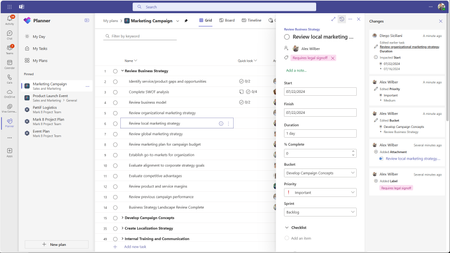
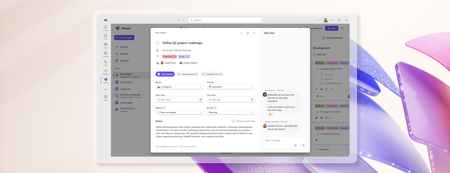
We’re excited to announce that a modernized user interface and new features are now rolling out to basic plans in both Planner in Teams and Planner for the web. The updated design offers enhanced navigation, responsive layouts, a new goals view for setting objectives and priorities, and task chat—one of your most requested features—to enable real-time collaboration and @ mentioning team members. This release aims to make planning easier for everyday users while preparing for future AI-powered capabilities. Our goal is to streamline planning by making it more intelligent and connected, so teams can concentrate on achieving results rather than managing tasks. What's new in Planner A refreshed design: With this rollout, users will be able to manage their plans in a cleaner, more modern interface that brings a more consistent planning experience across work. Planner’s new look was designed to feel simpler, allowing users to find what they need. It reduces visual clutter, improves layout and spacing, and creates a more focused workspace. Task chat with @ mentions: A new task chat is coming to basic plans, bringing real-time, threaded conversations directly into tasks, including @ mentions, rich formatting, emojis, and notifications to help keep decisions tied to the specific task at hand. Plan members who are @ mentioned in a task will receive a notification in their Teams Activity feed and via email and can select the notification which takes them directly to the task card for additional context. Note that previously, users received notifications for every task comment, but as a result of customer feedback, we now only send notifications to mentioned users. The ability to @ mention team members directly in a task has been a top request, and we’re excited to roll this out in a familiar, chat-based experience. Please note, premium plans will continue to utilize the existing task conversation experience. This will converge into the new experience at a later point in time. Goals view: Basic plans will now include a dedicated Goals view, allowing teams to set clear, well-defined objectives to help prioritize work. By connecting tasks to shared goals, teams achieve greater alignment, gain clarity on priorities, and track progress and outcomes—driving the plan forward together. Access to Goals view in basic plans requires either a Planner premium license or a Microsoft 365 Copilot license. Notes on availability Please note that not all users will see the new Planner interface at the same time. This refreshed interface, along with Task chat and Goals view, begins rolling out to basic plans today and will continue to roll out over the coming weeks. This is only the beginning This redesign lays the groundwork for many more improvements coming to Planner in the next few weeks and months, including: Project Manager agent in basic plans – to help with task execution and the creation of status reports. Custom templates. Planner in Outlook. Stay tuned for announcements regarding these updates and more aligned to our long-term vision for integrated work management. Feature availability, naming, and timelines are subject to change. Please refer to the Microsoft 365 Roadmap for the latest status. Addressing your feedback We heard your feedback about inconsistencies between basic and premium plans. This refresh starts closing those gaps, so features appear consistently across plans based on your license. For example, users with a Planner premium license will now see Goals in basic plans, and users with a Microsoft 365 Copilot license will soon have access to Project Manager Agent in basic plans as well. Tell us what you think about the new Planner interface, Task chat, and Goals view by selecting More (circled question mark icon) in the top right corner of the app, then selecting Feedback from the dropdown menu. We also encourage you to share any feature requests by adding your ideas to the Planner Feedback Portal. Your feedback helps inform our feature updates, and we look forward to hearing from you. Learn more Visit planner.cloud.microsoft to access Planner directly from your browser. Sign up to receive future communication about Planner. Learn more about Planner in our Frequently asked questions. Check out the Planner adoption page and Planner help & learning page to learn more about Planner. Visit the Microsoft 365 roadmap for feature descriptions and estimated release dates for Planner. Walk through the interactive demos for Project Manager Agent in Planner and Project Manager Agent skills in Teams meetings.19KViews7likes34Comments
Disable incessant nagware popups
I don't know about everyone else, but I am sick and tired of the nagware pop ups in Word, Excel, PowerPoint, Outlook, etc. Every single product harasses me with pop ups trying to tell me "hey, did you know this feature was here?", "you can do this if you click that", "let me hold your hand through using products you've used for decades even though you don't want daddy Microslop to do that". This is a prime example. I keep getting the same ones again and again and again and everything I've read indicates they should only appear once. But they don't. They keep coming back like a psychotic stalker ex who wants alimony even though you were never married. How do I get this nagware to stop?!33Views0likes1CommentAnnouncing the 2026 Microsoft 365 Community Conference Keynotes
The Microsoft 365 Community Conference returns to Orlando this April, bringing together thousands of builders, innovators, creators, communicators, admins, architects, MVPs, and product makers for three unforgettable days of learning and community. This year’s theme, “A Beacon for Builders, Innovators & Icons of Intelligent Work,” celebrates the people shaping the AI‑powered future — and the keynote lineup reflects exactly that. These leaders will set the tone for our biggest, boldest M365 Community Conference. Below is your first look at the official 2026 keynote order and what to expect from each session. Opening Keynote Jeff Teper — President, Microsoft 365 Collaborative Apps & Platforms Building for the future: Microsoft 365, Agents and AI, what's new and what's next Join Jeff Teper, to discover how AI-powered innovation across Copilot, Teams, and SharePoint is reshaping how people communicate, create, and work together. This session highlights what’s new, what’s fundamentally different, and why thoughtful design continues to matter. See the latest advances in AI and agents, gain insight into where collaboration is headed, and learn why Microsoft is the company to continue to bet on when it comes to building what’s next. Expect: New breakthroughs in collaboration powered by AI and agents Fresh innovations across Teams, Copilot, and SharePoint Practical guidance on how design continues to shape effective teamwork Real world demos that show how AI is transforming communication and content Insight into what is new, what is changing, and what is coming next Business Apps & Agents Keynote Charles Lamanna — President, Business Apps & Agents In this keynote, Charles Lamanna will share how Microsoft 365 Copilot, Copilot Studio, Power Apps, and Agent 365 come together to help makers build powerful agents and help IT teams deploy and govern them at scale. We’ll share how organizations can design, extend, and govern a new model for the intelligent workplace – connecting data, workflows, and systems into intelligent agents that move work forward. Copilot, apps, and agents: the next platform shift for Microsoft 365 Microsoft 365 Copilot has changed how we interact with software. Now AI agents are changing how work gets done – moving from responding to prompts to taking action, across the tools and data your organization already relies on. Expect: A clear explanation of how to leverage and build with Copilot and agents How agents access data, use tools, and complete multi-step work A deeper look at the latest capabilities across Microsoft 365 Copilot, Copilot Studio, and Power Apps End-to-end demos of agents in action Security, Trust & Responsible AI Keynote Vasu Jakkal — Corporate Vice President, Microsoft Security & Rohan Kumar — Corporate Vice President, Microsoft Security, Purview & Trust In our third keynote, Vasu Jakkal and Rohan Kumar join forces to address one of the most urgent topics of the AI era: trust and security at scale. As organizations accelerate into AI‑powered work, safeguarding identities, data, compliance, and governance is mission‑critical. Securing AI: Building Trust in the Era of AI Join Vasu Jakkal and Rohan Kumar as they unveil Microsoft’s vision for securing the new frontier of AI—showing how frontier firms are protecting their data, identities, and models amid rapid AI adoption. This session highlights how Microsoft is embedding security and governance into every layer of our AI platforms and unifying Purview, Defender, Entra, and Security Copilot to defend against threats like prompt injection, model tampering, and shadow AI. You’ll see how built-in protections across Microsoft 365 enable responsible, compliant AI innovation, and gain practical guidance to strengthen your own security posture as AI transforms the way everyone works. Expect: Microsoft's unified approach to secure AI transformation Forward‑looking insights across Security, Purview & Trust Guidance for building safe, responsible AI environments How to protect innovation without slowing momentum Future of Work Fireside Keynote Dr. Jaime Teevan — Chief Scientist & Technical Fellow, Microsoft Dr. Jaime Teevan, one of the foremost thought leaders on AI, productivity, and how work is evolving. In this intimate fireside‑style session, she’ll share research, real‑world insights, and Microsoft’s learnings from being both the maker and the first customer of the AI‑powered workplace. Expect: Insights from decades of workplace research The human side of AI transformation Practical guidance for leaders, creators, and practitioners Why collaboration is essential to unlock the true potential of AI. Community Closer Keynote Karuana Gatimu - Director, Microsoft Customer Advocacy Group & Heather Cook - Principal PM, MIcrosoft Customer Advocacy Group From Momentum to Movement: Where Community Goes Next As the final moments of Microsoft 365 Community Conference come to a close, Heather Cook and Karuana Gatimu invite the community to pause, reflect, and look forward together. This Community Closer keynote connects the breakthroughs, conversations, and shared experiences of the week into a bigger story—one about people, purpose, and progress. Together, they’ll explore how community transforms technology into impact, how advocates and builders shape what’s next across Microsoft 365, and why this moment matters more than ever. More than a recap, this session is a call to action—challenging attendees to take the energy of the conference back to their teams, regions, and communities, and turn inspiration into sustained momentum. You’ll leave not just with ideas, but with clarity, confidence, and a renewed sense of belonging—because community doesn’t end when the conference does. It’s where the real work begins. More Than Keynotes: Why You’ll Want to Be in Orlando The M365 Community Conference brings together: 200+ sessions and breakouts 21 hands‑on workshops 200+ Microsoft engineers and product leaders onsite The Microsoft Innovation Hub Ask the Experts, Meet & Greets, and Community Studio Women in Tech & Allies Luncheon SharePoint’s 25th Anniversary Celebration And an epic attendee party at Universal’s Islands of Adventure Whether you create, deploy, secure, govern, design, or lead with Microsoft 365 — this is your community, and this is your moment. Join Us for the Microsoft 365 Community Conference April 21–23, 2026 Loews Sapphire Falls & Loews Royal Pacific 👉 Register now: https://aka.ms/M365Con26 Use the SAVE150 code for $150USD off current pricing Come be part of the global community building the future of intelligent work.2.3KViews3likes2CommentsFeature Suggestion: hover over description for teams within MS Teams
My organization has been using teams for about six years now. Slowly, my left column in teams has filled up with many teams. Sometimes I'm added to a team and I don't even know what it is! Sometimes I joined the team three years ago and forget what they do. The name of the team may not be very descriptive, or is an acronym I've forgotten / never learned, and this leads me to browsing posts to get an idea of the main function of the team. I predict that this issue will only grow as time goes on. In the early days of teams, this was not as much of an issue. I'm suggesting a feature with this intent: allow users either with a mouseover on the team name, or with clicking on the three dots next to a team name (ideally both), to see a brief 200 character or less synopsis / description of the team. In this way, we'll quickly relay the intent of the team to any / all users. Currently, hovering your mouse over the team name produces the team name again and "Public" or "Private" as far as I can tell. Currently it is clean and light, but I propose adding an optional description below the "Public" / "Private" part. Thoughts? NOTE: I would have submitted this in other more appropriate forums like feedbackportal.microsoft.com but i don't have access.21Views0likes0Comments