microsoft purview
109 Topics
Two labels does not appear in outlook
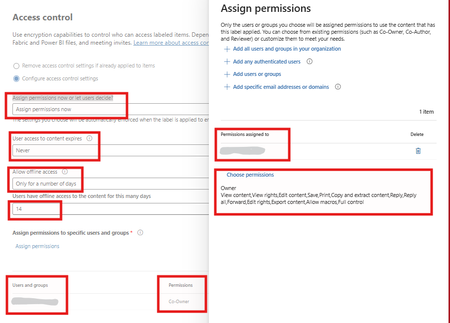
We are at the very beginning of deploying the four sensitivity labels: Public, Internal, Restricted, and Confidential. The labels are visible in Word, Excel, PowerPoint, and other Microsoft 365 apps, but they do not appear in Outlook Desktop or Outlook on the Web (OWA) for me or the pilot users. Restricted and Confidential are configured with encryption and settings for both of them are same , i know strange but that's what mgmt want refer to the attached screenshot.308Views0likes4Comments
Best Way to Exclude Delta _delta_log Folders from Purview Scans?
Hi Purview Community, We're scanning ADLS Gen2 assets with Microsoft Purview Data Map and have encountered issues with _delta_log folders being ingested as catalog assets. Initially, _delta_log folders were included in scans and were ingested into the Data Map. This appears to have introduced a large number of technical assets that are not useful for business users and may be contributing to unexpected metadata and row count discrepancies. Questions What is the recommended ignore pattern to exclude all _delta_log folders from ADLS Gen2 / Fabric scans? After updating a scan rule to exclude _delta_log, how can previously ingested _delta_log assets be completely removed from the Data Map? Is deleting the assets from Data Map sufficient? Is there a metadata purge process? Are there any known limitations where deleted _delta_log assets still affect resource sets, lineage, profiling, DQ, or row count calculations? Has anyone experienced inflated row counts or profiling results after _delta_log folders were previously scanned? For example, we're seeing significant differences between Purview-reported row counts and source system row counts even after excluding _delta_log folders and deleting the corresponding assets. Any guidance, best practices, or Microsoft documentation references would be greatly appreciated. Thanks!119Views0likes0Comments
Objects in a Retention Policy populated by Adaptive Scopes
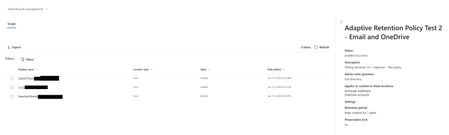
I need a way to get all users in a retention policy that is populated by an adaptive scope. I can get all the members of the scope, and I can show that the policy uses that adaptive scope. But I know my audience. They will want to see that the users are actually in the policy. They will probably even want to see that it matches the users in the adaptive scope. In the GUI, I can click on an adaptive retention policy and click on "policy details". This will show all the users that the policy applies to and the date/time they were added, if they were removed from the policy, etc. And I can even export that. How can I get this same information via PowerShell? It's going to be important because, as you can see, there's a big difference in the date/time added. they were all in the adaptive scope BEFORE this policy was created, but it still took nearly 24 hours for all users to be added. Which is fine, and typical, but if a user gets added to the adaptive scope and does not have the policy applied to them within 24 hours, we need to know this. The goal is as much automation as possible, with checks and balances in place. Checks and balances require gathering information. That's going to require getting this information via PowerShell.655Views0likes7Comments
Anthropic Claude Purview Data Connector showing all users as Guests..
It appears this connector is not mapping fields properly causing internal users to be mapped as "guests", and since prompts/data isn't maintained for guest users the connector is effectively not gathering anything but noise. Unlike the other data connectors, one cannot create field mappings. Also the app being named using the guid of Microsoft's own "dataassessments" service principal I don't think is intended either. Has anybody else experienced this? See below for an example.910Views3likes8Comments
Microsoft Purview | Share block at external users
Hello community. I have an issue with Microsoft Purview DLP policies. I am trying to create a policy that prevents documents from being shared through OneDrive with external users, while allowing certain exceptions. However, when I select the option "Block Access to external domains and users" and assign a specific email address to be blocked, it does not work. The configured email address is not being blocked. I was reviewing this with Copilot, and it mentioned that if the external user you are sharing with already exists in Entra ID, the tenant may treat the user differently (not necessarily as an external user). My external user exists in Entra ID as a Guest account. The external user is registered as follows: Displayname: User Name Userprincipalname: user.name_external.domain#EXT#@company.onmicrosoft.com User Type: Guest Has anyone else experienced this issue? I am sharing evidence of the policy configuration.1.1KViews0likes7CommentsInsider Risk Level not being correctly picked up by DLP
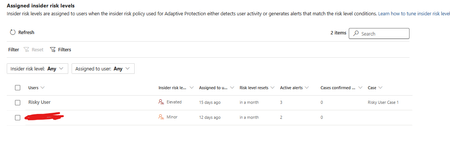
I have two users currently with assigned Insider Risk levels, one elevated and one minor. I have taken the templated DLP policy (DSPM for AI - Block sensitive info from AI sites) which looks for sensitive information being pasted to generative AI sites, and applies a block if the user is an elevated risk user, and a block with override for a moderate/minor risk user (this was audit only originally). For each advanced DLP rule within that policy, I have a separate policy tip which shows so I know which Advanced DLP rule has been hit. However, I'm having some discrepancies with the correct insider risk level being identified by Purview and therefore the wrong advanced DLP rule is being applied. Testing examples: Logged into a Windows 11 PC with the account, and using Medium confidence UK NINO's I try pasting the content into ChatGPT: Elevated risk user: Block with Override Minor Risk user: Block with Override If I try the exact same scenario on a different PC, I can sometimes get to the point where even though its the same set of data, Purview allows me to paste it at after checking the data. Or in another scenario, I was getting both users hitting the "elevated risk" advanced DLP rule. The Devices are all showing as up to date sync wise with DLP policies, and the policy itself is showing as fully synced. Assigned insider risk levels: DLP Rules: Elevated: Moderate/Minor:Solved673Views0likes2CommentsI just want to secure AI. DLP vs Info Protection vs DSPM vs Governance vs...
I'm with an MSP, and I've avoided Purview like the plague, because it seems to be suffering from the same 'made by marketing teams' 'strategy' the 365 documentation is. However, it's my understanding Purview policies are needed for Data control of Copilot. Here's my issue: all of these different 'solutions' sound like the exact same thing, but are pitched as if they are something different. i'm going to post a couple of descriptions for these 'solutions' to illustrate this. 'discover, label, and protect sensitive and business-critical info' 'make sure your organization can identify, monitor, and protect sensitive info across the expanding Microsoft 365 landscape' 'discover and secure all your sensitive data across Microsoft 365 and non-365 data sources' 'Discover, label, and protect sensitive and business-critical info across your multicloud data estate.' I genuinely do not have time to figure out what each of these 'solutions' are, then figure out their policies, then their giant library of settings (below)... It's not even clear to me what's active NOW, considering we never licensed Purview - but somehow have been roped into it. It SEEMS like these are all variations of marketing terms, which all point to 3-4 actual technical implementations in obscure ways. Can someone advise on the ACTUAL technical policies we want to target and enable? Or just give some clarity? I've never felt so overwhelmed or disconnected from Microsoft's environment. We just want to secure our tenant's AI usage.901Views1like9CommentsPurview SDK
I've been spending quite a bit of time working with Purview APIs, The APIs themselves are fine, but after a while I realized I was writing the same authentication, pagination and relationship handling code over and over again. So instead of construction the same code from project to project, I turned it into a python package, and now it's available on PyPI pip install purview-unified-sdk Right now, the SDK supports most of the common operations, such as creating, retrieving, updating and deleting business domains, data products, glossary terms, objectives, key results and etc., It also make it much easier to work with relationships, add group id as a owner, navigate resources and retrieve metadata across the unified catalog. https://niki9001.github.io/purview-unified-sdk/ https://github.com/purview-unified-sdk Feel free to fork the project, submit a pull request or open an issue if you have ideas or suggestions226Views0likes0Comments