microsoft purview
656 TopicsNew Archiving Capability for Purview Data Lifecycle Management
Tenants with Microsoft 365 Archive configured can incorporate an archiving step in how Purview retention policies and labels process SharePoint Online and OneDrive for Business files. It makes perfect sense to move inactive files to lower-cost archive storage as an intermediate point some time before their final deletion. You’ll save on storage and stop AI tools processing the digital debris that invariably accumulates in SharePoint. https://office365itpros.com/2026/08/20/microsoft-365-archive-retention/65Views0likes0Comments
Microsoft Purview | Share block at external users
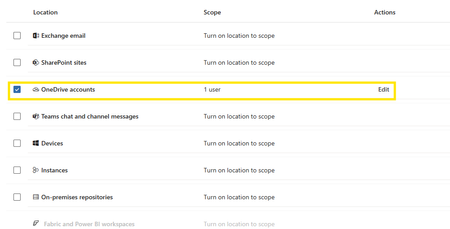
Hello community. I have an issue with Microsoft Purview DLP policies. I am trying to create a policy that prevents documents from being shared through OneDrive with external users, while allowing certain exceptions. However, when I select the option "Block Access to external domains and users" and assign a specific email address to be blocked, it does not work. The configured email address is not being blocked. I was reviewing this with Copilot, and it mentioned that if the external user you are sharing with already exists in Entra ID, the tenant may treat the user differently (not necessarily as an external user). My external user exists in Entra ID as a Guest account. The external user is registered as follows: Displayname: User Name Userprincipalname: user.name_external.domain#EXT#@company.onmicrosoft.com User Type: Guest Has anyone else experienced this issue? I am sharing evidence of the policy configuration.367Views0likes6CommentsSharePoint Online Expands Sensitivity Labels to OneNote and Video Files
Microsoft has updated SharePoint Online to provide full support for sensitivity labels assigned to OneNote and MP4 files. Full support means that SharePoint Online can decrypt and encrypt file content, which then allows SharePoint to protect the content while storing it in a way that’s accessible to Purview services like Data Loss Prevention and eDiscovery, and of course, accessible to Copilot. https://office365itpros.com/2026/08/12/sensitivity-label-mp4-onenote/77Views0likes0Comments
Insider Risk Level not being correctly picked up by DLP
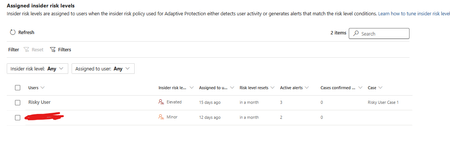
I have two users currently with assigned Insider Risk levels, one elevated and one minor. I have taken the templated DLP policy (DSPM for AI - Block sensitive info from AI sites) which looks for sensitive information being pasted to generative AI sites, and applies a block if the user is an elevated risk user, and a block with override for a moderate/minor risk user (this was audit only originally). For each advanced DLP rule within that policy, I have a separate policy tip which shows so I know which Advanced DLP rule has been hit. However, I'm having some discrepancies with the correct insider risk level being identified by Purview and therefore the wrong advanced DLP rule is being applied. Testing examples: Logged into a Windows 11 PC with the account, and using Medium confidence UK NINO's I try pasting the content into ChatGPT: Elevated risk user: Block with Override Minor Risk user: Block with Override If I try the exact same scenario on a different PC, I can sometimes get to the point where even though its the same set of data, Purview allows me to paste it at after checking the data. Or in another scenario, I was getting both users hitting the "elevated risk" advanced DLP rule. The Devices are all showing as up to date sync wise with DLP policies, and the policy itself is showing as fully synced. Assigned insider risk levels: DLP Rules: Elevated: Moderate/Minor:Solved227Views0likes2Comments
Purview SDK
I've been spending quite a bit of time working with Purview APIs, The APIs themselves are fine, but after a while I realized I was writing the same authentication, pagination and relationship handling code over and over again. So instead of construction the same code from project to project, I turned it into a python package, and now it's available on PyPI pip install purview-unified-sdk Right now, the SDK supports most of the common operations, such as creating, retrieving, updating and deleting business domains, data products, glossary terms, objectives, key results and etc., It also make it much easier to work with relationships, add group id as a owner, navigate resources and retrieve metadata across the unified catalog. https://niki9001.github.io/purview-unified-sdk/ https://github.com/purview-unified-sdk Feel free to fork the project, submit a pull request or open an issue if you have ideas or suggestions71Views0likes0CommentsUnderstanding Microsoft 365 Copilot Risk Surface and Mitigations
Microsoft 365 Copilot acts on the access users already have. It does not grant new permissions — it is a force multiplier that makes existing access faster and easier to discover, aggregate, and act on across Microsoft 365. That speed and accessibility can also amplify existing security and governance gaps. In environments with overshared content, excessive permissions, or inconsistent governance, users may gain faster access to sensitive information than organizations realize. It’s a shift that carries important security implications organizations should understand before scaling deployment. Customers with Microsoft 365 E5 licensing may already have access to many of the tools that can help identify and reduce Copilot-related risk, but licensing alone does not reduce exposure. What’s often missing during early Copilot deployments is a clear understanding of the risk surface itself: what data is exposed, who can access it, and through which vectors.Purview DLP Blocks Sharing Files with Specific Domains or Users
A new DLP rule is available to control sharing of SharePoint and OneDrive files with selected domains and email addresses. The new rule supports an allow list (permit sharing) and can also specify a deny list (block sharing). The user interface takes a little getting used to, but when everything is configured and SharePoint has had a chance to respond to the block, the rule works and any attempt by a blocked user to use a sharing link is refused. https://office365itpros.com/2026/07/22/block-sharing-dlp-sharepoint/198Views0likes4Comments
Missing activity names from Audit Log documentation
We all know that the documentation team is A-tier and amazing at what they do and isn't just copy and pasting marketing materials. But I've noticed that some really obscure functionalities like 'user registered a device' or 'user joined a device' or about half the other things a user can do, are not documented on this list of activity names. The ironically named 'friendly' list doesn't work. So I actually can't audit the unfamiliar devices under our tenants? It appears that this KB is actually locked down, so more can't be added when they are discovered. How are we supposed to use the tool Microsoft has forced everyone towards, when the Documentation team is too bad to document anything, so they outsource it to the community (Microsoft victims), but then they lock down contributions (presumably, because they have some metric that keeps them from being useful - atleast based on my interactions with them). Documentation seems to be a massive fail on Microsoft's part. How did it get this way? Is there a reliable way of finding the activity name - one that ISN'T some preview Graph endpoint that I can't teach my techs to use, because I'm not teaching my techs to program?137Views1like1CommentExtend data security to the network with Microsoft Purview and Microsoft Entra
Protection that keeps up with how data moves in the AI era Enterprise data used to be easier to contain. It lived in files, in apps you managed, within boundaries you controlled. Security teams could focus on endpoints and known systems, and that was often enough. That’s no longer the case. Today, data travels constantly between trusted endpoints and unmanaged web apps, SaaS apps, and most critically, generative AI tools over the network. Employees type and paste sensitive information into prompts, upload work-related files to external services or personal cloud storage, and interact with systems that sit entirely outside the traditional enterprise perimeter. AI has expanded the risk surface for potential enterprise data loss. That’s why Microsoft Purview and Microsoft Entra now integrate to extend data security to the network layer (available in public preview). Traditional data loss prevention (DLP) approaches lack real-time visibility and enforcement, flagging incidents after data has already left the organization. In other cases, vendors rely heavily on physical network appliances that are complex and expensive to deploy, or compute resources that can add significant latency. In the era of AI, that model breaks down quickly. Real-time data protection for how work happens today To adapt to how enterprise data moves in the AI era, we’re announcing the extension of data security to the network layer, powered by Microsoft Purview and Microsoft Entra, now in public preview. This integration brings together data context and identity-aware enforcement to help protect sensitive data in transit, in real time: Detect how sensitive data is shared to shadow AI tools, unmanaged SaaS apps, and personal cloud repositories Help block the sharing of sensitive data in real time based on identity, user activity, and data context, before data leakage occurs Unify investigation workflows by correlating identity, data, and insider risk signals across Purview, Entra, and Defender Prevent employees from sharing proprietary or sensitive organizational data to potentially risky locations such as consumer AI apps. By combining Purview data classification, DLP policies, and insider risk detection with identity-aware enforcement at the network layer through Entra, organizations can dynamically apply protections based on: The sensitivity of the data Who the user is How that user has interacted with sensitive data over time Together, Purview and Entra enable a modern approach to data protection that follows the data to prevent leakage instead of relying on at-rest controls alone. Not only that, but the same Purview classification and policies that you already leverage for the rest of your enterprise data can now be applied consistently across data in motion, at rest, and in use. Learn more in the detailed blog. See the capabilities in action here. Start your free trial of Purview Suite here.
Onboarding Devices to Purview
I am not clear on how can I onboard devices to MDE so that I can enforce EDLP policies. We have CrowdStrike as Primary AV and other policies. Devices are managed through Intune for Bitlocker encryption and all the other settings except they don't have Defender. These devices are not showing up in Purview nor under "Endpoint detection and response" location under Endpoint Security. If we create an EDR onboarding policy and deploy to devices, then it shows the devices and says that AMRUnningMode is Passive, but Antivirus is true. Which I feel like Defender is taking over CrowdStrike? or am I wrong. My goal is to make sure CrowdStrike still primary AV and devices should be onboarded to MDE and then to Purview so that we can scope EDLP policies properly. Can anyone help me to understand or provide right steps?255Views0likes1Comment