microsoft information protection
520 Topics
From “No” to “Now”: A 7-Layer Strategy for Enterprise AI Safety
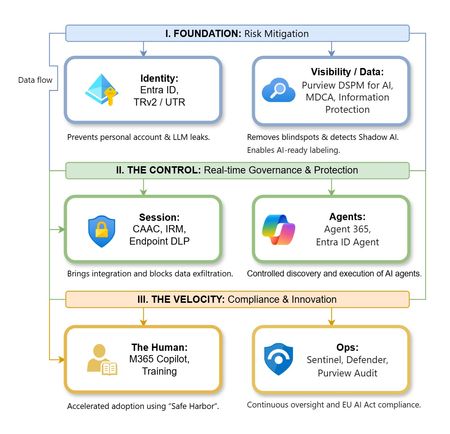
The “block” posture on Generative AI has failed. In a global enterprise, banning these tools doesn't stop usage; it simply pushes intellectual property into unmanaged channels and creates a massive visibility gap in corporate telemetry. The priority has now shifted from stopping AI to hardening the environment so that innovation can run at velocity without compromising data sovereignty. Traditional security perimeters are ineffective against the “slow bleed” of AI leakage - where data moves through prompts, clipboards, and autonomous agents rather than bulk file transfers. To secure this environment, a 7-layer defense-in-depth model is required to treat the conversation itself as the new perimeter. 1. Identity: The Only Verifiable Perimeter Identity is the primary control plane. Access to AI services must be treated with the same rigor as administrative access to core infrastructure. The strategy centers on enforcing device-bound Conditional Access, where access is strictly contingent on device health. To solve the "Account Leak" problem, the deployment of Tenant Restrictions v2 (TRv2) is essential to prevent users from signing into personal tenants using corporate-managed devices. For enhanced coverage, Universal Tenant Restrictions (UTR) via Global Secure Access (GSA) allows for consistent enforcement at the cloud edge. While TRv2 authentication-plane is GA, data-plane protection is GA for the Microsoft 365 admin center and remains in preview for other workloads such as SharePoint and Teams. 2. Eliminating the Visibility Gap (Shadow AI) You can’t secure what you can't see. Microsoft Defender for Cloud Apps (MDCA) serves to discover and govern the enterprise AI footprint, while Purview DSPM for AI (formerly AI Hub) monitors Copilot and third-party interactions. By categorizing tools using MDCA risk scores and compliance attributes, organizations can apply automated sanctioning decisions and enforce session controls for high-risk endpoints. 3. Data Hygiene: Hardening the “Work IQ” AI acts as a mirror of internal permissions. In a "flat" environment, AI acts like a search engine for your over-shared data. Hardening the foundation requires automated sensitivity labeling in Purview Information Protection. Identifying PII and proprietary code before assigning AI licenses ensures that labels travel with the data, preventing labeled content from being exfiltrated via prompts or unauthorized sharing. 4. Session Governance: Solving the “Clipboard Leak” The most common leak in 2025 is not a file upload; it’s a simple copy-paste action or a USB transfer. Deploying Conditional Access App Control (CAAC) via MDCA session policies allows sanctioned apps to function while specifically blocking cut/copy/paste. This is complemented by Endpoint DLP, which extends governance to the physical device level, preventing sensitive data from being moved to unmanaged USB storage or printers during an AI-assisted workflow. Purview Information Protection with IRM rounds this out by enforcing encryption and usage rights on the files themselves. When a user tries to print a "Do Not Print" document, Purview triggers an alert that flows into Microsoft Sentinel. This gives the SOC visibility into actual policy violations instead of them having to hunt through generic activity logs. 5. The “Agentic” Era: Agent 365 & Sharing Controls Now that we're moving from "Chat" to "Agents", Agent 365 and Entra Agent ID provide the necessary identity and control plane for autonomous entities. A quick tip: in large-scale tenants, default settings often present a governance risk. A critical first step is navigating to the Microsoft 365 admin center (Copilot > Agents) to disable the default “Anyone in organization” sharing option. Restricting agent creation and sharing to a validated security group is essential to prevent unvetted agent sprawl and ensure that only compliant agents are discoverable. 6. The Human Layer: “Safe Harbors” over Bans Security fails when it creates more friction than the risk it seeks to mitigate. Instead of an outright ban, investment in AI skilling-teaching users context minimization (redacting specifics before interacting with a model) - is the better path. Providing a sanctioned, enterprise-grade "Safe Harbor" like M365 Copilot offers a superior tool that naturally cuts down the use of Shadow AI. 7. Continuous Ops: Monitoring & Regulatory Audit Security is not a “set and forget” project, particularly with the EU AI Act on the horizon. Correlating AI interactions and DLP alerts in Microsoft Sentinel using Purview Audit (specifically the CopilotInteraction logs) data allows for real-time responses. Automated SOAR playbooks can then trigger protective actions - such as revoking an Agent ID - if an entity attempts to access sensitive HR or financial data. Final Thoughts Securing AI at scale is an architectural shift. By layering Identity, Session Governance, and Agentic Identity, AI moves from being a fragmented risk to a governed tool that actually works for the modern workplace.Why “Data in Switzerland” Is Not Enough
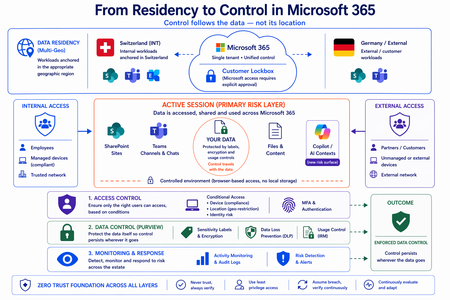
Moving from Residency to Control in Microsoft 365 Every conversation about data sovereignty in regulated industries tends to start the same way: “We use Multi-Geo. The data stays in Switzerland.” It’s the right starting point. Microsoft 365 Multi-Geo allows organizations to place selected workloads - SharePoint sites, OneDrive accounts, Teams data, or Exchange mailboxes - into specific regions, including Switzerland, while maintaining a single global tenant. This makes it possible to align sensitive data with regulatory or customer requirements without fragmenting the overall environment. But it only answers one question: Where is the data stored? It does not answer who accessed the data, from where, under which conditions, or what happened after access. That is where the real problem begins. A scenario that happens every day A Swiss engineering firm stores sensitive project documentation in Switzerland using Multi-Geo. An external contractor - working from an unmanaged device outside Switzerland - is granted access to review a file. The document opens. The data is now on a screen in an unknown location, on a device with no compliance posture, in a session with no restrictions. From the platform’s perspective, residency was enforced. From a sovereignty perspective, control was lost the moment access was granted without conditions. The file never left Switzerland. But sovereignty did. Residency is static. Control is not. The moment a document is opened, storage location stops being the relevant boundary. The file is no longer just “in Switzerland.” It moves instantly across endpoints and browsers, collaboration tools like Teams, external users and partners, and increasingly AI-driven contexts. The infrastructure remains unchanged. The data does not. From the platform’s perspective, everything is working as designed - access was granted, residency was enforced - and control was lost. Most “data in Switzerland” strategies fail at exactly this moment: when the data is used. The shift: from location to conditions If data sovereignty is the goal, the question must change. Not “Where is the data stored?” but: Under which conditions can data be accessed and used? This shift fundamentally changes the architecture. Control must be applied across three distinct layers - and all three must be connected. Layer 1: Access is conditional, not static Conditional Access extends control beyond authentication and turns it into continuous evaluation. Access decisions can depend on: Device compliance Location (geo-restriction) Identity and risk signals Multi-Geo ensures data is placed correctly. Conditional Access ensures it is reachable only under defined conditions. The two must work together - residency without access governance is an incomplete control. Layer 2: The session is the real risk surface Even with strict access controls, risk remains. A session is an exposure surface by design. During an active session, data is viewed, copied, shared, processed by applications, and connected to AI prompts. The gap does not appear at storage or authentication. It appears during active usage - inside the session. This is the layer most architectures do not explicitly address. Controls must extend into the session itself: limiting data transfer and replication, restricting interaction patterns, and enforcing policies in real time. Access is no longer a one-time event. It becomes continuously governed. This becomes even more critical as AI assistants consume content across SharePoint, Teams, Exchange, and other Microsoft 365 services. The question is no longer only where the source document resides - but whether the AI interaction itself is governed by the same access and protection controls as direct access. Layer 3: The document becomes the control point The most durable control does not sit in the network or in the session. It sits in the data itself. In regulated industries, organizations often arrive at this architecture having first evaluated sovereign or national encryption solutions. The decision to rely on native Microsoft 365 Purview encryption rather than a separate layer comes down to integration: AES-256 protection operating natively at file, user, and SharePoint level - including geo-based access restrictions - without an additional system to maintain. When protection is applied directly to the document through Microsoft Purview: Sensitivity labels define classification - automatically assigned based on content Encryption enforces access - AES-256, bound to the file itself IRM controls usage - view, copy, print, share, and presentation rights DLP governs movement across services - preventing data from leaving defined boundaries Dynamic watermarking tracks exposure - applied on open, view, or print At that point, access is enforced by the file, usage restrictions travel with it, and control persists regardless of location. The document becomes the perimeter. Platform control: limiting provider access One dimension often overlooked in sovereignty discussions is platform access itself. Even a perfectly configured tenant is only as sovereign as the controls placed on the operator. Customer Lockbox ensures that even Microsoft support cannot access customer data without explicit, logged, time-bound approval. Every access request is visible, auditable, and subject to customer veto. Data control applies not only to users - but also to the platform operating the service. Enforcement requires an integrated architecture Most organizations already have the required capabilities: Multi-Geo, Conditional Access, session control, Purview (labels, encryption, DLP, IRM), and monitoring. The issue is not capability. It is fragmentation. In practice, fragmentation looks like this: residency is configured in one project, Conditional Access policies are managed by a different team, and Purview labels were applied during a compliance initiative that never connected to the access layer. The tools exist. The signals do not flow between them. When designed as a single architecture: Data is placed intentionally - residency aligned to regulatory requirements Access is governed by context - device, location, and identity evaluated continuously Usage is controlled dynamically - session-level restrictions enforced in real time Protection is embedded in the document - encryption and IRM travel with the file Signals are connected across the platform - monitoring feeds access policy, not just audit logs “Data in Switzerland” becomes not just a statement - but an enforceable system property. Closing thought Placing data in Switzerland is the right first step. Multi-Geo makes it possible, even in global environments. But residency alone is not control. Data residency answers where information is stored. Data sovereignty requires proving who can access it, under which conditions, and what controls remain in place after access is granted. In Microsoft 365, sovereignty is no longer defined by geography alone. It is defined by the ability to enforce control wherever the data travels.
Short survey: Feedback on Sensitivity Label Suggestions in Microsoft 365 Apps
Hi everyone, I’m looking to gather feedback on user experiences with Sensitivity Label suggestions in Microsoft 365 apps. This short survey aims to understand how label recommendations are working in practice and where improvements may be needed. Your responses will help identify common challenges and opportunities to make the label recommendation process more accurate, useful, and seamless for users. Survey link: Experience with Recommended Sensitivity Labels in Microsoft 365 – Fill out form The survey takes around 3 minutes to complete. Your feedback will directly help us better understand real-world experiences with label suggestions. Thank you very much for taking the time to contribute.
Email alerts for sharepoint action "DownloadedFile"
Hi, We are trying setup alerts for files being downloaded on specific executive sharepoint sites. We have created a custom alert policy in security.microsoft.com for that specific site and did few test downloads. We have not received any notifications for these activities. Tried searching the audit logs manually and there are no entries for these activities. Is there any specific setting that needs to be turned on in order to trigger the alert policy? We have activated "Reporting" in Site collection features. Thanks in advance!!Help! Sensitivity label applied to whole tenant mistakenly with Watermark
We create a sensitivity label to have a watermark to be applied on the files on where it assigned but accidentally or due to misconfiguration, the watermark applied to whole tenant and the files, need a solution to automatically removed these watermarks from the files wherever it is applied. Please assist, TIA... .Sharing: All Built-in SIT categorised
So, Microsoft Purview gives you 313 built-in Sensitive Information Types (SITs)—yes, I counted! When I worked with an Cyber Risk auditor, one of their ask was categorizing all the items that we decided for it to be deployed. This was a bit of a nightmare, so I took one for the team and grouped them into three neat categories: PII, Financial, and Medical. Now, I’m sharing it with you so that my struggle can save you the headache. You’re welcome! Download the excel spreadsheet here: All SIT list and their categories.xlsx
Old Tenant Name visible in Outlook Desktop Client under Protect button
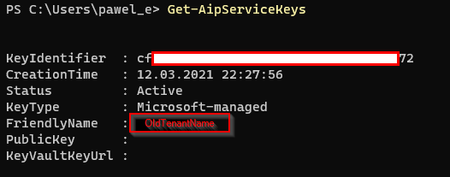
Hello I have a two accounts (two is a minimum to see Tenant Name in front of your email address) added to Outlook Dekstop client. When i create new email and try to Encrypt email using Options > Encrypt button i can see Old tanant name in front of my email address. Organization Settings in admin portal were changed, change is visible in azure portal as well but old tenant name is still visible in outlook. I've found PS command Get-AipServiceKeys which showed me AipServiceKey where old tenant name is visible. Contoso is an OldTenantName Tried to user Set-AipServiceKeyProperties with -RefreshSlcName switch on this key but even command completed succesfully, there is still old name visible under FriendlyName property when i run Get-AipServiceKeys Do you know how to generete new key with correct FriendlyName or how to refresh name in current AipServiceKey? Thanks for your help PS. Microsoft is trying to find answer for my issue since december and there is no any valuable feedback from them.1.2KViews0likes2CommentsAll the locations where you can find Sensitivity labels
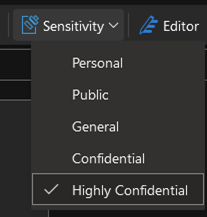
Update (14-Mar-25): Removed Windows Explorer Here are the locations where you can find the sensitivity label of a document (if there are any that I've missed, please feel free to add it here) Sensitivity Label Button in the Document: In Office applications such as Word, Excel, and PowerPoint, you can find the Sensitivity label button on the Home tab. This button allows users to apply or view sensitivity labels directly within the document interface. (Sensitivity label app on the upper right) Document Properties > Advanced Properties Sensitivity labels can also be found in the document properties. To access this, go to File > Info > Properties > Advanced Properties. Here, you can see detailed metadata, including any applied sensitivity labels. Sensitivity Label Column in SharePoint: In SharePoint, sensitivity labels are displayed in a dedicated column. This allows users to quickly see the sensitivity level of documents stored within SharePoint libraries (Removed) Windows File Explorer: - As it was rightly pointed in the comment section, this is a roadmap item that has yet to materialise. Mobile Applications: Office mobile apps for iOS and Android also support sensitivity labels, enabling users to apply and view labels on the go. Microsoft Purview Compliance Portal: Administrators can manage and view sensitivity labels applied across the organization through the Microsoft Purview Compliance Portal. This portal is only accessible to IT admins who has the right Purview role.6.4KViews0likes11CommentsNew Place to Chat with the Microsoft Information Protection Team
Happy Wednesday, all! We're constantly working to provide easily accessible channels for direct interaction with our product team including feedback on how to improve your experience with our products! Moving forward, you can: talk to the Microsoft Information Protection team about our product and integrations via our Yammer Channel or provide feedback via our UserVoice Forum. You can also continue to get updates in our Microsoft Information Protection blog. Finally, we have a complete list of resources available here. If you're currently engaged in a conversation, the conversation space will be moved to the Microsoft Security and Compliance conversation space on 9/2. Feel free to comment with any questions regarding channels or informational resources.Sensitivity column in Windows Explorer populated
Hi Does anybody know when the sensitivity column in Windows explorer will be populated? Currently the only way I see which label is applied to a file is either through AIP unified labeling client, sharepoint document libraries or open a file. Thanks for a feedback. Best regards PhilippSolved18KViews8likes29Comments