microsoft defender for office 365
426 TopicsSentinel - Defender XDR KQL Queries Library
Hello all, I’ve been building something over the past few weeks that I think the security community might find useful. https://goxdr.fyi is a searchable KQL query library for Microsoft Sentinel and Defender XDR. The name comes from a nickname my colleagues gave me (GoX) combined with XDR. I also picked up https://goxdr.fyi as a short and easy to remember domain for it. You can check it out here: https://goxdr.fyi The idea came from my own day to day work as someone working in IAM and SOC operations. I constantly find myself writing and refining KQL queries for threat hunting, detection engineering and incident investigation. Over time I realized I had a growing collection of queries that I kept going back to and I thought why not make these available to others? It currently has 117 queries covering identity security, BEC/AiTM detection, NTLM and LDAP attack hunting, OAuth governance, AI/Copilot security, Sentinel alert trending, SOC performance metrics and more. Some of these queries are ones I wrote from scratch based on real scenarios I encountered in production environments. Others are community queries I tested and validated in my own setup. Only the ones I found genuinely useful and that actually worked against real data made it in. Each query comes with a description explaining what it detects and why it matters, along with severity levels, platform tags (Sentinel, XDR or both) and a copy button so you can paste it directly into Advanced Hunting or use it as the basis for an Analytics Rule. The site is open source, hosted on GitHub Pages and licensed under CC BY 4.0. No sign-up, no paywall, no tracking. The source is available. I’ll keep adding queries as new scenarios come up. If there’s enough interest I’m also considering adding Cortex XQL queries for Palo Alto environments. Suggestions, feedback or ideas for new detections are always welcome. Feel free to reach out. Thanks97Views0likes0CommentsFeature Request: Manual Invocation Mode for Embedded Security Copilot Experiences to reduce cost !
Hello, I see that Copilot for Security in XDR dashboards , if used in embedded mode (I mean whenever you are opening a case to investigate) you get AUTOMATICALLY a summary of the incident , and you are consuming SCU costs. I want a way either globally as a tenant option, or through a pwsh to be able to DISABLE this, or be able to PRESS the AI button AND THEN generate the AI reply (and consume SCU credits ..) Current behavior: Open Incident --> Copilot automatically generates Incident Summary --> SCUs ARE consumed Desired behavior: Open Incident --> No AI execution --> Click "Generate Summary" MANUALLY --> SCUs consumed I am not talking about RBAC controls to assign WHO of my admins can use Security Copilot, I have set that, BUT I want my admin to decide IF they want AI to help them (and consume - pay for that SCU credits-costs) OR NOT !! At the moment I havent found any solution, except to educate my admin to press CANCEL the moment he/she opens such an XDR dashboard ! :) Does anyone knows something ? Regards, Panos108Views0likes2Comments
Defender of XDR - Quarantine - Lack of filter/search options
Hi Microsoft, I love what you're doing with the Defender XDR portal, but could you please show some love to the Quarantine section soon? On a daily basis, I have to review emails caught in quarantine for false positives, and the lack of search and filtering options is appalling. As a company based in Denmark, 99% of legitimate emails come from .dk domains. Yet there is no way to search for or filter on something this simple. If I type .dk into the search box, I get 0 results, even though I can clearly see .dk sender addresses on the page. The filter options only allow me to enter full sender or recipient email addresses, which is of course almost useless in a quarantine-review context. Some examples of filters that would be extremely useful: Sender domain ends with .dk Sender domain contains .dk URL domain filtering Attachment name filtering Saved filter views More flexible search across message properties The Quarantine experience could be made dramatically better with relatively little effort. So please, pretty please, give the Quarantine portal some attention. It's often the part of Defender that security teams interact with every single day.178Views0likes4CommentsCampaign-Centric Hunting with Microsoft Defender XDR and Microsoft Sentinel
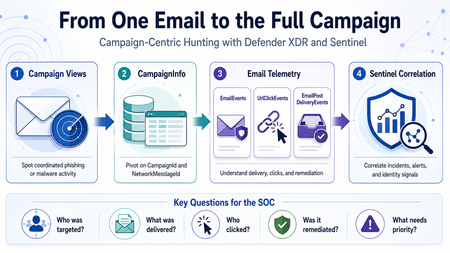
Phishing investigations usually start with one suspicious email. A user reports a message. An alert is generated. An analyst opens the email details, checks the sender, reviews the URL, and tries to understand whether the message is malicious. That is a normal starting point. However, in a real SOC investigation, one email is rarely the full story. Attackers usually operate in campaigns. They reuse sender infrastructure, similar subjects, URLs, payloads, templates, and delivery techniques. A single email may be only one part of a wider phishing or malware campaign targeting multiple users. This is why campaign-centric hunting is important. I wrote this article from the perspective of a SOC analyst who often needs to move quickly from a single suspicious email to the full campaign impact. The goal is simple: use Microsoft Defender XDR and Microsoft Sentinel together to understand who was targeted, what was delivered, who clicked, and what should be prioritized first. Why Campaign-Centric Hunting When investigating a phishing or malware email, analysts usually need to answer practical questions: How many users received messages from the same campaign? Were the messages blocked, junked, delivered, or remediated? Did any user click the URL? Did anyone click through a Safe Links warning? Were any priority or high-risk users affected? Was the email removed after delivery? Are there related Defender XDR or Sentinel incidents? If we only investigate one message, we may miss the bigger picture. Campaign-centric hunting helps the SOC move from this question: Is this email malicious? To this question: What is the full impact of this campaign? That shift is important because the response priority should be based on campaign impact, not only on a single alert. What Campaign Views Provides Campaign Views in Microsoft Defender for Office 365 help analysts investigate coordinated email attacks such as phishing and malware campaigns. From Campaign Views, analysts can review campaign-level information such as: Campaign name Campaign type Campaign subtype Targeted users Inboxed messages Clicked users Visited links Sender domains Sender IPs Payload URLs Delivery actions Campaign timeline Campaign flow This is useful during triage because it quickly shows whether an email is part of a wider attack. For example, one reported phishing message may look small at first. But if Campaign Views shows that the same campaign targeted 50 users, delivered messages to 15 inboxes, and had 2 users click the URL, the investigation becomes much more urgent. Where CampaignInfo Fits The CampaignInfo table gives analysts a KQL-based way to query campaign-related data. Some useful fields are: Field Purpose CampaignId Unique identifier for the campaign CampaignName Name of the campaign CampaignType Campaign category, such as Phish or Malware CampaignSubtype Additional context, such as brand being phished or malware family NetworkMessageId Unique identifier for the email message RecipientEmailAddress Recipient affected by the campaign Timestamp Time when the event was recorded For correlation, the most important field is usually: NetworkMessageId This field can help connect campaign data with other Defender XDR email tables, including: EmailEvents UrlClickEvents EmailPostDeliveryEvents EmailAttachmentInfo EmailUrlInfo This makes CampaignInfo a useful pivot table for campaign-level hunting. Important note: CampaignInfo is currently documented as Preview. Before using these queries in production analytics rules, validate the table availability, schema, and results in your own tenant. Practical Scenario An analyst receives a phishing alert in Microsoft Defender XDR. The alert is related to a user who received a suspicious email with a credential-harvesting URL. The analyst opens Campaign Views and sees that the message belongs to a wider phishing campaign. At that point, the investigation should not stop with the original user. The analyst should now ask: Who else received this campaign? How many messages were delivered? Which users clicked? Did any users click through the Safe Links warning? Were the messages removed after delivery? Are there related incidents in Microsoft Sentinel? The investigation flow could look like this: Start from Campaign Views in Microsoft Defender XDR. Identify the campaign details. Use CampaignInfo to list affected users and messages. Join with EmailEvents to validate delivery status. Join with UrlClickEvents to identify user interaction. Join with EmailPostDeliveryEvents to confirm remediation. Review related Microsoft XDR incidents in Microsoft Sentinel. Prioritize response based on campaign impact. Query 1: List Recent Campaigns The first query gives a simple overview of recent campaigns. CampaignInfo | where Timestamp > ago(14d) | summarize FirstSeen = min(Timestamp), LastSeen = max(Timestamp), AffectedUsers = dcount(RecipientEmailAddress), Messages = dcount(NetworkMessageId) by CampaignId, CampaignName, CampaignType, CampaignSubtype | order by LastSeen desc This helps analysts quickly identify campaigns that affected the organization during the selected period. Useful questions to ask from this output: Which campaigns are most recent? Which campaigns affected the most users? Are the campaigns phishing, malware, or spam? Is there a specific brand or malware family in the subtype? Are similar campaigns appearing repeatedly? Query 2: Understand Delivery Impact After identifying campaigns, the next step is to understand delivery impact. A campaign that was fully blocked is different from a campaign that reached user inboxes. let Campaigns = CampaignInfo | where Timestamp > ago(14d) | project CampaignId, CampaignName, CampaignType, CampaignSubtype, NetworkMessageId, RecipientEmailAddress; Campaigns | join kind=leftouter ( EmailEvents | where Timestamp > ago(14d) | project NetworkMessageId, RecipientEmailAddress, Subject, SenderFromAddress, SenderFromDomain, SenderIPv4, DeliveryAction, DeliveryLocation, ThreatTypes, DetectionMethods, Timestamp ) on NetworkMessageId, RecipientEmailAddress | summarize Messages = dcount(NetworkMessageId), AffectedUsers = dcount(RecipientEmailAddress), Subjects = make_set(Subject, 5), SenderDomains = make_set(SenderFromDomain, 10), SenderIPs = make_set(SenderIPv4, 10) by CampaignId, CampaignName, CampaignType, CampaignSubtype, DeliveryAction, DeliveryLocation | order by AffectedUsers desc, Messages desc This query helps separate campaigns that were blocked from campaigns that actually reached users. From a SOC perspective, delivered messages deserve closer attention, especially if they reached the inbox. Query 3: Identify Users Who Clicked Campaign URLs Delivery is important, but clicks usually increase the priority of the incident. This query joins campaign data with UrlClickEvents. let Campaigns = CampaignInfo | where Timestamp > ago(14d) | project CampaignId, CampaignName, CampaignType, CampaignSubtype, NetworkMessageId, RecipientEmailAddress; Campaigns | join kind=inner ( UrlClickEvents | where Timestamp > ago(14d) | project NetworkMessageId, AccountUpn, Url, ActionType, IsClickedThrough, ThreatTypes, DetectionMethods, IPAddress, Workload, ClickTime = Timestamp ) on NetworkMessageId | summarize FirstClick = min(ClickTime), LastClick = max(ClickTime), ClickEvents = count(), ClickedUsers = dcount(AccountUpn), ClickThroughUsers = dcountif(AccountUpn, IsClickedThrough == true), ClickedUrls = make_set(Url, 10), SourceIPs = make_set(IPAddress, 10) by CampaignId, CampaignName, CampaignType, CampaignSubtype | order by ClickThroughUsers desc, ClickedUsers desc, LastClick desc This query helps identify campaigns where users interacted with the payload. If a user clicked a phishing URL, the next step should usually include identity-focused investigation, such as reviewing sign-in activity, MFA status, session activity, and possible risky sign-ins. Query 4: Focus on Click-Through Events Safe Links may block access to a malicious site. In some cases, however, a user may continue through a warning page. Those cases should be reviewed carefully. let Campaigns = CampaignInfo | where Timestamp > ago(30d) | project CampaignId, CampaignName, CampaignType, CampaignSubtype, NetworkMessageId, RecipientEmailAddress; Campaigns | join kind=inner ( UrlClickEvents | where Timestamp > ago(30d) | where IsClickedThrough == true | project NetworkMessageId, AccountUpn, Url, ActionType, ThreatTypes, IPAddress, ClickTime = Timestamp ) on NetworkMessageId | project ClickTime, CampaignId, CampaignName, CampaignType, CampaignSubtype, AccountUpn, RecipientEmailAddress, Url, ActionType, ThreatTypes, IPAddress | order by ClickTime desc This is one of the most useful views during incident response. A click-through event does not automatically mean compromise, but it is a strong reason to investigate the user account further. Query 5: Confirm Post-Delivery Remediation A malicious message may be delivered first and removed later by ZAP, AIR, or manual remediation. This query joins CampaignInfo with EmailPostDeliveryEvents. let Campaigns = CampaignInfo | where Timestamp > ago(30d) | project CampaignId, CampaignName, CampaignType, CampaignSubtype, NetworkMessageId, RecipientEmailAddress; Campaigns | join kind=leftouter ( EmailPostDeliveryEvents | where Timestamp > ago(30d) | project NetworkMessageId, RecipientEmailAddress, RemediationTime = Timestamp, Action, ActionType, ActionTrigger, ActionResult, DeliveryLocation, SourceLocation ) on NetworkMessageId, RecipientEmailAddress | summarize RemediatedMessages = dcountif(NetworkMessageId, isnotempty(ActionType)), RemediationTypes = make_set(ActionType, 10), RemediationResults = make_set(ActionResult, 10), LastRemediation = max(RemediationTime) by CampaignId, CampaignName, CampaignType, CampaignSubtype | order by LastRemediation desc This helps answer a very important question: Were the delivered malicious messages actually removed? This is useful for both SOC triage and reporting because it shows not only detection, but also response. Query 6: Campaign Blast Radius Summary The following query combines campaign, delivery, click, and remediation data into one campaign-level view. let TimeRange = 30d; let Campaigns = CampaignInfo | where Timestamp > ago(TimeRange) | project CampaignId, CampaignName, CampaignType, CampaignSubtype, NetworkMessageId, RecipientEmailAddress; let Delivery = EmailEvents | where Timestamp > ago(TimeRange) | summarize DeliveryActions = make_set(DeliveryAction, 10), DeliveryLocations = make_set(DeliveryLocation, 10), DeliveredMessages = dcountif(NetworkMessageId, DeliveryAction =~ "Delivered"), JunkedMessages = dcountif(NetworkMessageId, DeliveryAction =~ "Junked"), BlockedMessages = dcountif(NetworkMessageId, DeliveryAction =~ "Blocked"), Subjects = make_set(Subject, 5), SenderDomains = make_set(SenderFromDomain, 10) by NetworkMessageId, RecipientEmailAddress; let Clicks = UrlClickEvents | where Timestamp > ago(TimeRange) | summarize ClickEvents = count(), ClickThroughEvents = countif(IsClickedThrough == true), FirstClick = min(Timestamp), LastClick = max(Timestamp), ClickedUrls = make_set(Url, 10) by NetworkMessageId; let Remediation = EmailPostDeliveryEvents | where Timestamp > ago(TimeRange) | summarize RemediationActions = make_set(ActionType, 10), LastRemediation = max(Timestamp) by NetworkMessageId, RecipientEmailAddress; Campaigns | join kind=leftouter Delivery on NetworkMessageId, RecipientEmailAddress | join kind=leftouter Clicks on NetworkMessageId | join kind=leftouter Remediation on NetworkMessageId, RecipientEmailAddress | summarize AffectedUsers = dcount(RecipientEmailAddress), Messages = dcount(NetworkMessageId), DeliveredMessages = sum(DeliveredMessages), JunkedMessages = sum(JunkedMessages), BlockedMessages = sum(BlockedMessages), TotalClickEvents = sum(ClickEvents), ClickThroughEvents = sum(ClickThroughEvents), Subjects = make_set(Subjects, 10), SenderDomains = make_set(SenderDomains, 10), ClickedUrls = make_set(ClickedUrls, 10), RemediationActions = make_set(RemediationActions, 10), LastClick = max(LastClick), LastRemediation = max(LastRemediation) by CampaignId, CampaignName, CampaignType, CampaignSubtype | extend SuggestedPriority = case( ClickThroughEvents > 0, "High", TotalClickEvents > 0, "Medium", DeliveredMessages > 0, "Medium", "Low" ) | order by SuggestedPriority asc, AffectedUsers desc, Messages desc This type of query can be useful during hunting sessions, incident review, and campaign reporting. The goal is not only to collect more data. The goal is to help the analyst decide what needs attention first. Correlating Campaign Activity with Microsoft Sentinel When Microsoft Defender XDR is connected to Microsoft Sentinel, incidents and alerts can be synchronized into the Sentinel incident queue. This allows the SOC to correlate campaign-related email activity with other security signals, such as: Suspicious sign-ins Identity alerts Endpoint alerts Cloud app activity OAuth consent activity Data exfiltration attempts Related Microsoft XDR incidents For example, if a user clicked a phishing URL, the SOC can then review whether the same user had suspicious sign-in activity shortly after the click. The following query is a simple starting point for reviewing Microsoft XDR incidents in Microsoft Sentinel. SecurityIncident | where TimeGenerated > ago(30d) | where ProviderName == "Microsoft XDR" | where Title has_any ("phish", "phishing", "email", "malware", "campaign") | summarize Incidents = count(), HighSeverity = countif(Severity == "High"), MediumSeverity = countif(Severity == "Medium"), Closed = countif(Status == "Closed"), Active = countif(Status == "Active") by bin(TimeGenerated, 1d) | order by TimeGenerated desc This query does not replace campaign hunting. It simply helps analysts understand how email-related activity is represented in the Sentinel incident queue. Suggested SOC Workflow A practical campaign-centric workflow could look like this: Step 1: Start from Campaign Views Review campaigns with delivered messages, clicked users, visited links, or high user impact. Step 2: Pivot to KQL Use CampaignInfo to list campaign-related messages and affected recipients. Step 3: Validate Delivery Join with EmailEvents to confirm whether messages were blocked, junked, delivered, or replaced. Step 4: Review User Interaction Join with UrlClickEvents to identify users who clicked URLs or clicked through Safe Links warnings. Step 5: Confirm Remediation Join with EmailPostDeliveryEvents to confirm whether delivered messages were removed after delivery. Step 6: Correlate in Sentinel Review related Microsoft XDR incidents and correlate with identity, endpoint, and cloud activity. Step 7: Decide Response Depending on the impact, the SOC may decide to: Escalate the incident Notify affected users Review user sign-ins Revoke user sessions Reset passwords Block sender domains or URLs Submit false negatives Create a watchlist for related indicators Tune analytics rules or response processes Suggested Priority Logic Not every campaign needs the same level of response. A simple triage model could be: Condition Suggested priority Campaign blocked before delivery Low Campaign delivered to junk Low to Medium Campaign delivered to inbox Medium Campaign delivered to multiple inboxes Medium to High User clicked URL High User clicked through warning High Priority account clicked High Click followed by suspicious sign-in Critical This model should be adapted to each organization’s risk profile and response process. Limitations and Things to Validate Before using this approach in production, validate the following: Defender for Office 365 Plan 2 availability Campaign Views permissions CampaignInfo table availability Defender XDR connector configuration Advanced hunting event streaming Field names in your environment Retention period Data latency Join behavior using NetworkMessageId Whether click events can be joined to email metadata in all cases One important limitation is that some URL click events may not join cleanly with email metadata. For example, clicks from Drafts or Sent Items may not have the same message metadata available for correlation. Also, because CampaignInfo is currently documented as Preview, I would avoid depending on it alone for critical production automation without testing and validation.210Views0likes0CommentsOperational Notes on Microsoft Security Copilot Agents in Defender XDR and Microsoft Entra ID
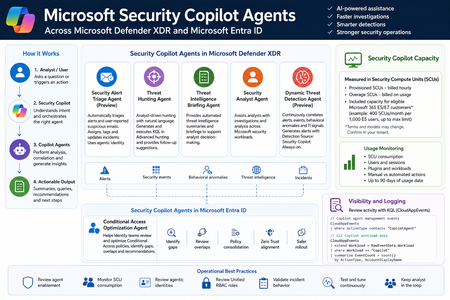
Microsoft Security Copilot is now becoming more visible inside day-to-day security operations, especially through embedded experiences and agent-based workflows across Microsoft Defender XDR, Microsoft Entra ID, Microsoft Intune, and Microsoft Purview. Instead of looking at Security Copilot only as a standalone prompt interface, SOC and identity teams should also understand how Security Copilot agents are deployed, how they consume Security Compute Units, how they appear in operational workflows, and where activity can be monitored. This post summarizes practical observations from a security operations perspective, with a focus on Microsoft Defender XDR, Microsoft Entra ID, usage monitoring, and KQL-based activity review. Licensing & Capacity Units Requirements Requires eligible Microsoft security licensing, typically: Microsoft 365 E5 Microsoft 365 E7 Security Compute Units (SCUs) Security Copilot capacity is measured using Security Compute Units (SCUs). SCUs are billed based on provisioned capacity. Indicative pricing: $4 per Provisionied SCU/hour $6 per Overage SCU/hour Billing is calculated hourly, based on the amount of SCUs provisioned. Included Capacity Organizations with: 1,000 Microsoft 365 E5 licenses Receive: 400 included SCUs Included SCUs are shared across the tenant within a common capacity pool. Scaling SCU capacity can be scaled dynamically based on operational requirements and workload demand. Data Retention Security Copilot session and interaction data without active SCU-backed retention is typically retained for: 90 days Security Copilot Agents - Microsoft Defender This section outlines the Microsoft Security Copilot agents currently available in the Microsoft Defender portal. NameKey characteristics Security Alert Triage Agent (Preview) Manual setup from Defender portal Automatically creates Unified RBAC custom role Runs automatically when a user reports a suspicious email or when a new supported alert is generated, supported alert sources: MDI, MDC, MDO If an alert tuning rule is enabled, it will be automatically disabled when the agent is deployed. Creates and connects with agentic user account: Phishing Triage Agent (Security Copilot) Automatic alert assignment to SecurityCopilotAgentUser-db16fec3-f1fb-4632-843e-46d07408c584@<tenant-domain>Alert was assigned to Phishing Triage Agent (Security Copilot). Adds Tag Agent to the created Incidents Threat Hunting Agent Manual setup from Defender portal Automatically creates Unified RBAC custom role This agent runs manually. There isn't an automatic trigger. Creates and connects with agentic user account: Threat Hunting Agent (Security Copilot) Analyst Questions in natural language Generates and executed KQL queries in Advanced hunting Provides charts, dynamic follow-up questions and remediation actions recommendations No activity is identified from agent's identity during agent execution Threat Intelligence Briefing Agent Manual setup from Defender portal Provides automated TI briefing summary Configured from https://security.microsoft.com/securitysettings/defender/agent_configuration-threatintelligencebriefingagent Security Analyst Agent Manual setup from Defender portal Dynamic Threat Detection Agent (Preview) Automatically enabled always-on, runs continuously in the background Correlates: Alerts, Security events, Behavioral anomalies, TI signals Generates Alerts with Detection Source: Security Copilot The Alerts can be correlated with existing Multi-Stage Incidents No agentic user account identity is used by this agent Available free of charge during public preview, will begin consuming Security Compute Units (SCUs) once generally available (GA) Incidents handled by Security Alert Triage Agent: Alerts created by Dynamic Threat Detection Agent: Execution of Threat Hunting Agent: View agents in use: https://security.microsoft.com/security-copilot/agents View Unified RBAC custom roles: https://security.microsoft.com/mtp_roles View Security Copilot user identities in Microsoft Entra ID: Notes: CloudAppEvents activity logs only from the following agents: Phishing Triage Agent Conditional Access Optimization Agent Security Copilot Agents - Microsoft Entra ID Conditional Access Optimization Agent Usage Monitoring Sign-in to Security Copilot portal using Global Admin account and navigate to the following location: https://securitycopilot.microsoft.com/usage-monitoring Reference: https://learn.microsoft.com/en-us/copilot/security/manage-usage Logging Activity Copilot Agents Management: CloudAppEvents | where ActionType contains "CopilotAgent" | extend AgentName = RawEventData.AgentName | extend Workload = RawEventData.Workload | extend ResultStatus = RawEventData.ResultStatus | project TimeGenerated, ActionType, ResultStatus, AgentName, Application, Workload All Copilot Workload data: CloudAppEvents | extend Workload = RawEventData.Workload | where Workload == "Copilot" | summarize EventCount = count() by ActionType, AccountDisplayName335Views3likes1CommentWhy UK Enterprise Cybersecurity Is Failing in 2026 (And What Leaders Must Change)
Enterprise cybersecurity in large organisations has always been an asymmetric game. But with the rise of AI‑enabled cyber attacks, that imbalance has widened dramatically - particularly for UK and EMEA enterprises operating complex cloud, SaaS, and identity‑driven environments. Microsoft Threat Intelligence and Microsoft Defender Security Research have publicly reported a clear shift in how attackers operate: AI is now embedded across the entire attack lifecycle. Threat actors use AI to accelerate reconnaissance, generate highly targeted phishing at scale, automate infrastructure, and adapt tactics in real time - dramatically reducing the time required to move from initial access to business impact. In recent months, Microsoft has documented AI‑enabled phishing campaigns abusing legitimate authentication mechanisms, including OAuth and device‑code flows, to compromise enterprise accounts at scale. These attacks rely on automation, dynamic code generation, and highly personalised lures - not on exploiting traditional vulnerabilities or stealing passwords. The Reality Gap: Adaptive Attackers vs. Static Enterprise Defences Meanwhile, many UK enterprises still rely on legacy cybersecurity controls designed for a very different threat model - one rooted in a far more predictable world. This creates a dangerous "Resilience Gap." Here is why your current stack is failing- and the C-Suite strategy required to fix it. 1. The Failure of Traditional Antivirus in the AI Era Traditional antivirus (AV) relies on static signatures and hashes. It assumes malicious code remains identical across different targets. AI has rendered this assumption obsolete. Modern malware now uses automated mutation to generate unique code variants at execution time, and adapts behaviour based on its environment. Microsoft Threat Intelligence has observed threat actors using AI‑assisted tooling to rapidly rewrite payload components, ensuring that every deployment looks subtly different. In this model, there is no reliable signature to detect. By the time a pattern exists, the attacker has already moved on. Signature‑based detection is not just slow - it is structurally misaligned with AI‑driven attacks. The Risk: If your security relies on "recognising" a threat, you are already breached. By the time a signature exists, the attacker has evolved. The C-Suite Pivot: Shift investment from artifact detection to EDR/XDR (Extended Detection and Response). We must prioritise behavioural analytics and machine learning models that identify intent rather than file names. 2. Why Perimeter Firewalls Fail in a Cloud-First World Many UK enterprise still rely on firewalls enforcing static allow/deny rules based on IP addresses and ports. This model worked when applications were predictable and networks clearly segmented. Today, enterprise traffic is encrypted, cloud‑hosted, API‑driven, and deeply integrated with SaaS and identity services. AI‑assisted phishing campaigns abusing OAuth and device‑code flows demonstrate this clearly. From a network perspective, everything looks legitimate: HTTPS traffic to trusted identity providers. No suspicious port. No malicious domain. Yet the attacker successfully compromises identity. The Risk: Traditional firewalls are "blind" to identity-based breaches in cloud environments. The C-Suite Pivot: Move to Identity-First Security. Treat Identity as the new Control Plane, integrating signals like user risk, device health, and geolocation into every access decision. 3. The Critical Weakness of Single-Factor Authentication Despite clear NCSC guidance, single-factor passwords remain a common vulnerability in legacy applications and VPNs. AI-driven credential abuse has changed the economics of these attacks. Threat actors now deploy adaptive phishing campaigns that evolve in real-time. Microsoft has observed attackers using AI to hyper-target high-value UK identities- specifically CEOs, Finance Directors, and Procurement leads. The Risk: Static passwords are now the primary weak link in UK supply chain security. The C-Suite Pivot: Mandate Phishing‑resistant MFA (Passkeys or hardware security keys). Implement Conditional Access policies that evaluate risk dynamically at the moment of access, not just at login. Legacy Security vs. AI‑Era Reality 4. The Inherent Risk of VPN-Centric Security VPNs were built on a flawed assumption: that anyone "inside" the network is trustworthy. In 2026, this logic is a liability. AI-assisted attackers now use automation to map internal networks and identify escalation paths the moment they gain VPN access. Furthermore, Microsoft has tracked nation-state actors using AI to create synthetic employee identities- complete with fake resumes and deepfake communication. In these scenarios, VPN access isn't "hacked"; it is legally granted to a fraudster. The Risk: A compromised VPN gives an attacker the "keys to the kingdom." The C-Suite Pivot: Transition to Zero Trust Architecture (ZTA). Access must be explicit, scoped to the specific application, and continuously re‑evaluated using behavioural signals. 5. Data: The High-Velocity Target Sensitive data sitting unencrypted in legacy databases or backups is a ticking time bomb. In the AI era, data discovery is no longer a slow, manual process for a hacker. Attackers now use AI to instantly analyse your directory structures, classify your files, and prioritise high-value data for theft. Unencrypted data significantly increases your "blast radius," turning a containable incident into a catastrophic board-level crisis. The Risk: Beyond the technical breach, unencrypted data leads to massive UK GDPR fines and irreparable brand damage. The C-Suite Pivot: Adopt Data-Centric Security. Implement encryption by default, classify data while adding sensitivity labels and start board-level discussions regarding post‑quantum cryptography (PQC) to future-proof your most sensitive assets. 6. The Failure of Static IDS Traditional Intrusion Detection Systems (IDS) rely on known indicators of compromise - assuming attackers reuse the same tools and techniques. AI‑driven attacks deliberately avoid that assumption. Threat actors are now using Large Language Models (LLMs) to weaponize newly disclosed vulnerabilities within hours. While your team waits for a "known pattern" to be updated in your system, the attacker is already using a custom, AI-generated exploit. The Risk: Your team is defending against yesterday's news while the attacker is moving at machine speed. The C-Suite Pivot: Invest in Adaptive Threat Detection. Move toward Graph‑based XDR platforms that correlate signals across email, endpoint, and cloud to automate investigation and response before the damage spreads. From Static Security to Continuous Security Closing Thought: Security Is a Journey, Not a Destination For UK enterprises, the shift toward adaptive cybersecurity is no longer optional - it is increasingly driven by regulatory expectation, board oversight, and accountability for operational resilience. Recent UK cyber resilience reforms and evolving regulatory frameworks signal a clear direction of travel: cybersecurity is now a board‑level responsibility, not a back‑office technical concern. Directors and executive leaders are expected to demonstrate effective governance, risk ownership, and preparedness for cyber disruption - particularly as AI reshapes the threat landscape. AI is not a future cybersecurity problem. It is a current force multiplier for attackers, exposing the limits of legacy enterprise security architectures faster than many organisations are willing to admit. The uncomfortable truth for boards in 2026 is that no enterprise is 100% secure. Intrusions are inevitable. Credentials will be compromised. Controls will be tested. The difference between a resilient enterprise and a vulnerable one is not the absence of incidents, but how risk is managed when they occur. In mature organisations, this means assuming breach and designing for containment: Access controls that limit blast radius Least privilege and conditional access restricting attackers to the smallest possible scope if an identity is compromised Data‑centric security using automated classification and encryption, ensuring that even when access is misused, sensitive data cannot be freely exfiltrated As a Senior Enterprise Cybersecurity Architect, I see this moment as a unique opportunity. AI adoption does not have to repeat the mistakes of earlier technology waves, where innovation moved fast and security followed years later. We now have a rare chance to embed security from day one - designing identity controls, data boundaries, automated monitoring, and governance before AI systems become business‑critical. When security is built in upfront, enterprises don’t just reduce risk - they gain the confidence to move faster and unlock AI’s value safely. Security is no longer a “department”. In the age of AI, it is a continuous business function - essential to preserving trust and maintaining operational continuity as attackers move at machine speed. References: Inside an AI‑enabled device code phishing campaign | Microsoft Security Blog AI as tradecraft: How threat actors operationalize AI | Microsoft Security Blog Detecting and analyzing prompt abuse in AI tools | Microsoft Security Blog Post-Quantum Cryptography | CSRC Microsoft Digital Defense Report 2025 | Microsoft https://www.ncsc.gov.uk/news/government-adopt-passkey-technology-digital-servicesAuthorization and Governance for AI Agents: Runtime Authorization Beyond Identity at Scale
Designing Authorization‑Aware AI Agents at Scale Enforcing Runtime RBAC + ABAC with Approval Injection (JIT) Microsoft Entra Agent Identity enables organizations to govern and manage AI agent identities in Copilot Studio, improving visibility and identity-level control. However, as enterprises deploy multiple autonomous AI agents, identity and OAuth permissions alone cannot answer a more critical question: “Should this action be executed now, by this agent, for this user, under the current business and regulatory context?” This post introduces a reusable Authorization Fabric—combining a Policy Enforcement Point (PEP) and Policy Decision Point (PDP)—implemented as a Microsoft Entra‑protected endpoint using Azure Functions/App Service authentication. Every AI agent (Copilot Studio or AI Foundry/Semantic Kernel) calls this fabric before tool execution, receiving a deterministic runtime decision: ALLOW / DENY / REQUIRE_APPROVAL / MASK Who this is for Anyone building AI agents (Copilot Studio, AI Foundry/Semantic Kernel) that call tools, workflows, or APIs Organizations scaling to multiple agents and needing consistent runtime controls Teams operating in regulated or security‑sensitive environments, where decisions must be deterministic and auditable Why a V2? Identity is necessary—runtime authorization is missing Entra Agent Identity (preview) integrates Copilot Studio agents with Microsoft Entra so that newly created agents automatically get an Entra agent identity, manageable in the Entra admin center, and identity activity is logged in Entra. That solves who the agent is and improves identity governance visibility. But multi-agent deployments introduce a new risk class: Autonomous execution sprawl — many agents, operating with delegated privileges, invoking the same backends independently. OAuth and API permissions answer “can the agent call this API?” They do not answer “should the agent execute this action under business policy, compliance constraints, data boundaries, and approval thresholds?” This is where a runtime authorization decision plane becomes essential. The pattern: Microsoft Entra‑Protected Authorization Fabric (PEP + PDP) Instead of embedding RBAC logic independently inside every agent, use a shared fabric: PEP (Policy Enforcement Point): Gatekeeper invoked before any tool/action PDP (Policy Decision Point): Evaluates RBAC + ABAC + approval policies Decision output: ALLOW / DENY / REQUIRE_APPROVAL / MASK This Authorization Fabric functions as a shared enterprise control plane, decoupling authorization logic from individual agents and enforcing policies consistently across all autonomous execution paths. Architecture (POC reference architecture) Use a single runtime decision plane that sits between agents and tools. What’s important here Every agent (Copilot Studio or AI Foundry/SK) calls the Authorization Fabric API first The fabric is a protected endpoint (Microsoft Entra‑protected endpoint required) Tools (Graph/ERP/CRM/custom APIs) are invoked only after an ALLOW decision (or approval) Trust boundaries enforced by this architecture Agents never call business tools directly without a prior authorization decision The Authorization Fabric validates caller identity via Microsoft Entra Authorization decisions are centralized, consistent, and auditable Approval workflows act as a runtime “break-glass” control for high-impact actions This ensures identity, intent, and execution are independently enforced, rather than implicitly trusted. Runtime flow (Decision → Approval → Execution) Here is the runtime sequence as a simple flow (you can keep your Mermaid diagram too). ```mermaid flowchart TD START(["START"]) --> S1["[1] User Request"] S1 --> S2["[2] Agent Extracts Intent\n(action, resource, attributes)"] S2 --> S3["[3] Call /authorize\n(Entra protected)"] S3 --> S4 subgraph S4["[4] PDP Evaluation"] ABAC["ABAC: Tenant · Region · Data Sensitivity"] RBAC["RBAC: Entitlement Check"] Threshold["Approval Threshold"] ABAC --> RBAC --> Threshold end S4 --> Decision{"[5] Decision?"} Decision -->|"ALLOW"| Exec["Execute Tool / API"] Decision -->|"MASK"| Masked["Execute with Masked Data"] Decision -->|"DENY"| Block["Block Request"] Decision -->|"REQUIRE_APPROVAL"| Approve{"[6] Approval Flow"} Approve -->|"Approved"| Exec Approve -->|"Rejected"| Block Exec --> Audit["[7] Audit & Telemetry"] Masked --> Audit Block --> Audit Audit --> ENDNODE(["END"]) style START fill:#4A90D9,stroke:#333,color:#fff style ENDNODE fill:#4A90D9,stroke:#333,color:#fff style S1 fill:#5B5FC7,stroke:#333,color:#fff style S2 fill:#5B5FC7,stroke:#333,color:#fff style S3 fill:#E8A838,stroke:#333,color:#fff style S4 fill:#FFF3E0,stroke:#E8A838,stroke-width:2px style ABAC fill:#FCE4B2,stroke:#999 style RBAC fill:#FCE4B2,stroke:#999 style Threshold fill:#FCE4B2,stroke:#999 style Decision fill:#fff,stroke:#333 style Exec fill:#2ECC71,stroke:#333,color:#fff style Masked fill:#27AE60,stroke:#333,color:#fff style Block fill:#C0392B,stroke:#333,color:#fff style Approve fill:#F39C12,stroke:#333,color:#fff style Audit fill:#3498DB,stroke:#333,color:#fff ``` Design principle: No tool execution occurs until the Authorization Fabric returns ALLOW or REQUIRE_APPROVAL is satisfied via an approval workflow. Where Power Automate fits (important for readers) In most Copilot Studio implementations, Agents calls Power Automate (agent flows), is the practical integration layer that calls enterprise services and APIs. Copilot Studio supports “agent flows” as a way to extend agent capabilities with low-code workflows. For this pattern, Power Automate typically: acquires/uses the right identity context for the call (depending on your tenant setup), and calls the /authorize endpoint of the Authorization Fabric, returns the decision payload to the agent for branching. Copilot Studio also supports calling REST endpoints directly using the HTTP Request node, including passing headers such as Authorization: Bearer <token>. Protected endpoint only: Securing the Authorization Fabric with Microsoft Entra For this V2 pattern, the Authorization Fabric must be protected using Microsoft Entra‑protected endpoint on Azure Functions/App Service (built‑in auth). Microsoft Learn provides the configuration guidance for enabling Microsoft Entra as the authentication provider for Azure App Service / Azure Functions. Step 1 — Create the Authorization Fabric API (Azure Function) Expose an authorization endpoint: HTTP Step 2 — Enable Microsoft Entra‑protected endpoint on the Function App In Azure Portal: Function App → Authentication Add identity provider → Microsoft Choose Workforce configuration (enterprise tenant) Set Require authentication for all requests This ensures the Authorization Fabric is not callable without a valid Entra token. Step 3 — Optional hardening (recommended) Depending on enterprise posture, layer: IP restrictions / Private endpoints APIM in front of the Function for rate limiting, request normalization, centralized logging (For a POC, keep it minimal—add hardening incrementally.) Externalizing policy (so governance scales) To make this pattern reusable across multiple agents, policies should not be hardcoded inside each agent. Instead, store policy definitions in a central policy store such as Cosmos DB (or equivalent configuration store), and have the PDP load/evaluate policies at runtime. Why this matters: Policy changes apply across all agents instantly (no agent republish) Central governance + versioning + rollback becomes possible Audit and reporting become consistent across environments (For the POC, a single JSON document per policy pack in Cosmos DB is sufficient. For production, add versioning and staged rollout.) Store one PolicyPack JSON document per environment (dev/test/prod). Include version, effectiveFrom, priority for safe rollout/rollback. Minimal decision contract (standard request / response) To keep the fabric reusable across agents, standardize the request payload. Request payload (example) Decision response (deterministic) Example scenario (1 minute to understand) Scenario: A user asks a Finance agent to create a Purchase Order for 70,000. Even if the user has API permission and the agent can technically call the ERP API, runtime policy should return: REQUIRE_APPROVAL (threshold exceeded) trigger an approval workflow execute only after approval is granted This is the difference between API access and authorized business execution. Sample Policy Model (RBAC + ABAC + Approval) This POC policy model intentionally stays simple while demonstrating both coarse and fine-grained governance. 1) Coarse‑grained RBAC (roles → actions) FinanceAnalyst CreatePO up to 50,000 ViewVendor FinanceManager CreatePO up to 100,000 and/or approve higher spend 2) Fine‑grained ABAC (conditions at runtime) ABAC evaluates context such as region, classification, tenant boundary, and risk: 3) Approval injection (Agent‑level JIT execution) For higher-risk/high-impact actions, the fabric returns REQUIRE_APPROVAL rather than hard deny (when appropriate): How policies should be evaluated (deterministic order) To ensure predictable and auditable behavior, evaluate in a deterministic order: Tenant isolation & residency (ABAC hard deny first) Classification rules (deny or mask) RBAC entitlement validation Threshold/risk evaluation Approval injection (JIT step-up) This prevents approval workflows from bypassing foundational security boundaries such as tenant isolation or data sovereignty. Copilot Studio integration (enforcing runtime authorization) Copilot Studio can call external REST APIs using the HTTP Request node, including passing headers such as Authorization: Bearer <token> and binding response schema for branching logic. Copilot Studio also supports using flows with agents (“agent flows”) to extend capabilities and orchestrate actions. Option A (Recommended): Copilot Studio → Agent Flow (Power Automate) → Authorization Fabric Why: Flows are a practical place to handle token acquisition patterns, approval orchestration, and standardized logging. Topic flow: Extract user intent + parameters Call an agent flow that: calls /authorize returns decision payload Branch in the topic: If ALLOW → proceed to tool call If REQUIRE_APPROVAL → trigger approval flow; proceed only if approved If DENY → stop and explain policy reason Important: Tool execution must never be reachable through an alternate topic path that bypasses the authorization check. Option B: Direct HTTP Request node to Authorization Fabric Use the Send HTTP request node to call the authorization endpoint and branch using the response schema. This approach is clean, but token acquisition and secure secretless authentication are often simpler when handled via a managed integration layer (flow + connector). AI Foundry / Semantic Kernel integration (tool invocation gate) For Foundry/SK agents, the integration point is before tool execution. Semantic Kernel supports Azure AI agent patterns and tool integration, making it a natural place to enforce a pre-tool authorization check. Pseudo-pattern: Agent extracts intent + context Calls Authorization Fabric Enforces decision Executes tool only when allowed (or after approval) Telemetry & audit (what Security Architects will ask for) Even the best policy engine is incomplete without audit trails. At minimum, log: agentId, userUPN, action, resource decision + reason + policyIds approval outcome (if any) correlationId for downstream tool execution Why it matters: you now have a defensible answer to: “Why did an autonomous agent execute this action?” Security signal bonus: Denials, unusual approval rates, and repeated policy mismatches can also indicate prompt injection attempts, mis-scoped agents, or governance drift. What this enables (and why it scales) With a shared Authorization Fabric: Avoid duplicating authorization logic across agents Standardize decisions across Copilot Studio + Foundry agents Update governance once (policy change) and apply everywhere Make autonomy safer without blocking productivity Closing: Identity gets you who. Runtime authorization gets you whether/when/how. Copilot Studio can automatically create Entra agent identities (preview), improving identity governance and visibility for agents. But safe autonomy requires a runtime decision plane. Securing that plane as an Entra-protected endpoint is foundational for enterprise deployments. In enterprise environments, autonomous execution without runtime authorization is equivalent to privileged access without PIM—powerful, fast, and operationally risky.Announcing public preview of custom graphs in Microsoft Sentinel
Security attacks span identities, devices, resources, and activity, making it critical to understand how these elements connect to expose real risk. In November, we shared how Sentinel graph brings these signals together into a relationship-aware view to help uncover hidden security risks. We’re excited to announce the public preview of custom graphs in Sentinel, available starting April 1 st . Custom graphs let defenders model relationships that are unique to their organization, then run graph analytics to surface blast radius, attack paths, privilege chains, chokepoints, and anomalies that are difficult to spot in tables alone. In this post, we’ll cover what custom graphs are, how they work, and how to get started so the entire team can use them. Custom graphs Security data is inherently connected: a sign-in leads to a token, a token touches a workload, a workload accesses data, and data movement triggers new activity. Graphs represent these relationships as nodes (entities) and edges (relationships), helping you answer questions like: “Who received the phishing email, who clicked, and which clicks were allowed by the proxy?” or “Show me users who exported notebooks, staged files in storage, then uploaded data to personal cloud storage- the full, three‑phase exfiltration chain through one identity.” With custom graphs, security teams can build, query, and visualize tailored security graphs using data from the Sentinel data lake and non-Microsoft sources, powered by Fabric. By uncovering hidden patterns and attack paths, graphs provide the relationship context needed to surface real risk. This context strengthens AI‑powered agent experiences, speeds investigations, clarifies blast radius, and helps teams move from noisy, disconnected alerts to confident decisions. In the words of our preview customers: “We ingested our Databricks management-plane telemetry into the Sentinel data lake and built a custom security graph. Without writing a single detection rule, the graph surfaced unusual patterns of activity and overprivileged access that we escalated for investigation. We didn't know what we were looking for, the graph surfaced the risk for us by revealing anomalous activity patterns and unusual access combinations driven by relationships, not alerts.” – SVP, Security Solutions | Financial Services organization Use cases Sentinel graph offers embedded, Microsoft managed, security graphs in Defender and Microsoft Purview experiences to help you at every stage of defense, from pre-breach to post-breach and across assets, activities, and threat intelligence. See here for more details. The new custom graph capability gives you full control to create your own graphs combining data from Microsoft sources, non-Microsoft sources, and federated sources in the Sentinel data lake. With custom graphs you can: Understand blast radius – Trace phishing campaigns, malware spread, OAuth abuse, or privilege escalation paths across identities, devices, apps, and data, without stitching together dozens of tables. Reconstruct real attack chains – Model multi-step attacker behavior (MITRE techniques, lateral movement, before/after malware) as connected sequences so investigations are complete and explainable, not a set of partial pivots. Reconstruct these chains from historical data in the Sentinel data lake. Figure 2: Drill into which specific MITRE techniques each IP is executing and in which tactic category Spot hidden risks and anomalies – Detect structural outliers like users with unusually broad access, anomalous email exfiltration, or dangerous permission combinations that are invisible in flat logs. Figure 3: OAuth consent chain – a single compromised user consented four dangerous permissions Creating custom graph Using the Sentinel VS Code extension, you can generate graphs to validate hunting hypotheses, such as understanding attack paths and blast radius of a phishing campaign, reconstructing multi‑step attack chains, and identifying structurally unusual or high‑risk behavior, making it accessible to your team and AI agents. Once persisted via a schedule job, you can access these custom graphs from the ready-to-use section in the graphs section in the Defender portal. Figure 4: Use AI-assisted vibe coding in Visual Studio Code to create tailored security graphs powered by Sentinel data lake and Fabric Graphs experience in the Microsoft Defender portal After creating your custom graphs, you can access them in the Graphs section of the Microsoft Defender portal under Sentinel. From there, you can perform interactive, graph-based investigations, for example, using a graph built for phishing analysis to quickly evaluate the impact of a recent incident, profile the attacker, and trace paths across Microsoft telemetry and third-party data. The graph experience lets you run Graph Query Language (GQL) queries, view the graph schema, visualize results, see results in a table, and interactively traverse to the next hop with a single click. Figure 5: Query, visualize, and traverse custom graphs with the new graph experience in Sentinel Billing Custom graph API usage for creating graph and querying graph is billed according to the Sentinel graph meter. Get started To use custom graphs, you’ll need Microsoft Sentinel data lake enabled in your tenant, since the lake provides the scalable, open-format foundation that custom graphs build on. Use the Sentinel data lake onboarding flow to provision the data lake if it isn’t already enabled. Ensure the required connectors are configured to populate your data lake. See Manage data tiers and retention in Microsoft Sentinel | Microsoft Learn. Create and persist a custom graph. See Get started with custom graphs in Microsoft Sentinel (preview) | Microsoft Learn. Run adhoc graph queries and visualize graph results. See Visualize custom graphs in Microsoft Sentinel graph (preview) | Microsoft Learn. [Optional] Schedule jobs to write graph query results to the lake tier and analytics tier using notebooks. See Exploring and interacting with lake data using Jupyter Notebooks - Microsoft Security | Microsoft Learn. Learn more Earlier posts (Sentinel graph general availability) RSAC 2026 announcement roundup Custom graphs documentation Custom graph billingWhat’s New in Microsoft Sentinel and XDR: AI Automation, Data Lake Innovation, and Unified SecOps
The most consequential “new” Microsoft Sentinel / Defender XDR narrative for a deeply technical Microsoft Tech Community article is the operational and engineering shift to unified security operations in the Microsoft Defender portal, including an explicit Azure portal retirement/sunset timeline and concrete migration implications (data tiering, correlation engine changes, schema differences, and automation behavior changes). Official sources now align on March 31, 2027 as the sunset date for managing Microsoft Sentinel in the Azure portal, with customers being redirected to the Defender portal after that date. The “headline” feature announcements to anchor your article around (because they create new engineering patterns, not just UI changes) are: AI playbook generator (preview): Natural-language-driven authoring of Python playbooks in an embedded VS Code environment (Cline), using Integration Profiles for dynamic API calls and an Enhanced Alert Trigger for broader automation triggering across Microsoft Sentinel, Defender, and XDR alert sources. CCF Push (public preview): A push-based connector model built on the Azure Monitor Logs Ingestion API, where deploying via Content Hub can automate provisioning of the typical plumbing (DCR/DCE/app registration/RBAC), enabling near-real-time ingestion plus ingestion-time transformations and (per announcement) direct delivery into certain system tables. Data lake tier ingestion for Advanced Hunting tables (GA): Direct ingestion of specific Microsoft XDR Advanced Hunting tables into the Microsoft Sentinel data lake without requiring analytics-tier ingestion—explicitly positioned for long-retention, cost-effective storage and retrospective investigations at scale. Microsoft 365 Copilot data connector (public preview): Ingests Copilot-related audit/activity events via the Purview Unified Audit Log feed into a dedicated table (CopilotActivity) with explicit admin-role requirements and cost notes. Multi-tenant content distribution expansion: Adds support for distributing analytics rules, automation rules, workbooks, and built-in alert tuning rules across tenants via distribution profiles, with stated limitations (for example, automation rules that trigger a playbook cannot currently be distributed). Alert schema differences for “standalone vs XDR connector”: A must-cite engineering artifact documenting breaking/behavioral differences (CompromisedEntity semantics, field mapping changes, alert filtering differences) when moving to the consolidated Defender XDR connector path. What’s new and when Feature and release matrix The table below consolidates officially documented Sentinel and Defender XDR features that are relevant to a “new announcements” technical article. If a source does not explicitly state GA/preview or a specific date, it is marked “unspecified.” Feature Concise description Status (official) Announcement / release date Azure portal Sentinel retirement / redirection Sentinel management experience shifts to Defender portal; sunset date extended; post-sunset redirection expected Date explicitly stated Mar 31, 2027 sunset (date stated) extension published Jan 29, 2026 Sentinel in Defender portal (core GA) Sentinel is GA in Defender portal, including for customers without Defender XDR/E5; unified SecOps surface GA Doc updated Sep 30, 2025; retirement note reiterated 2026 AI playbook generator Natural language → Python playbook, documentation, and a visual flow diagram; VS Code + Cline experience Preview Feb 23, 2026 Integration Profiles (playbook generator) Centralized configuration objects (base URL, auth method, credentials) used by generated playbooks to call external APIs dynamically Preview feature component Feb 23, 2026 Enhanced Alert Trigger (generated playbooks) Tenant-level trigger designed to target alerts across Sentinel + Defender + XDR sources and apply granular conditions Preview feature component Feb 23, 2026 CCF Push Push-based ingestion model that reduces setup friction (DCR/DCE/app reg/RBAC), built on Logs Ingestion API; supports transformations and high-throughput ingestion Public preview Feb 12–13, 2026 Legacy custom data collection API retirement Retirement of legacy custom data collection API noted as part of connector modernization Retirement date stated Sep 2026 (retirement) Data lake tier ingestion for Microsoft XDR Advanced Hunting tables Ingest selected Advanced Hunting tables from MDE/MDO/MDA directly into Sentinel data lake; supports long retention and lake-first analytics GA Feb 10, 2026 Microsoft 365 Copilot data connector Ingests Copilot activities/audit logs; data lands in CopilotActivity; requires specific tenant roles to enable; costs apply Public preview Feb 3, 2026 Multi-tenant content distribution: expanded content types Adds support for analytics rules, automation rules, workbooks, and built-in alert tuning rules; includes limitations and prerequisites Stated as “supported”; feature described as part of public preview experience in monthly update Jan 29, 2026 GKE dedicated connector Dedicated connector built on CCF; ingests GKE cluster activity/workload/security events into GKEAudit; supports DCR transformations and lake-only ingestion GA Mar 4, 2026 UEBA behaviors layer “Who did what to whom” behavior abstraction from raw logs; newer sources state GA; other page sections still label Preview GA and Preview labels appear in official sources (inconsistent) Feb 2026 (GA statement) UEBA widget in Defender portal home Home-page widget to surface anomalous user behavior and accelerate workflows Preview Jan 2026 Alert schema differences: standalone vs XDR connector Documents field mapping differences, CompromisedEntity behavior changes, and alert filtering/scoping differences Doc (behavioral/change reference) Feb 4, 2026 (last updated) Defender incident investigation: Blast radius analysis Graph visualization built on Sentinel data lake + graph for propagation path analysis Preview (per Defender XDR release notes) Sep 2025 (release notes section) Advanced hunting: Hunting graph Graph rendering of predefined threat scenarios in advanced hunting Preview (per Defender XDR release notes) Sep 2025 (release notes section) Sentinel repositories API version retirement “Call to action” to update API versions: older versions retired June 1, 2026; enforcement June 15, 2026 for actions Dates explicitly stated March 2026 (noticed); Jun 1 / Jun 15, 2026 (deadline/enforcement) Technical architecture and integrations Unified reference architecture Microsoft’s official integration documentation describes two “centers of gravity” depending on how you operate: In Defender portal mode, Sentinel data is ingested alongside organizational data into the Defender portal, enabling SOC teams to analyze and respond from a unified surface. In Azure portal mode, Defender XDR incidents/alerts flow via Sentinel connectors and analysts work across both experiences. Integration model: Defender suite and third-party security tools The Defender XDR integration doc is explicit about: Supported Defender components whose alerts appear through the integration (Defender for Endpoint, Identity, Office 365, Cloud Apps), plus other services such as Purview DLP and Entra ID Protection. Behavior when onboarding Sentinel to the Defender portal with Defender XDR licensing: the Defender XDR connector is automatically set up and component alert-provider connectors are disconnected. Expected latency: Defender XDR incidents typically appear in Sentinel UI/API within ~5 minutes, with additional lag before securityIncident ingestion is complete. Cost model: Defender XDR alerts and incidents that populate SecurityAlert / SecurityIncident are synchronized at no charge, while other data types (for example, Advanced Hunting tables) are charged. For third-party tools, Microsoft’s monthly “What’s new” explicitly calls out new GA out-of-the-box connectors/solutions (examples include Mimecast audit logs, Vectra AI XDR, and Proofpoint POD email security) as part of an expanding connector ecosystem intended to unify visibility across cloud, SaaS, and on-premises environments. Telemetry, schemas, analytics, automation, and APIs Data flows and ingestion engineering CCF Push and the “push connector” ingestion path Microsoft’s CCF Push announcement frames the “old” model as predominantly polling-based (Sentinel periodically fetching from partner/customer APIs) and introduces push-based connectors where partners/customers send data directly to a Sentinel workspace, emphasizing that “Deploy” can auto-provision the typical prerequisites: DCE, DCR, Entra app registration + secrets, and RBAC assignments. Microsoft also states that CCF Push is built on the Logs Ingestion API, with benefits including throughput, ingestion-time transformation, and system-table targeting. A precise engineering description of the underlying Logs Ingestion API components (useful for your article even if your readers never build a connector) is documented in Azure Monitor: Sender app authenticates via an app registration that has access to a DCR. Sender sends JSON matching the DCR’s expected structure to a DCR endpoint or a DCE (DCE required for Private Link scenarios). The DCR can apply a transformation to map/filter/enrich before writing to the target table. DCR transformation (KQL) Microsoft documents “transformations in Azure Monitor” and provides concrete sample KQL snippets for common needs such as cost reduction and enrichment. // Keep only Critical events source | where severity == "Critical" // Drop a noisy/unneeded column source | project-away RawData // Enrich with a simple internal/external IP classification (example) source | extend IpLocation = iff(split(ClientIp,".")[0] in ("10","192"), "Internal", "External") These are direct examples from Microsoft’s sample transformations guidance; they are especially relevant because ingestion-time filtering is one of the primary levers for both performance and cost management in Sentinel pipelines. A Sentinel-specific nuance: Microsoft states that Sentinel-enabled Log Analytics workspaces are not subject to Azure Monitor’s filtering ingestion charge, regardless of how much data a transformation filters (while other Azure Monitor transformation cost rules still exist in general). Telemetry schemas and key tables you should call out A “new announcements” article aimed at detection engineers should explicitly name the tables that are impacted by new features: Copilot connector → CopilotActivity table, with a published list of record types (for example, CopilotInteraction and related plugin/workspace/prompt-book operations) and explicit role requirements to enable (Global Administrator or Security Administrator). Defender XDR incident/alert sync → SecurityAlert and SecurityIncident populated at no charge; other Defender data types (Advanced Hunting event tables such as DeviceInfo/EmailEvents) are charged. Sentinel onboarding to Defender advanced hunting: Sentinel alerts tied to incidents are ingested into AlertInfo and accessible in Advanced hunting; SecurityAlert is queryable even if not shown in the schema list in Defender (notable for KQL portability). UEBA “core” tables (engineering relevance: query joins and tuning): IdentityInfo, BehaviorAnalytics, UserPeerAnalytics, Anomalies. UEBA behaviors layer tables (new behavior abstraction): SentinelBehaviorInfo and SentinelBehaviorEntities, created only if behaviors layer is enabled. Microsoft XDR Advanced Hunting lake tier ingestion GA: explicit supported tables from MDE/MDO/MDA (for example DeviceProcessEvents, DeviceNetworkEvents, EmailEvents, UrlClickEvents, CloudAppEvents) and an explicit note that MDI support will follow. Detection and analytics: UEBA and graph UEBA operating model and scoring Microsoft’s UEBA documentation gives you citeable technical detail: UEBA uses machine learning to build behavioral profiles and detect anomalies versus baselines, incorporating peer group analysis and “blast radius evaluation” concepts. Risk scoring is described with two different scoring models: BehaviorAnalytics.InvestigationPriority (0–10) vs Anomalies.AnomalyScore (0–1), with different processing characteristics (near-real-time/event-level vs batch/behavior-level). UEBA Essentials is positioned as a maintained pack of prebuilt queries (including multi-cloud anomaly detection), and Microsoft’s February 2026 update adds detail about expanded anomaly detection across Azure/AWS/GCP/Okta and the anomalies-table-powered queries. Sentinel data lake and graph as the new “analytics substrate” Microsoft’s data lake overview frames a two-tier model: Analytics tier: high-performance, real-time analytics supporting alerting/incident management. Data lake tier: centralized long-term storage for querying and Python-based analytics, designed for retention up to 12 years, with “single-copy” mirroring (data in analytics tier mirrored to lake tier). Microsoft’s graph documentation states that if you already have Sentinel data lake, the required graph is auto-provisioned when you sign into the Defender portal, enabling experiences like hunting graph and blast radius. Microsoft also notes that while the experiences are included in existing licensing, enabling data sources can incur ingestion/processing/storage costs. Automation: AI playbook generator details that matter technically The playbook generator doc contains unusually concrete engineering constraints and required setup. Key technical points to carry into your article: Prerequisites: Security Copilot must be enabled with SCUs available (Microsoft states SCUs aren’t billed for playbook generation but are required), and the Sentinel workspace must be onboarded to Defender. Roles: Sentinel Contributor is required for authoring Automation Rules, and a Detection tuning role in Entra is required to use the generator; permissions may take up to two hours to take effect. Integration Profiles: explicitly defined as Base URL + auth method + required credentials; cannot change API URL/auth method after creation; supports multiple auth methods including OAuth2 client credentials, API key, AWS auth, Bearer/JWT, etc. Enhanced Alert Trigger: designed for broader coverage across Sentinel, Defender, and XDR alerts and tenant-level automation consistency. Limitations: Python only, alerts as the sole input type, no external libraries, max 100 playbooks/tenant, 10-minute runtime, line limits, and separation of enhanced trigger rules from standard alert trigger rules (no automatic migration). APIs and code/CLI (official) Create/update a DCR with Azure CLI (official) Microsoft documents an az monitor data-collection rule create workflow to create/update a DCR from a JSON file, which is directly relevant if your readers build their own “push ingestion” paths outside of CCF Push or need transformations not supported via a guided connector UI. az monitor data-collection rule create \ --location 'eastus' \ --resource-group 'my-resource-group' \ --name 'my-dcr' \ --rule-file 'C:\MyNewDCR.json' \ --description 'This is my new DCR' Send logs via Azure Monitor Ingestion client (Python) (official) Microsoft’s Azure SDK documentation provides a straightforward LogsIngestionClient pattern (and the repo samples document the required environment variables such as DCE, rule immutable ID, and stream name). import os from azure.identity import DefaultAzureCredential from azure.monitor.ingestion import LogsIngestionClient endpoint = os.environ["DATA_COLLECTION_ENDPOINT"] rule_id = os.environ["LOGS_DCR_RULE_ID"] # DCR immutable ID stream_name = os.environ["LOGS_DCR_STREAM_NAME"] # stream name in DCR credential = DefaultAzureCredential() client = LogsIngestionClient(endpoint=endpoint, credential=credential) body = [ {"Time": "2026-03-18T00:00:00Z", "Computer": "host1", "AdditionalContext": "example"} ] # Actual upload method name/details depend on SDK version and sample specifics. # Refer to official ingestion samples and README for the exact call. The repo sample and README explicitly define the environment variables and the use of LogsIngestionClient + DefaultAzureCredential. Sentinel repositories API version retirement (engineering risk) Microsoft’s Sentinel release notes contain an explicit “call to action” that older REST API versions used for Sentinel Repositories will be retired (June 1, 2026) and that Source Control actions using older versions will stop being supported (starting June 15, 2026), recommending migration to specific versions. This is critical for “content-as-code” SOC engineering pipelines. Migration and implementation guidance Prerequisites and planning gates A technically rigorous migration section should treat this as a set of gating checks. Microsoft’s transition guidance highlights several that can materially block or change behavior: Portal transition has no extra cost: Microsoft explicitly states transitioning to the Defender portal has no extra cost (billing remains Sentinel consumption). Data storage and privacy policies change: after onboarding, Defender XDR policies apply even when working with Sentinel data (data retention/sharing differences). Customer-managed keys constraint for data lake: CMK is not supported for data stored in Sentinel data lake; even broader, Sentinel data lake onboarding doc warns that CMK-enabled workspaces aren’t accessible via data lake experiences and that data ingested into the lake is encrypted with Microsoft-managed keys. Region and data residency implications: data lake is provisioned in the primary workspace’s region and onboarding may require consent to ingest Microsoft 365 data into that region if it differs. Data appearance lag when switching tiers: enabling ingestion for the first time or switching between tiers can take 90–120 minutes for data to appear in tables. Step-by-step configuration tasks for the most “new” capabilities Enable lake-tier ingestion for Advanced Hunting tables (GA) Microsoft’s GA announcement provides direct UI steps in the Defender portal: Defender portal → Microsoft Sentinel → Configuration → Tables Select an Advanced Hunting table (from the supported list) Data Retention Settings → choose “Data lake tier” + set retention + save Microsoft states that this allows Defender data to remain accessible in the Advanced Hunting table for 30 days while a copy is sent to Sentinel data lake for long-term retention (up to 12 years) and graph/MCP-related scenarios. Deploy the Microsoft 365 Copilot data connector (public preview) Microsoft’s connector post provides the operational steps and requirements: Install via Content Hub in the Defender portal (search “Copilot”, install solution, open connector page). Enablement requires tenant-level Global Administrator or Security Administrator roles. Data lands in CopilotActivity. Ingestion costs apply based on Sentinel workspace settings or Sentinel data lake tier pricing. Configure multi-tenant content distribution (expanded content types) Microsoft documents: Navigate to “Content Distribution” in Defender multi-tenant management portal. Create/select a distribution profile; choose content types; select content; choose up to 100 workspaces per tenant; save and monitor sync results. Limitations: automation rules that trigger a playbook cannot currently be distributed; alert tuning rules limited to built-in rules (for now). Prerequisites: access to more than one tenant via delegated access; subscription to Microsoft 365 E5 or Office E5. Prepare for Defender XDR connector–driven changes Microsoft explicitly warns that incident creation rules are turned off for Defender XDR–integrated products to avoid duplicates and suggests compensating controls using Defender portal alert tuning or automation rules. It also warns that incident titles will be governed by Defender XDR correlation and recommends avoiding “incident name” conditions in automation rules (tags recommended). Common pitfalls and “what breaks” A strong engineering article should include a “what breaks” section, grounded in Microsoft’s own lists: Schema and field semantics drift: The “standalone vs XDR connector” schema differences doc calls out CompromisedEntity behavior differences, field mapping changes, and alert filtering differences (for example, Defender for Cloud informational alerts not ingested; Entra ID below High not ingested by default). Automation delays and unsupported actions post-onboarding: Transition guidance states automation rules might run up to 10 minutes after alert/incident changes due to forwarding, and that some playbook actions (like adding/removing alerts from incidents) are not supported after onboarding—breaking certain playbook patterns. Incident synchronization boundaries: incidents created in Sentinel via API/Logic App playbook/manual Azure portal aren’t synchronized to Defender portal (per transition doc). Advanced hunting differences after data lake enablement: auxiliary log tables are no longer available in Defender Advanced hunting once data lake is enabled; they must be accessed via data lake exploration KQL experiences. CI/CD failures from API retirement: repository connection create/manage tooling that calls older API versions must migrate by June 1, 2026 to avoid action failures. Performance and cost considerations Microsoft’s cost model is now best explained using tiering and retention: Sentinel data lake tier is designed for cost-effective long retention up to 12 years, with analytics-tier data mirrored to the lake tier as a single copy. For Defender XDR threat hunting data, Microsoft states it is available in analytics tier for 30 days by default; retaining beyond that and moving beyond free windows drives ingestion and/or storage costs depending on whether you extend analytics retention or store longer in lake tier. Ingesting data directly to data lake tier incurs ingestion, storage, and processing costs; retaining in lake beyond analytics retention incurs storage costs. Ingestion-time transformations are a first-class cost lever, and Microsoft explicitly frames filtering as a way to reduce ingestion costs in Log Analytics. Sample deployment checklist Phase Task Acceptance criteria (engineering) Governance Confirm target portal strategy and dates Internal cutover plan aligns with March 31, 2027 retirement; CI/CD deadlines tracked Identity/RBAC Validate roles for onboarding + automation Required Entra roles + Sentinel roles assigned; propagation delays accounted for Data lake readiness Decide whether to onboard to Sentinel data lake CMK policy alignment confirmed; billing subscription owner identified; region implications reviewed Defender XDR integration Choose integration mode and test incident sync Incidents visible within expected latency; bi-directional sync fields behave as expected Schema regression Validate queries/rules against XDR connector schema KQL regression tests pass; CompromisedEntity and filtering changes handled Connector modernization Inventory connectors; plan CCF / CCF Push transitions Function-based connectors migration plan; legacy custom data collection API retirement addressed Automation Pilot AI playbook generator + enhanced triggers Integration Profiles created; generated playbooks reviewed; enhanced trigger scopes correct Multi-tenant operations Configure content distribution if needed Distribution profiles sync reliably; limitations documented; rollback/override plan exists Outage-proofing Update Sentinel repos tooling for API retirement All source-control actions use recommended API versions before June 1, 2026 Use cases and customer impact Detection and response scenarios that map to the new announcements Copilot governance and misuse detection The Copilot connector’s published record types enable detections for scenarios such as unauthorized plugin/workspace/prompt-book operations and anomalous Copilot interactions. Data is explicitly positioned for analytic rules, workbooks, automation, and threat hunting within Sentinel and Sentinel data lake. Long-retention hunting on high-volume Defender telemetry (lake-first approach) Lake-tier ingestion for Advanced Hunting tables (GA) is explicitly framed around scale, cost containment, and retrospective investigations beyond “near-real-time” windows, while keeping 30-day availability in the Advanced Hunting tables themselves. Faster automation authoring and customization (SOAR engineering productivity) Microsoft positions the playbook generator as eliminating rigid templates and enabling dynamic API calls across Microsoft and third-party tools via Integration Profiles, with preview-customer feedback claiming faster automation development (vendor-stated). Multi-tenant SOC standardization (MSSP / large enterprise) Multi-tenant content distribution is explicitly designed to replicate detections, automation, and dashboards across tenants, reducing drift and accelerating onboarding, while keeping execution local to target tenants. Measurable benefit dimensions (how to discuss rigorously) Most Microsoft sources in this announcement set are descriptive (not benchmark studies). A rigorous article should therefore describe what you can measure, and label any numeric claims as vendor-stated. Recommended measurable dimensions grounded in the features as documented: Time-to-detect / time-to-ingest: CCF Push is positioned as real-time, event-driven delivery vs polling-based ingestion. Time-to-triage / time-to-investigate: UEBA layers (Anomalies + Behaviors) are designed to summarize and prioritize activity, with explicit scoring models and tables for query enrichment. Incident queue pressure: Defender XDR grouping/enrichment is explicitly described as reducing SOC queue size and time to resolve. Cost-per-retained-GB and query cost: tiering rules and retention windows define cost tradeoffs; ingestion-time transformations reduce cost by dropping unneeded rows/columns. Vendor-stated metrics: Microsoft’s March 2026 “What’s new” roundup references an external buyer’s guide and reports “44% reduction in total cost of ownership” and “93% faster deployment times” as outcomes for organizations using Sentinel (treat as vendor marketing unless corroborated by an independent study in your environment). Comparison of old vs new Microsoft capabilities and competitor XDR positioning Old vs new (Microsoft) Capability “Older” operating model (common patterns implied by docs) “New” model emphasized in announcements/release notes Primary SOC console Split experience (Azure portal Sentinel + Defender portal XDR) Defender portal as the primary unified SecOps surface; Azure portal sunset Incident correlation engine Sentinel correlation features (e.g., Fusion in Azure portal) Defender XDR correlation engine replaces Fusion for incident creation after onboarding; incident provider always “Microsoft XDR” in Defender portal mode Automation authoring Logic Apps playbooks + automation rules Adds AI playbook generator (Python) + Enhanced Alert Trigger, with explicit constraints/limits Custom ingestion Data Collector API legacy patterns + manual DCR/DCE plumbing CCF Push built on Logs Ingestion API; emphasizes automated provisioning and transformation support Long retention Primarily analytics-tier retention strategies Data lake tier supports up to 12 years; lake-tier ingestion for AH tables GA; explicit tier/cost model Graph-driven investigations Basic incident graphs Blast radius analysis + hunting graph experiences built on Sentinel data lake + graph Competitor XDR offerings (high-level, vendor pages) The table below is intentionally “high-level” and marks details as unspecified unless explicitly stated on the cited vendor pages. Vendor Positioning claims (from official vendor pages) Notes / unspecified items CrowdStrike Falcon Insight XDR is positioned as “AI-native XDR” for “endpoint and beyond,” emphasizing detection/response and threat intelligence. Data lake architecture, ingestion transformation model, and multi-tenant content distribution specifics are unspecified in cited sources. Palo Alto Networks Cortex XDR is positioned as integrated endpoint security with AI-driven operations and broader visibility; vendor site highlights outcome metrics in customer stories and “AI-driven endpoint security.” Lake/graph primitives, connector framework model, and schema parity details are unspecified in cited sources. SentinelOne Singularity XDR is positioned as AI-powered response with automated workflows across the environment; emphasizes machine-speed incident response. Specific SIEM-style retention tiering and documented ingestion-time transformations are unspecified in cited sources.1.9KViews10likes0Comments