microsoft 365 admin center
298 Topics
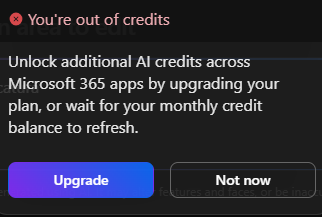
"Unlock additional AI credits across M365 apps by upgrading your plan..." It didn't happen
a { text-decoration: none; color: #464feb; } tr th, tr td { border: 1px solid #e6e6e6; } tr th { background-color: #f5f5f5; } I exhausted all my AI credits on Microsoft 365 Personal. I was then prompted to upgrade in order to get more AI credits. Based on that information, I upgraded to Microsoft 365 Family. However, after upgrading, I still have no AI credits available. 1. The prompt I received did not mention any specific plan needed to get more credits than I had. Simply stated that I needed to upgrade my account to get more credits (as shown here below). 2. I entered my Microsoft account and chose to upgrade. In any of the plans, the amount of AI credits included is shown. So I chose to upgrade to "365 family" 3. I did not get any credits for that as expected, and the prompt above kept showing the same. 4. The same day (Oct,10th) I contacted support to have this cleared out. They said it was a matter of account type migration for the upgrade to charge the AI credits, and I was told to wait for that to happen. If not, to come back for them to solve it. 5. I asked copilot about that, and I was told that "365 Personal" and "365 Family" have the same credits (????). So I did not get any additional credits unlocked for having done the upgrade as suggested by Microsoft. 6. Today I came back to support saying nothing happened, and I wanted to be compensated with the promised unlocked credits that I did not get, or to be refunded for the upgrade that did not produce the expected result. This might qualify the prompt as a misleading publicity teaser. 7. Support service unexpectedly told me they are not the ones to solve this complaint, and it was supposed to be solved by you here at the discussion forum. Which I found odd, but here I am asking you to solve my problem. Had I known that upgrading from Personal to Family would not provide additional AI credits I would not have upgraded. I believe the information presented to me was misleading, as I was not clearly informed that this specific upgrade would not serve the pourpose to unlock additional AI credits.56Views0likes1Comment
Planning a Google Workspace to Microsoft 365 Migration? What Should You Consider?
Hi everyone, Has anyone recently migrated from Google Workspace to Microsoft 365? I’m interested in knowing what challenges you faced during the migration, especially around mailbox data, calendars, contacts, user mapping, or the final cutover process. For those planning the migration, what are the key things you recommend preparing before getting started? Would like to hear your experiences and suggestions.566Views0likes5Comments
Microsoft Sign In Loop
I am trying to sing into Microsoft 365, but every time I do, it takes me back to the login screen. I sing in with my outlook account, but I can't reach the applications. I can sign in on the browser, but not the applications on my computer. I have tried uninstalling and reinstalling M365, but the issue still persists173Views0likes1CommentM365 Business Standard renewal surprise: new subscription required!
Hi all, I wanted to share a recent experience in case it helps other Microsoft 365 admins. For many years, I have renewed several Microsoft 365 Business Standard subscriptions by purchasing annual product keys through the Microsoft eCompany Store and redeeming them in the Microsoft 365 Admin Center using the Extend end date workflow. This year, the renewal process suddenly stopped working. Symptoms When redeeming a newly purchased Microsoft 365 Business Standard key, the Admin Center displayed: "The product key you've entered can't be applied to this subscription. Instead, use this product key to add licenses to a new subscription." At first glance, this made no sense because: The existing subscription was Microsoft 365 Business Standard. The newly purchased product was also Microsoft 365 Business Standard. The purchase source was the same Microsoft eCompany Store that had been used previously. The renewal process had worked successfully for years. I initially suspected: Region mismatch Billing platform changes Subscription corruption Invalid product keys None of those turned out to be the cause. Investigation A few interesting findings: The subscription was still under MOSA (Microsoft Online Subscription Agreement). The keys were valid and recognized by Microsoft. The same behavior occurred with multiple Business Standard subscriptions. Redeeming from a US IP address vs. a non-US IP address made no difference. After multiple support escalations, Microsoft eventually confirmed that the behavior is by design. Root Cause (per Microsoft Support) Microsoft advised that although the product name is still Microsoft 365 Business Standard, the newly purchased keys belong to a different offer variant than the existing subscription. As a result: The keys are valid. The subscription is valid. However, the new keys cannot extend the existing subscription. The keys can only be used to create a new subscription. In other words, two products can both be called Microsoft 365 Business Standard while still being considered different offers internally. Workaround The Microsoft-recommended workaround was: Redeem the new product keys using Create Subscription. A new Microsoft 365 Business Standard subscription is created in the same tenant. Reassign users from the old subscription to the new one. Allow the old subscription to expire. The existing tenant, users, mailboxes, OneDrive, SharePoint, Teams, domains, etc. remain unchanged. Only the underlying subscription providing the licenses changes. Feedback The frustrating part was not the technical workaround. The issue was that there was no obvious indication prior to purchase that a Business Standard key purchased today would not be able to extend a Business Standard subscription that had historically been renewed using identical-looking keys from the same source. The eventual answer from Microsoft was reasonable, but it took over a week, multiple escalations, and considerable investigation to determine that the behavior was actually expected. Question for the community Has anyone else encountered this recently with: Microsoft 365 Business Standard eCompany Store purchases MOSA subscriptions Retail/prepaid product-key renewals I'm particularly interested in whether others have seen this offer-compatibility issue and whether future renewals of the newly created subscription behave normally. Thanks!368Views1like3CommentsI built a free, open-source M365 security assessment tool - looking for feedback
I work as an IT consultant, and a good chunk of my time is spent assessing Microsoft 365 environments for small and mid-sized businesses. Every engagement started the same way: connect to five different PowerShell modules, run dozens of commands across Entra ID, Exchange Online, Defender, SharePoint, and Teams, manually compare each setting against CIS benchmarks, then spend hours assembling everything into a report the client could actually read. The tools that automate this either cost thousands per year, require standing up Azure infrastructure just to run, or only cover one service area. I wanted something simpler: one command that connects, assesses, and produces a client-ready deliverable. So I built it. What M365 Assess does https://github.com/Daren9m/M365-Assess is a PowerShell-based security assessment tool that runs against a Microsoft 365 tenant and produces a comprehensive set of reports. Here is what you get from a single run: 57 automated security checks aligned to the CIS Microsoft 365 Foundations Benchmark v6.0.1, covering Entra ID, Exchange Online, Defender for Office 365, SharePoint Online, and Teams 12 compliance frameworks mapped simultaneously -- every finding is cross-referenced against NIST 800-53, NIST CSF 2.0, ISO 27001:2022, SOC 2, HIPAA, PCI DSS v4.0.1, CMMC 2.0, CISA SCuBA, and DISA STIG (plus CIS profiles for E3 L1/L2 and E5 L1/L2) 20+ CSV exports covering users, mailboxes, MFA status, admin roles, conditional access policies, mail flow rules, device compliance, and more A self-contained HTML report with an executive summary, severity badges, sortable tables, and a compliance overview dashboard -- no external dependencies, fully base64-encoded, just open it in any browser or email it directly The entire assessment is read-only. It never modifies tenant settings. Only Get-* cmdlets are used. A few things I'm proud of Real-time progress in the console. As the assessment runs, you see each check complete with live status indicators and timing. No staring at a blank terminal wondering if it hung. The HTML report is a single file. Logos, backgrounds, fonts -- everything is embedded. You can email the report as an attachment and it renders perfectly. It supports dark mode (auto-detects system preference), and all tables are sortable by clicking column headers. Compliance framework mapping. This was the feature that took the most work. The compliance overview shows coverage percentages across all 12 frameworks, with drill-down to individual controls. Each finding links back to its CIS control ID and maps to every applicable framework control. Pass/Fail detail tables. Each security check shows the CIS control reference, what was checked, what the expected value is, what the actual value is, and a clear Pass/Fail/Warning status. Findings include remediation descriptions to help prioritize fixes. Quick start If you want to try it out, it takes about 5 minutes to get running: # Install prerequisites (if you don't have them already) Install-Module Microsoft.Graph, ExchangeOnlineManagement -Scope CurrentUser Clone and run git clone https://github.com/Daren9m/M365-Assess.git cd M365-Assess .\Invoke-M365Assessment.ps1 The interactive wizard walks you through selecting assessment sections, entering your tenant ID, and choosing an authentication method (interactive browser login, certificate-based, or pre-existing connections). Results land in a timestamped folder with all CSVs and the HTML report. Requires PowerShell 7.x and runs on Windows (macOS and Linux are experimental -- I would love help testing those platforms). Cloud support M365 Assess works with: Commercial (global) tenants GCC, GCC High, and DoD environments If you work in government cloud, the tool handles the different endpoint URIs automatically. What is next This is actively maintained and I have a roadmap of improvements: More automated checks -- 140 CIS v6.0.1 controls are tracked in the registry, with 57 automated today. Expanding coverage is the top priority. Remediation commands -- PowerShell snippets and portal steps for each finding, so you can fix issues directly from the report. XLSX compliance matrix -- A spreadsheet export for audit teams who need to work in Excel. Standalone report regeneration -- Re-run the report from existing CSV data without re-assessing the tenant. I would love your feedback I have been building this for my own consulting work, but I think it could be useful to the broader community. If you try it, I would genuinely appreciate hearing: What checks should I prioritize next? Which security controls matter most in your environment? What compliance frameworks are most requested by your clients or auditors? How does the report land with non-technical stakeholders? Is the executive summary useful, or does it need work? macOS/Linux users -- does it run? What breaks? I have tested it on macOS, but not extensively. Bug reports, feature requests, and contributions are all welcome on GitHub. Repository: https://github.com/Daren9m/M365-Assess License: MIT (free for commercial and personal use) Runtime: PowerShell 7.x Thanks for reading. Happy to answer any questions in the comments.5.8KViews2likes4CommentsNeed to Restore PST Files to Office 365 Mailboxes - What's the Best Approach
Hey everyone, I have a task coming up where I need to restore several PST files back into Office 365 mailboxes. Haven't done this before at this scale and honestly not sure where to begin. I've looked at Microsoft's native import service through Purview but I have a few concerns: Some of the PST files are quite large — not sure how well it handles that I need to restore only specific folders for some users, not the entire PST I'm worried about data consistency after the restore Would prefer something that doesn't require too many admin roles or complex setup For those who have done PST to Office 365 restores — what approach worked best for you? Any tools, tips, or things to watch out for that you wish you knew before starting?668Views0likes5Comments
microsoft 365 basic plan -- issue with products/licenses
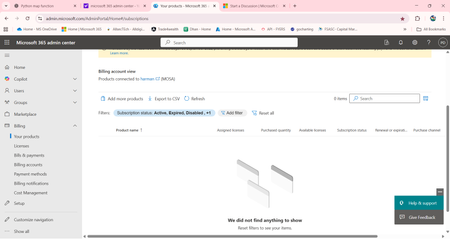
Hello guys, I had subscribed for microsoft 365 basic plan around 1 month back for the purpose of getting organization email. I got the email. But I could not see any products in the billing menu or licenses under my admin center after logging in. Please see the below screenshots. Does this mean, did I get organization email freely, without any billing? Can someone please help me understand here.? unfortunately, I am not able to reach microsoft support also.. if you have email id of microsoft support, kindly provide to me so that I can ask them. Thank you in advance. Regards, Pavan.250Views0likes3CommentsTaken over MS365 tenant, failed payment stuck
Hi all, I have taken over an MS365 tenant for a customer that took over another company. This was a tenant managed by an MSP, but they canceled the relationship. So I tried to purchase a Business Premium subscription for one month and couple it to my admin account, so that I can decoupled some devices from Intune, and also reinstate 1 or 2 accounts for the time being. I added a new billing profile (I could not add a billing account) while ordering from Microsoft directly. However the payment failed, there were 3 attempts in very quick succession. Probably because my card setting were too strict. So I switched the payment method to another card after this. However since then I have one product under "Your products" with the label "failed", the errors it gives: "We weren't able to create a subscription for one of your products. Update the selected filters and choose subscription status Failed to view the product in the list below." Clicking the product just shows "subscription failed". It does show renews on 1-7-2026. So it is expiring? How can I retry the payment? Unfortunately all support options keep pointing to the previous tenant owner so I'm posting here. So I'm trying here. I've been at this for way too long already.221Views0likes2CommentsWho's Performing Microsoft 365 License Audits For Their Clients?
If you’re an MSP or IT leader and aren't running these regularly, you might be leaving money on the table or letting your clients overpay by over 20% on average. Common quick wins we see all the time: Disabled user accounts that still hold active paid licenses. Inactive or dormant users that could easily be converted to free shared mailboxes. Over-licensed users who only need OWA/web access instead of full desktop suites. Paying for unassigned licenses sitting idle in the tenant. Doing a full, manual audit can feel tedious, but following a structured process makes it painless. If you want to run a complete audit via the Admin Center, PowerShell, or free automated tools, check out this comprehensive guide: https://www.gitbit.org/docs/microsoft-365-license-audit102Views0likes0Comments